



Earlobe Reduction Surgery in London

Earlobe reduction surgery reduces the size, length, or width of earlobes that are disproportionately large, elongated, or age-related pendulous. The procedure is performed under local anaesthetic as a day-case, takes 20–40 minutes per earlobe, and has no medical downtime — most patients return to normal activities the same day.
Earlobes lose elasticity with age, gradually elongating as collagen and skin quality decline — the earlobe is the only part of the ear shown to lengthen significantly through adult life. Our guide to whether ears keep growing and why earlobes get bigger with age sets out the measurements. For some patients the concern is congenital (naturally large earlobes from birth). For others it is the pixie ear deformity — where the earlobe becomes tethered downward against the cheek, a known complication of facelift surgery. Earlobe reduction addresses all of these presentations through precise tissue excision and reshaping.
At Centre for Surgery, earlobe reduction is performed by GMC-registered plastic surgeons at our CQC-regulated Baker Street facility, and the surgeon who assesses you is the surgeon who performs the procedure. Results are permanent — reduced earlobes don’t grow back — though the natural ageing process continues and earring habits that caused the original elongation will produce recurrence if not changed.
Earlobe Reduction at a Glance
These are typical timeframes. Your surgeon will give you specific guidance based on the technique used, whether repair or pixie ear correction is added, and how you’re healing at each review.
Considering earlobe reduction?Speak to a plastic surgeon about whether reduction, repair or a change in earring habits suits your earlobes. No obligation, and no pressure to book.
What Causes Large Earlobes?
Understanding why earlobes become enlarged helps patients choose the right timing for surgery and avoid habits that cause recurrence after treatment.
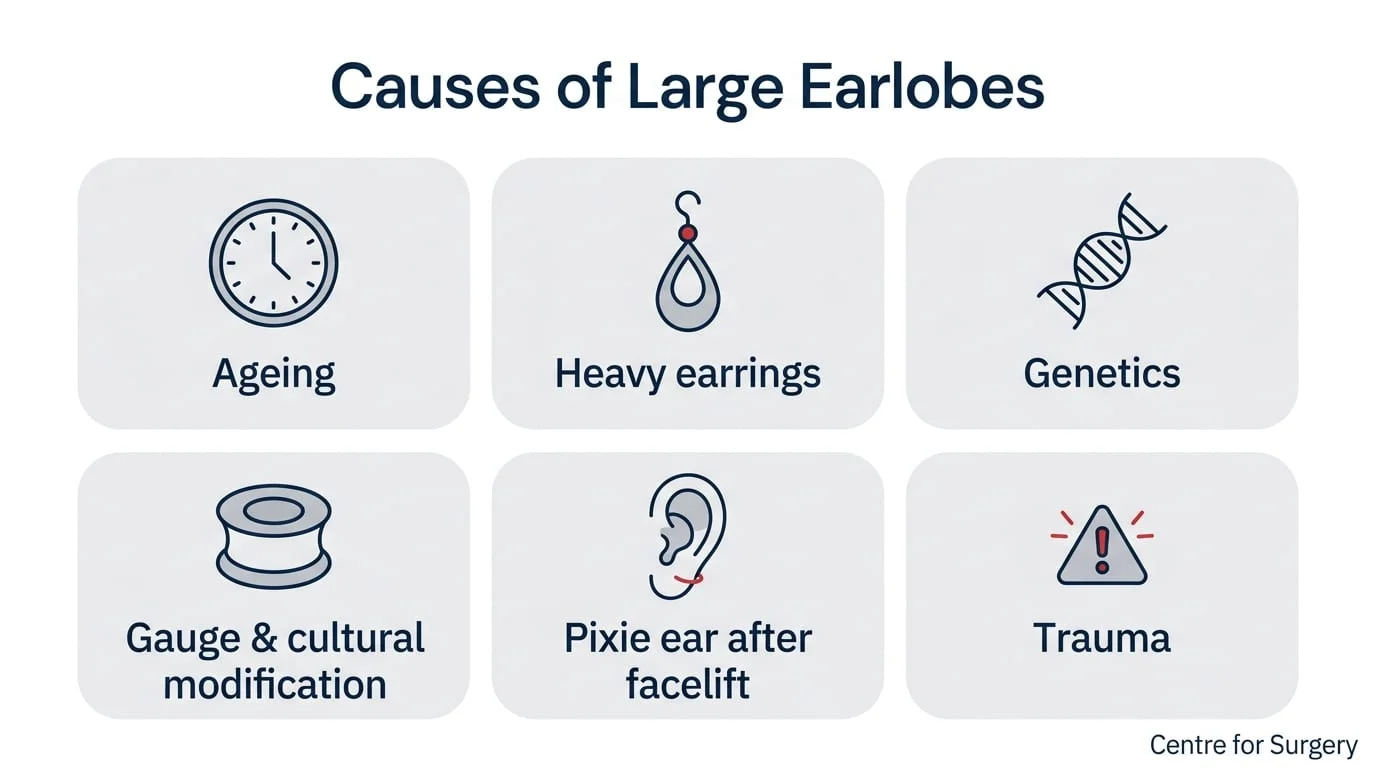
The six main causes of large or elongated earlobes.
Ageing
The most common cause of acquired earlobe enlargement. As the body ages, skin and soft tissues lose collagen and elastin, reducing elasticity and firmness. The earlobe — composed largely of soft tissue and fat with minimal structural support — progressively elongates and droops under gravity. This process accelerates after the mid-40s and continues throughout life. The result is a larger, longer, more pendulous lobe that can make the face appear older.
Heavy earrings
A major accelerant of age-related earlobe elongation. Drop, chandelier, and hoop earrings exert continuous downward gravitational force on the earlobe, stretching the skin and soft tissue progressively over years. The piercing hole migrates downward, the lobe elongates, and in some cases stretches to the point of splitting. This effect is cumulative — the longer and heavier the earrings worn over a lifetime, the more pronounced the stretching.
Genetics
Some patients have naturally larger, more pendulous earlobes from birth — an inherited characteristic unrelated to ageing or earring use. Genetic earlobe enlargement doesn’t reduce without surgery; patients may present at any age for correction.
Gauge and cultural modification
Intentional progressive stretching through gauge use produces large skin redundancy when the gauge is discontinued. This is addressed by earlobe repair (for stretched or split lobes) or earlobe reduction (when the lobe is enlarged without a piercing gap). The two procedures are sometimes combined.
Pixie ear deformity after facelift
A specific type of earlobe distortion where the inferior earlobe becomes tethered to the cheek skin, producing a pointed or downward-pulled appearance. This is a recognised complication of facelift surgery — caused by excessive tension on the earlobe closure, or by advancing cheek skin that distorts the natural ear-lobe junction. Earlobe reduction and reshaping corrects pixie ear by releasing the tethering and repositioning the earlobe in a natural position.
Trauma
Injury-related distortion — from biting, laceration, or previous poorly executed repair — can leave an earlobe enlarged or misshapen. This category overlaps with earlobe repair surgery.
What is Earlobe Reduction?
Earlobe reduction — also called loboplasty, earlobe reshaping, or earlobe lift — is a surgical procedure that removes excess earlobe tissue to reduce lobe size, correct elongation, or reshape a distorted lobe. The procedure is tailored to the specific concern:
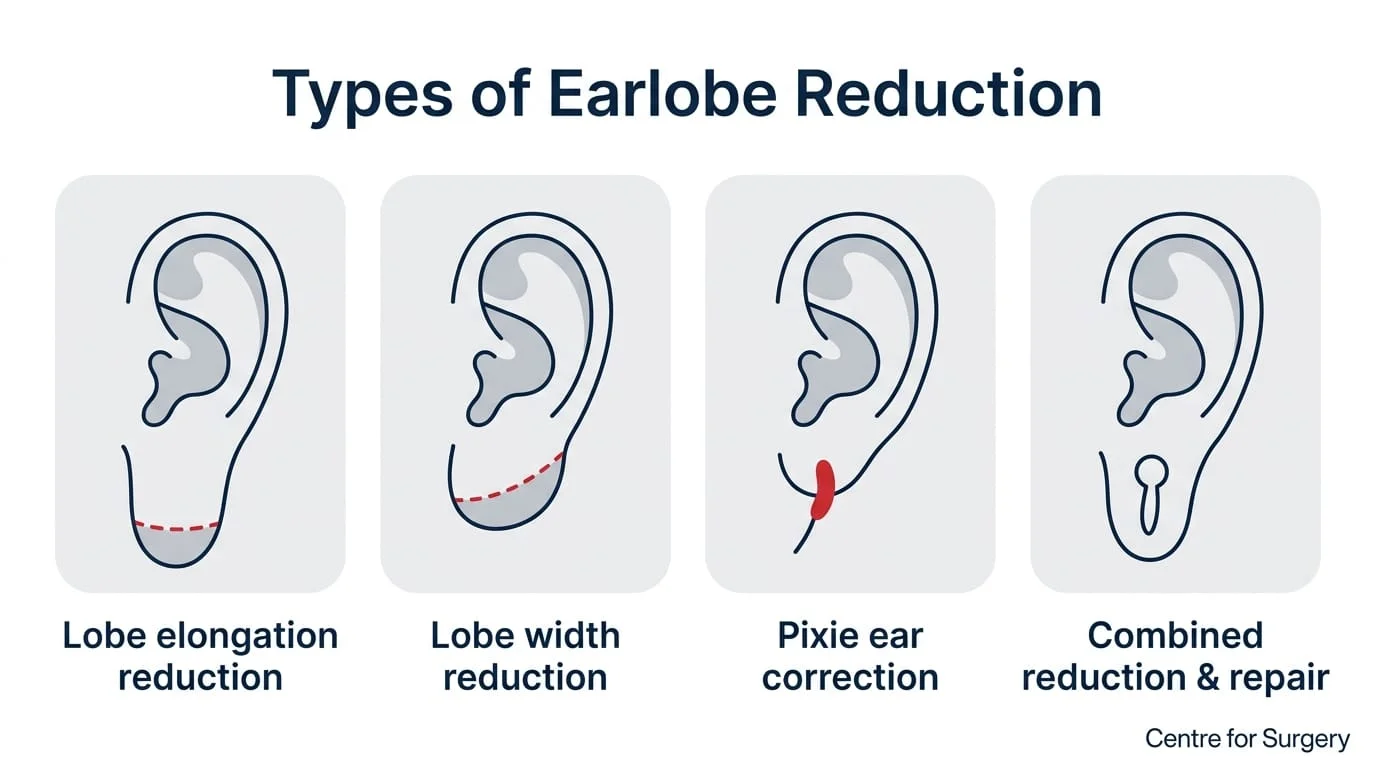
The four presentations addressed by earlobe reduction.
Lobe elongation (age-related or genetic)
The most common presentation. The lobe has become too long — hanging below its ideal position. The surgeon removes a measured strip of tissue from the inferior or inferior-anterior lobe margin, reducing lobe length and creating a shorter, more youthful earlobe profile.
Lobe width reduction
For lobes that are disproportionately wide or bulky rather than (or in addition to) too long. Tissue is excised from the anterior or posterior lobe margin.
Pixie ear correction
The tethered earlobe is released from the cheek skin, the excess tissue causing the tethering is excised, and the earlobe is repositioned in a natural hanging position. Scar revision of the facelift scar may be included if the original facelift closure scar has contributed to the distortion.
Combined earlobe reduction and repair
For patients with both an enlarged lobe and a split or stretched piercing — addressing both in a single procedure. Particularly common in patients who have worn heavy earrings for many years, producing both piercing enlargement and overall lobe elongation. Where the stretching is from gauges or tribal-style piercings, our guide to repairing stretched earlobes covers what is involved.
The result is a proportionate earlobe that sits in a natural position relative to the ear and face. All incisions are placed within or adjacent to the natural lobe contour — along the inferior lobe margin, within the ear-cheek junction, or at the inferior anterior lobe edge — to minimise visible scarring.
Earlobe reduction Before & After
All patients consented to their images being used for educational purposes. Individual results vary. A wider gallery of earlobe reduction results is available to view at your in-person consultation. You can also view more earlobe reduction and ear surgery before and after photos, or browse our full range of procedure results at the Centre for Surgery Before & After Photos gallery.
Benefits of Earlobe Reduction
For patients with genuinely enlarged, elongated, or misshapen earlobes, earlobe reduction delivers specific, lasting benefits:
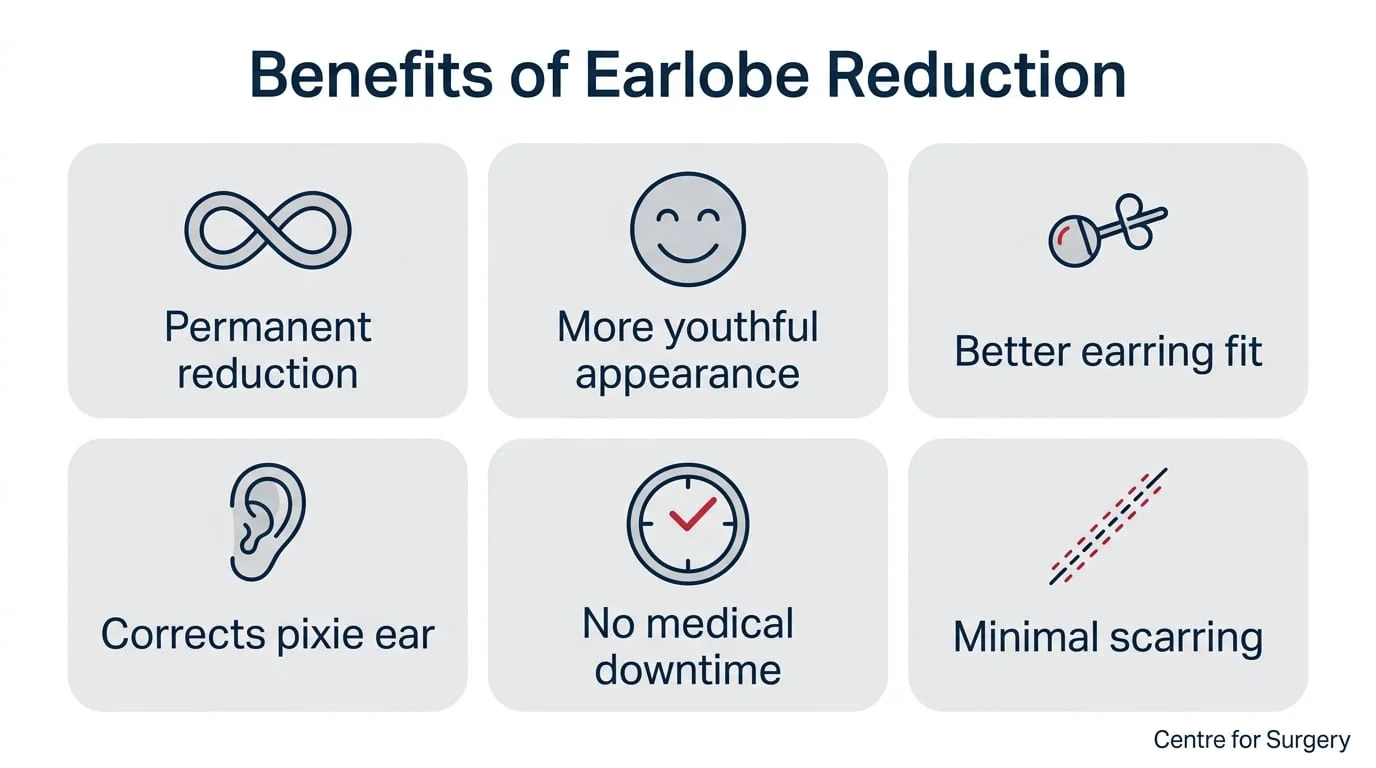
The key benefits of earlobe reduction surgery.
Permanent reduction
Reduced earlobe tissue doesn’t grow back. The result of earlobe reduction is permanent — unlike non-surgical options, there’s no repeat treatment needed. The natural ageing process continues to act on the remaining lobe tissue over time, but the baseline size reduction is lasting.
More youthful facial appearance
Elongated earlobes are a recognised marker of facial ageing. Reducing lobe size removes one of the visible indicators of ageing around the ear and jawline — patients often describe looking refreshed without an obvious “surgical” appearance.
Better earring fit and comfort
Earrings sit proportionately on a reduced lobe — not too far below the ear, not pulling the lobe to an unnatural position. Patients who had avoided wearing earrings because of how their lobes looked can wear them comfortably again after reduction.
Correction of pixie ear deformity
For patients who developed a pixie ear after facelift surgery, earlobe reduction releases the tethering and restores a natural, freely hanging earlobe — correcting one of the most visible signs of previous facelift surgery.
No medical downtime
Earlobe reduction is performed under local anaesthetic as a day-case. There’s no overnight stay, no general anaesthesia, and no formal recovery period — most patients return to normal activities immediately after the procedure.
Minimal visible scarring
Incisions are placed within or adjacent to the natural lobe contour — at the inferior lobe margin, within the ear-cheek junction, or at the anterior lobe edge. Once healed, scars are typically very hard to see.
Combines well with earlobe repair and otoplasty
Patients needing both lobe reduction and split repair can have both addressed in one appointment. Patients having otoplasty (ear pinning) can combine earlobe reduction for comprehensive ear refinement.
Applicable to all skin types and ages
Earlobe reduction is not age or skin-type restricted at the upper end — we operate on patients from their 20s through their 70s and 80s. The most common candidates are in their 40s–60s with age-related and heavy earring–related elongation.
Am I suitable for earlobe reduction?
Ideal candidates for earlobe reduction include:
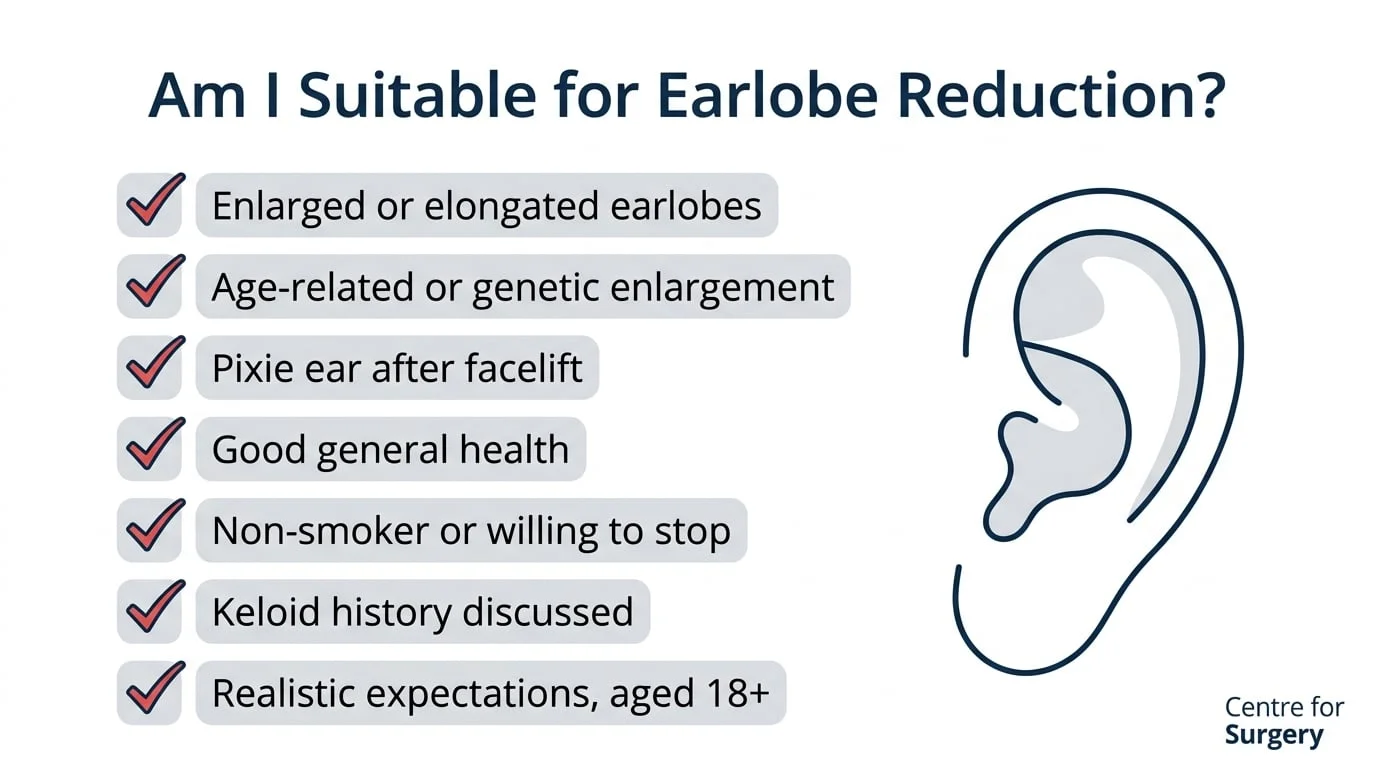
Suitability checklist for earlobe reduction surgery.
Patients with objectively enlarged or elongated earlobes
The most reliable indication is a lobe that is measurably too long or wide relative to the ear and facial proportions. Your surgeon will measure the lobe at consultation and assess proportion objectively.
Age-related earlobe elongation
Patients in their 40s–70s whose earlobes have elongated gradually over time — often combined with years of heavy earring use. The most common presentation.
Genetic large earlobes
Patients with congenitally large or pendulous earlobes from birth — may present at any adult age.
Pixie ear deformity after facelift
Patients who developed a tethered, downward-pulled earlobe as a result of previous facelift surgery. Earlobe reduction combined with scar revision corrects the deformity.
Stretched earlobes from gauge or heavy jewellery
Patients who have discontinued gauge use or heavy earring wearing and are left with enlarged, pendulous lobes. Overlaps with earlobe repair — your surgeon will assess whether repair alone, reduction alone, or combined repair and reduction is most appropriate.
Good general health
No uncontrolled medical conditions, no active local infection at the repair site, good skin condition in the area to be treated.
Non-smoker or willing to stop
Stop all nicotine, including vaping and nicotine replacement, for four weeks before and four weeks after surgery — it affects wound healing and scar quality.
No keloid history — or willing to discuss management
Patients with known keloid tendency need careful pre-operative discussion. The keloid tendency can affect the surgical scar but doesn’t prevent surgery — steroid injection prophylaxis at the time of surgery and during healing is appropriate management.
Realistic expectations
Earlobe reduction produces a proportionate, natural-looking lobe — not a dramatically different face. The earlobe will be slightly shorter after repair than the original because tissue is removed. Patients expecting radical transformation rather than natural refinement may be disappointed.
18 or older
We operate on patients 18 and over for elective cosmetic procedures.
What does earlobe reduction involve?
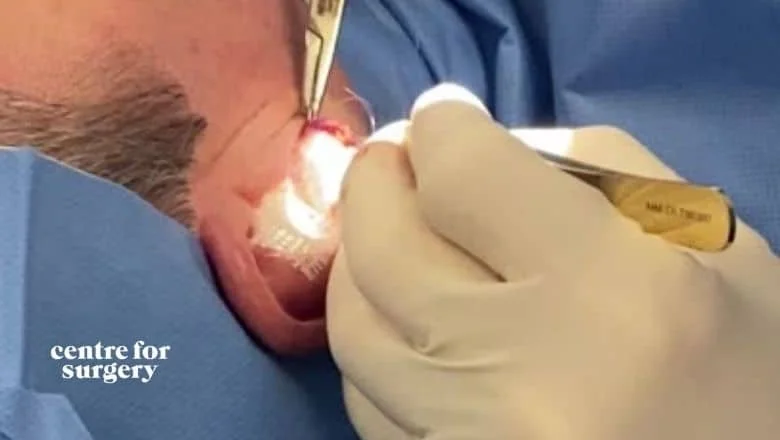
Earlobe reduction is performed as an outpatient procedure at our Baker Street clinic under local anaesthetic. There is no general anaesthesia and no overnight stay.
Surgical techniques
The technique chosen depends on the specific concern — lobe length, width, shape, or pixie ear correction.
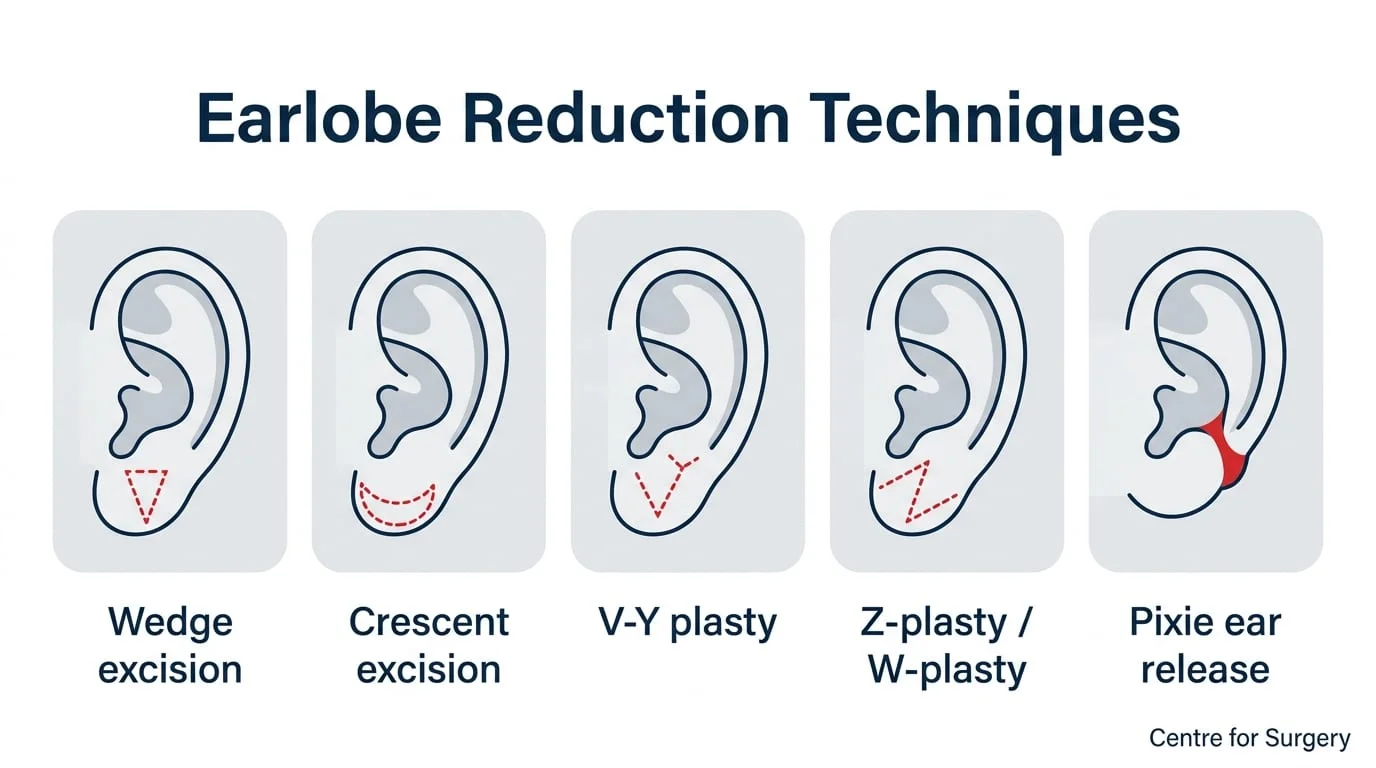
The five surgical techniques used for earlobe reduction.
Wedge excision
A wedge-shaped section of tissue is removed from the inferior or middle lobe, and the remaining edges are sutured together. The most versatile technique for straightforward lobe reduction — can address length, width, or both. The wedge size is precisely measured pre-operatively to achieve the planned reduction.
Crescent excision
A crescent-shaped section is removed from the lower lobe margin, producing a reduction in lobe length with a scar that sits naturally within the inferior lobe contour. Particularly appropriate for age-related earlobe elongation where the main concern is the pendulous inferior lobe.
V-Y or V-plasty
A V-shaped section of tissue is removed and the closure performed in a Y-configuration. Useful for correcting elongated lobes where a lift as well as a reduction in length is needed — the V-Y closure shortens and lifts the lobe simultaneously while minimising straight-line scar contraction.
Z-plasty or W-plasty
Geometric rearrangements of tissue that change the direction of the final scar and minimise contraction or notching. Used when simple excision would produce an aesthetically unfavourable scar line or when lobe recontouring is needed alongside reduction.
Pixie ear release and reshaping
The tethering between the inferior earlobe and cheek skin is released, excess tissue producing the tethering is excised, and the earlobe is repositioned in a natural hanging configuration. The ear-cheek junction scar is revised as part of the procedure.
Step-by-step
- You lie comfortably on the treatment couch. The earlobe area is cleaned and draped for sterility.
- Local anaesthetic is infiltrated into the earlobe — a brief stinging sensation for 5–10 seconds, then complete numbness.
- Your surgeon precisely marks the tissue to be excised based on pre-operative measurements confirmed on the day.
- The planned tissue is excised using the appropriate technique.
- The two lobes are checked for symmetry before closure begins.
- The incision is closed with fine sutures — typically a combination of absorbable deeper sutures and non-absorbable surface sutures (removed at day 5–7).
- A small dressing or antibiotic ointment is applied.
- For bilateral procedures, the same process is performed on the second earlobe.
Total operating time: 20–30 minutes per earlobe for straightforward reduction; 30–40 minutes for combined reduction and repair or pixie ear correction. Bilateral procedures are performed in a single appointment.
Recovery after Earlobe Reduction Surgery
Earlobe reduction recovery is one of the fastest of any procedure we offer. There is no medical downtime.
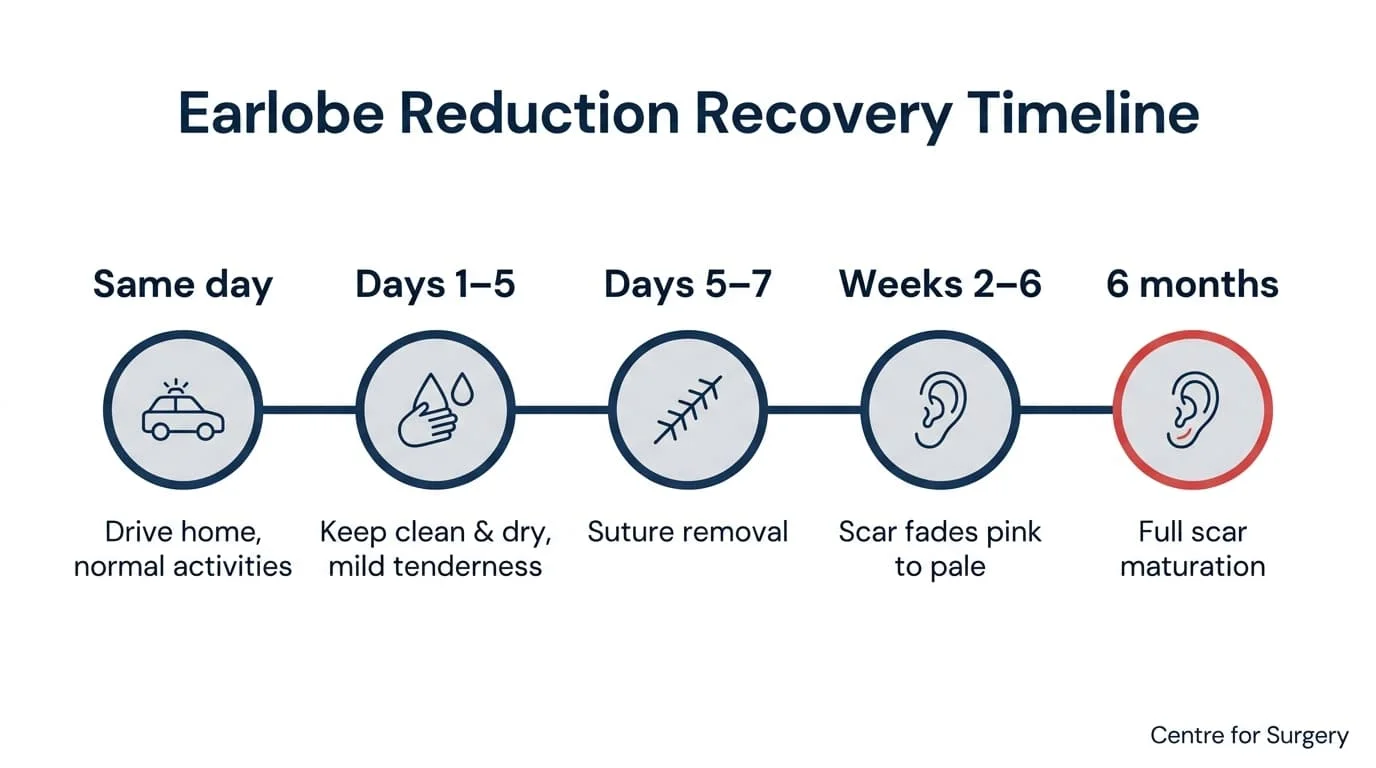
The earlobe reduction recovery timeline, from same-day to full scar maturation at six months.
Immediately after surgery
You can leave the clinic immediately after the procedure. Only local anaesthetic is used, so you may drive home yourself. The anaesthetic wears off gradually over 1–2 hours. Mild tenderness after the anaesthetic resolves — paracetamol is usually sufficient; most patients need nothing.
Days 1–5
Keep the earlobe clean and dry. Apply the prescribed antibiotic ointment as directed. Avoid pressing a phone against the earlobe. Avoid polar neck or tight-collar clothing that might catch on the sutures. Avoid direct sun exposure on the healing wound. Minor swelling resolves within 2–3 days.
Days 5–7
Suture removal appointment — non-absorbable surface sutures are removed. Brief and painless. The wound is checked to confirm healing is progressing correctly. After suture removal, all normal activities resume fully.
Weeks 2–6
The scar matures from pink to pale. Apply silicone gel or tape consistently from 2–3 weeks to optimise scar quality. Sun protection on the scar for the first 3 months prevents UV-related discolouration.
6 months
Full scar maturation. Re-piercing is possible at this point if the earlobe was repierced prior to surgery — the new hole should be placed 2–3 mm from any scar line.
Key restrictions
- No aspirin or anti-inflammatories for 2 weeks before and after
- No heavy earrings for at least 3 months — and ideally a permanent change in earring habits
- No swimming until sutures removed and wound fully sealed
- No nicotine, including vaping, for four weeks after surgery
Preventing recurrence
Earlobe reduction results are permanent, but the same forces that caused the original enlargement continue to act. To minimise recurrence: switch to lightweight earrings; use broad earring backs that distribute weight across more of the lobe; avoid drop or chandelier earrings for extended periods. Patients who continue heavy earring use will see progressive re-elongation over years.
How much does earlobe reduction cost?
Earlobe reduction at Baker Street
From£800one lobe
One package price, agreed with your surgeon before anything is booked. No obligation, and at least two weeks to decide.
£100 consultation, redeemed against your surgery
What your price includes
- GMC-registered consultant plastic surgeon
- Local anaesthetic, home the same day
- Theatre time at our CQC-regulated Baker Street clinic
- Pre-operative assessment with a nurse
- A named patient coordinator throughout
- Follow-up reviews with your surgeon
Performed under local anaesthetic, so you go home the same day
Earlobe reduction pricing depends on whether one or both earlobes are treated, the technique required, and whether reduction is combined with earlobe repair or otoplasty. Current pricing for each of these is set out in our otoplasty and earlobe surgery cost guide. Pixie ear correction and more complex reshaping procedures are priced individually at consultation, and your exact quote is confirmed in writing.
What affects the price
The main variables are whether one or both earlobes are being treated, the technique required (straightforward crescent excision vs V-Y plasty or pixie ear correction), and whether reduction is combined with earlobe repair.
What’s included in the price
- Surgeon’s fee
- Procedure room time at our CQC-regulated Baker Street facility
- Local anaesthetic
- Post-operative dressings
- Suture removal at day 5–7
- Clinical review and aftercare, with further appointments if needed
Prescribed medications, including antibiotic ointment, are purchased separately and confirmed with you in advance.
Combining with other procedures
Earlobe reduction is commonly combined with earlobe repair or with otoplasty in a single appointment, sharing one anaesthetic and recovery — see the cost guide for combined pricing. Where earlobe reduction is performed as pixie ear correction during a facelift, it is included in the facelift pricing where appropriate.
Finance
You can pay in full or spread the cost with finance through Chrysalis Finance, subject to status. Plans and a representative example are on our finance options page, and a patient coordinator can talk you through them on 020 7993 4849.
Why choose Centre for Surgery for earlobe reduction
Earlobe reduction is a small procedure where technique quality matters significantly. Poor technique — notching, over-reduction, asymmetric closure, or visible scarring — is apparent every time the ear is exposed, and revision of a poorly executed primary procedure is more complex than doing the primary procedure correctly.
GMC-registered surgeons
All earlobe reduction at Centre for Surgery is performed by GMC-registered plastic surgeons, and the surgeon who assesses you is the surgeon who performs the procedure. Unlike many providers offering earlobe procedures (including non-surgical practitioners, beauticians, and cosmetic clinics), our surgeons are trained in the full range of plastic and reconstructive techniques needed for all presentations — including V-Y plasty, Z-plasty, pixie ear correction, and complex combined repair and reduction.
CQC-regulated private hospital
Our purpose-built private hospital at 95–97 Baker Street, Marylebone is independently regulated and inspected by the Care Quality Commission, which rated us Good overall.
Specialist experience including pixie ear correction
Our surgeons have specific experience in pixie ear correction — one of the more technically demanding earlobe presentations, requiring release of tethering, lobe reshaping, and scar revision. Patients referred from other centres for correction of facelift-related earlobe complications are seen regularly.
Full range of ear procedures
We offer earlobe reduction, earlobe repair, and otoplasty — so the recommendation at consultation is always the approach that fits your specific anatomy rather than a single procedure for all presentations. If earlobe repair alone would address your concern without reduction, we’ll say so.
Honest case selection
If your earlobes fall within normal proportion and the concern is recent or driven by external comparison, we’ll discuss this openly. Not every large earlobe needs surgery — some patients benefit from simply changing earring habits.
Aftercare
Our post-operative support includes suture removal at day 5–7, scar management guidance through the first six months, and a direct contact number for the clinical team if any concerns arise during healing.
Book your consultation
- Phone: 020 7993 4849
- Email: contact@centreforsurgery.com
- Address: 95–97 Baker Street, Marylebone, London W1U 6RN
- Contact us to schedule your consultation
Your initial in-person consultation is £100, redeemable against the cost of the procedure if you proceed.
Alternatives to earlobe reduction surgery
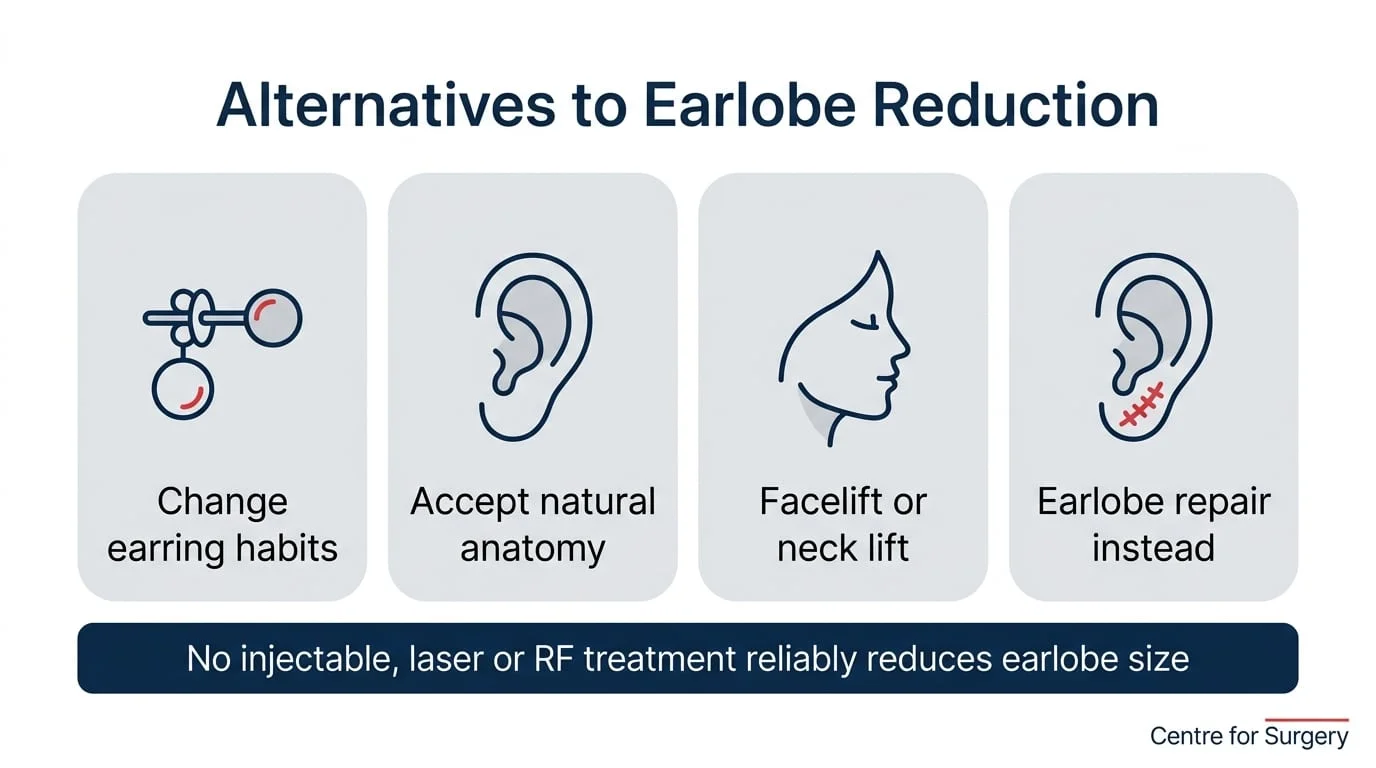
Before committing to surgical earlobe reduction, consider whether simpler changes might address your concern:
Alternatives to consider before earlobe reduction surgery.
Change earring habits
The most important non-surgical intervention. Switching to lightweight stud earrings, using broad earring backs that distribute lobe weight, and avoiding heavy drop or chandelier earrings halts the progression of earring-related elongation. For patients whose earlobes are mildly elongated and still changing, stabilising the lobe size before surgery is sensible — operating on a lobe that will continue to elongate produces a shorter-lasting result.
Accepting natural anatomy
Large or pendulous earlobes are a normal anatomical variant, more visible in some faces than others. For some patients, the concern is proportionate to the actual variation — particularly if the concern is recent or driven by external comparison rather than a longstanding personal preference.
Facelift or neck lift (for earlobe concerns related to facial ageing)
For patients whose earlobe elongation is part of a broader facial ageing picture — loose neck skin, jowling, descended midface — facelift or neck lift may address the overall picture more effectively than earlobe reduction alone. In some cases earlobe reduction is most logically combined with facelift surgery rather than performed separately.
Earlobe repair rather than reduction
For patients with a split or stretched piercing hole who also have some lobe elongation, earlobe repair alone may produce sufficient improvement without a separate reduction procedure. Your surgeon will assess which approach — repair alone, reduction alone, or combined — is most appropriate at consultation.
There is no effective non-surgical earlobe reduction
Unlike some cosmetic concerns, enlarged earlobes cannot be meaningfully addressed without surgery. No injectable, laser, or radiofrequency treatment produces reliable reduction in earlobe size. Patients who don’t want surgery should focus on preventing further elongation through earring habit changes rather than seeking non-surgical alternatives that don’t reliably work.
What To Expect
The consultation
A 15 to 30 minute consultation at Baker Street with the plastic surgeon who will operate, or longer for pixie ear correction or combined procedures.
- Examination: both earlobes are measured, the cause of enlargement assessed, any split or stretched piercing noted and your keloid history checked.
- Your technique: wedge or crescent excision, V-Y plasty, Z-plasty or pixie ear release, chosen for your lobe anatomy.
- Marking: your surgeon marks the incision with you looking in a mirror, and confirms the scar position and amount of reduction.
- No pressure: we recommend a two-week cooling-off period. For straightforward reductions, same-day treatment can sometimes be arranged if requested when booking.
Before your procedure
Preparation is minimal compared with other surgery.
- Nicotine: stop smoking, vaping and nicotine replacement four weeks before and four weeks after, as it affects healing and scar quality.
- Medicines: stop aspirin and ibuprofen two weeks before, unless prescribed. No alcohol for 48 hours before.
- Earrings: remove them at least 24 hours before, and make sure any infection or inflammation has settled.
- Keloid scars: if you form them, agree a scar plan with your surgeon. A steroid injection may be given during the procedure.
On the day of your procedure
Your surgeon confirms the plan and takes final consent, then re-marks the incisions with you upright and looking in a mirror, so you agree the reduction before lying down.
- Anaesthetic: local anaesthetic, so you can eat and drink normally. A responsible adult to take you home and stay with you for the first 24 hours is only needed if you have oral sedation or TIVA, for example when combining it with otoplasty.
- The procedure: 20 to 30 minutes per earlobe, or 30 to 40 minutes with a repair or pixie ear correction. Both lobes are checked for symmetry before closing.
- Stitches: fine stitches close the wound in layers, under a small dressing or antibiotic ointment.
- Going home: straight afterwards, and you can drive yourself.
After your procedure
There is no medical downtime: normal activities resume straight away. You have a direct contact number for the clinical team.
- Days 1 to 5: keep the earlobe clean and dry and use the antibiotic ointment. Avoid pressing a phone against it, tight collars and direct sun.
- Days 5 to 7: stitches out at the clinic, quickly and painlessly.
- Scar care: silicone gel or tape from 2 to 3 weeks, sun protection for 3 months, and no heavy earrings for at least 3 months.
- Keeping your result: the reduction is permanent, but the forces that stretched the lobe still act, so switch to lightweight earrings with broad backs. Final review at 6 months.
FAQs
-
Earlobe reduction, also called loboplasty or earlobe reshaping, is a minor operation that makes long, large or droopy earlobes smaller. Your surgeon removes a measured wedge or crescent of tissue and closes the lobe with fine stitches, with the scar along the natural edge of the lobe. It is done under local anaesthetic and takes 20 to 40 minutes per earlobe. See our earlobe reduction before and after photos.
-
Ageing is the most common cause of big earlobes. The lobe is mostly soft tissue and fat with little support, so it lengthens as skin loses collagen and elasticity, especially from the mid-40s. Years of heavy drop or hoop earrings speed this up. Some people have naturally large earlobes from birth, and others are left with excess skin after gauges. Our guide to whether ears keep growing shows how much earlobes lengthen with age.
-
Pixie ear is an earlobe pulled down and tethered to the cheek, so it looks pointed or stuck on rather than hanging freely. It is a recognised complication of facelift surgery, caused by too much tension on the earlobe closure or by how the cheek skin was advanced. It is corrected by releasing the tether, removing the excess tissue and repositioning the lobe, with revision of the facelift scar. If it followed a facelift elsewhere, see revision facelift.
-
No. Enlarged earlobes cannot be made smaller without surgery, because no injection, laser or radiofrequency treatment reliably reduces earlobe size. What you can do is stop them getting bigger: wear lightweight studs, use broad earring backs that spread the weight, and avoid heavy drop or chandelier earrings. If the problem is a stretched or split piercing hole rather than the size of the lobe, earlobe repair is the right procedure.
-
There is no upper age limit for earlobe reduction. It is for adults aged 18 and over, and we treat patients from their 20s to their 80s; most are in their 40s to 60s, when ageing and years of earrings have lengthened the lobe. Suitability depends on your general health, not your age. If heavy earrings are still stretching your lobes, changing earring habits first gives a longer-lasting result.
-
Yes. Male earlobe reduction uses the same techniques, and the most common reasons are naturally large earlobes or age-related lengthening. Men often notice their earlobes more with short hair or hair loss, so the incision is planned with an exposed ear in mind. Pixie ear after a male facelift is corrected in the same way as in women.
-
The cost of earlobe reduction depends on whether one or both earlobes are treated, the technique needed, and whether it is combined with earlobe repair or otoplasty. Pixie ear correction and complex reshaping are priced individually. Indicative prices are in our otoplasty and earlobe surgery cost guide, and your quote is confirmed in writing after consultation. Antibiotic ointment is bought separately. Finance is available through Chrysalis Finance, subject to status.
-
Earlobe reduction is not usually painful. Local anaesthetic is injected into the earlobe, which stings for 5 to 10 seconds and then numbs it completely, so you are awake but comfortable. As it wears off over 1 to 2 hours you may feel mild tenderness; paracetamol is usually enough and most people need nothing. Sedation or TIVA is usually only needed when it is combined with otoplasty.
-
Earlobe reduction takes 20 to 30 minutes per earlobe, or 30 to 40 minutes with a repair or pixie ear correction. Both lobes are done in one appointment. Your surgeon marks the reduction with you sitting up and looking in a mirror, then removes a wedge or crescent, or uses a V-Y or Z-plasty when a lift or a change in scar direction is needed. Both lobes are checked for symmetry before closing.
-
Recovery after earlobe reduction is quick, with no medical downtime, and most people return to normal activities the same day. For the first 5 days, keep the earlobe clean and dry with the antibiotic ointment, and avoid pressing a phone against it, tight collars and direct sun. Stitches come out at day 5 to 7. Avoid swimming until they are out, and expect the scar to mature over about 6 months.
-
Yes, a fine scar, but it sits along the natural edge of the lobe or in the ear-cheek junction, so it usually fades over 3 to 6 months until it is very hard to see. Silicone gel or tape from 2 to 3 weeks and sun protection for 3 months help. Darker skin has a higher risk of discolouration, and if you form keloids, a steroid injection may be given during the procedure.
-
Earlobe reduction is a low-risk procedure. The most common problem is notching, a small step in the lobe edge as the scar contracts, which V-Y or Z-plasty helps prevent and which can be revised under local anaesthetic. Other risks are infection (uncommon), asymmetry, over-reduction, keloid or raised scarring, small stitch reactions, and the lobe lengthening again with heavy earrings. Our guide to the risks of cosmetic surgery covers the general risks.
-
Yes. The tissue removed does not grow back, so the reduction is permanent, but ageing and earring weight keep acting on the lobe that remains. Avoid heavy earrings for at least 3 months, then choose lightweight studs or small hoops with broad backs that spread the weight. People who go back to heavy earrings can see the lobe lengthen again, over years rather than months.
-
Yes. Earlobe reduction is often combined with earlobe repair when a lobe is both too long and has a split or stretched piercing hole, so it ends up the right size and correctly closed in one procedure. It can also be done alongside otoplasty (ear pinning), sharing one anaesthetic and one recovery. Your surgeon will advise whether combining suits you.