



In this guide13 sections
- The Core Trade-Off: Scarring vs Correction
- How Breast Ptosis Grade Determines Your Technique
- Crescent Lift
- Periareolar (Donut) Lift
- Vertical (Lollipop) Lift
- Anchor (Inverted-T) Lift
- Comparison at a Glance
- Vertical (Lollipop) vs Anchor: The Comparison Patients Ask About Most
- Combining a Lift with Implants or Reduction
- Recovery and Results Across All Techniques
- Is a Breast Lift Worth It? An Honest Answer
- Frequently Asked Questions
- Choosing a Breast Lift Technique at Centre for Surgery
A breast lift (mastopexy) isn’t a single operation — it’s a family of techniques, each defined by a different incision pattern, and the right one for you depends almost entirely on your degree of breast sagging (ptosis), not personal preference. This guide compares all four recognised breast lift techniques — crescent, periareolar (donut), vertical (lollipop), and anchor (inverted-T) — so you understand the genuine trade-off between scarring and correction before your consultation, and can go into it asking sharper questions.
The Core Trade-Off: Scarring vs Correction
Every breast lift technique sits on the same spectrum. Less scarring means less skin can be removed, which means less correction of sagging. More scarring means more skin removed and a more dramatic lift. There’s no technique that gives you maximum correction with minimal scarring — that trade-off is fixed by anatomy, not by finding the “right” surgeon or the newest technique. Your surgeon’s job at consultation is to match the smallest incision that will still achieve a genuine, lasting result for your specific degree of sagging — not to default to the biggest procedure, and not to undersell what you actually need either.
How Breast Ptosis Grade Determines Your Technique
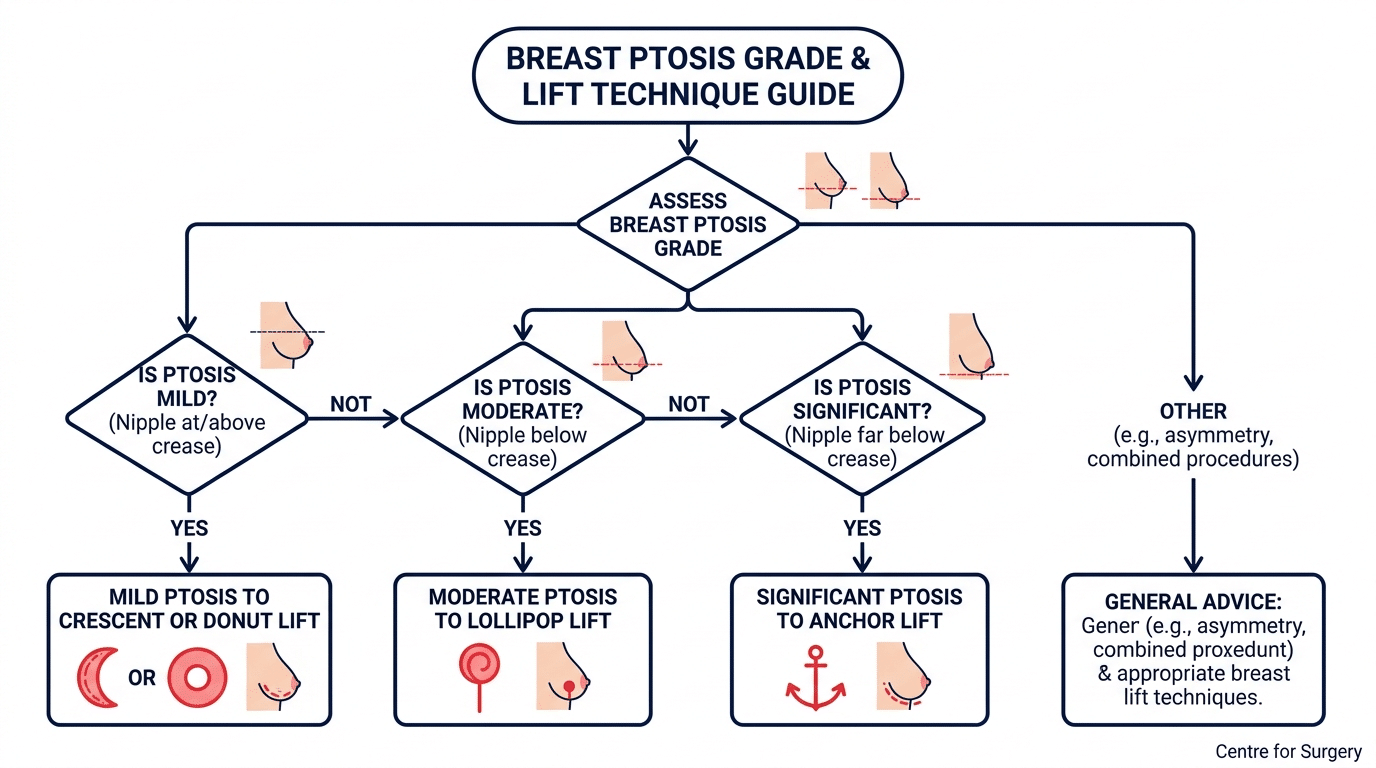
Ptosis — the medical term for breast sagging — is graded by where the nipple sits relative to the inframammary fold (the crease beneath the breast). This grading, more than any other factor, is what determines which technique genuinely suits you. Our guide to breast ptosis grades explains each one in detail and how to check your own:
- Pseudoptosis (nipple above the fold, lower breast hanging below it) — often suits implants or fat transfer, sometimes with a small lift
- Grade 1, mild ptosis (nipple level with the fold) — typically suits a crescent or periareolar (donut) lift, or implants alone
- Grade 2, moderate ptosis (nipple below the fold but above the lowest point of the breast) — typically suits a vertical (lollipop) lift
- Grade 3, severe ptosis (nipple at the lowest point of the breast, pointing downward) — typically requires an anchor (inverted-T) lift
This is why an honest surgeon won’t quote you a technique before examining you. Anyone who does is either guessing or defaulting to whatever they find easiest to perform.
Crescent Lift
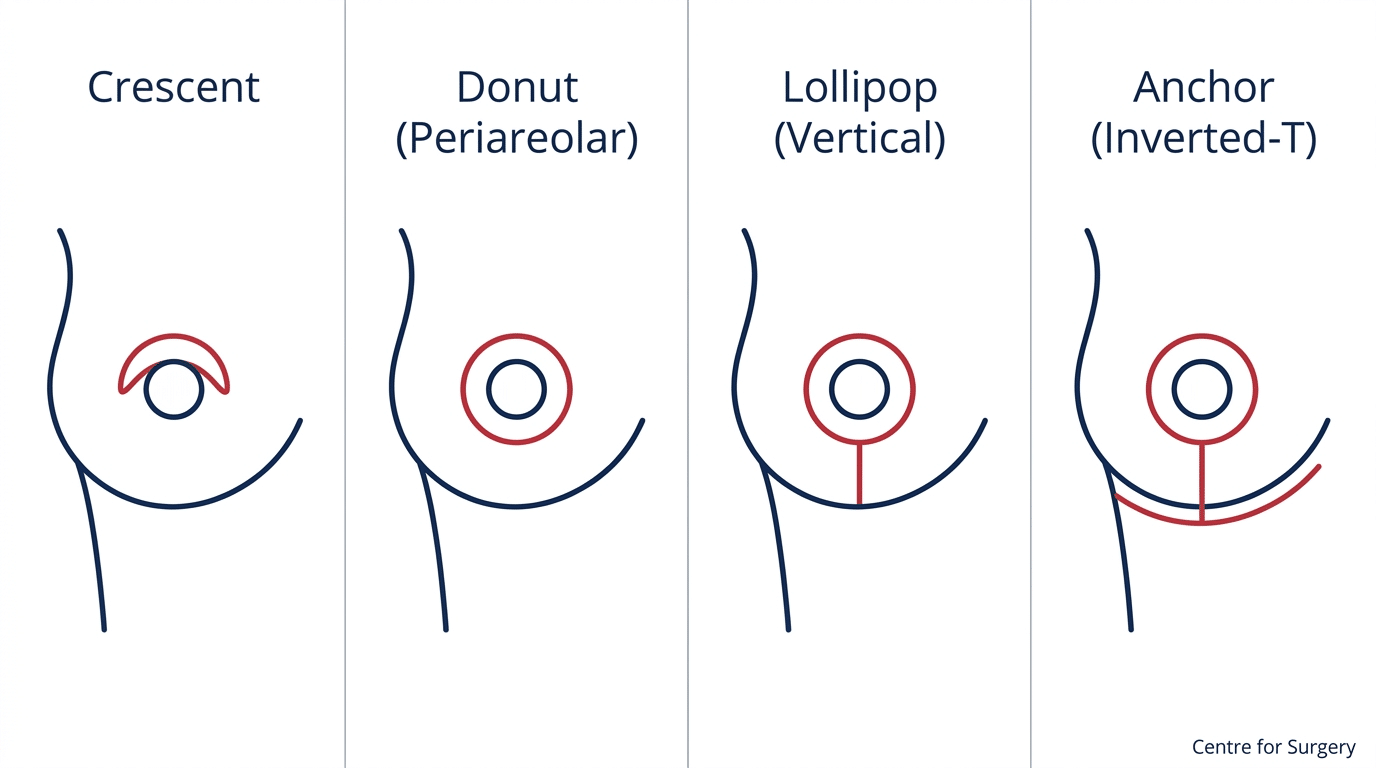
The crescent lift uses a single, small half-moon incision along the top edge of the areola — the least invasive of all four techniques, suited only to minor sagging or nipple repositioning, typically raising the nipple by around 2cm. Minimal scarring, but limited correction — it isn’t an option for anyone with genuine, established sagging.
Periareolar (Donut) Lift
The periareolar lift — also called a donut lift or Benelli lift — uses a single incision that fully circles the areola, removing a disc of skin to tighten the breast and lift the nipple by around 2–3cm. It suits mild to moderate sagging and is often chosen when areola size reduction is also wanted, since the technique naturally allows for that.
Vertical (Lollipop) Lift
The vertical lift — commonly called the lollipop lift, or vertical mastopexy — combines a circular incision around the areola with a second, vertical incision running down to the breast fold. This is the workhorse technique for moderate sagging: more correction and reshaping power than a donut lift, without the third, horizontal scar of a full anchor lift.
Anchor (Inverted-T) Lift
The anchor lift — also called the inverted-T lift, or Wise pattern mastopexy — is the most extensive technique, using three incisions: around the areola, vertically down to the fold, and horizontally along the fold itself. It’s reserved for significant sagging, larger breasts, or cases combined with breast reduction, where the additional access is genuinely needed to remove enough skin and reshape enough tissue for a lasting result.
Comparison at a Glance
| Technique | Incisions | Best for | Typical lift | Scarring |
|---|---|---|---|---|
| Crescent | 1 (half-moon, areola edge) | Minor sagging | ~2cm | Minimal |
| Periareolar (Donut) | 1 (full circle, areola) | Mild–moderate sagging | 2–3cm | Minimal, circles areola |
| Vertical (Lollipop) | 2 (areola + vertical) | Moderate sagging | Significant | Moderate |
| Anchor (Inverted-T) | 3 (areola + vertical + fold) | Significant sagging | Most dramatic | Most extensive |
Vertical (Lollipop) vs Anchor: The Comparison Patients Ask About Most
These two techniques are the ones most commonly confused with each other and most often directly compared, since the choice between them is where the real decision usually lies for anyone with moderate-to-significant sagging.
- Severity of sagging: mild-to-moderate ptosis generally suits vertical; severe ptosis, larger breasts, or a combined reduction generally needs anchor.
- Scarring: vertical avoids the horizontal fold scar that anchor requires — if minimising scarring is a real priority and your anatomy allows it, vertical is preferred.
- Breast size: anchor provides more access, which matters more as breast size and the amount of excess skin increases.
Choosing between them is not something to settle from an article — it depends on an in-person assessment of your specific ptosis grade, skin quality, and goals.
Combining a Lift with Implants or Reduction
Any of these four techniques can be combined with implants (augmentation-mastopexy) if volume loss needs correcting alongside sagging, or with breast reduction if the breasts are also too large or heavy. A lift alone reshapes existing tissue — it does not add volume. If you want a lift and more fullness, that’s a lift-plus-implant conversation with your surgeon, not something a lift alone will deliver.
A lift removes skin, so many women find their breasts look slightly smaller afterwards, often by around a cup size, even though no breast tissue is taken away. When a lift and implants are done in one operation, surgeons usually choose a more modest implant: the lift tightens the skin envelope while the implant stretches it, and a large implant under a freshly tightened lift raises the risk of wound-healing problems. Where a lot of lift is needed, the two can be staged as separate operations.

Recovery and Results Across All Techniques
Recovery scales roughly with how extensive the incisions are: crescent and donut lifts tend to feel the most comfortable early on, while anchor lifts involve more initial discomfort given the greater amount of tissue reshaping. Across all four techniques, most patients return to desk-based work within about 10 days, resume light exercise around 2 weeks, and are cleared for full activity by 6 weeks — though final, settled results take 6 to 12 months to fully reveal themselves as swelling resolves and scars mature. Each technique-specific guide linked above covers its own recovery timeline in more detail.
Is a Breast Lift Worth It? An Honest Answer
Most patients are satisfied with their results, but it’s worth being honest that a small minority of people do come to regret breast lift surgery — usually not because the surgery itself went wrong, but because expectations weren’t properly set beforehand. The two things patients most commonly underestimate are the permanence of the scars (they fade, but they never disappear) and the fact that a lift alone doesn’t add volume. If you go in expecting fuller-looking breasts and only get repositioned ones, that mismatch between expectation and result is the single biggest driver of dissatisfaction — which is exactly why an honest consultation, where your surgeon tells you plainly what a lift can and can’t do for your specific anatomy, matters more than the marketing around any particular technique.
Frequently Asked Questions
What are the 4 types of breast lift?
Crescent, periareolar (donut), vertical (lollipop), and anchor (inverted-T) — each defined by a different incision pattern, matched to increasing degrees of breast sagging.
Which breast lift has the least scarring?
The crescent lift, followed closely by the periareolar (donut) lift — both use a single incision confined to the areola. However, both are only suitable for mild sagging; they can’t deliver the correction that moderate or severe ptosis genuinely needs.
What’s the difference between a lollipop and an anchor lift?
A lollipop (vertical) lift uses two incisions — around the areola and vertically down to the breast fold. An anchor (inverted-T) lift adds a third, horizontal incision along the fold itself, giving more correction for more significant sagging at the cost of more extensive scarring.
How do I know which breast lift technique I need?
It’s determined mainly by your ptosis grade — how far your nipple sits below the breast fold — assessed by your surgeon at a face-to-face consultation, not chosen from an article or a preference for less scarring.
Does a breast lift make breasts bigger?
No. A lift repositions and reshapes existing tissue and removes excess skin — it doesn’t add volume. If you want both a lift and more fullness, this is typically combined with implants or fat transfer.
How much does a breast lift cost?
Breast lift prices are quoted at your consultation rather than published, because the cost depends on which technique your ptosis grade needs and whether the lift is combined with implants or a reduction. Our breast lift cost guide explains what affects the price.
Choosing a Breast Lift Technique at Centre for Surgery
At Centre for Surgery, all four breast lift techniques are performed by GMC-registered plastic surgeons, at our CQC-regulated Baker Street facility, rated Good overall, under TIVA (Total Intravenous Anaesthesia) as a day case. Your technique is chosen at consultation based on your anatomy and ptosis grade — not offered as a fixed menu.
See real patient results in our breast lift before and after photo gallery, or read verified, independently-published patient reviews on Google or on our own patient reviews page.
We offer flexible finance options through Chrysalis Finance, and a recommended two-week cooling-off period as standard.
To book a consultation, call 020 7993 4849 or complete the contact form below.



