


In this guide14 sections
- Key Points
- Do Breast Enlargement Pills Work?
- What Is in Breast Enlargement Pills and Creams?
- What Does the Evidence Show? Each Method Graded
- Are Breast Enhancement Pills and Creams Safe?
- Why Are Breast Enlargement Supplements Still Sold?
- Is There a Medicine for Breast Enlargement?
- Do Breast Enhancement Creams Work?
- Can Exercise, Massage or Pumps Make Breasts Bigger?
- What Actually Increases Breast Size?
- How Much Does Breast Augmentation Cost?
- Frequently Asked Questions
- References
- Talk to a Surgeon About Breast Enlargement
Key Points
- No breast enlargement pill, capsule, cream or supplement has been shown in a published clinical trial to increase breast size. A review of “bust enhancing” herbal products found no clinical trials at all.[1]
- Most products rely on phytoestrogens, plant compounds that act weakly like oestrogen, such as Pueraria mirifica, fenugreek, fennel, hops, wild yam and saw palmetto. Their strength varies from batch to batch.[7]
- They are not risk-free. Hormonally active herbs can cause breast pain and vaginal spotting, may interact with medicines, and some supplements have been linked to contamination with a potent fungal oestrogen.[2][4]
- Chest exercises build the pectoral muscle behind the breast, not the breast itself. Massage does not add tissue, and weight gain enlarges the breasts only along with the rest of the body.[6]
- The only reliable, lasting ways to increase breast size are surgical: breast augmentation with implants or fat transfer to the breasts.
Breast enlargement pills, breast growth supplements and breast enhancement creams are sold everywhere online, often with before-and-after photos and promises of a cup size in weeks. We see many women at our clinic who have tried them first. This guide sets out what is actually in these products, what the research shows, the safety concerns, and what does change breast size.
If you are looking at the wider picture, including natural changes in breast size through life, our guide on how to increase breast size covers the options in broader terms, and breast augmentation myths deals with common misunderstandings about surgery.
Do Breast Enlargement Pills Work?
No. There is no good evidence that any breast enlargement pill, tablet or capsule makes the breasts bigger in a lasting, measurable way. When a 2003 review of “bust enhancing” herbal products in Obstetrics & Gynecology ↗[1] looked for clinical trials, it found none had been published, and concluded that their use should be discouraged on the grounds of no proven benefit and unanswered questions about long-term safety. More than twenty years on, that has not changed: we are not aware of any well-designed trial showing that a breast enhancement supplement grows breast tissue.
Women who think a product has worked have usually noticed one of a few things: normal swelling before a period, water retention, weight gain, or the difference between how the breasts feel when they are being massaged with a cream every day and when they are not. These changes are temporary and fade when the product is stopped.
Why the claims sound convincing
The marketing borrows real biology. Oestrogen does drive breast growth in puberty and pregnancy, and some plants contain compounds that bind to oestrogen receptors. The leap from “this plant has weak oestrogen-like activity in a laboratory” to “this capsule will give you a fuller bust” is the part that has never been shown.
What Is in Breast Enlargement Pills and Creams?
The ingredients vary, but the same herbs appear again and again. The 2003 review listed grains, hops, saw palmetto, dong quai, chaste-tree berry, wild yam, kava, fennel, black cohosh and fenugreek among the ingredients of bust-enhancing products.[1] Several of these are hormonally active.
Pueraria mirifica
Pueraria mirifica (sometimes sold as white kwao krua) is a Thai root that contains potent phytoestrogens and is the headline ingredient in many breast enlargement capsules and creams. Its main studied use is for menopausal symptoms, not breast growth. A 2018 systematic review in the Journal of Ethnopharmacology ↗[2] found the trials were small, poorly reported and at high risk of bias, that the active ingredients and sources of the products were not defined, and that reported side effects included breast pain (mastodynia), vaginal spotting and dizziness. Laboratory work has also shown that the oestrogen-like activity of Pueraria mirifica varies with the plant variety and the season it is harvested in,[7] so two capsules with the same label may not contain the same dose.
Fenugreek and fennel
Fenugreek and fennel are traditionally used to support milk supply in breastfeeding, which is a different process from breast enlargement. A large review of botanicals for women’s health notes that fenugreek is used as a galactagogue but that rigorous safety and efficacy studies are lacking.[3] Neither has been shown to increase breast size in women who are not breastfeeding.
Saw palmetto
Saw palmetto is best known in products for prostate symptoms and hair loss in men. It appears in breast enhancement pills on the theory that it changes the balance of sex hormones, but there is no evidence that it grows breast tissue.
Wild yam
Wild yam is often marketed as a “natural progesterone”. The body cannot convert the plant compound in wild yam (diosgenin) into progesterone; that conversion is done in a laboratory. It has no shown effect on breast size.
Hops, dong quai and other herbs
Hops contain 8-prenylnaringenin, a phytoestrogen that is more potent than most dietary phytoestrogens.[1] Dong quai, black cohosh and chaste-tree berry also turn up in blends. More potent does not mean proven: it means more likely to have hormonal side effects, without any evidence of the breast growth the label implies.
What about vitamins for breast growth?
No vitamin or mineral increases breast size. Vitamins matter for general health, and the NHS guidance on vitamins and minerals ↗ explains which ones most people need, but products sold as “breast vitamins” are usually ordinary vitamins combined with the herbs above.
What Does the Evidence Show? Each Method Graded
This table summarises the evidence for the methods people most often ask us about.
| Method | What it claims | What the evidence shows |
|---|---|---|
| Breast enlargement pills and capsules | Phytoestrogens stimulate breast growth | No published clinical trials showing growth; hormonal side effects reported[1][2] |
| Breast enhancement creams and serums | Herbs absorbed through the skin grow tissue | No trials showing growth; any effect is skin hydration or temporary swelling |
| Breast massage | Improves circulation and “stimulates” growth | No evidence of new tissue |
| Chest exercises | Bigger, perkier breasts | Builds the pectoral muscle behind the breast, not breast tissue |
| Vacuum pumps | Suction expands the breast | One small, uncontrolled study using 10–12 hours a day for 10 weeks; not a practical option for most people[5] |
| Weight gain | More fat in the breasts | Breast volume tracks body weight, but you cannot choose where fat goes[6] |
| Breast augmentation with implants | Permanent increase in size | Predictable increase chosen at consultation |
| Fat transfer to the breasts | Natural increase using your own fat | Modest, lasting increase once the transferred fat has settled |
Are Breast Enhancement Pills and Creams Safe?
The honest answer is that nobody knows for certain, and that is the problem. Products that have never been through clinical trials have also never been through proper safety testing.
Hormonal side effects
Phytoestrogens are weak, but they are not inactive. In the Pueraria mirifica trials, side effects included breast pain and vaginal spotting.[2] Herbs that act on oestrogen receptors may also disturb the menstrual cycle. Anyone with a history of a hormone-sensitive condition, such as breast cancer, endometriosis or fibroids, should not take them without speaking to their doctor.
Contamination and unknown ingredients
Many bust-enhancing supplements contain grains and other plant material that can be contaminated with Fusarium, a fungus that produces zearalenone, a potent oestrogen.[1] A 2012 review in the International Journal of Clinical Practice ↗[4] notes that zearalenone has been associated with breast enlargement in humans and has been included in bust-enhancing supplements, while the long-term effect on breast cancer risk is unknown. Products bought from overseas websites and marketplaces may also contain ingredients that are not on the label.
Interactions with medicines
Herbal products can interact with prescribed medicines. A major review of botanicals used for women’s health warns that, although they are seen as natural and safe, they have not been rigorously tested for toxic effects or drug interactions.[3] If you take hormonal contraception, HRT, hormone-blocking breast cancer treatment, blood thinners or any regular medicine, check with your GP or pharmacist before taking any breast enhancement supplement.
Who should avoid them
- Anyone pregnant, trying to conceive or breastfeeding
- Anyone with a personal history of breast cancer or another hormone-sensitive condition
- Anyone taking hormonal medicines or blood thinners
- Teenagers whose breasts are still developing (our guide on when breasts stop growing explains the timeline)
If you think a herbal product has caused a side effect, you can report it to the MHRA through the Yellow Card scheme ↗, which covers herbal remedies as well as medicines.
Why Are Breast Enlargement Supplements Still Sold?

In the UK, breast enlargement pills are usually sold as food supplements and creams as cosmetics. Food supplements are regulated as foods, so they do not have to prove they work before going on sale. A product that is presented as a medicine, with claims to treat or change how the body works, needs authorisation from the Medicines and Healthcare products Regulatory Agency (MHRA) ↗. Products sold from outside the UK through online marketplaces may not meet UK rules at all.
That is why you will see careful wording such as “supports a fuller-looking bust” or “firming”, and why the most dramatic claims tend to appear in adverts, testimonials and social media rather than on the packaging.
How to spot a breast enlargement scam
- A fixed timeline, such as “one cup size in 7 days” or “results in 2 days”. Breast tissue does not grow to a schedule.
- Before-and-after photos with no verifiable source. Lighting, posture and bra choice can change how breasts look between two photos.
- “Clinically proven” with no named study. If a trial existed, the company would link to it.
- “Natural, so no side effects”. Hormonally active herbs can have side effects.
- No UK address or manufacturer. This makes complaints and recalls very difficult.
Is There a Medicine for Breast Enlargement?
There is no medicine licensed in the UK for enlarging the breasts. This is worth stating clearly, as many people search for a “breast growth medicine name” or the “best medicine for breast enlargement”.
Do oestrogen pills increase breast size?
Prescribed oestrogen can cause breast growth, which is why it is part of gender-affirming hormone treatment for trans women under specialist care; our article on breast development on HRT explains what to expect. It is not a safe or appropriate way for anyone else to try to enlarge their breasts. Oestrogen carries real risks, including blood clots, and should only ever be taken on prescription for a medical reason. Buying oestrogen tablets online without a prescription is unsafe.
Can the contraceptive pill increase breast size?
Some women notice their breasts feel fuller or more tender when they start the combined pill. This is usually mild fluid retention and often settles within a few months. It is a side effect, not a reason to take the pill, and the size change is small and not permanent.
Does HRT make breasts bigger?
HRT can cause breast tenderness and some fullness, particularly at the start. Around the menopause, falling oestrogen often leads to a loss of breast volume, which our guide on how ageing influences breast shape and size explains. HRT is prescribed for menopausal symptoms, not as a breast enlargement treatment.
Do Breast Enhancement Creams Work?
Breast enlargement creams, serums and oils work no better than pills. They often contain the same herbal extracts, and there is no evidence that these pass through the skin in amounts that could grow breast tissue. What a cream can do is moisturise the skin, which may make it look smoother for a few hours. Any “plumping” after applying it is usually from the massage itself or mild irritation. Some creams contain essential oils and fragrances that can cause skin reactions on the delicate skin of the breast.
Can Exercise, Massage or Pumps Make Breasts Bigger?
Do chest exercises increase breast size?
No. The breast is made of fat and glandular tissue (the milk-producing lobules and ducts). It contains no muscle. The pectoralis major muscle sits behind the breast, on the chest wall.

Press-ups, chest presses and flies strengthen the pectoral muscle. A firmer muscle and better posture can make the chest look slightly more lifted, but they do not add any breast tissue. Lots of cardio and a lower body fat percentage can actually make the breasts smaller, as part of the breast is fat.
Does breast massage make breasts grow?
There is no evidence that massage, with or without a cream or oil, increases breast size. It may feel pleasant and temporarily increase blood flow to the skin, but it does not create new tissue. Massage is used for other reasons, for example to help with milk flow during breastfeeding.
Do breast pumps and suction devices work?
External vacuum devices are the one non-surgical method with some data. In a 2000 study in Plastic and Reconstructive Surgery ↗[5], 17 women were asked to wear a bra-like suction device for 10–12 hours a day for 10 weeks. Only 12 completed it, and those women kept an average increase of 55% over their starting breast size. The study was small, had no control group and was carried out by authors linked to the company behind the device. Wearing a suction dome for most of the day and night for months is not realistic for most people, and the cheap hand pumps sold online are not the same thing: they cause only short-lived swelling and can bruise the skin.
Does gaining weight increase breast size?
Yes, to a degree, as the breasts contain fat. Breast volume rises and falls with body weight: in a 2024 study of 106 women before and after weight-loss surgery in the Journal of Plastic, Reconstructive & Aesthetic Surgery ↗[6], a 20% fall in BMI was predicted to reduce breast volume by about 25%. The reverse is broadly true, but you cannot choose where the extra fat goes, and gaining weight for the sake of breast size is not a healthy plan. Breasts that are smaller than you would like are a normal variation, and many women are happy with them. Our article on breast size based on height and weight looks at proportion.
What Actually Increases Breast Size?
If you want a definite, lasting change in breast size, surgery is the only option with a predictable result. At Centre for Surgery there are two main approaches, both carried out as day cases under TIVA (total intravenous anaesthesia).
Breast augmentation with implants
Breast augmentation places an implant behind the breast tissue or partly behind the chest muscle to increase size and improve shape. You choose the size with your surgeon at consultation, and our breast implant options page explains shapes, profiles and placement. For a subtler change there is the mini boob job with smaller implants.
We use Silimed breast implants, which come with a 10-year warranty covering rupture and grade III–IV capsular contracture. Implants are placed using a Keller funnel, all of our breast surgeons specialise in breast surgery, and implants are submitted to the breast implant registry.

Real Centre for Surgery patient before and after breast augmentation with 470cc implants.
Fat transfer to the breasts
Fat transfer to the breasts uses liposuction to take fat from areas such as the abdomen or thighs, which is then purified and injected into the breasts in small amounts. It gives a softer, more modest increase, typically up to about one cup size, with no implant, and slims the donor area at the same time. Some of the transferred fat does not survive, so the final size shows once it has settled; our article on whether fat transfer to the breasts lasts explains this. For more volume with a natural feel, hybrid breast augmentation combines an implant with fat transfer. Our comparison of breast implants vs fat transfer sets out the differences.
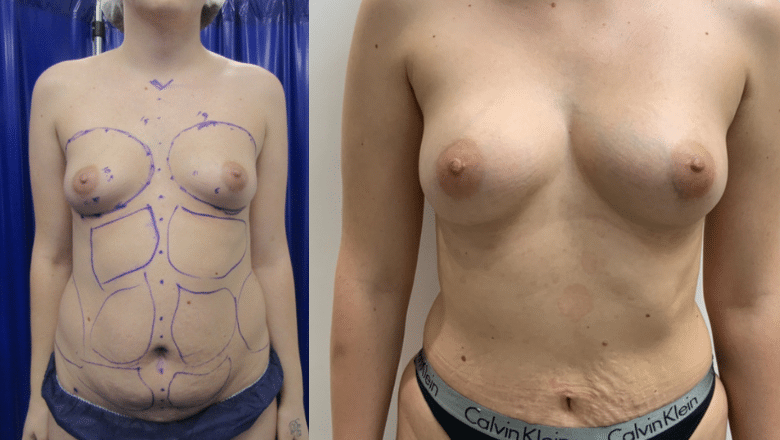
Real Centre for Surgery patient before and after liposuction with fat transfer to the breasts.
What about non-surgical breast fillers?
Injectable fillers have been used to enlarge the breasts, but concerns about lumps and interference with breast imaging mean they are rarely used in the UK. Centre for Surgery does not offer non-surgical breast fillers. If your main concern is sagging rather than size, a breast lift may suit you better than augmentation.
Before you decide on surgery
Your consultation is with the surgeon who will operate, and any further consultations before surgery are free. We recommend a two-week cooling-off period between consultation and surgery. If you have recently had a baby, breast surgery should wait until at least 3 months, and ideally around 6 months, after you have completely stopped breastfeeding. Breast augmentation is a cosmetic procedure and is rarely available on the NHS; our article on breast enlargement on the NHS explains why. The NHS guide to breast enlargement ↗ is a useful independent overview of risks and recovery.
How Much Does Breast Augmentation Cost?
The cost depends on the technique, the implant and whether fat transfer is included. Our breast augmentation cost guide sets out current prices and what is included, and finance is available, subject to status. Compared with months or years of buying supplements that do not work, a single consultation will tell you what is realistic for your body.
Frequently Asked Questions
What pills can make your breasts bigger?
None that are safe or proven for the purpose. Over-the-counter breast enlargement pills have no clinical trial evidence behind them. The only tablets that reliably cause breast growth are prescription hormones such as oestrogen, which are used for specific medical reasons under supervision and carry real risks, so they should never be taken to enlarge the breasts.
Will my breasts grow if I take oestrogen?
Oestrogen taken on prescription can cause breast growth, which is seen in gender-affirming hormone treatment. For women who already have normal hormone levels, taking extra oestrogen is not a safe or effective way to change breast size and increases the risk of side effects such as blood clots. Do not take hormones without a prescription.
What increases breast size fast?
Nothing non-surgical increases breast size quickly and permanently. A well-fitted or padded bra makes an immediate visual difference, and swelling before a period can make the breasts feel fuller for a few days. For a real, lasting change, breast augmentation with implants gives the most predictable result.
Is there any cream to make breasts bigger?
No cream has been shown to grow breast tissue. Some may moisturise or slightly firm the look of the skin for a short time.
Do breast enlargement pills cause cancer?
There is no clear evidence either way, which is part of the concern. Some ingredients act on oestrogen receptors, and contamination with a fungal oestrogen has been described in bust-enhancing supplements, but long-term studies have not been done. Anyone with a history of breast cancer or a strong family history should avoid them and speak to their GP.
Can I take breast enhancement supplements while breastfeeding?
This is not advisable. Hormonally active herbs may pass into breast milk, and their safety for babies has not been tested. Your breasts will change in size after you stop breastfeeding, so it is best to wait and see how they settle.
Do breast enhancement pills work for men?
No. Men searching for this are usually either trying to reduce chest fat or looking for gender-affirming care. Herbal pills do not do either reliably, and hormone treatment should only be started under specialist supervision.
References
- Fugh-Berman A. “Bust enhancing” herbal products. Obstet Gynecol. 2003;101(6):1345-1349. doi:10.1016/s0029-7844(03)00362-4 ↗
- Kongkaew C, Scholfield NC, Dhippayom T, et al. Efficacy and safety of Pueraria candollei var. mirifica (Airy Shaw & Suvat.) Niyomdham for menopausal women: a systematic review of clinical trials and the way forward. J Ethnopharmacol. 2018;216:162-174. doi:10.1016/j.jep.2018.01.028 ↗
- Dietz BM, Hajirahimkhan A, Dunlap TL, Bolton JL. Botanicals and their bioactive phytochemicals for women’s health. Pharmacol Rev. 2016;68(4):1026-1073. doi:10.1124/pr.115.010843 ↗
- Pazaiti A, Kontos M, Fentiman IS. ZEN and the art of breast health maintenance. Int J Clin Pract. 2012;66(1):28-36. doi:10.1111/j.1742-1241.2011.02805.x ↗
- Khouri RK, Schlenz I, Murphy BJ, Baker TJ. Nonsurgical breast enlargement using an external soft-tissue expansion system. Plast Reconstr Surg. 2000;105(7):2500-2512. doi:10.1097/00006534-200006000-00032 ↗
- Ockell J, Biörserud C, Fagevik Olsén M, Elander A, Hansson E. “Normal” breast dimensions in obese women: reference values and the effect of weight loss. J Plast Reconstr Aesthet Surg. 2024;94:187-197. doi:10.1016/j.bjps.2024.05.021 ↗
- Cherdshewasart W, Sriwatcharakul S. Metabolic activation promotes estrogenic activity of the phytoestrogen-rich plant. Maturitas. 2008;59(2):128-136. doi:10.1016/j.maturitas.2008.01.002 ↗
Talk to a Surgeon About Breast Enlargement
If you have tried pills or creams without results, or would like an honest view of what would suit your body, you can book a consultation at our Baker Street clinic by calling 020 7993 4849 or using the form below. A breast surgeon will talk you through implants, fat transfer and whether surgery is right for you at all. Our guide on how to prepare for your consultation lists useful questions to ask.







