

Real pectoral implant results from patients treated at our Baker Street day surgery facility, grouped by condition. Jump to Pectus Excavatum or Poland Syndrome.
Results vary from patient to patient. All photos are published with written patient consent and are examples of outcomes achieved at Centre for Surgery, not guaranteed results. After photos were taken at least six months after surgery unless the caption says otherwise. No photograph has been retouched or filtered; some are cropped or masked only to protect patient privacy. Full disclaimer below, and how to read these photos — including why a pectoral implant changes the shape of the chest without changing the chest wall beneath it.
Pectus Excavatum — Before & After
9 photographs
Pectus excavatum is a congenital condition in which the breastbone and adjacent ribs are depressed, producing a sunken chest. A custom pectoral implant is designed from the individual’s own anatomy and placed to fill the depression, restoring an even contour across the chest.


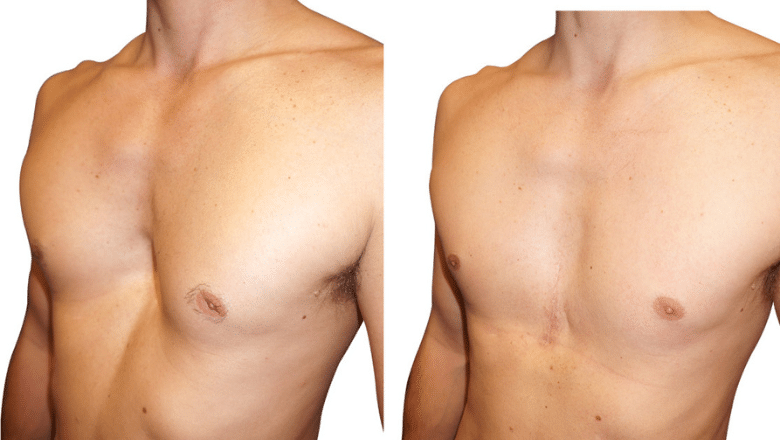


An implant fills the depression. It does not lift the breastbone, reshape the ribs, or alter the space available to the heart and lungs. Where the depression is deep enough to affect breathing or cardiac function, the operation that addresses it is a thoracic one, not a cosmetic one — and the two are sometimes confused because the photographs can look similar.
Poland Syndrome — Before & After
3 photographs
Poland syndrome is a congenital condition in which the pectoralis major muscle on one side of the chest is absent or underdeveloped, producing visible asymmetry. Only one side is affected, so the implant is custom-made to match the opposite chest wall rather than to a standard shape.


About These Pectoral Implant Photos
The pectoral implant photos above are presented for educational purposes only and should be interpreted subjectively. They do not represent the opinion or view of any patient regarding their result, and they are not intended to suggest the result that any other patient may achieve. No two patients are alike, and no two results are necessarily alike. Only a personal consultation with your surgeon can provide you with a reasonable expectation of the results you may achieve from any specific procedure. We only publish photographs of patients who have given full written consent for their images to be used.
How to Read Pectoral Implant Before and After Photos
The chest is the region of the body where photography is least trustworthy, and it is not close. Lighting alone can create or erase the appearance of a pectoral border. Before you compare anything else, compare the light.
The light, then the chest
A chest photographed from slightly above with the light behind the camera looks flat. The same chest, photographed with the light raked across it from the side, shows a defined lower border and a visible cleft at the sternum. Nothing has changed but the lamp. In a genuine before-and-after pair, the shadow beneath the collarbone and the shadow at the armpit should fall the same way in both frames. Where they do not, you are looking at two lighting set-ups, and the surgery is no longer the only variable.
Arms down, and identically
Raising or bracing the arms contracts the pectoralis major and changes the shape of the chest instantly and dramatically. The arms should hang at the same angle, relaxed, in both photographs. A subject who is pressing their palms against their thighs in the after image is flexing.
The implant is under the muscle, so what you see is muscle
A pectoral implant is a solid silicone form placed beneath the pectoralis major. It does not sit on the surface. What the photograph shows you is the muscle draped over the implant — which means body fat, muscle bulk and skin thickness all sit between you and the thing that was actually inserted. Two men given identical implants will not photograph alike.
Corrective and cosmetic cases are not the same operation
Every case in this gallery is corrective — a custom implant made for a specific chest wall in pectus excavatum or Poland syndrome. The starting point in these photographs is a structural asymmetry, not an unremarkable chest. A man considering cosmetic augmentation should not read a Poland syndrome result as a prediction of his own, and vice versa.
What Stage of Healing You’re Looking At
The implant sits beneath a muscle that has been lifted off the chest wall, and that muscle objects.
In the early weeks the chest is swollen and tight, the shoulders sit forward, and raising the arms is uncomfortable. The implant can look high and its edges more obvious than they will be later. Muscle spasm is common and normal. Most of this settles over the first two to three months as swelling resolves and the muscle relaxes over the implant.
The scar is usually placed in the armpit, where it is out of sight in a front-facing photograph — which is where almost every photograph in every pectoral implant gallery is taken from, this one included.
A photograph at six weeks and a photograph at six months are showing you different stages of the same result. A gallery that never states the interval is asking you to assume the later one.
The after photographs in this gallery were taken at least six months after surgery, unless the caption says otherwise. For what to expect at each stage before then, see our pectoral implant recovery guide.
What These Photographs Cannot Show You
There is a limit to what any gallery can tell you, and a clinic that pretends otherwise is selling rather than informing.
- Whether the chest wall was corrected. In pectus excavatum, an implant camouflages the depression. It does not raise the sternum or remodel the ribs. If the depression is causing symptoms, that is a different operation, under a different specialty, with different photographs.
- How it feels and moves. A solid implant beneath a working muscle can be felt, particularly at its edges and particularly in a lean chest. It moves when the muscle contracts. No still photograph records either.
- The scar. Placed in the armpit and therefore absent from every image here. Ask to see it.
- Sensation. Numbness across the chest and nipple is common early on and does not always resolve completely.
- What happens at the gym. The implant does not grow, shrink or respond to training. The muscle over it does. The relationship between the two changes as your body changes, and a photograph taken at one body composition tells you nothing about how the same chest looks at another.
- The complications that were not photographed. Implant displacement or rotation, fluid collection, and capsular contracture are recognised outcomes of this operation. Galleries show results. Ask your surgeon about the rest.
None of this is a reason to distrust before and after photographs. It is a reason to treat them as the beginning of a conversation with a surgeon rather than the end of one.
Pectoral Implant Results: Common Questions
How long do pec implants last?
Pectoral implants are made of solid silicone, so they cannot rupture or leak, and most men keep them long term without replacement. Further surgery may be needed if a problem develops, such as displacement, rotation, fluid collection or capsular contracture.
Can you tell if a man has pec implants?
In a lean chest, the edges of an implant can sometimes be seen or felt, particularly at its lower and outer border, and the chest moves differently when the muscle contracts. With more muscle and fat cover, implants are harder to detect. The scar sits in the armpit.
Can men get pectoral implants?
Yes. Pectoral implants can add definition for men who find the chest hard to build through training, and custom-made implants are used to correct chest wall conditions such as pectus excavatum and Poland syndrome, as in the cases above.
Pectoral Implants at Centre for Surgery
Centre for Surgery is a private hospital for plastic and cosmetic surgery on Baker Street in Marylebone, London, registered with and independently inspected by the Care Quality Commission. Our plastic surgeons perform pectoral implant surgery, including custom implants for pectus excavatum and Poland syndrome, at our Baker Street day surgery facility.
Custom Implants for Corrective Cases
Where the chest wall is asymmetric, an off-the-shelf implant will reproduce the asymmetry. A custom implant is designed from imaging of your own chest so that the finished contour matches the opposite side. Your surgeon will explain which approach applies to you, where the incision sits, and what the implant will and will not change.
Aftercare and Follow-Up
Surgery is performed at our Baker Street day surgery facility. You have your surgeon’s direct number for the first 24 hours after surgery, and your surgeon will review you at regular follow-up appointments. Every plastic surgeon on our team is GMC-registered and independently verifiable on the General Medical Council register.
Verified Patient Reviews
We invite you to read what our pectoral implant patients say on independent, verified review platforms. Every review is publicly verifiable, dated, and linked to a real named patient.
- Google Reviews: Read our Google reviews ↗ — rated 4.6 stars based on hundreds of verified patient reviews.
- Patient reviews page: Read patient reviews by procedure — Google and Trustpilot reviews brought together on our own site.
As a CQC-regulated provider, every surgeon on our team is GMC-registered and independently verifiable. View our CQC rating.
Related Reading
- Pectoral Implants Recovery and Aftercare
- How Much Do Pectoral Implants Cost?
- Do Pectoral Implants Impact Muscle Growth?
Explore More Before and After Galleries
View our full collection of plastic surgery before and after photos, or browse related male surgery galleries: Gynecomastia Before and After Photos | Calf Augmentation Before and After Photos | Liposuction Before and After Photos
Subject to status, we offer finance options with Chrysalis Finance. Browse our Plastic Surgery Blog or find answers in our Clinic FAQs.
To book a consultation, call us on 020 7993 4849, email contact@centreforsurgery.com, or visit us at 95–97 Baker Street, London W1U 6RN. Visit our About Us page to learn more.