


In this guide14 sections
- Key Points
- What Is Gyno (Gynaecomastia)?
- Gyno vs Chest Fat: What Is the Difference?
- How to Tell If You Have Gyno: Signs and Symptoms
- The Pinch Test: How to Check for Gyno at Home
- Gyno vs Chest Fat Pictures: What Does Gyno Look Like?
- Can You Have Both Gyno and Chest Fat?
- When Should You See a GP About a Lump Under the Nipple?
- What Causes Gyno?
- Does Chest Fat Go Away With Weight Loss?
- How Do You Get Rid of Gyno? Treatment Options
- Frequently Asked Questions
- Gynaecomastia Treatment at Centre for Surgery
- References
Key Points
- Gyno is gland; chest fat is fat. Gyno is short for gynaecomastia, a benign growth of glandular breast tissue in men. Chest fat (pseudogynaecomastia) is ordinary fat with no extra gland beneath it.
- Texture is the main clue. Gyno feels like a firm or rubbery disc directly under the nipple. Chest fat feels soft and even across the whole chest.
- Weight loss shrinks fat, not gland. Chest fat reduces as body fat falls. Established glandular tissue stays, which is why some men keep a firm lump after losing weight.
- An examination confirms it. A home pinch test can only suggest which you have. A doctor’s examination, sometimes with an ultrasound scan, tells gland from fat.
- Teenage gyno usually settles. Around half of boys develop some breast tissue in mid-puberty, and in more than 90% it goes away within two years.
- Some changes need a GP first. A new lump, nipple discharge, nipple or skin changes, or swelling in the armpit should be checked by your GP before anything else.
Gyno is short for gynaecomastia (often spelled gynecomastia), a benign enlargement of the glandular breast tissue in men. Chest fat, known clinically as pseudogynaecomastia, is ordinary fat stored on the chest. If your chest looks fuller than you would like, the first question is which of the two you have. Telling gyno from chest fat matters because, although they can look alike in the mirror, they respond to different treatments: chest fat reduces as you lose weight, while established glandular tissue does not and is usually corrected with gynaecomastia surgery.
The quick answer: texture, position, tenderness and response to weight loss. Gyno feels firm or rubbery, sits as a distinct disc directly beneath the nipple, is often tender, and stays put when you lose weight. Chest fat feels soft, spreads evenly across the chest, is rarely tender, and shrinks as your overall body fat falls.
This guide covers what gyno is, the signs to look for, a self-check you can do at home, real patient photographs of gland and fat, what causes gynaecomastia and how each is treated. If your concern is limited to the nipple area, our guide to puffy nipples covers that presentation.
At Centre for Surgery, gynaecomastia is assessed and treated by GMC-registered plastic surgeons at our hospital on Baker Street, rated Good overall by the Care Quality Commission.
What Is Gyno (Gynaecomastia)?
Gyno is the everyday name for gynaecomastia, a benign growth of the glandular tissue of the breast in males[1]. It develops when the effect of oestrogen on the breast tissue outweighs the effect of testosterone[2]. Doctors call it true gynaecomastia when there is real glandular tissue. When the fullness is made of fat alone, the medical terms are pseudogynaecomastia or lipomastia[1]. People also search for both using everyday words for enlarged male breasts, but the question is always the same: gland, fat or a mixture of the two.
Gyno is common. Depending on age and the definition used, studies report it in 32–65% of men[1]. The range is wide because studies define it differently, and recorded diagnoses are far less common: in a 2024 Israeli study of 531,686 boys aged 12 to 15 without a recorded obesity diagnosis, about 1% had a recorded diagnosis of gynaecomastia[3]. Gyno appears most often at three stages of life (in newborns, during puberty and in older age) and it can affect one or both sides. It is not a precancerous condition, but in adults a thorough assessment finds an underlying cause in around half of cases, which is why a new chest lump deserves a proper history and examination[1]. Our guide to how common gynaecomastia is looks at the figures in more detail.
It can also have a real effect on confidence. A review of the research found that gynaecomastia has been linked with body dissatisfaction, reduced self-esteem, anxiety and depression[4], and men often describe avoiding swimming pools, changing rooms and fitted shirts for years before seeking help.
Gyno vs Chest Fat: What Is the Difference?

Gyno is a benign growth of glandular breast tissue, driven by a hormone imbalance. Chest fat is adipose tissue laid down on the chest as part of overall body fat. The distinction sits at the centre of clinical assessment: the European Academy of Andrology’s 2019 clinical practice guidelines recommend that the breast examination confirms whether glandular tissue can be felt, because that is what separates true gynaecomastia from fatty enlargement[1].
| Feature | Gyno (gynaecomastia) | Chest fat (pseudogynaecomastia) |
|---|---|---|
| What it is | Glandular breast tissue | Fat under the skin |
| How it feels | A firm or rubbery disc | Soft and even |
| Where it sits | Directly beneath and around the nipple | Spread across the whole chest |
| Tenderness | Common, especially while it is developing | Uncommon |
| Weight loss | Little or no change | Reduces as body fat falls |
| Usual treatment | Gland excision, often with liposuction | Weight loss, or liposuction if it persists |
Many men have a mixture of both, which is why a chest can shrink with weight loss and still keep a firm disc behind the nipple.
How to Tell If You Have Gyno: Signs and Symptoms
The signs of gyno are usually easier to feel than to see:
- A firm lump under the nipple. The earliest sign is often a small, rubbery disc or “button” directly behind one or both nipples.
- Tenderness or sensitivity. Newly growing tissue is often sore to press, or sensitive when clothing rubs against it.
- Puffy, protruding nipples. The areola can look swollen or cone-shaped, especially through a T-shirt.
- Swelling on one or both sides. Gyno is often uneven, and unilateral gynaecomastia, affecting one side only, also occurs.
- A full chest even when you are lean. Fullness that stays despite training and a low body-fat percentage points to gland rather than fat. Our article on why gynaecomastia can affect men who are physically fit explains why.
In teenagers, these early signs are very common. Around half of boys develop some breast tissue in mid-puberty, and in more than 90% it settles on its own within two years[1]. Our guide to whether gynaecomastia goes away on its own explains what happens when it does not, and our article on what gynaecomastia feels like describes the typical texture in more detail.
The Pinch Test: How to Check for Gyno at Home

If you are wondering whether it is gyno or just fat, you can get a reasonable indication at home with the pinch test. It is not a diagnosis, but it tells you whether an assessment is worth booking.
- Lie on your back. Put one hand behind your head. This flattens the chest tissue and makes a gland easier to feel.
- Pinch from the outside in. Using your thumb and forefinger, gently pinch the tissue at the outer edge of the chest and work slowly towards the nipple.
- Feel for a disc. A firm, rubbery mass concentrated under the nipple, which feels different from the tissue around it, points to gynaecomastia. Tissue that feels uniformly soft all the way across points to chest fat.
- Note any tenderness. Glandular tissue is often tender when pressed, particularly if it has appeared recently. Fat usually is not.
Glandular tissue can range from a small, button-sized disc to a larger mass. If you can feel a defined lump rather than soft padding, it is worth having it examined. Where examination alone cannot settle whether tissue is gland or fat, guidelines suggest that breast imaging can help[1]. Ultrasound is generally the first choice: a 2026 review of the role of ultrasound in gynaecomastia describes how it helps to tell gynaecomastia from pseudogynaecomastia and to pick out features that need further checks[5].
Gyno vs Chest Fat Pictures: What Does Gyno Look Like?
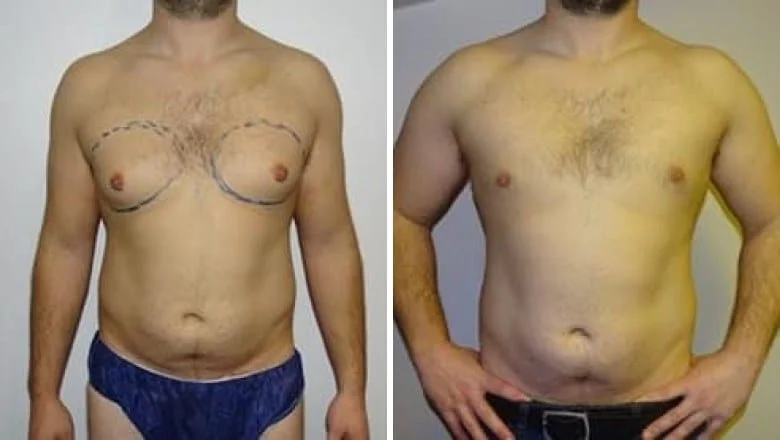
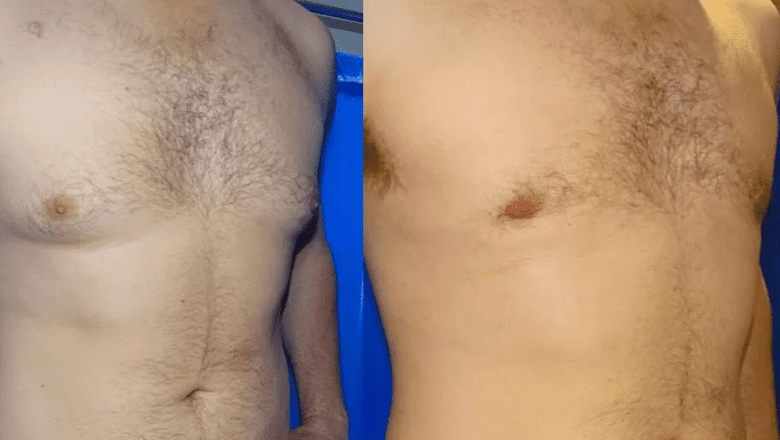
These are Centre for Surgery patients, photographed with their written consent. Individual results vary, and a photograph alone cannot tell you what your own chest is made of.
Compared with a normal male chest, which is flat behind the nipple, a chest with gyno usually shows a rounded fullness centred on the nipple, often with a puffy or cone-shaped areola. Chest fat tends to give a broader, softer fullness that spreads across the chest rather than sitting behind the nipple.
Chest fat (pseudogynaecomastia) · front view. Fullness from fat spread across the chest, corrected with liposuction alone (before on the left, after on the right). Individual results vary.
Glandular gynaecomastia in a lean man · front view. Predominantly glandular tissue, the kind of fullness weight loss cannot remove, corrected with gland excision and liposuction. Individual results vary.
More results, including side views and the scars left by gland excision, are in our gynaecomastia before and after photos.
Can You Have Both Gyno and Chest Fat?
Yes, and a mixed picture is common. A mixed chest has a glandular disc behind the nipple with fat around it. Weight loss shrinks the fatty part, which is why the chest can look smaller while a firm lump remains. It is also why surgery often combines liposuction for the fat with removal of the gland: in a large review of published series, about half of the patients had a combined operation[6]. If you have lost weight and can still feel or see a firm mass under the nipple, a mixed picture is the likely explanation. Our guide to the grades of gynaecomastia explains how the amount of gland, fat and loose skin is classified.
When Should You See a GP About a Lump Under the Nipple?
Gynaecomastia is benign and is not a precancerous condition[1]. Breast cancer in men is rare, accounting for less than 1% of all breast cancers, but it typically shows up as a lump behind the nipple, nipple changes or pain[7]. That overlap with gyno is why a new lump should be examined rather than assumed to be harmless. European guidelines suggest that this first check, to rule out fat alone, an obvious breast cancer or testicular cancer, can be done by a GP[1]. The NHS advises seeing a GP if you notice any of the following (see its pages on gynaecomastia and symptoms of breast cancer in men):
- a lump or swelling in your chest or armpit
- liquid leaking from either nipple, which may contain blood
- a change in the shape or look of a nipple, or a rash on it
- dimpling, sores, ulcers or other changes in the skin of the chest
- a change in the size or shape of one side of your chest, or pain that does not go away
Our guide to gynaecomastia and breast cancer risk in men explains the difference in more detail.
What Causes Gyno?

Gynaecomastia develops when oestrogen activity outweighs testosterone activity in the breast tissue[2]. That balance can shift for several reasons, and more than one can apply at once. Our full guide to the causes of gynaecomastia covers each in depth.
Hormone changes through life
Temporary gynaecomastia is common in newborns and in puberty, and most cases at these ages settle without treatment[1]. Gynaecomastia also becomes more common with age[1]. Increased conversion of testosterone into oestrogen in the body’s tissues is one of the mechanisms behind both the pubertal and the age-related forms[2]. Our advice for teenagers with gynaecomastia covers the pubertal form.
Medicines
Medicines are estimated to cause around 10–25% of cases[8]. The strongest evidence links gynaecomastia to spironolactone, cimetidine, ketoconazole, anti-androgens, GnRH analogues, 5-alpha-reductase inhibitors such as finasteride, oestrogens, hCG and growth hormone. Probable links include some antipsychotics, some calcium channel blockers, omeprazole, some HIV medicines, some chemotherapy drugs and opioids, while many other reported associations rest on weak evidence[8]. Some antidepressants have also been reported. Never stop a prescribed medicine without speaking to your GP first.
Products applied to the skin can matter too. A report of three prepubertal boys linked repeated use of products containing lavender and tea tree oils to breast growth, which resolved once the products were stopped[9].
Anabolic steroids, alcohol and cannabis
Anabolic steroids and alcohol both appear among the probable causes[8]. Steroid use is worth considering in particular when gyno appears in a lean, muscular man; see our guides to steroid-related gynaecomastia and bodybuilder gynaecomastia. Cannabis is widely reported as a trigger, although the published evidence is weaker, and our article on whether cannabis causes gynaecomastia looks at it closely. Whatever the evidence, both cannabis and anabolic steroids need to have been stopped for at least four to six months before surgery.
Weight gain
Body fat contains an enzyme, aromatase, that converts testosterone into oestrogen, and increased conversion is one of the ways obesity is linked to gland growth[2]. That is one reason many men have a mixed picture of gland and fat.
Underlying medical conditions
Less commonly, gynaecomastia is a sign of a condition that needs treatment in its own right, such as an overactive thyroid, liver disease such as cirrhosis or, rarely, a tumour of the testis, adrenal gland or liver[2]. Low testosterone and kidney disease are among the other causes doctors look for, which is why guidelines recommend a full history and examination, including examination of the testicles supported by an ultrasound scan, and suggest blood tests that can include testosterone and other hormones, and thyroid, liver and kidney function[1].
Does Chest Fat Go Away With Weight Loss?
Usually, yes. If the self-check and examination point to fat, it responds to lifestyle change. Exercise cannot target fat on the chest alone, so the approach is overall fat loss: a sustainable calorie deficit, regular cardiovascular exercise and strength training, as our guide to losing body fat explains. There is no fixed body-fat percentage at which chest fat disappears, because people store fat differently. If you are a normal weight with little muscle and a soft chest, you may be skinny fat, where building muscle matters as much as losing fat. Chest training builds the pectoral muscle underneath and improves the shape as the fat comes off, although if there is gland behind the nipple, a bigger muscle may push it forward and make it more noticeable, as our guide to whether exercise gets rid of gynaecomastia explains. Give it months rather than weeks. If fullness persists once your weight is stable, liposuction is an option for the remaining chest fat, and any firm disc that remains is gland that dieting will not shift.
How Do You Get Rid of Gyno? Treatment Options

The right treatment depends on what the tissue is made of and how long it has been there.
Treating the cause and waiting
Where a medicine or other trigger is found, it is addressed first and the chest is monitored, because recent gynaecomastia can settle once the cause is removed. Pubertal gynaecomastia is usually managed the same way[1],[10].
Medication
Anti-oestrogen tablets are sometimes suggested, but the evidence for them is limited. European guidelines do not recommend them for gynaecomastia in general[1], while more recent Italian guidelines say medication may be considered in selected cases where no cause is found or the tissue is painful[10]. Testosterone treatment is only appropriate for men with proven testosterone deficiency[1]. Our guide to non-surgical treatments for gynaecomastia looks at each option.
Surgery
For long-standing gynaecomastia that has not settled, surgery is the treatment of choice, because established glandular tissue becomes fibrous and is unlikely to respond to diet, exercise or medication[1],[10]. Male breast reduction is tailored to what your chest is made of:
- Liposuction removes the fatty component through small incisions at the side of the chest. Power-assisted liposuction and VASER liposuction are both available, and your surgeon will advise which suits your chest. VASER uses ultrasound energy to loosen fat before it is removed, and ultrasound-assisted liposuction has been described as particularly efficient in the dense, fibrous tissue of the male chest[11]. On its own, liposuction suits chest fat, and our male liposuction page explains the options.
- Gland excision removes the firm glandular disc through a small incision along the lower edge of the areola or, in suitable cases, through the liposuction incisions using a pull-through technique.
- Skin reduction is added for higher grades with loose skin, and a stretched areola can be reduced at the same time with areola reduction.
Combining techniques matters. A 2022 systematic review of 94 studies and 7,294 patients recorded a complication rate of 30.6% with excision alone, compared with 11.8% when excision was combined with liposuction, although the studies used different techniques and grading systems[6]. A separate systematic review of liposuction-assisted surgery through small incisions for milder grades found that patients’ satisfaction and quality of life improved consistently after surgery, while noting that most of the studies were of low quality[12].
As with any operation, there are risks. They include bleeding or a collection of blood under the skin (haematoma), a collection of fluid (seroma), infection, an uneven contour, changes in nipple sensation and scarring. Your surgeon will go through these with you at your consultation.
Your quote depends on your grade and the techniques involved, and our gynaecomastia surgery cost guide sets out indicative prices. Finance is available, subject to status; see our finance options. Many men are back at desk-based work within about a week, and our gynaecomastia recovery guide covers the full timeline.
Which cosmetic surgery for men is right for you?
A few short questions, including a simple pinch test if stomach fat is your concern. You will get a suggested procedure, realistic recovery times, and an honest answer if surgery is not what you need.
Frequently Asked Questions
How do I know if I have gyno or just fat?
Feel the area directly behind the nipple. Gyno is a firm or rubbery disc centred under the nipple that feels different from the tissue around it, while chest fat feels soft and even all the way across. Chest fat also shrinks as you lose weight and gyno does not. A home check can only suggest which you have; an examination, sometimes with an ultrasound scan, confirms it[1].
Is gyno soft or hard?
Gyno usually feels firm or rubbery, although newer tissue can feel softer and more elastic. What sets it apart from fat is a distinct disc centred under the nipple, and newly growing tissue is often tender. Tissue that has been present for a long time tends to become more fibrous[10]. Soft tissue with no distinct disc is more likely to be fat.
Does gyno go away with weight loss?
Not the glandular part. Losing weight reduces chest fat, so a mixed chest can look smaller, but it does not shrink a firm glandular disc behind the nipple. Long-standing glandular tissue usually needs surgery to remove it[1]. If fullness remains once your weight is stable, it is likely to be gland.
Can you have gyno with low body fat?
Yes. Gyno is glandular tissue rather than fat, so it can be obvious in lean, muscular men, where there is little fat to hide it. In men who train, it is worth considering whether anabolic steroids or a medicine could be the trigger[8].
Does gyno go away on its own?
Pubertal gyno usually does: in more than 90% of boys who develop it, it settles within two years[1]. In adults, gyno that has been present for a long time rarely resolves by itself, although recent gynaecomastia can improve once a trigger such as a medicine is removed[1],[10].
Does gyno mean low testosterone?
Not necessarily. Gyno reflects the balance between oestrogen and testosterone action in the breast tissue, so it can develop without low testosterone[2]. Low testosterone is one of the causes a doctor may check for with a blood test, and testosterone treatment is only recommended for men with proven deficiency[1].
Is gyno genetic?
Usually not in a directly inherited way. Most gyno is linked to life-stage hormone changes, weight, medicines or other health conditions. Rarely, it is part of a genetic condition such as Klinefelter syndrome, or of an inherited excess of the enzyme aromatase[2].
Can gyno affect only one side?
Yes. It can be uneven and can affect one side only. A one-sided lump should still be checked by your GP if it is new or growing, or if it comes with any of the warning signs above.
How common is gynaecomastia?
Very common. Depending on age and definition, it is found in roughly a third to two-thirds of men, and around half of boys develop some breast tissue in mid-puberty[1].
Is gynaecomastia surgery permanent?
For most men, yes. Glandular tissue that has been removed does not grow back, although new tissue can form if the original cause continues, and weight gain can add fat to the chest. Our guide to whether gynaecomastia can come back after surgery explains why.
Is gyno dangerous?
No. Gynaecomastia is benign and is not considered a precancerous condition[1]. A new lump is still worth having examined, both to confirm the diagnosis and to look for a cause that may need treatment.
Gynaecomastia Treatment at Centre for Surgery
Every gynaecomastia assessment at Centre for Surgery is carried out by a GMC-registered plastic surgeon, and the surgeon who examines you is the surgeon who performs your surgery. Your consultation confirms whether your chest is gland, fat or both. We treat every grade, including loose skin after weight loss and gynaecomastia revision surgery after operations elsewhere, as a day case at our Baker Street hospital. Your consultation is £100, redeemable against the cost of your procedure, and we recommend a two-week cooling-off period after consent before surgery is booked.
Phone: 020 7993 4849 | Email: contact@centreforsurgery.com | Address: 95–97 Baker Street, London W1U 6RN
References
- Kanakis GA, Nordkap L, Bang AK, et al. EAA clinical practice guidelines: gynecomastia evaluation and management. Andrology 2019;7(6):778–793. doi:10.1111/andr.12636
- Braunstein GD. Aromatase and gynecomastia. Endocrine-Related Cancer 1999;6(2):315–324. doi:10.1677/erc.0.0060315
- Berger O, Hornik-Lurie T, Talisman R. Pubertal gynecomastia incidence among 530,000 boys: a cross sectional population based study. Frontiers in Pediatrics 2024;12:1367550. doi:10.3389/fped.2024.1367550
- Ordaz DL, Thompson JK. Gynecomastia and psychological functioning: a review of the literature. Body Image 2015;15:141–148. doi:10.1016/j.bodyim.2015.08.004
- Stoian D, Bena A, Neagoe O. The role of ultrasound in gynecomastia. Ultraschall in der Medizin 2026;47(2):122–145. doi:10.1055/a-2790-6576
- Innocenti A, Melita D, Dreassi E. Incidence of complications for different approaches in gynecomastia correction: a systematic review of the literature. Aesthetic Plastic Surgery 2022;46(3):1025–1041. doi:10.1007/s00266-022-02782-1
- Khatri L, Fraker J, Pruthi S. Male breast health and breast cancer risk. Maturitas 2026;206:108850. doi:10.1016/j.maturitas.2026.108850
- Deepinder F, Braunstein GD. Drug-induced gynecomastia: an evidence-based review. Expert Opinion on Drug Safety 2012;11(5):779–795. doi:10.1517/14740338.2012.712109
- Henley DV, Lipson N, Korach KS, et al. Prepubertal gynecomastia linked to lavender and tea tree oils. New England Journal of Medicine 2007;356(5):479–485. doi:10.1056/NEJMoa064725
- Pozza C, Selice R, Barbonetti A, et al. Management of gynecomastia in adolescence and adults: the clinical practice guidelines from the Italian Society of Andrology and Sexual Medicine (SIAMS). Journal of Endocrinological Investigation 2026;49(10):2583–2610. doi:10.1007/s40618-026-02915-2
- Rohrich RJ, Ha RY, Kenkel JM, et al. Classification and management of gynecomastia: defining the role of ultrasound-assisted liposuction. Plastic and Reconstructive Surgery 2003;111(2):909–923. doi:10.1097/01.PRS.0000042146.40379.25
- Prasetyono TOH, Budhipramono AG, Andromeda I. Liposuction assisted gynecomastia surgery with minimal periareolar incision: a systematic review. Aesthetic Plastic Surgery 2022;46(1):123–131. doi:10.1007/s00266-021-02520-z



