


Real gynecomastia (gyno) surgery results from patients treated at our Baker Street day surgery facility. Jump to Gynecomastia Surgery or Vaser & BodyTite Correction.
Results vary from patient to patient. All photos are published with written patient consent and are examples of outcomes achieved at Centre for Surgery, not guaranteed results. After photos were taken at least six months after surgery unless the caption says otherwise. No photograph has been retouched or filtered; some are cropped or masked only to protect patient privacy. Full disclaimer below, and how to read these photos — including why a photograph cannot tell you whether your own chest is glandular or fatty.
Gynecomastia before and after — male breast reduction results
40 photographs
Gynecomastia surgery reduces enlarged male breast tissue and restores a flat chest contour. Depending on what the tissue is made of, that means liposuction, surgical excision of the gland, or both together. The photographs below span both approaches.


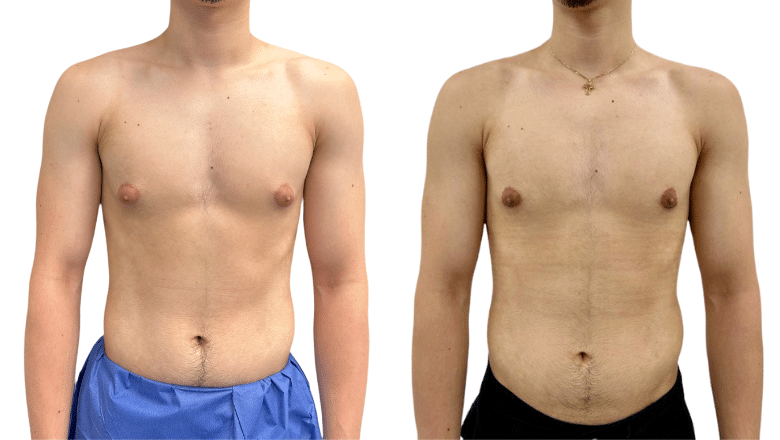


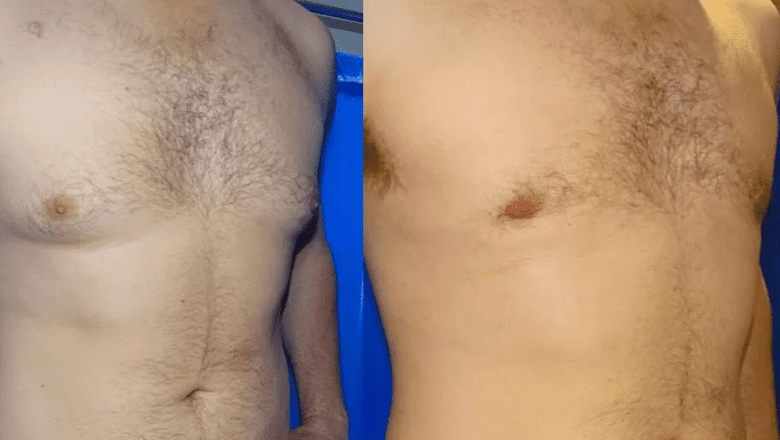


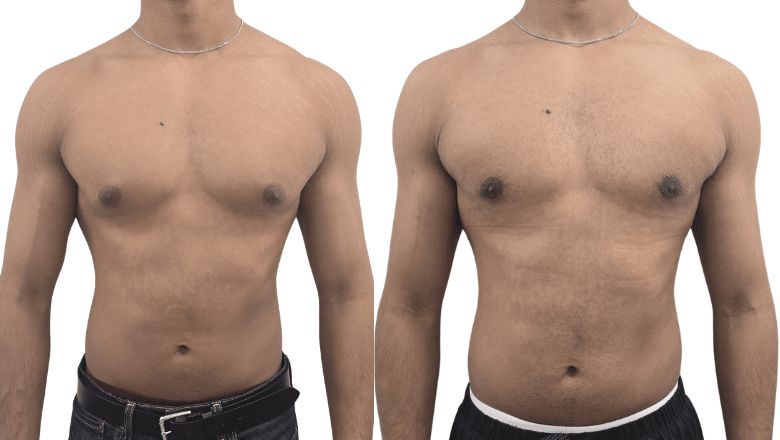
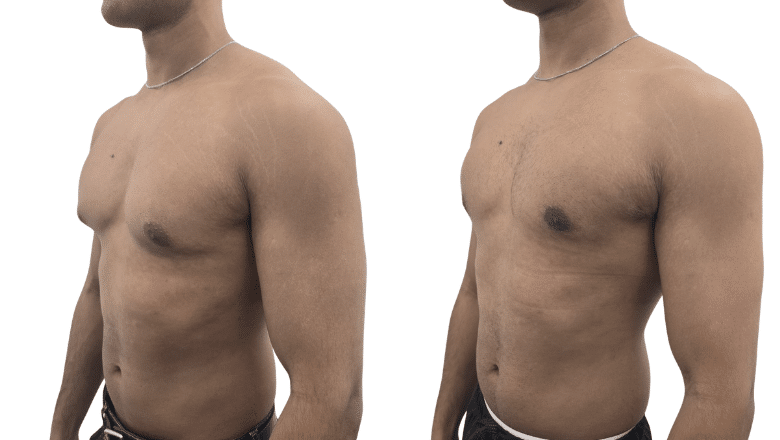
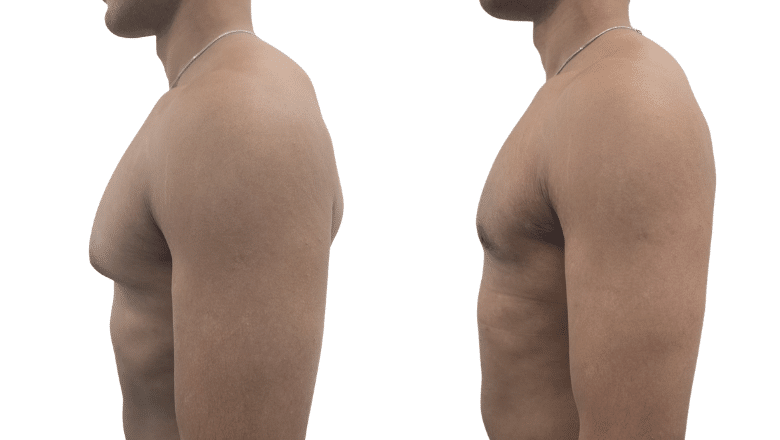


Vaser and BodyTite gyno before and after
1 photograph
For gynecomastia that is predominantly fatty rather than glandular, VASER liposuction is our preferred non-excisional option. VASER uses ultrasonic energy to liquefy fat before it is removed by cannula, allowing more precise, controlled fat removal than standard liposuction and encouraging some skin tightening as the treated area heals — without the incision needed for surgical excision of glandular tissue. As with any liposuction-based approach to gynecomastia, VASER suits a chest that is largely fatty; it is not a substitute for excision where a firm gland sits behind the nipple. Learn more about VASER liposuction at Centre for Surgery.
BodyTite — radiofrequency-assisted liposuction — is a further non-excisional option for suitable patients, working on a similar principle of liquefying and tightening before fat removal.

How to read gynecomastia before and after photos
A photograph cannot tell you whether the tissue is glandular or fatty. This is the single most important thing to understand about the images above, because that distinction decides the operation. A chest that is largely fat can often be corrected by liposuction alone, through two small incisions. A firm gland behind the nipple has to be cut out, and cutting it out leaves a scar. Two men whose before photographs look identical can need different operations and finish with different scars. That determination is made by examination — and sometimes ultrasound — not by looking at a stranger’s photograph, and not by looking at your own in the mirror.
Look for the scars, and look for where they are. Several of the after photographs on this page show them plainly. Where the gland is removed through an incision around the lower edge of the areola, the scar hides in the colour change and becomes hard to see. Where a large volume of skin has to come out as well, the scar is longer and runs across the chest. Both are on this page.
Check the arm position and the lighting. A chest photographed with the arms slightly abducted and lit from above looks flatter than the same chest at rest under flat light. Where the before and after differ in stance, some of what you are seeing is stance.
Look at the side profile, not only the front. The front view is the wrong angle for the thing men most fear.
What Stage of Healing You Are Looking At
A chest photographed six weeks after surgery is still swollen, still firm, and still settling. Swelling in the chest wall takes months to resolve fully, and the final contour is not reliably assessed before six months. Scars behave on a slower curve again: they are pink and raised at three months, and they pale and flatten over a year or more.
This matters for how you read the scars in the photographs above. A pink scar in an after photograph is not a permanent pink scar. It is a scar photographed early. The after photographs in this gallery were taken at least six months after surgery, unless the caption says otherwise. Scars keep fading for 12 to 18 months, so some of those shown here are still maturing. For what to expect at each stage, see our gynecomastia recovery guide.
What These Photographs Cannot Show You
What the nipple does afterwards. Removing the gland removes the tissue that sits directly behind the nipple-areola complex, and what that means for nipple sensation and shape is covered in our guide to cosmetic breast surgery and your nipples. Take too much and the area can look hollowed or tethered — a crater deformity. Take too little and a firm disc remains. Neither is legible in a front-view photograph taken from six feet away, which is precisely the angle most galleries use.
Whether the chest is firm or soft to touch. Men who have had gynaecomastia surgery describe the result partly in terms of what it feels like under a shirt. No photograph conveys that.
Skin retraction. Younger skin with good elasticity redrapes over a smaller chest. Older skin, or skin stretched by significant weight loss, may not — and then the operation is a different one, with different scars. Every patient here had skin that behaved. Patients whose skin did not are not in this gallery.
Recurrence. Gynaecomastia driven by an ongoing hormonal cause, or by anabolic steroid use, can recur. A photograph taken six months after surgery cannot tell you what the chest looked like at three years.
The men who were not operated on. Some men who come to clinic with what looks like gynaecomastia have pseudogynecomastia — fat rather than gland — and are better served by weight loss than by surgery. They are not in this gallery, because they did not have an operation.
None of this is a reason to distrust the photographs on this page. It is a reason to treat them as the beginning of a conversation with a surgeon rather than the end of one.
About These Gynecomastia Photos
The photographs above are presented for educational purposes only and should be interpreted subjectively. They do not represent the opinion or view of any patient regarding their result, and they are not intended to suggest the result that any other patient may achieve. No two patients are alike, and no two results are necessarily alike. Only a personal consultation with your surgeon can provide you with a reasonable expectation of the results you may achieve from any specific procedure.
Gynecomastia Results: Common Questions
What does gyno look like?
Gynecomastia ranges from a small, firm lump behind the nipple, often with puffy nipples, to a fuller chest with a breast-like shape and, in the most advanced grades, loose skin and a drooping chest. Surgeons often grade it from 1 to 4. We treat every grade, including grade 3 to 4 and revision cases.
Does gynecomastia go away on its own?
Sometimes. Gynecomastia during puberty often settles within one to two years, and gynecomastia caused by a medicine or steroid use can improve when the cause stops. Glandular tissue that has been present for more than a year or two usually becomes fibrous and is unlikely to go away without surgery.
Is gyno surgery safe?
Gynecomastia surgery is a routine day-case operation, but every operation carries risks, including bleeding, fluid collection, changes in nipple sensation, contour irregularities and asymmetry. Choosing a GMC-registered surgeon working in a CQC-regulated hospital, and following your aftercare advice, help keep the risks low.
Gynecomastia (Gyno) Surgery at Centre for Surgery
Gynecomastia surgery — sometimes searched for as “gyno surgery,” particularly among gym-goers and bodybuilders — is performed at our Baker Street day surgery facility as a day case. Our surgeons treat the full range of presentations, from predominantly fatty chests through to significant glandular cases, and select the surgical approach accordingly, including VASER liposuction for suitable fatty cases.
Centre for Surgery is registered with and independently inspected by the Care Quality Commission. Every surgeon on our team is registered with the General Medical Council, and you can check each one on the GMC register.
Accurate Diagnosis, Tailored Treatment
Not all cases of gynaecomastia are the same. Some are predominantly fatty (pseudogynecomastia), some involve primarily glandular tissue, and many involve a combination of both. Our surgeons assess each patient individually and recommend the surgical approach appropriate to the tissue actually present.
Aftercare and Follow-Up
You will go home the same day with a compression garment, and your surgeon will monitor your recovery at post-operative appointments. You have your surgeon’s direct number for the first 24 hours, and our nursing team is available from 9am to 6pm, Monday to Saturday for any questions or concerns.
Verified Patient Reviews
We invite you to read what our gynecomastia patients say on independent, verified review platforms. Every review is publicly verifiable, dated, and linked to a real named patient.
- Google Reviews: Read our Google reviews — rated 4.6 stars.
- Patient reviews page: Read patient reviews by procedure — Google and Trustpilot reviews brought together on our own site.
As a CQC-regulated provider, every surgeon on our team is GMC-registered and independently verifiable. View our CQC rating.
Related Reading
- Are There Non-Surgical Treatments for Gynecomastia That Work?
- Can Teenagers Get Gynecomastia Surgery?
- Does Gynecomastia Increase The Risk Of Breast Cancer In Men?
- How much does gynecomastia surgery cost?
Explore More Before and After Galleries
View our full collection of plastic surgery before and after photos, or browse related male surgery galleries: Pectoral Implants Before and After Photos | Calf Augmentation Before and After Photos | Liposuction Before and After Photos
Subject to status, we offer finance options with Chrysalis Finance. Learn more on our About Us page, browse our Plastic Surgery Blog, or find answers in our Clinic FAQs.
To book a face-to-face consultation with a consultant gynecomastia surgeon, call us on 020 7993 4849 or complete the contact form below.



