


In this guide18 sections
- Key Points
- Is a Tummy Tuck a Weight Loss Operation?
- Can You Get the Same Result With Diet and Exercise?
- Does a Tummy Tuck Always Need Liposuction?
- Is a Mini Tummy Tuck the Same as a Full Tummy Tuck?
- Is a Tummy Tuck Only for Women? Can Men Have One?
- Is a Tummy Tuck Just a Cosmetic Procedure?
- Are Tummy Tuck Scars Always Obvious?
- Is a Tummy Tuck Dangerous? Risks and Complications
- Do You Need a Tummy Tuck After a C-Section?
- Can You Get Pregnant After a Tummy Tuck?
- Are Tummy Tuck Results Permanent? Do People Regret It?
- Is a Tummy Tuck Available on the NHS or Through Insurance?
- Who Is a Good Candidate for a Tummy Tuck?
- What Happens at a Tummy Tuck Consultation in London?
- Frequently Asked Questions
- Tummy Tuck in London
- References
Key Points
- Tummy tuck myths mostly come from confusing three different problems: excess fat, loose skin and separated muscles. A tummy tuck (abdominoplasty) treats the last two. Liposuction treats the first.
- A tummy tuck is not a weight loss operation. It removes skin and some fat, and the change on the scales is modest. It suits people whose weight is already stable.
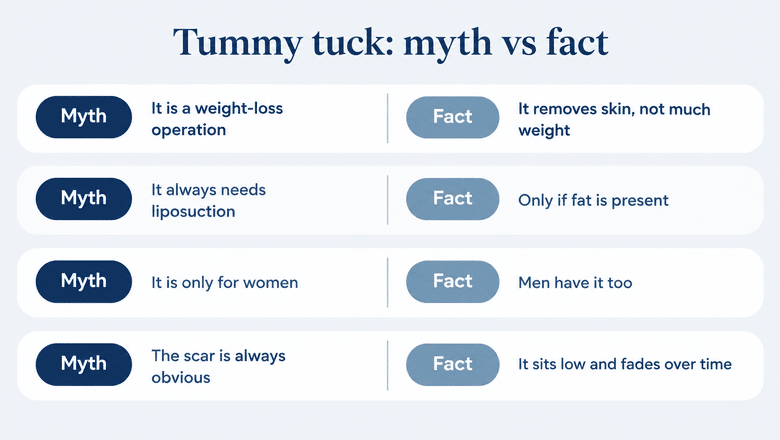
- It is not only for women. Men have abdominoplasty too, usually after major weight loss, and the technique is essentially the same.
- The scar is real but placed low. It sits around the bikini line, starts red and raised, and fades over 12 to 24 months. A 2026 meta-analysis found hypertrophic scarring in about 2.4% of patients.
- It is major surgery with real risks, including seroma, infection, bleeding and blood clots. Choosing a GMC-registered surgeon, stopping smoking and following aftercare all lower them.
- It is not always permanent. Removed skin and fat cells do not return, but large weight gain or another pregnancy can change the result.
A tummy tuck is one of the most researched and most misunderstood body contouring operations. Searches for tummy tuck myths and facts tend to circle the same handful of worries: whether it counts as a shortcut to weight loss, whether it must be combined with liposuction, whether it leaves an obvious scar and whether it is only for new mums. The honest answers are more specific than a simple yes or no, and they depend on what is actually changing your stomach shape.
This guide takes each common myth in turn and checks it against published research and what happens in clinic. If you are just starting to read about the operation, our overview of tummy tuck (abdominoplasty) and the key facts about tummy tucks explain the basics, and our guide to what a tummy tuck involves walks through the operation step by step. For the shape of the tummy after pregnancy specifically, see our mum tum guide and the separate myths article on the mummy makeover.
Is a Tummy Tuck a Weight Loss Operation?
No. This is the most persistent of all the tummy tuck myths. An abdominoplasty removes a panel of excess skin and fat from the lower abdomen and tightens the muscle wall underneath. The tissue removed does weigh something, so the scales may move by a little, but the operation is designed to change shape rather than weight. Surgeons usually ask for a stable weight before operating, because the plan is based on the skin and fat you have on the day.
That is also why the operation is not a substitute for losing weight first. If you still have a large amount of weight to lose, the skin that looks loose today may tighten as you slim, and any further weight loss after surgery can leave new looseness. Long-term studies of body contouring after major weight loss describe high and lasting satisfaction, but they are equally clear that managing expectations before surgery is essential[1]. Our guides on how much weight can be lost from a tummy tuck and the ideal weight for a tummy tuck go into the numbers and timing.
Can You Get the Same Result With Diet and Exercise?
Not always. Diet and exercise reduce fat, and that can flatten a stomach where fat is the main problem. They cannot remove stretched skin that has lost its elasticity, and they cannot close a gap between the two halves of the rectus abdominis, the paired muscles at the front of the abdomen. Both are common after pregnancy and after significant weight loss.
A simple way to tell what you are dealing with is to pinch the skin and look at the profile. A soft, thick pinch is mostly fat. A hanging fold or apron, or crepey skin that droops over the waistband, is mostly skin. A rounded bulge that pushes forward when you strain or sit up from lying down often points to separated muscles, known as diastasis recti. Fat sitting deeper around the organs, called visceral fat, cannot be removed by any cosmetic procedure and responds to weight loss. Our guide to how to get a flat stomach sets out what lifestyle change can realistically achieve, and our article on loose skin after pregnancy explains why skin sometimes does not recover.
Does a Tummy Tuck Always Need Liposuction?
No. Liposuction is added to a tummy tuck when there is fat that needs contouring, and left out when there is not. The two are often discussed together because they overlap, not because one demands the other. The question for your surgeon is whether the upper abdomen, flanks or lower back hold fat that would spoil the contour once the loose skin is removed.
When liposuction is combined with an abdominoplasty, the evidence on safety is reassuring. A 2026 randomised clinical trial in Plastic and Reconstructive Surgery ↗ compared limited undermining with liposuction, wide undermining without liposuction and a combination of the two. Complication rates did not differ significantly between the groups, and liposuction did more than undermining to reduce the thickness of the abdominal flap and improve the aesthetic result[2]. In other words, when fat is present, adding liposuction usually improves the outcome and it does not appear to add significant risk in suitable patients.
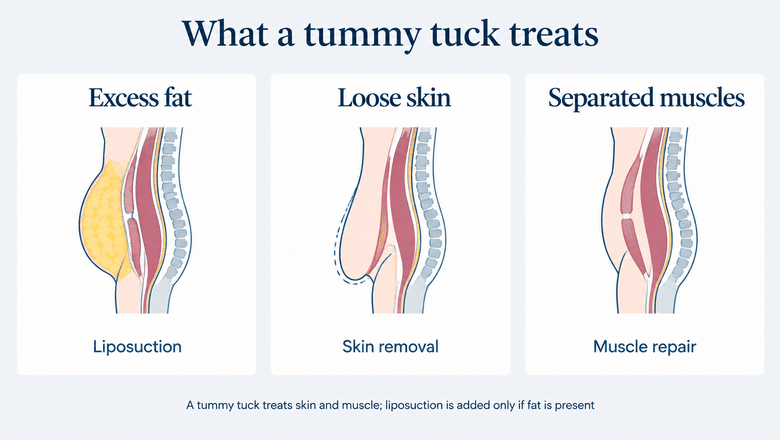
Which one you need depends on your tissue, not your goal. Mostly fat with good skin quality points to liposuction alone, while loose skin with or without a muscle gap points to a tummy tuck. Our comparison of liposuction vs tummy tuck and our guide to adding liposuction to a tummy tuck explain how surgeons decide, and abdominoplasty vs Brazilian tummy tuck covers the combined approach.
Is a Mini Tummy Tuck the Same as a Full Tummy Tuck?
Not at all, and this is another source of confusion. A mini tummy tuck deals with a small amount of loose skin below the belly button, uses a shorter scar and usually leaves the navel where it is. A full abdominoplasty treats skin above and below the navel, repairs the muscle wall along its full length and repositions the navel. If most of the looseness is in the upper abdomen or the muscles have separated widely, a mini tummy tuck will not reach it. Our guide to the difference between a full and mini tummy tuck compares the two, and surgeons also use the extended tummy tuck and the fleur de lis tummy tuck for people with more extensive excess skin.
Is a Tummy Tuck Only for Women? Can Men Have One?
Men can and do have tummy tucks. The myth that abdominoplasty is purely a post-pregnancy operation overlooks the many men and women who are left with an apron of skin after major weight loss. In men the loose skin often sits lower and the fat tends to be more internal, so the assessment pays particular attention to how much of the bulge is visceral fat that surgery cannot reach. The technique, the scar position and the recovery are otherwise very similar. Our page on male tummy tuck (abdominoplasty for men) explains who it suits.

Is a Tummy Tuck Just a Cosmetic Procedure?
It is usually done for appearance, but it is not purely cosmetic, and that is worth knowing when you weigh up the decision. In a cross-sectional study of 460 people after major weight loss, patients who had body contouring reported significantly better quality of life, body image and psychosocial wellbeing, and abdominoplasty was the procedure with the greatest effect on quality of life[3].
There are functional gains too. A 2025 systematic review in Aesthetic Plastic Surgery ↗ pooled 13 studies and 719 patients, almost all women who had also had their muscles repaired, and found that stress urinary incontinence improved in about 55% after abdominoplasty, stayed the same in about 35% and was worse in about 7%[4]. The evidence is not strong enough to promise this, and a tummy tuck is not a treatment for incontinence, but it does show that the abdominal wall matters for more than looks. Other practical reasons people choose surgery include skin rubbing and irritation under an overhanging fold, and a muscle gap that makes the abdomen feel unsupported. Our article on the medical benefits of a tummy tuck sets these out, and tummy tuck with muscle repair explains what the muscle repair involves. Hernias can be corrected at the same time, as described in combining tummy tuck and hernia repair.
Are Tummy Tuck Scars Always Obvious?
The scar is the one part of the myth that is true: every tummy tuck leaves a permanent scar. What is exaggerated is how visible it is. The incision runs low across the lower abdomen, usually hip to hip for a full abdominoplasty and shorter for a mini, and is designed to sit below the line of underwear and swimwear. A second scar usually surrounds the navel, which is often hard to see.
In the early weeks the scar is red, raised and firm, and that stage is the one that worries people most. It then softens and fades gradually, with most of the change in the first year and continued maturing for up to two years. In a 2026 systematic review and meta-analysis in Aesthetic Plastic Surgery ↗, about 98% of patients were pleased with their abdominoplasty, hypertrophic scars occurred in about 2.4% of 1,533 patients across ten studies and umbilical problems in about 1.6%[5]. Pooled satisfaction figures like these come from published series and are not a guarantee, but they do not support the idea that obvious, unsightly scarring is the usual outcome. Our guides to tummy tuck scars and the belly button after a tummy tuck describe the stages and how to look after the healing skin.
Is a Tummy Tuck Dangerous? Risks and Complications
A tummy tuck is major surgery, and describing it as routine or risk-free is a myth in the opposite direction. The main risks are bleeding, infection, poor wound healing, a collection of fluid under the skin called a seroma, blood clots in the legs or lungs, changes in skin sensation and, rarely, loss of skin at the edge of the wound. Seroma is the commonest. A 2026 meta-analysis in the Journal of Plastic, Reconstructive & Aesthetic Surgery ↗ describes seroma rates of around 11% in abdominoplasty and found that preserving a layer of tissue called Scarpa’s fascia was associated with fewer seromas, although most of the data were observational and larger randomised trials are still needed[6].
You influence your own risk more than many people expect. Stopping smoking and nicotine well before and after surgery, being at a stable weight, managing conditions such as diabetes and following aftercare instructions all matter. Equally, a muscle repair that is too tight, or lifting and straining too early, can cause pain or disrupt the repair, which is why our recovery advice is detailed. Our guides to the risks of abdominoplasty and whether a tummy tuck is safe, tummy tuck seroma and the signs of a bad tummy tuck explain what to look for, and our tummy tuck recovery guide covers the weeks afterwards, including the compression garment and activity limits. Your surgeon should explain these risks in plain language before you decide, and you should never feel rushed to sign anything.
Do You Need a Tummy Tuck After a C-Section?
Not automatically. Many women assume that a lower abdominal bulge above a caesarean scar is simply weight that has not shifted, and many are told it will settle. Sometimes it does. In others, a ledge of skin and fat overhangs the scar. This is sometimes called a C-section shelf, pouch or apron, and a 2026 review in the American Journal of Obstetrics and Gynecology describes it as a frequent deformity that affects women of every build and can occur even after an uncomplicated caesarean[7]. The same review notes that treatment ranges from liposuction and limited scar revision for mild cases to mini or full abdominoplasty with muscle plication for more advanced ones.
So the answer depends on what is there. A tummy tuck and a C-section are also entirely different operations: a caesarean opens the abdominal wall to deliver a baby, whereas a tummy tuck removes tissue and tightens the wall. Our article on tummy tuck after a C-section covers timing and combining the two, and the mummy makeover page explains how tummy surgery is combined with breast surgery for mothers who want both.
Can You Get Pregnant After a Tummy Tuck?
Yes, it is physically possible, but it is not advisable to plan another pregnancy after a tummy tuck, and most surgeons advise waiting until your family is complete. A pregnancy stretches the abdominal wall and skin again, which can undo the tightened muscle repair and the flattened contour, and a further caesarean may need to go through or around the scar. The operation does not make pregnancy unsafe in itself, and women have successfully had babies after abdominoplasty, but the result you paid for can change. If you are still thinking of having children, it is usually sensible to delay surgery. This is something to raise at your consultation, and our body contouring team can talk through timing.
Are Tummy Tuck Results Permanent? Do People Regret It?
The skin and fat cells removed during a tummy tuck do not grow back, and the muscle repair is intended to be long lasting, so the change is lasting in that sense. What can change is the tissue that remains. Significant weight gain, a further pregnancy and ageing all alter the abdomen over time. In a retrospective study of 41 patients who had abdominoplasty after losing an average of 40 kg, 14 had regained more than 10 kg at follow-up, yet 77% were satisfied with the surgery and 96% said they would have it again[8]. A separate multicentre study found that one body contouring operation improved how patients felt about untreated areas of their body at one year as well[9].
Regret does happen, and it is most often tied to unrealistic expectations, an unexpected scar, a long recovery or a result that did not match the photos the patient had in mind. Our guide to tummy tuck regrets and how to avoid them covers the common reasons. The strongest protection is a thorough consultation, honest before-and-after photographs of patients with a similar starting point and enough time to decide.
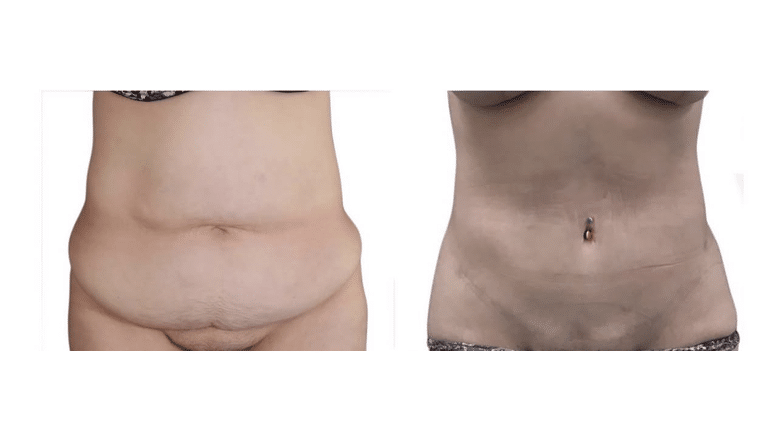
You can browse more in our tummy tuck before and after photos.
Is a Tummy Tuck Available on the NHS or Through Insurance?
NHS funding for a tummy tuck is limited to specific circumstances, usually after major weight loss with significant functional problems, and it varies by area. Cosmetic abdominoplasty is not routinely funded. Private health insurance generally does not cover it either unless there is a clear medical indication. Our guides explain whether you can get a tummy tuck on the NHS and whether private health insurance can cover a tummy tuck. Costs depend on the type of tummy tuck and any added procedures and are confirmed at consultation, and our tummy tuck cost guide explains what a quote includes. Finance options are available.
Who Is a Good Candidate for a Tummy Tuck?
A good candidate is usually an adult in good general health, at a stable weight, with loose skin or a muscle gap that exercise has not fixed, who does not smoke and who has realistic expectations. People who plan to lose a large amount of weight, who are planning pregnancies or who hope the operation will solve a problem unrelated to their abdomen are generally advised to wait. Age alone is not a barrier, but general health, medical history and body mass index are all assessed. If you are unsure whether a tummy tuck or a lighter option suits you, our article on non-surgical tummy tuck options explains what non-surgical treatments can and cannot do, and our hourglass tummy tuck page describes a technique that shapes the waist as well.
What Happens at a Tummy Tuck Consultation in London?
At Centre for Surgery, your consultation is with a GMC-registered plastic surgeon at our CQC-regulated hospital on Baker Street, and the surgeon who assesses you is the surgeon who operates. They will examine your abdomen, ask about pregnancies, weight history and health, check for muscle separation or hernias, explain which type of tummy tuck suits you and talk through the risks and the recovery. Anaesthesia is discussed too, and our guide to anaesthesia for cosmetic surgery explains the options. If you are choosing a surgeon, our guide to how to choose a tummy tuck surgeon in London lists what to ask. Many people find it helpful to bring a list of questions and, if possible, a photo of their stomach before and after pregnancy or weight change.
Frequently Asked Questions
Do tummy tucks get rid of stretch marks?
Partly. Stretch marks on the skin that is removed, usually the lower abdomen below the navel, are removed with it. Marks above the navel stay, although they may be pulled lower and tightened. A tummy tuck is not a treatment for stretch marks, and any left behind will remain.
Does a tummy tuck help with pelvic floor problems?
It is not a treatment for pelvic floor weakness, and you should not have surgery for that reason alone. A 2025 review found that stress urinary incontinence improved in about half of women after abdominoplasty with muscle repair, stayed the same in about a third and was worse in a small number[4]. Pelvic floor physiotherapy is the usual first step.
Is a tummy tuck like a C-section?
No. Both leave a low scar, but a caesarean opens the abdominal wall to deliver a baby, while a tummy tuck removes skin and fat and tightens the muscle wall. Recovery has some similarities, including soreness and limits on lifting, although a tummy tuck usually involves a longer period of restricted activity.
Do people regret having a tummy tuck?
Most published studies report high satisfaction, but some people do regret it, usually because of unrealistic expectations, scarring or a difficult recovery[5]. Understanding the scar, the recovery and what the operation cannot do before you commit is the most reliable way to avoid it.
What are the worst days after a tummy tuck?
The first few days are usually the hardest, with tightness, discomfort, swelling and difficulty standing fully upright. Many people feel they turn a corner within the first week or two, although swelling and tiredness can last weeks. Your surgeon will give you pain relief, a compression garment and clear instructions.
What is the ideal weight for a tummy tuck?
There is no single number. Surgeons look for a stable weight that you have held for several months, ideally close to the weight you want to maintain, and they assess body mass index as part of safety. Our guide to the ideal weight for a tummy tuck explains this in more detail.
Is a mini tummy tuck dangerous?
It is a smaller operation than a full tummy tuck, with a shorter scar and often a quicker recovery, but it is still surgery and carries risks such as infection, bleeding and seroma. It is only suitable if the excess skin is confined to the area below the navel.
Can you tell if someone has had a tummy tuck?
Usually only if you know where to look. The scar sits low and fades, and the navel is repositioned to look natural. A well-planned result gives a flatter, smoother contour that looks like your own body at a different point in time rather than an obvious operation.
Tummy Tuck in London
If you would like to talk through which of these myths applies to you, a consultation will establish what is causing your stomach shape and what would change it. Find out more about tummy tuck surgery at Centre for Surgery and our excess skin removal surgery.
Phone: 020 7993 4849 | Address: 95–97 Baker Street, Marylebone, London W1U 6RN
Contact us to schedule a consultation
References
- Tremp M, Delko T, Kraljević M, Zingg U, Rieger UM, Haug M, et al. Outcome in body-contouring surgery after massive weight loss: a prospective matched single-blind study. Journal of Plastic, Reconstructive & Aesthetic Surgery 2015;68(10):1410–1416. doi:10.1016/j.bjps.2015.05.035 ↗
- El Minawi HM, Kadry HM, Rizkalla YR, Edalatpour A, Via EC, Wirth P, et al. Redefining limits: a clinical trial on the safety of combining liposuction with undermining during abdominoplasty. Plastic and Reconstructive Surgery 2026. doi:10.1097/PRS.0000000000013489 ↗
- Aitzetmüller MM, Raschke L, Klietz ML, Kueckelhaus M, Hirsch T, Wiebringhaus P, et al. After weight loss, what skin removal procedure has the most effect using Body Q metrics? Surgery for Obesity and Related Diseases 2022;18(8):1049–1056. doi:10.1016/j.soard.2022.04.019 ↗
- Karunaratne YG, Kim J, Fayers W, Meares T, Romeo PB, Phoon A. Can abdominoplasty relieve symptoms of urinary incontinence? Aesthetic Plastic Surgery 2025;49(23):6632–6639. doi:10.1007/s00266-025-05178-z ↗
- Ibrahim AS, Zayid TEB, Nasef MA. Stigmata of abdominoplasty: a systematic review and meta-analysis. Aesthetic Plastic Surgery 2026;50(17):7239–7247. doi:10.1007/s00266-026-05962-5 ↗
- Magalhães CAB, Machado GF, Albuquerque KM, Iqbal A, Duraes EFR. Impact of Scarpa’s fascia preservation in abdominoplasty: a systematic review and meta-analysis. Journal of Plastic, Reconstructive & Aesthetic Surgery 2026;118:195–208. doi:10.1016/j.bjps.2026.05.029 ↗
- Pelosi MA, Romero R. The cesarean apron: description, proposed pathophysiology, classification, and prevention through Scarpa fascia closure at cesarean delivery. American Journal of Obstetrics and Gynecology 2026;233(6S):S118–S128. doi:10.1016/j.ajog.2025.09.040 ↗
- Lazar CC, Clerc I, Deneuve S, Auquit-Auckbur I, Milliez PY. Abdominoplasty after major weight loss: improvement of quality of life and psychological status. Obesity Surgery 2009;19(8):1170–1175. doi:10.1007/s11695-009-9883-x ↗
- Opyrchal J, van Beek A, Hoogbergen M, van den Berg L, Verkaar J, Paul M. Change in perception of non-operated body areas after abdominoplasty in massive weight loss patients: a prospective multicenter study. Journal of Plastic, Reconstructive & Aesthetic Surgery 2025;106:108–113. doi:10.1016/j.bjps.2025.05.005 ↗







