


Real thigh lift results from patients treated at our Baker Street day surgery facility. Jump to Inner Thigh Lift, Thigh Lift with Liposuction or Thigh Lift After Weight Loss.
Results vary from patient to patient. All photos are published with written patient consent and are examples of outcomes achieved at Centre for Surgery, not guaranteed results. After photos were taken at least six months after surgery unless the caption says otherwise. No photograph has been retouched or filtered; some are cropped or masked only to protect patient privacy. Full disclaimer below, and how to read these photos — including why the scar decides everything and why a thigh gap is not something surgery creates.
Inner Thigh Lift — Before & After
4 photographs
A thigh lift removes loose skin from the inner thigh and tightens what remains. Like every lift, it is an operation about skin rather than fat: where skin has lost its elasticity, nothing tightens it except removing some of it. Where the excess is confined to the upper inner thigh, the skin is removed through an incision sited in the groin crease. Where it extends down the leg, a longer scar is needed — which is the subject of the weight loss section below, and of the honest discussion further down this page.


Thigh Lift with Liposuction — Before & After
1 photograph
Where a thigh carries excess fat as well as lax skin, thigh liposuction is performed alongside the skin excision. The distinction matters more here than almost anywhere on the body. Liposuction removes fat and leaves the skin envelope behind; in a thigh whose skin no longer recoils, that produces a looser thigh, not a tighter one. Fat is why a thigh is full. Skin is why it hangs. Only one of them responds to liposuction — the same principle that governs our liposuction results.
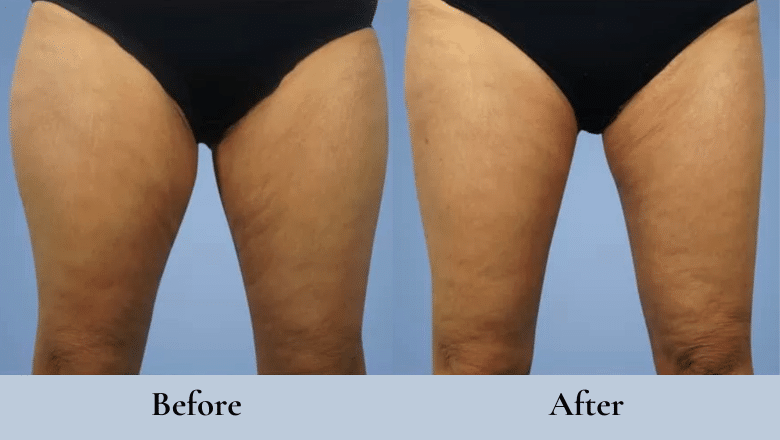
Thigh Lift After Weight Loss — Before & After
2 photographs
After substantial or bariatric weight loss the inner thigh carries skin that has been stretched beyond its capacity to retract, often from groin to knee. A crease incision cannot reach that far. The skin is removed instead through a vertical incision running down the inner thigh, which takes out considerably more skin and leaves a considerably longer scar. That is the trade, and it should be made deliberately.


About These Thigh Lift Photos
The thigh lift photos above are presented for educational purposes only and should be interpreted subjectively. They do not represent the opinion or view of any patient regarding their result, and they are not intended to suggest the result that any other patient may achieve. No two patients are alike, and no two results are necessarily alike. Only a personal consultation with your surgeon can provide you with a reasonable expectation of the results you may achieve from any specific procedure. We only publish photographs of patients who have given full written consent for their images to be used.
The photographs above are a small selection. You will see a considerably wider range at your face-to-face consultation, including cases whose starting point resembles yours.
How to Read Thigh Lift Before and After Photos
Of all the operations in this gallery collection, the thigh lift is the one where the photograph tells you least and the scar tells you most.
There are two scars, and they are not interchangeable
A crease incision sits in the fold of the groin. It is well hidden, it is short, and it can only remove skin from the very top of the thigh. A vertical incision runs down the inner thigh, sometimes as far as the knee. It removes far more skin and it is visible whenever the legs are apart — in swimwear, on a beach, sitting down. Which one you need is determined by how far down your leg the loose skin extends, not by which scar you would prefer. A surgeon who offers you the crease incision for laxity that reaches your knee is offering you a scar you will like and a result you will not.
Inner thigh skin heals badly, and it is honest to say so
The inner thigh is thin-skinned, mobile, warm and moist, and it is pulled by every step you take. Wounds there are slower to heal than wounds almost anywhere else on the body, and scars there are more prone to widening. A crease scar can also settle downwards over time rather than staying in the fold. None of this is a reason not to have the operation. It is a reason to know it before, rather than after.
A thigh gap is anatomy, not surgery
The space between the thighs is determined by the width of your pelvis and the angle of your femurs. Surgery removes skin and fat from the inner thigh; it does not move your hip joints. Some patients gain a small gap because the tissue that filled it is gone. Many do not, however much is removed, because their skeleton does not permit one. If a photograph on any clinic’s website is being read as a promise of a gap, it is being read wrongly. Our own discussion of this is in thigh gap surgery: liposuction versus thigh lift.
Radiofrequency tightens skin. It does not remove it
A mini thigh lift combined with BodyTite uses radiofrequency energy to contract the skin as the fat is removed, through much smaller incisions. Where laxity is genuinely moderate and skin quality is good, that can be enough. Where the skin is thin and stretched, energy will not substitute for excision, and a smaller scar buys a smaller result.
Stance, light and the photograph itself
A thigh photographed with the feet together looks different from the same thigh with the feet a hand’s width apart. Weight shifted onto one leg tightens that thigh and slackens the other. In a trustworthy pair, the feet are in the same place in both frames.
What Stage of Healing You’re Looking At
Thigh lift surgery is performed as a day case, and the leg in an after photograph is at a point on a slow curve.
The thighs are swollen and bruised for the first weeks, and compression garments are worn to control swelling and to help the skin settle. Fluid can collect beneath the skin and may need draining. Walking is restricted at first — not because it hurts, but because the incision sits where the leg bends. Swelling settles substantially over the first three months, and the contour continues to refine for six to twelve.
The scar is the slow part, and on the inner thigh it is slower than most. It is raised, firm and red or pink for several months, then softens and pales towards white over roughly twelve to eighteen months. Inner thigh scars are more likely than scars elsewhere to widen as they mature, because the skin is under tension every time you take a step. Its final appearance depends on your skin and on how the wound was closed, and it is not known until a year or more has passed.
A photograph at three months shows a settled thigh and an unfinished scar. Where a thigh lift gallery does not tell you which it is showing, assume the flattering one.
The after photographs in this gallery were taken at least six months after surgery, unless the caption says otherwise. For what to expect at each stage before then, see our thigh lift recovery guide.
What These Photographs Cannot Show You
There is a limit to what any gallery can tell you, and a clinic that pretends otherwise is selling rather than informing.
- The scar as it actually looks. Its length, its position, how far down the leg it runs, and how it matured. This is the whole trade, and no thigh lift gallery anywhere shows it properly — including this one.
- Which incision was used. A crease scar and a vertical scar produce different results, address different degrees of laxity, and are visible in different circumstances.
- Whether the scar stayed where it was put. Crease scars can descend over time.
- Whether the wound healed cleanly. Delayed healing and wound separation are more common at the inner thigh and groin than almost anywhere else operated on.
- Seroma. Fluid collecting beneath the skin is common after thigh surgery and may need drainage.
- Swelling of the lower leg and ankle in the early weeks, which is usual and settles, and lymphatic disturbance, which occasionally does not.
- Numbness. Altered sensation across the inner thigh is common and can persist.
- Whether liposuction was performed alongside, which changes the contour and changes nothing about the skin.
- What happened when the patient’s weight changed afterwards. Skin removed does not return; skin that stretches again can.
- Whether the scar was revised. Revisions are rarely photographed and never published.
None of this is a reason to distrust before and after photographs. It is a reason to treat them as the beginning of a conversation with a surgeon rather than the end of one.
Thigh Lift Results: Common Questions
How is a thigh lift performed?
Excess skin and fat are removed from the inner thigh. Where the looseness is confined to the upper thigh, the scar sits in the groin crease. Where it extends further down, a vertical scar runs along the inner thigh towards the knee. Liposuction is often combined to reduce fat and refine the shape.
Do thigh lifts leave scars?
Yes. The groin scar is usually hidden by underwear, but a vertical inner thigh scar shows in shorts or swimwear. Thigh lift scars can widen, because the area moves and is under tension, and they take 12 to 18 months to mature.
Is there an alternative to a thigh lift?
If the problem is mainly fat and the skin is firm, thigh liposuction may be enough. For mild looseness, liposuction combined with skin tightening such as BodyTite or Argo Plasma can help. Where there is significant loose skin, particularly after major weight loss, only a thigh lift removes it.
Thigh Lift Surgery at Centre for Surgery
Centre for Surgery is a private hospital for plastic and cosmetic surgery on Baker Street in Marylebone, London, registered with and independently inspected by the Care Quality Commission. Our plastic surgeons perform thigh lift surgery at our Baker Street day surgery facility, for loose thigh skin following weight loss, bariatric surgery, or the natural effects of ageing.
Crease and Vertical Scar Techniques
Where skin excess is confined to the upper inner thigh, a horizontal incision within the groin crease removes it and leaves a well-concealed scar. Where laxity extends down the leg — most often after substantial weight loss — a vertical incision along the inner thigh is required to remove the skin that is actually there. Loose skin is not tightened by any means other than removing it, and the amount removed determines the length of the scar. Your surgeon will show you where the scar will run before you decide.
Liposuction and BodyTite
Thigh liposuction is commonly performed alongside a thigh lift where fat as well as skin contributes to the shape. This is worth knowing when reading the photographs above: where your surgeon recommends it, liposuction of the inner thighs is performed at the same session, using either power-assisted liposuction or VASER lipo depending on tissue quality. Where it was used, the results shown reflect fat removal and skin excision together, not excision alone. For patients with moderate laxity and good skin quality who wish to avoid a longer incision, a mini thigh lift combined with BodyTite radiofrequency uses energy to contract the skin through smaller incisions. It tightens skin; it does not excise it, and where a large volume of skin needs to come out it is not an equivalent. Your surgeon will tell you which applies to your thigh, including when the answer is that a smaller operation will not achieve what you want.
Day-Case Surgery and Aftercare
Thigh lift surgery is performed as a day case at our Baker Street facility. You have your surgeon’s direct number for the first 24 hours after surgery, and your surgeon will review your progress at follow-up appointments throughout your recovery, including scar management over the first year. Every plastic surgeon on our team is GMC-registered and independently verifiable on the General Medical Council register.
Verified Patient Reviews
We invite you to read what our thigh lift patients say on independent, verified review platforms. Every review is publicly verifiable, dated, and linked to a real named patient.
- Google Reviews: Read our Google reviews ↗ — rated 4.6 stars based on hundreds of verified patient reviews.
- Patient reviews page: Read patient reviews by procedure — Google and Trustpilot reviews brought together on our own site.
As a CQC-regulated provider, every surgeon on our team is GMC-registered and independently verifiable. View our CQC rating.
Related Reading
- Thigh Gap Surgery: Liposuction vs Thigh Lift
- Thigh Liposuction
- How Much Does a Thigh Lift Cost?
- Which Areas Of The Body Are Most Affected By Excess Skin After Weight Loss?
- Can I Get Skin Removal Surgery On The NHS After Weight Loss?
Explore More Before and After Galleries
View our full collection of plastic surgery before and after photos, or browse related body contouring galleries: Arm Lift Before and After Photos | Liposuction Before and After Photos | Tummy Tuck Before and After Photos
Subject to status, we offer finance options with Chrysalis Finance. For a full price breakdown, see our thigh lift cost guide. Learn more on our About Us page, browse our Plastic Surgery Blog, or find answers in our Clinic FAQs.
To book a face-to-face consultation with a thigh lift surgeon, call us on 020 7993 4849 or complete the contact form below.