


In this guide18 sections
- Key Points
- What Is a Nose Thread Lift?
- How Does a Nose Thread Lift Work?
- How Long Does a Nose Thread Lift Last?
- Is a Nose Thread Lift Safe? Risks and Side Effects
- Why Do Plastic Surgeons Hate Thread Lifts?
- Nose Thread Lift vs Nose Filler: What Is the Difference?
- Do You Offer a Nose Thread Lift in London?
- What Is a Tinkerbell Nose Lift?
- Nose Tip Lift Surgery: Tip Rhinoplasty Options
- Nose Thread Lift vs Rhinoplasty: Which Is Better?
- What Can a Nose Lift Not Change?
- Nose Lift Recovery: What to Expect
- Tip Rhinoplasty Before and After
- What Happens at a Nose Lift Consultation?
- Frequently Asked Questions
- Nose Tip Lift and Rhinoplasty in London
- References
Key Points
- What is a nose thread lift? A non-surgical treatment in which fine dissolvable threads, usually PDO (polydioxanone), are placed under the skin of the nose to lift the tip or add a little height to the bridge. It is sometimes called a lunchtime nose job.
- Centre for Surgery does not offer nose thread lifts. This guide explains them honestly as a treatment other providers sell, compares them with non-surgical rhinoplasty with filler, and sets out the surgical options we offer.
- How long does a nose thread lift last? The threads are absorbed by the body, so the effect is temporary. The published nasal studies follow patients for only around six months, and good long-term data are missing.[1][2]
- Nose thread lift risks include swelling, bruising, dimpling, visible or palpable threads, infection and, rarely, thread extrusion. Most of the safety data come from facial rather than nasal thread lifts.[3][4]
- The Tinkerbell nose lift is different. Also called a one stitch nose lift or suspension rhinoplasty, it is a minor surgical procedure under local anaesthetic that lifts a droopy nose tip with a suspension stitch.
- For a lasting change to the tip, tip rhinoplasty reshapes the cartilage itself, and full rhinoplasty is the answer when the bridge, hump or breathing also need attention.
A nose thread lift is one of the most searched-for ways to lift a drooping nose tip without an operation, and it is easy to see the appeal: no incision, under an hour in the chair and no obvious downtime. This guide explains how a nose thread lift works, what the evidence shows, the risks, and how it compares with a Tinkerbell nose lift and with tip rhinoplasty. To be clear from the start, Centre for Surgery does not offer nose thread lifts. We describe them here because patients ask about them every week, and because the honest answer is more useful than a sales page.
If what bothers you is a nose tip that points downwards, drops when you smile or looks long, our guides to what causes a droopy nose and nose tip surgery explain the anatomy. If you are comparing the whole field, the different types of rhinoplasty sets out which operation suits which concern, and our overview of rhinoplasty (nose job) covers the full operation.
What Is a Nose Thread Lift?
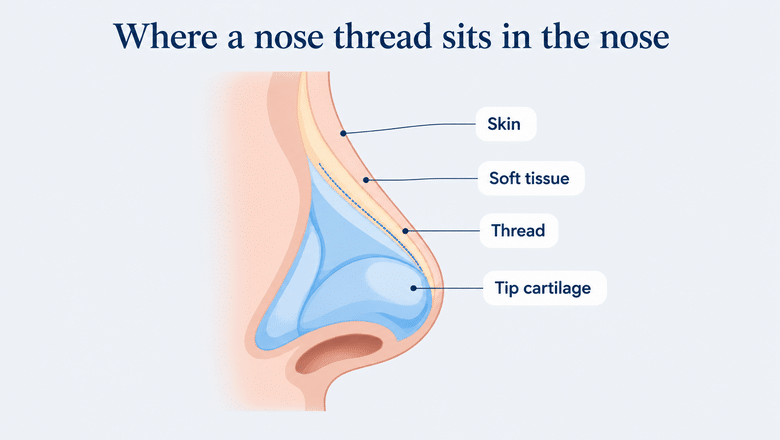
A nose thread lift, also searched for as a thread lift nose job, nasal thread lift, nose threads or the lunchtime nose job, is a non-surgical cosmetic treatment. A practitioner passes one or more fine threads through a needle or cannula into the tissue under the skin of the nose. The thread is anchored at the bridge, tip or both, and tension on it raises the tip or projects it slightly forward. Some practitioners also place threads along the bridge to add a little height.
The threads used are usually polydioxanone (PDO), the same absorbable material used in some surgical stitches. Over several months the body breaks the thread down. Marketing often adds that the thread stimulates collagen, but the lift you see on day one is mechanical, and it fades as the thread is absorbed.
A published study from Korea, a 2020 retrospective study in Dermatologic Surgery ↗, looked at 31 patients given PDO threads together with filler in one session. At six months, 93.5% rated the result satisfactory, and the nasolabial angle (the angle between the nose and upper lip) had increased by an average of 6.3 degrees. Complications were low and minor. The study was small, retrospective, combined threads with fillers, and stopped at six months, so it cannot tell you how a thread-only lift behaves after a year.[1]
What is a HIKO nose lift?
HIKO is a trade name for a thread-based nose lift. Like any nose thread, it is placed under the skin to raise the tip or bridge, and a brand name does not change the limits of the technique: a small lift and a temporary result. It should not be confused with the surgical Tinkerbell nose lift, covered below.
How Does a Nose Thread Lift Work?
The nose is a demanding place for threads. The skin over the tip is often thicker and more oily than skin elsewhere on the face, and beneath it lies a firm cartilage framework rather than soft, mobile tissue. Threads were first developed for sagging cheeks and jowls, where there is loose tissue to lift. In the nose, a thread has far less to grip.
In a typical session, the practitioner numbs the area, passes the threads through tiny entry points and trims them. A small amount of tip rotation or bridge height is the realistic aim. Many clinics combine threads with dermal filler to improve the result, as in the Korean study above.[1]
How Long Does a Nose Thread Lift Last?
A nose thread lift is temporary, since PDO threads dissolve. Clinics quote a range of durations, but there is no robust long-term research on nasal threads specifically. The one nasal study above followed patients for six months, and a 2025 systematic review of absorbable facial thread lifts concluded that the lift is immediately effective but that long-term efficacy data are lacking.[1][2] A meta-analysis of facial thread lifts also found that long-term satisfaction was lower than satisfaction straight after treatment (88% against 98%).[3]
In practice that means a nose thread lift is something you would repeat, rather than a one-off change. If you want a result that lasts, it is a different decision from choosing a temporary treatment, and our guide on whether a nose job is permanent explains what lasting means after surgery.
Is a Nose Thread Lift Safe? Risks and Side Effects
Serious complications are uncommon, but the nose is a high-stakes area, and it helps to know the full list of what can go wrong. Nearly all of the published safety data come from facial threads, so they are a guide rather than a direct measure of nose threads.
A meta-analysis of 26 studies of facial thread lifting, the 2021 meta-analysis in Aesthetic Plastic Surgery ↗, found pooled rates of swelling of 35%, skin dimpling 10%, altered sensation 6%, visible or palpable threads 4%, infection 2% and thread extrusion 2%. Absorbable threads carried a lower risk of altered sensation and extrusion than non-absorbable ones.[3] A 2025 systematic review of 19 studies and 1,406 patients found that bruising (19.5%), swelling (16.8%) and tenderness (10%) were the commonest problems, and infection (2.5%) and haematoma (0.6%) were uncommon.[4]
Threads in the nose can also cause:
- Visible or palpable threads. Nasal skin is thin over the bridge and tip, so a thread can show or be felt.
- Asymmetry. Uneven pull on the tip can leave one side higher than the other.
- Infection or a reaction to the thread. A thread is a foreign body, and an infected thread may need to be removed.
- Disappointing change. The lift available is small, and some patients see little difference once the swelling settles.
What are the downsides of a PDO thread lift?
The main downsides are the temporary result, the modest degree of change, the lack of long-term evidence in the nose and the variation in practitioner technique. A thread lift also cannot treat a hump, a wide bridge, a bulbous tip or a deviated septum. Those are structural problems that need structural treatment.
Nose thread lift gone wrong: what to do
If a thread is visible, a nostril or the tip looks uneven, or the skin becomes red, hot, painful or breaks down, contact the practitioner who placed it straight away. If you cannot reach them, seek urgent medical advice. Persistent changes can sometimes be improved by removing the thread. If you are unhappy with the shape of the nose more generally, our guide to what counts as a nose job gone wrong explains what can be improved and when.
How painful is a nose thread lift?
Most patients describe a pinching or pulling sensation during treatment, which is eased with local anaesthetic or numbing cream, followed by tenderness and swelling for a few days. Pain varies from person to person and with the technique used.
Why Do Plastic Surgeons Hate Thread Lifts?
Surgeons are not opposed to thread lifts in principle, and some use them in the face. The concerns about nose threads are specific:
- The nose has a firm cartilage framework and a tight skin envelope, so the lift available is limited.
- The thread is temporary, and repeating it adds repeated small risks.
- Threads are sold as a nose job alternative, yet they cannot reshape cartilage, correct a deviated septum or remove a hump. Patients can be left expecting a change the treatment cannot give.
The fairest summary is that a nose thread lift can suit a small number of people who want a modest, temporary change and understand its limits. It is not a substitute for surgery.
Nose Thread Lift vs Nose Filler: What Is the Difference?
A thread lift raises the tip by pulling tissue; filler adds volume. Non-surgical rhinoplasty with hyaluronic acid filler is the more widely offered option, and it is one we do provide. It can camouflage a small bump, smooth a dip or give the tip a little lift by adding volume, but it cannot make the nose smaller, and a nose that is already large can look larger.
Filler also has a risk that deserves plain language. The blood vessels of the nose connect with those that supply the eye, and a 2026 review in the Journal of Craniofacial Surgery ↗ concluded that the nose remains among the highest-risk sites for filler-related blindness and embolic events, and that vessel anatomy varies so much between people that “safe plane” rules cannot be relied on.[5] A 2026 anatomical study using ultrasound and cadaver dissection reached a similar conclusion about the highly variable and asymmetric arteries of the nose.[6] Severe complications are uncommon, but anyone considering nose filler, wherever they have it, should ask who is injecting and how they would recognise and treat a blocked vessel. Our page on dermal fillers covers how we approach injectables more generally.
If you are weighing surgical against non-surgical routes, our comparison of non-surgical vs surgical rhinoplasty may help.
Do You Offer a Nose Thread Lift in London?
No. We do not offer nose thread lifts, in London or elsewhere. That is a deliberate clinical decision. The nose is a poor site for threads, the result is temporary and the long-term evidence is thin. We prefer to offer options whose results we can explain, measure and stand behind.
What we do offer are surgical options for a drooping or under-rotated nose tip, performed at our CQC-regulated hospital at 95–97 Baker Street by GMC-registered surgeons. The surgeon who assesses you is the surgeon who operates. Take a look at our Baker Street hospital if you would like to see where.
What Is a Tinkerbell Nose Lift?
The Tinkerbell nose lift, also called a one stitch nose lift, tip stitch or suspension rhinoplasty, is a minor surgical procedure. Instead of reshaping the tip cartilage, the surgeon lifts the tip and holds it in a higher position with a suspension stitch. Searches for a Tinkerbell nose, pixie nose lift or nose tip lift usually describe this idea of a gently upturned, lifted tip.
At Centre for Surgery it is done under local anaesthetic in about 45 to 60 minutes. There is no bone work and no splint, and most patients return to desk-based work within one to two days. Results typically last two to three years. It lifts the position of the tip only. It cannot narrow a bulbous tip, correct asymmetry or change the bridge. Your surgeon assesses whether it is suitable at consultation, as part of tip rhinoplasty.
The principle has support in the surgical literature. A 2021 study in the American Journal of Otolaryngology ↗ reported that a percutaneous suspension-suture technique under local anaesthetic improved a droopy tip, with better nasal obstruction scores that persisted at follow-up in patients with excess skin volume.[7] Separately, surgeons describe internal suspension sutures as a way to improve the lasting stability of tip rotation after rhinoplasty.[8]
Who is suitable for a one stitch nose lift?
It suits someone whose main concern is a tip that droops or looks slightly long, whose bridge and nostrils are fine, and who wants something shorter than a full operation. It is a poor fit if the tip is bulbous, the nostrils flare, the bridge has a hump or breathing is poor. In those cases, tip rhinoplasty or a fuller operation does the job properly. You need to be 18 or over, in good general health and a non-smoker, or willing to stop before and after surgery.
Nose Tip Lift Surgery: Tip Rhinoplasty Options
When the tip needs more than repositioning, tip rhinoplasty (sometimes called tip plasty or a mini nose job) reshapes the lower cartilages of the nose. It can lift a droopy tip, refine a bulbous one, narrow a wide one and correct asymmetry, leaving the bridge and nasal bones untouched. The operation takes around one to two hours, under TIVA or local anaesthetic with sedation, and you go home the same day.
Lifting the tip is planned in millimetres. Lifting too far gives an upturned, operated look; our guide to the retroussé or upturned nose explains where that line sits. A drooping tip often interacts with the lip, which is why a tip lift can change your smile. Read does a nose job change your smile for the detail.
Other options may sit alongside it:
- Alar base reduction (alarplasty) narrows wide or flared nostrils and is often combined with tip work.
- Rhinoplasty addresses the bridge, hump and overall proportions when the whole nose, not just the tip, is the concern.
- Septorhinoplasty combines cosmetic reshaping with correction of a deviated septum when breathing is also a problem.
- Revision rhinoplasty is for people who have already had nose surgery and want a change.
Nose Thread Lift vs Rhinoplasty: Which Is Better?
They answer different questions. A nose thread lift is a temporary, low-commitment way to try for a small lift. Surgery is a permanent change that can address a much wider range of concerns, with a recovery to match. The list below is not a ranking; it shows which option fits which concern.
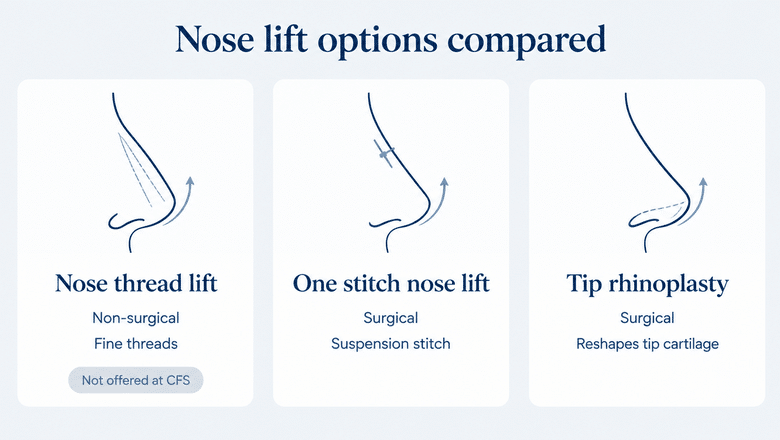
- Droopy tip only, modest lift wanted: a one stitch nose lift or tip rhinoplasty.
- Bulbous, wide or asymmetric tip: tip rhinoplasty. Threads cannot narrow cartilage.
- Hump, wide or crooked bridge: rhinoplasty. Nothing non-surgical removes a hump.
- Blocked breathing: septorhinoplasty. Our guides to the bulbous nose and the hooked nose show where tip concerns overlap with overall shape.
- Thick skin: results are more gradual and more subtle with any operation. Read about rhinoplasty with thick skin.
What Can a Nose Lift Not Change?
Neither threads nor a suspension stitch can reduce the overall size of the nose, narrow a bridge, remove a dorsal hump, correct a deviated septum or improve breathing. Be wary of any provider who suggests otherwise. If shrinking the nose is the goal, see how to make your nose smaller and what works.
Nose Lift Recovery: What to Expect
Recovery depends on the operation. After a one stitch nose lift, swelling and tenderness settle over days to a couple of weeks, and most people return to desk work within one to two days. After tip rhinoplasty, most people are back at desk work after five to seven days, once the splint comes off at about a week. Avoid blowing your nose for two weeks, keep glasses off the nose for around four weeks, and return to full exercise from about six weeks. The tip holds swelling longest, so refinement continues for up to 12 months. Our guides to rhinoplasty recovery and rhinoplasty swelling go week by week, and is rhinoplasty painful answers the pain question directly.
Tip Rhinoplasty Before and After
Photographs help, but they are no guarantee of your own result. A before and after can show what changes in a tip and what does not.
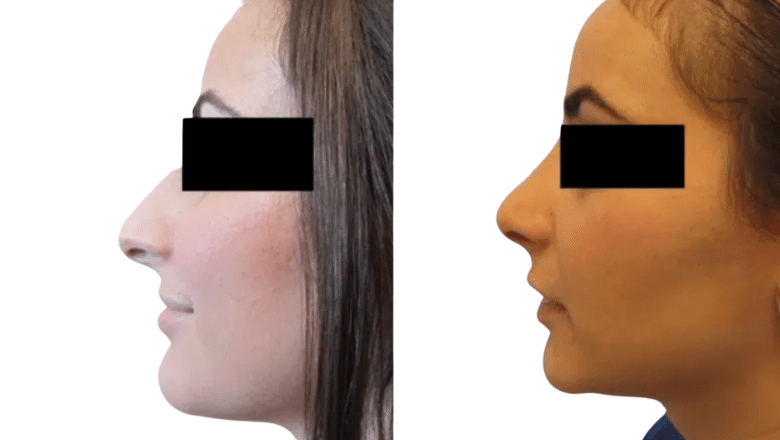
See more cases in our rhinoplasty before and after photos.
What Happens at a Nose Lift Consultation?
A consultation at Centre for Surgery is one-to-one with the surgeon who would operate on you. They examine the tip, the bridge, the skin thickness and the airway, and listen to what you want to change. If a suspension stitch will do, we say so. If tip rhinoplasty or a fuller operation is the honest answer, we say that too. If surgery is not right for you, we tell you. The shape of your nose and skin determines the plan, not a price list.
Costs are confirmed at consultation once the operation is agreed, and finance options are available, subject to status. A two-week cooling-off period applies after you consent. Our guide to choosing a nose job surgeon in London sets out what to check, and the rhinoplasty risks page lists what is expected, uncommon and rare.
Frequently Asked Questions
How long does a nose thread lift last?
The effect is temporary, since the threads dissolve. Nasal studies follow patients for only around six months, and there is no good long-term data for nose threads. Many practitioners advise repeat treatment.
Is a nose thread lift permanent?
No. PDO threads are absorbed by the body, so the lift fades. A Tinkerbell nose lift lasts longer, typically two to three years, and tip rhinoplasty is permanent.
How safe is a nose thread lift?
Most people have swelling and bruising that settles. Less commonly, threads can be visible, cause dimpling or become infected. Safety data come mainly from facial thread lifts, so the figures are only a guide for the nose. Choose a practitioner who can explain how they would manage a complication.
What is the difference between nose filler and nose thread?
Filler adds volume under the skin; threads pull tissue to raise the tip. Both are temporary and neither can narrow the nose. Filler in the nose carries a recognised risk of blocked blood vessels, so the injector’s training matters. We offer non-surgical rhinoplasty with filler, but not nose threads.
Is a Tinkerbell nose the same as a nose thread lift?
No. A Tinkerbell nose lift, or one stitch nose lift, is a minor surgical procedure that uses a suspension stitch under local anaesthetic. A nose thread lift is a non-surgical treatment using dissolvable threads.
Can a thread lift make my nose smaller or fix a bump?
No. Threads can only lift or slightly project. They cannot reduce the size of the nose, remove a hump or narrow a wide bridge. Those changes need rhinoplasty.
Is a nose thread lift available in London?
Several clinics offer it. Centre for Surgery does not, but we do offer surgical options for a droopy nose tip at our Baker Street hospital.
Nose Tip Lift and Rhinoplasty in London
If you are considering a nose thread lift and want to know whether surgery would serve you better, a consultation with a GMC-registered plastic surgeon will answer that. Find out more about tip rhinoplasty at Centre for Surgery.
Phone: 020 7993 4849 | Address: 95–97 Baker Street, Marylebone, London W1U 6RN
Contact us to schedule a consultation
References
- Kang SH, Moon SH, Kim HS. Nonsurgical rhinoplasty with polydioxanone threads and fillers. Dermatologic Surgery 2020;46(5):664–670. doi:10.1097/DSS.0000000000002146 ↗
- Riopelle AM, Geisler AN, Eber A, Dover JS. Update on absorbable facial thread lifts. Dermatologic Surgery 2025;51(5):509–514. doi:10.1097/DSS.0000000000004521 ↗
- Niu Z, Zhang K, Yao W, Li Y, Jiang W, Zhang Q, et al. A meta-analysis and systematic review of the incidences of complications following facial thread-lifting. Aesthetic Plastic Surgery 2021;45(5):2148–2158. doi:10.1007/s00266-021-02256-w ↗
- Ojha AS, Farahbakhsh N, Saikaly SK. An assessment and comparison of adverse effect rates in differing absorbable thread lift suture materials. Dermatologic Surgery 2025;51(3):272–276. doi:10.1097/DSS.0000000000004466 ↗
- Yi KH, Lee S, Lau KH, Song JK, Weiner S, Melin A, et al. Sonoanatomy of the nose: anatomic observation. Journal of Craniofacial Surgery 2026. doi:10.1097/SCS.0000000000012878 ↗
- Nguyen TT, Nguyen NB, Tran CQ, Hoang AN, Nguyen CD. Mapping the nasal arterial topography: a dual-cohort ultrasound and cadaveric study. Surgical and Radiologic Anatomy 2026;48(1). doi:10.1007/s00276-026-03990-z ↗
- Habesoglu TE, Ozturk Kulekci S, Deveci S, Toraman M, Habesoglu M. Percutaneous rhinolift procedure for droopy tip. American Journal of Otolaryngology 2021;42(4):102988. doi:10.1016/j.amjoto.2021.102988 ↗
- Alvo A. Internal suspension sutures in tip rhinoplasty. European Archives of Oto-Rhino-Laryngology 2024;281(1):523–525. doi:10.1007/s00405-023-08276-3 ↗