


In this guide15 sections
- Key Points
- Can You Get Rid of Gyno Without Surgery?
- Is It Gland or Fat? Why It Decides the Treatment
- Watchful Waiting: When Gyno Treats Itself
- Treating the Cause: Medicines, Steroids and Health Conditions
- Gynecomastia Tablets: Do Tamoxifen and Other Medicines Work?
- Does Gynecomastia Cream Really Work?
- Can Exercise or Diet Get Rid of Gyno?
- Fat Freezing, Radiofrequency and Other Non-Invasive Treatments
- Compression Vests: Flattening Gyno Without Surgery
- What Happens If Gynecomastia Is Left Untreated?
- When Is Surgery the Better Option?
- Frequently Asked Questions
- Why Choose Centre for Surgery for Gynecomastia Surgery?
- References
Key Points
- Whether gyno can be treated without surgery depends on what it is made of and how long it has been there. New, tender gland can sometimes shrink; long-standing, firm gland cannot.
- Chest fat responds to non-surgical treatment; gland does not. Weight loss and fat freezing can help pseudogynecomastia, but they leave true gynecomastia behind.
- Tamoxifen is the only tablet with reasonable evidence. In a UK study of 81 men with recent, mostly painful gynecomastia, 90% had complete resolution, but it is prescription-only and used off-label.
- Anastrozole and other aromatase inhibitors do not work for most men. In a randomised trial in teenage boys, anastrozole was no better than a placebo.
- Creams, supplements and gym exercises do not remove gland. No product sold online has good evidence behind it.
- For established gyno, surgery is the only reliable treatment. Gland that has been present for more than a year or two is fibrous, and fibrous tissue does not respond to tablets or weight loss.
Most men who search for gynecomastia treatment without surgery want to know one thing: is there any way to get rid of gyno without an operation? The honest answer is yes for some men and no for most. This guide sets out every non-surgical option, from waiting and weight loss to tablets, creams, fat freezing and compression vests, what the evidence says about each, and how to tell whether gynecomastia surgery is the better route for you.
The right treatment depends on the cause. Our guide to the causes of gynecomastia explains why gland forms, and does gynecomastia go away on its own? explains when it is likely to settle without any treatment at all.
Can You Get Rid of Gyno Without Surgery?
Sometimes. Non-surgical treatment works best for chest fat, for gyno that is new and still tender, and for gyno with a cause that can be removed. It rarely works for gland that has been present for more than a year or two.[1]
| Option | Can help with | Does not help with |
|---|---|---|
| Watchful waiting | Pubertal gyno, gyno after stopping a medicine | Gyno present for more than two years |
| Treating the cause | Gyno from medicines, steroids or a hormone problem, if caught early | Gland that has already become fibrous |
| Tamoxifen (prescription) | Recent, tender gland, under specialist care | Long-standing, firm gland |
| Weight loss and exercise | Chest fat (pseudogynecomastia) | True gland |
| Fat freezing | Small amounts of chest fat | Gland and loose skin |
| Compression vest | Hiding the shape under clothes | Any permanent change |
| Creams and supplements | Nothing reliably | Gland and fat |
Is It Gland or Fat? Why It Decides the Treatment
True gynecomastia is a firm, rubbery disc of glandular tissue directly behind the nipple. Pseudogynecomastia is an enlarged chest made of fat alone. Most men have a mixture of both.
The difference matters because almost every non-surgical treatment works on fat, not gland. If your chest is mostly fat, weight loss or fat freezing may be all you need. If there is a firm disc behind the nipple, those treatments will slim the chest around it and can leave the gland looking more obvious. Our guide to gynecomastia vs chest fat explains the pinch test, and what gyno feels like describes the typical lump.
Watchful Waiting: When Gyno Treats Itself
The most effective non-surgical treatment for many men is time. Gyno that starts in puberty settles on its own within two years in more than 90% of boys, and the European guidelines recommend watchful waiting after any underlying cause has been treated or a medicine or substance has been stopped.[1] If you are a teenager or your gyno is less than a year old, waiting is usually the right first step. Our page on teenage gynecomastia explains when surgery is considered for younger patients.
Treating the Cause: Medicines, Steroids and Health Conditions
Medicines are thought to cause 10% to 25% of all gynecomastia, including spironolactone, some anti-ulcer and heart medicines, finasteride and anti-androgens.[2] If a prescribed medicine may be responsible, speak to the doctor who prescribed it. Never stop it on your own. Gyno caught early often settles once the medicine is changed.
The same applies to anabolic steroids, prohormones and cannabis. Stopping them is the most effective way to reverse gyno from steroids, and the earlier you stop, the more likely the tissue is to shrink. Gyno that keeps returning with each cycle, or that has been present for many months, usually needs surgery once steroid use has stopped. Our guides to steroid gyno, finasteride gynecomastia and cannabis and gynecomastia cover each in detail.
If your gyno started in adulthood without an obvious reason, see your GP. Hormone problems, thyroid, liver and kidney conditions and, rarely, testicular tumours can all cause gynecomastia, and treating them can stop it progressing.[1]
Gynecomastia Tablets: Do Tamoxifen and Other Medicines Work?
No medicine is licensed in the UK to treat gynecomastia. Some are used off-label by specialists, and the evidence for them varies widely.
Tamoxifen
Tamoxifen blocks the effect of oestrogen on breast tissue. A 10-year prospective study from NHS breast clinics in The Breast Journal ↗ treated 81 men with idiopathic gynecomastia with tamoxifen 10 mg daily. Most had recent, painful, one-sided swelling, and 90% had complete resolution. Only two went on to have surgery.[3] In teenagers, a 2022 systematic review found tamoxifen was the most studied tablet and appeared effective and safe, but the studies were small and of limited quality.[4]
The catch is timing. Tamoxifen works on active, tender gland. It does not dissolve fibrous tissue that has been there for years, which is why the European guidelines do not recommend it as a general treatment for gynecomastia.[1] It is a prescription medicine with possible side effects, including hot flushes and, rarely, blood clots, and it should only be taken under a doctor’s supervision.
Anastrozole and other aromatase inhibitors
Aromatase inhibitors reduce the body’s oestrogen production, and they are widely discussed on bodybuilding forums. The evidence is disappointing. In a randomised, placebo-controlled trial of 80 boys with pubertal gynecomastia ↗, 38.5% improved on anastrozole and 31.4% improved on placebo, a difference that was not significant.[5]
Preventing gyno from prostate cancer treatment
The strongest evidence for tablets comes from men taking the anti-androgen bicalutamide for prostate cancer. In one randomised trial, gynecomastia developed in 73% of men taking bicalutamide alone, 51% of those also taking anastrozole and only 10% of those also taking tamoxifen.[6] This is a prevention setting, decided by the cancer team, and it does not mean tamoxifen will remove established gyno in other men.
Do not buy tamoxifen, anastrozole or similar drugs online without a prescription. Products sold for bodybuilders are unregulated, may not contain what the label says, and are taken without the checks a doctor would make first.
Does Gynecomastia Cream Really Work?
No. Creams sold to reduce male breasts, whether marketed as fat-burning, hormone-blocking or herbal, have no good evidence behind them. Gland sits beneath the skin and fat, and creams do not reach it in any meaningful amount. The same is true of gynecomastia supplements and natural remedies sold online.
Can Exercise or Diet Get Rid of Gyno?
Only the fat part. Weight loss and exercise reduce chest fat, and if your chest is mostly fat, they may be all you need. They do not shrink gland, and building the chest muscle underneath can push gland forward and make it more visible. Our guides to whether gyno can go away with exercise and gyno in fit men explain why many lean men still have it. If you carry fat around the chest without being heavy overall, our guide to skinny fat may help.
Fat Freezing, Radiofrequency and Other Non-Invasive Treatments
Fat freezing (cryolipolysis) can reduce a modest amount of chest fat. In a study of 21 men with pseudogynecomastia, two sessions reduced the fat layer by an average of 1.6 mm, and 95% said their chest looked better.[7] A 2022 study of 15 men found chest circumference fell by about 3 cm after two treatments.[8] Both studies treated fat, not gland, and the changes are modest compared with surgery.
Radiofrequency and laser skin tightening can improve mild skin laxity but do not remove gland or much fat. Electrical muscle stimulation strengthens the chest muscle but leaves the tissue on top of it unchanged. None of these is a treatment for true gynecomastia.
Compression Vests: Flattening Gyno Without Surgery
A well-fitted compression vest or shirt flattens the chest under clothes and is a useful short-term option while you wait to see whether gyno settles, or while you decide about surgery. It does not change the tissue itself, and the shape returns as soon as the vest comes off. Wear one that fits properly rather than one that restricts breathing. Our guide to the gynecomastia compression vest explains what a vest can and cannot do.
What Happens If Gynecomastia Is Left Untreated?
Physically, usually nothing harmful. Gynecomastia is benign and is not a pre-cancerous condition.[1] Over time the gland becomes firmer and more fibrous, which makes it less likely to shrink on its own or with tablets, but it does not usually keep growing once the cause has settled. The main effect for most men is on confidence, clothing choices and willingness to take their shirt off. A hard, one-sided lump, nipple discharge or skin change should always be checked by a GP. Our guide to gynecomastia and breast cancer risk explains the difference.
When Is Surgery the Better Option?
Surgery is the most reliable treatment when gyno has been present for more than one to two years, has not responded to treating the cause, or is made mainly of gland. The guidelines suggest surgery for long-lasting gynecomastia that has not regressed.[1]
Male breast reduction removes the gland through a small incision at the edge of the areola, usually combined with VASER liposuction or power-assisted liposuction to contour the surrounding fat. Where the skin needs tightening, argon plasma skin tightening can be added for suitable cases. Smaller cases can be done under local anaesthetic, and some suit the pull-through technique through a very small incision. Our guides to gynecomastia grades, gynecomastia surgery cost, gynecomastia recovery and whether gyno surgery is worth it explain what to expect.

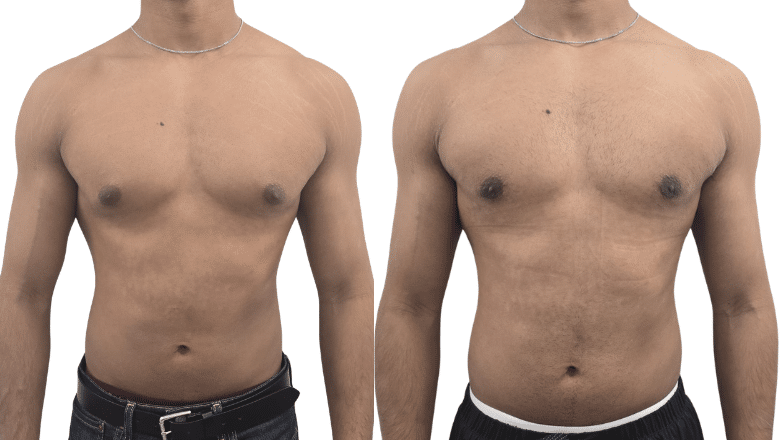
More results are in our gynecomastia before and after photos gallery.
Frequently Asked Questions
Can you get rid of gyno without surgery?
Sometimes. Pubertal gyno often settles on its own, gyno from a medicine or steroids can shrink if the cause is stopped early, and chest fat responds to weight loss. Gland that has been present for more than a year or two usually needs surgery.
What is the best non-surgical treatment for gynecomastia?
It depends on the cause. For pubertal gyno, waiting. For gyno from a medicine or steroids, stopping the cause early. For recent, painful gland, tamoxifen under a specialist can help. For chest fat, weight loss. No single treatment works for everyone.
Does gynecomastia cream really work?
No. There is no good evidence that any cream reduces glandular breast tissue in men, and creams do not penetrate deeply enough to reach it.
How do you reverse gyno from steroids?
Stop the steroids as early as possible and see a doctor, who may check your hormones. New, tender gyno can shrink once the cycle ends. Gyno that has been present for months, or that returns with each cycle, usually needs surgery once steroid use has stopped.
Can tamoxifen get rid of gyno?
For recent, tender gyno, it often helps. In one UK study, 90% of men with idiopathic gynecomastia had complete resolution. It does not remove long-standing fibrous gland, it is used off-label, and it should only be taken on prescription under a doctor’s supervision.
Can you get male breast reduction without surgery?
Only if the chest is mostly fat. Weight loss and fat freezing can reduce chest fat. True gland can only be removed surgically.
What is mistaken for gynecomastia?
Chest fat (pseudogynecomastia) is the most common, along with puffy nipples, well-developed chest muscle and, rarely, a lipoma or a breast lump that needs checking. A hard, one-sided, off-centre lump should always be seen by a GP.
What happens if gynecomastia is left untreated?
It is not harmful in itself and does not turn into cancer. Over time the gland becomes firmer and less likely to shrink, so treating it later usually means surgery rather than tablets.
Why Choose Centre for Surgery for Gynecomastia Surgery?
We treat every grade of gynecomastia, including grade 3 to 4 and revision cases after surgery elsewhere, with VASER or power-assisted liposuction and gland removal matched to your chest. Surgery is performed by GMC-registered plastic surgeons at our CQC-regulated hospital at 95–97 Baker Street, which has been caring for patients for over 10 years, and the surgeon who examines you at consultation is the surgeon who performs your operation. If your chest is mostly fat, or your gyno may still settle, your surgeon will tell you, and will recommend a GP review first if anything suggests an underlying cause. When you are asleep, your anaesthetic is TIVA given by a consultant anaesthetist, and almost all of our operations are day cases. Our other options for men are on our surgery for men page. We recommend a two-week cooling-off period before any surgery, and we publish our clinical outcomes and patient safety data.
Finance is available through Chrysalis Finance, subject to status. See our finance options page for details.
Phone: 020 7993 4849 | Address: 95–97 Baker Street, Marylebone, London W1U 6RN
Contact us to schedule a consultation
References
- Kanakis GA, Nordkap L, Bang AK, et al. EAA clinical practice guidelines: gynecomastia evaluation and management. Andrology 2019;7(6):778–793. doi:10.1111/andr.12636 ↗
- Deepinder F, Braunstein GD. Drug-induced gynecomastia: an evidence-based review. Expert Opinion on Drug Safety 2012;11(5):779–795. doi:10.1517/14740338.2012.712109 ↗
- Mannu GS, Sudul M, Bettencourt-Silva JH, Tsoti SM, Cunnick G, Ahmed SF. Role of tamoxifen in idiopathic gynecomastia: a 10-year prospective cohort study. The Breast Journal 2018;24(6):1043–1045. doi:10.1111/tbj.13080 ↗
- Berger O, Landau Z, Talisman R. Gynecomastia: a systematic review of pharmacological treatments. Frontiers in Pediatrics 2022;10:978311. doi:10.3389/fped.2022.978311 ↗
- Plourde PV, Reiter EO, Jou HC, et al. Safety and efficacy of anastrozole for the treatment of pubertal gynecomastia: a randomized, double-blind, placebo-controlled trial. Journal of Clinical Endocrinology and Metabolism 2004;89(9):4428–4433. doi:10.1210/jc.2004-0082 ↗
- Boccardo F, Rubagotti A, Battaglia M, et al. Evaluation of tamoxifen and anastrozole in the prevention of gynecomastia and breast pain induced by bicalutamide monotherapy of prostate cancer. Journal of Clinical Oncology 2005;23(4):808–815. doi:10.1200/JCO.2005.12.013 ↗
- Munavalli GS, Panchaprateep R. Cryolipolysis for targeted fat reduction and improved appearance of the enlarged male breast. Dermatologic Surgery 2015;41(9):1043–1051. doi:10.1097/DSS.0000000000000415 ↗
- Hong JY, Park SJ, Kim SY, Kim BJ. Efficacy and safety of cold-induced noninvasive targeted fat reduction in pseudogynecomastia. Annals of Dermatology 2022;34(6):412–418. doi:10.5021/ad.21.180 ↗







