


In this guide15 sections
- Key Points
- Can Stretched Earlobes Go Back to Normal?
- How Is Stretched Earlobe Repair Done?
- How Big Can a Gauge Be and Still Be Repaired?
- Can You Fix Stretched Earlobes Without Surgery?
- Who Is Suitable for Stretched Earlobe Repair?
- Stretched Earlobe Repair Before and After
- Stretched Earlobe Repair Recovery: What to Expect
- Does Stretched Earlobe Repair Leave a Scar?
- What Are the Risks of Stretched Earlobe Repair?
- Are the Results of Stretched Earlobe Repair Permanent?
- Does the NHS Repair Stretched Earlobes, and How Is Cost Decided?
- Stretched Earlobe Repair in London
- Frequently Asked Questions
- References
Key Points
- Can stretched earlobes be repaired? In most cases, yes. Surgery removes the stretched tract of skin and rebuilds the lobe, and published case series report good cosmetic results with low complication rates.
- Can stretched earlobes go back to normal on their own? Smaller stretches may tighten a little once jewellery is removed. Once the skin has healed around a larger hole, it usually will not close without surgery.
- The bigger the stretch, the more tissue has to be rebuilt. There is no agreed maximum gauge size, but very large holes usually need a flap technique rather than a simple closure, and the result is harder to predict.
- Stretched earlobe repair is usually done under local anaesthetic, with fine stitches and a scar placed to follow the natural contour of the lobe.
- Re-piercing is usually delayed for several months until the repair has healed. One published series described re-piercing after around six months, and your surgeon will confirm the timing for you.
- Risks include a visible scar, notching at the edge of the lobe, infection, uneven healing and the hole stretching again. Avoiding heavy jewellery and re-stretching protects the result.
If you have stretched your ears with gauges, tunnels or plugs and now want your earlobes back, the question behind most searches is simple: can stretched earlobes be repaired? For most people the answer is yes. Stretched earlobe repair is a minor operation that removes the lining of the stretched hole and rebuilds the lobe so that it closes and looks natural again. How well it works, and how complex the operation is, depends on how large the hole is, how thin the remaining lobe has become and how well your skin heals.
This guide explains whether stretched earlobes can go back to normal without surgery, how surgeons repair gauged ears, how big a stretch can be fixed, what recovery and re-piercing involve, and what the research says about results and risks. If your concern is a lobe that has simply lengthened or sagged with age rather than from gauges, our guide to why ears and earlobes get bigger with age, including why earlobes sag, is a better starting point.
Can Stretched Earlobes Go Back to Normal?
Can stretched ears go back to normal on their own? Sometimes, a little, but not reliably. Skin is elastic, and a recently stretched piercing may tighten partially once the jewellery is taken out. How much it recovers is not well quantified in research, and it varies from person to person. Once a hole has been stretched wide enough, and for long enough, the skin lining it settles into a permanent tunnel. The skin has lost its ability to spring back, and the thinned lobe will not close the hole by itself.
That is why people searching for “do gauged ears go back to normal” often find the same advice: small stretches may improve, larger ones usually need surgery. A 2010 surgical report in Aesthetic Plastic Surgery ↗ describes expanding the earlobe by gauging or plugging as an increasingly fashionable practice, and notes that as patients get older, some seek to have their ears restored to normal[1]. If you are early in the process and thinking about going back to normal, taking the jewellery out sooner rather than later gives the skin a better chance to recover.
Why do stretched earlobes not close?
A pierced hole is lined with skin that has grown through the channel. When the hole is stretched, that lining stretches with it and the lobe tissue around it becomes thinner. Closing the hole therefore means more than pulling the edges together. The lining has to be removed first, then the lobe is rebuilt in layers so that it holds together. A thinned lobe loaded with heavy jewellery can also go on to split.
How Is Stretched Earlobe Repair Done?
Stretched earlobe repair, sometimes called gauged earlobe repair, earlobe reconstruction or lobuloplasty, is normally carried out under local anaesthetic. You stay awake, the lobe is numbed, and the surgeon works on one or both ears in the same session. The aim is to close the hole, rebuild the lobe and place the scar where it is least visible.
The steps are broadly the same whichever technique is used:
- The surgeon marks the lobe and removes the stretched, epithelialised lining of the hole.
- Excess loose or thinned skin is trimmed, keeping as much useful tissue as possible.
- The lobe is rebuilt in layers, often with skin flaps, so that the free edge sits naturally without a notch.
- Fine stitches close the skin, and a small dressing is applied.
The operation often takes around 30 to 45 minutes per ear, although this depends on the size of the defect.
Which technique is used for gauged ears?
There is no single standard technique, and that is something the research makes clear. A 2021 systematic review in the Journal of Cosmetic Dermatology ↗ identified 26 studies of earlobe repair techniques and grouped them into six categories: straight-line closure, Z-plasty, flaps, L-specular plasty, double-curve specular plasty and non-surgical methods. It concluded that the techniques are generally simple and efficient, that complication rates and morbidity are relatively low, and that the choice should be based on surgeon and patient preference. Z-plasty had the highest post-operative infection rate in that review, at 11.5%[4]. Note that most of those studies looked at torn or split earlobes after trauma, not specifically at gauged ears.
For gauging, surgeons have described several tailored approaches:
- Simple local flap: a case report described a local flap that gave uneventful healing and acceptable cosmetic results for an expanded earlobe[1].
- Opposing crescents: for medium-sized gauge defects, one technique uses two opposite crescents of skin removed from the front and back of the lobe, giving a natural curve along the lower border, which is the hardest part of the operation to get right[2].
- Rolling earlobe flap: in a small case series of three patients (six earlobes), a 2017 report in Archives of Plastic Surgery ↗ described a flap that preserves the volume of the lobe and avoids a scar along its free edge. The authors noted that other techniques either reduce the volume of the lobe too much or leave an obvious scar on the edge, and reported no infection, wound breakdown or hypertrophic scarring[3].
These are small studies, and the numbers are limited, so they show what is possible rather than what every patient should expect. Your surgeon will choose the approach that suits the size of your hole, the thickness of your remaining lobe and how you want the lobe to look.
How Big Can a Gauge Be and Still Be Repaired?
Patients often ask what gauge size is too big to repair. The honest answer is that there is no agreed cut-off, and the research does not report outcomes by gauge size. What the literature does show is that repair gets more demanding as the defect grows. One paper on “medium” gauge defects points out that many techniques exist for major defects but very few papers address medium ones[2], and a classification and algorithm for acquired split earlobes was proposed precisely because choosing the right method is difficult[5].
In practice, the points that matter more than the number on a gauge chart are:
- How much healthy lobe remains. A wide hole in a thick lobe is simpler to rebuild than a thin rim of skin.
- Whether the lobe has split. A complete split needs the edges to be rebuilt and is a separate repair problem.
- Your scarring history. People who scar thickly may need a more cautious plan, and our guide to ear keloids explains why.
Even large or long-standing stretches are often repairable, but a very stretched or thinned lobe may not return to a perfect copy of its original shape, and sometimes a staged approach or a compromise on lobe size is discussed. A surgeon can only tell you what is realistic after examining your ear.
Can You Fix Stretched Earlobes Without Surgery?
For an established, healed stretched hole, there is no reliable non-surgical way to close it. Creams, massage, tapes and fillers do not remove the skin lining of the tunnel, so they are not expected to close a hole. The 2021 review above did include a group of non-surgical techniques, but it looked at traumatic earlobe injuries rather than long-standing gauged holes[4].
What you can do without surgery is stop further stretching, wear lighter jewellery or smaller sizes, and give a recent stretch time to settle. If the lobe also looks long or heavy rather than just holed, a separate procedure may be relevant: our earlobe reduction page explains when the lobe itself is reduced in size, sometimes at the same time as the repair.
Who Is Suitable for Stretched Earlobe Repair?
Most healthy adults whose stretched ears have stopped enlarging can be considered. A consultation looks at the size and shape of the hole, the quality of the remaining lobe, your general health and your reasons for wanting the repair. Smoking and some medical conditions can affect healing, and you may be asked to change habits or medication beforehand.
A good consultation also covers expectations. In a 2025 single-surgeon series in the Journal of Craniofacial Surgery ↗, covering 1,131 ears in 662 adults that included split and tribal earlobe repairs, the author stressed that the history, including a psychological assessment, is the hardest and most important part of the process, and that any mismatch between what patient and surgeon expect should be explored until both are aligned on clearly defined goals[7]. That applies to gauged ears particularly: the scar will be small but it will not be invisible, and the repaired lobe will look like a natural lobe rather than one that has never been pierced.
If your concern is the shape of the whole ear rather than the lobe, our guide to ear shapes and our ear reshaping page cover that separately.
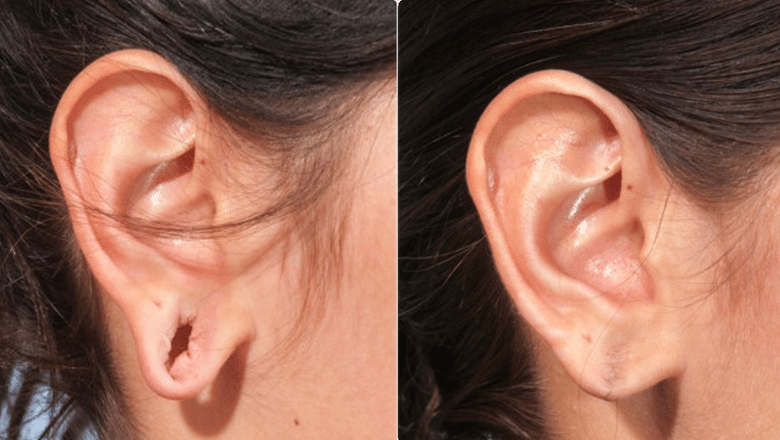
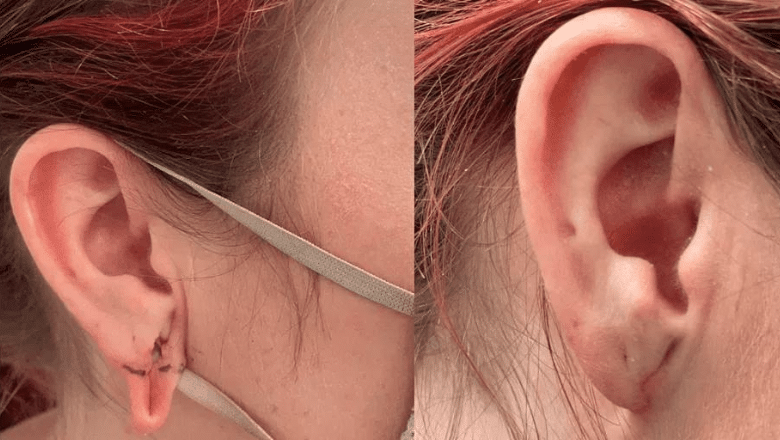
Stretched Earlobe Repair Before and After
Real before and after photographs are a useful way to understand what repair can and cannot change. The two examples below show stretched earlobe repair at Centre for Surgery. Individual results vary, and these photographs are shown with the patients’ consent for educational purposes. More cases are available in our ear surgery before and after gallery.
Stretched Earlobe Repair Recovery: What to Expect
Recovery after stretched earlobe repair is usually straightforward, but you should expect some swelling, tenderness and bruising around the lobe for the first few days. Keeping the area clean and dry, following your aftercare instructions and avoiding pressure from phones, headphones and sleeping on the treated side all help.
Some practical points:
- Stitches: these are either dissolvable or removed after about one to two weeks. In one published series of 30 patients, the sutures were removed after two weeks[6].
- Returning to work: many people manage routine activities within a day or two, although you should follow your surgeon’s advice for contact sport and swimming.
- Scars: a fine line is expected, and it often becomes less noticeable with time. Protect it from the sun while it matures.
- Jewellery: no earrings through the repaired area until your surgeon says the tissue is strong enough.
When can you re-pierce after earlobe repair?
Most surgeons ask you to wait until the repair has fully healed before piercing again. The timing is a matter of surgeon preference rather than a fixed rule: in the series of 30 patients above, re-piercing was described as possible after around six months[6], while other reports describe techniques designed to keep or recreate a piercing hole as part of the repair, avoiding a separate visit[5]. Our guide on whether you can repair and repierce earlobes in the same procedure covers the options in detail.
If you do re-pierce, your surgeon will usually advise placing the new hole slightly away from the scar line rather than directly through it, and using lightweight, hypoallergenic studs at first.
Does Stretched Earlobe Repair Leave a Scar?
Yes, there will be a scar, but the aim is to make it small, fine and well placed. Scar quality depends on the technique, the position of the incision, how your skin heals and how well you look after the area. Many surgeons try to hide the scar in the natural contour of the lobe, or along the back of it, and some techniques are designed specifically to avoid a scar on the free edge[3].
Notching, where the lower edge of the lobe forms a small dip, is the classic cosmetic problem of a straight-line closure under tension. This is why many techniques use a broken-line design such as a Z-plasty or L-plasty, or flaps, to interrupt the scar line[4]. People who tend to form raised scars should say so at consultation.
What Are the Risks of Stretched Earlobe Repair?
Stretched earlobe repair is a small operation, and published series report low complication rates, but no surgery is risk-free. Possible problems include:
- Infection: rates vary between techniques and studies. In one comparison of two techniques in 30 patients, a wound infection treated with antibiotics was reported[6].
- Hypertrophic or keloid scarring: thick (hypertrophic) scars were reported in the same series[6].
- Notching or asymmetry: a small step in the lower border, or lobes that are not quite equal in size or shape.
- Recurrence: the repair can open up again if the lobe is stretched, pulled or injured.
- Changes in sensation: numbness or tingling around the lobe, which is usually temporary.
Recurrence is worth taking seriously. A study of 25 patients with split earlobes suggested that allergy to the metal in earrings might contribute, and recommended avoiding the offending metal to prevent recurrence[8]. By contrast, a review of 25 patients (36 earlobes) with partial splits treated by an orifice-preserving double Z-plasty reported no recurrence or wound breakdown over 12 months[9]. Studies are small, follow-up is short and techniques differ, so the realistic message is that recurrence is uncommon but possible, and your habits after surgery matter.
Are the Results of Stretched Earlobe Repair Permanent?
A repaired lobe is a healed structure, so there is no reason it should stretch again unless something stretches it. Heavy earrings, repeated pulling, further gauging and injury can all put the repair under strain. The published studies follow patients for months to a couple of years at most, so we do not have long-term data on how repairs hold up over decades. In a prospective study of 24 partially torn earlobes treated with a rotation flap, good results were seen over one year of follow-up[10]. Keeping to lightweight jewellery and avoiding re-stretching is the sensible way to protect the result.
Does the NHS Repair Stretched Earlobes, and How Is Cost Decided?
Searches for stretched earlobe repair on the NHS are common. Cosmetic ear surgery is not routinely funded in most areas, and policies vary, so it is worth asking your GP what is available locally. Private repair is quoted after a consultation, when the surgeon can see how complex the defect is. Cost depends on whether one or both ears are treated, the size of the stretch, the technique needed and the type of anaesthetic. We do not publish figures in articles, but a patient coordinator can explain how a quote is prepared.
Stretched Earlobe Repair in London
At Centre for Surgery, earlobe repair is carried out under local anaesthetic at our CQC-regulated hospital on Baker Street. A consultation will assess your hole, discuss the technique, set out the risks and explain what to expect, including a realistic view of scarring and re-piercing. You can read more about earlobe repair at Centre for Surgery, or if you also have a lump or cyst in the lobe, our guide to earlobe cysts explains what to do.
Phone: 020 7993 4849 | Address: 95–97 Baker Street, Marylebone, London W1U 6RN
Contact us to schedule a consultation
Frequently Asked Questions
Can stretched earlobes go back to normal?
Small or recent stretches may tighten a little once jewellery is removed, but there is little research on how much. Larger, long-standing holes usually will not close on their own because the skin has healed around the tunnel, and surgery is the reliable way to repair them.
Can you fix stretched earlobes without surgery?
Not reliably. Creams, massage and fillers do not remove the skin lining of an established hole. You can stop further stretching and switch to lighter jewellery, but closing a healed stretched hole generally needs surgery.
What size gauge can be repaired?
There is no agreed upper limit and the research does not report outcomes by gauge size. Larger stretches usually need a more complex flap repair, and results are harder to predict. A surgeon can judge what is realistic after examining your ear.
How long does stretched earlobe repair take?
It often takes around 30 to 45 minutes per ear under local anaesthetic, although this varies with the size of the stretch and the technique used. Both ears can usually be repaired in the same appointment.
How long should you wait to re-pierce after earlobe repair?
Surgeons usually advise waiting until the repair has healed fully. One published series described re-piercing after around six months, though your surgeon may advise a different timing and will guide the position of the new hole.
Does stretched earlobe repair leave a scar?
Yes, but it should be a fine line placed to follow the natural shape of the lobe. Scarring varies from person to person, and anyone prone to thick or keloid scars should mention it before surgery.
Is stretched earlobe repair painful?
The lobe is numbed with local anaesthetic, so you should feel pressure rather than pain during the operation. Afterwards, tenderness and swelling are common for a few days and usually settle with simple pain relief, as your surgeon advises.
Can you get stretched earlobes repaired on the NHS?
Cosmetic earlobe repair is not routinely funded and local policies vary. Ask your GP whether your area funds it. Private repair is quoted after a consultation.
Can stretched earlobes be repaired after many years?
Often yes, but the longer and larger the stretch, the more skin needs to be removed and rebuilt, and the less predictable the result. There is no strict time limit, and suitability is decided at consultation.
Can a repaired earlobe stretch again?
It can if it is pulled, injured or loaded with heavy jewellery, or if you begin gauging again. Studies suggest recurrence is uncommon but possible, so lightweight earrings and avoiding re-stretching give the most protection.
References
- Henderson J, Malata CM. Surgical correction of the expanded earlobe after ear gauging. Aesthetic Plastic Surgery 2010;34(5):632–633. doi:10.1007/s00266-010-9500-3 ↗
- de Boutray M, Veyssiere A, Bekara F, Graillon N. Repair of gauge earlobe medium defect. Journal of Stomatology, Oral and Maxillofacial Surgery 2020;121(4):430–433. doi:10.1016/j.jormas.2019.12.008 ↗
- Pek WS, Goh LHT, Pek CH. The rolling earlobe flap for dilated ear holes following ear gauging: a novel approach to aesthetically preserving earlobe soft tissue volume. Archives of Plastic Surgery 2017;44(5):453–456. doi:10.5999/aps.2017.44.5.453 ↗
- Nassour N, Watfa W. Outcomes and complications of traumatic ear lobe repair techniques: a systematic review. Journal of Cosmetic Dermatology 2021;21(3):910–923. doi:10.1111/jocd.14223 ↗
- Sadasivan K, Kochunarayanan A. A revised classification and treatment algorithm for acquired split earlobe, with a description of the composite technique and its outcome. Cureus 2020;12(9):e10422. doi:10.7759/cureus.10422 ↗
- Chiummariello S, Iera M, Arleo S, Alfano C. L-specular plasty versus double-round plasty: two new techniques for earlobe split repair. Aesthetic Plastic Surgery 2011;35(3):398–401. doi:10.1007/s00266-010-9596-5 ↗
- Lloyd MS. One thousand ears in 7 years: a single surgeon’s experience of performing otoplasty and cosmetic ear surgery in adults. Journal of Craniofacial Surgery 2025. doi:10.1097/SCS.0000000000011923 ↗
- Raveendran SS, Amarasinghe L. The mystery of the split earlobe. Plastic and Reconstructive Surgery 2004;114(7):1903–1909. doi:10.1097/01.prs.0000142745.63017.e1 ↗
- Sharma HK, Gupta D, Punj S. Orifice preserving double opposing Z-plasty for partial split ear lobe repair: a review of 25 cases. Dermatologic Surgery 2018;44(2):270–274. doi:10.1097/DSS.0000000000001271 ↗
- Sharma R, Krishnan S, Kumar S, Verma M. Rotation flap lobuloplasty: technique and experience with 24 partially torn earlobes. International Journal of Oral and Maxillofacial Surgery 2014;43(10):1206–1210. doi:10.1016/j.ijom.2014.04.009 ↗





