


In this guide10 sections
- Which Type of Eye Bag Do You Have?
- Why Eye Bags Form
- How to Get Rid of Eye Bags at Home
- How to Get Rid of Eye Bags Overnight or Fast
- Eye Bag Treatment Options
- Can You Get Rid of Eye Bags Permanently?
- Eye Bag Surgery — What Lower Blepharoplasty Involves
- Who Is Not a Good Candidate?
- Eye Bag Treatment FAQs
- Eye Bag Treatment at Centre for Surgery
Whether you can get rid of eye bags depends entirely on what is actually causing them — and for most people over forty, the honest answer is that no cream, compress or amount of sleep will remove them, because the problem is structural rather than superficial. Puffy eye bags caused by fluid retention genuinely do respond to home measures and settle within hours. Eye bags caused by a prolapsed fat pad do not, and never will, because there is nothing about a topical product that can reposition fat sitting behind the orbital septum. This guide explains how to tell which type you have, what genuinely works for each, how to get rid of eye bags at home when the cause is fluid, and when lower eyelid surgery is the only treatment that will produce a permanent result.
Which Type of Eye Bag Do You Have?
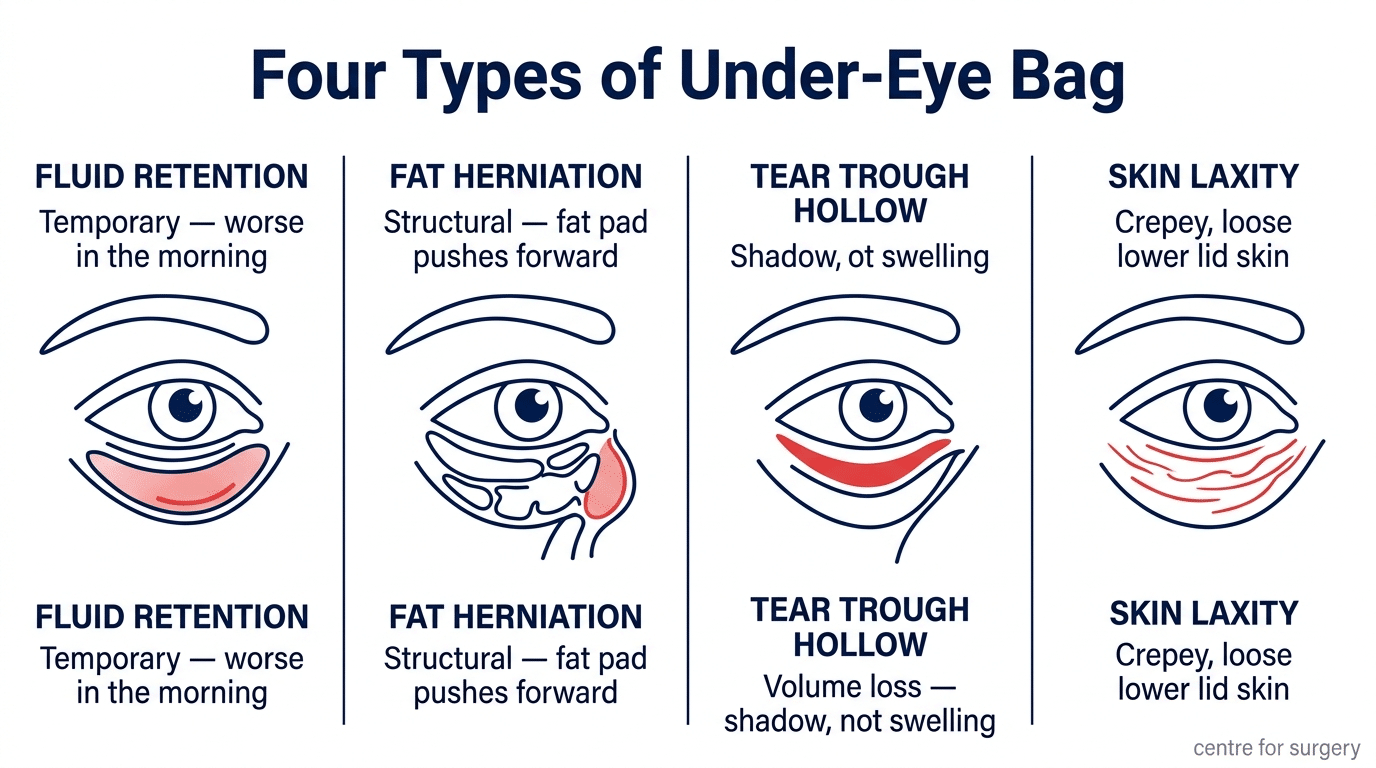
This is the step almost every article on this subject skips, and it is the reason so many people spend years buying products that were never going to work. “Eye bags” is a single phrase covering four distinct problems.
Fluid retention — temporary
Puffiness that is worst first thing in the morning, improves through the day, and gets noticeably worse after a salty meal, a late night, alcohol or crying. The tissue around the eye is thin and loosely attached, so it holds fluid readily. This is the only type that responds meaningfully to cold compresses, sleeping propped up and reducing salt. If your bags disappear by lunchtime, this is what you have.
Fat herniation — structural
A defined bulge that is present all day, every day, and looks the same at 8am as it does at 8pm. The small fat pads that cushion the eyeball are held back by a membrane called the orbital septum. As that membrane weakens, the fat pushes forward against the skin. This is the most common cause of persistent under eye bags in adults, it is strongly hereditary, and it does not respond to any topical treatment.
Tear trough hollow — volume loss
Not swelling at all, but a groove between the lower lid and the cheek that casts a shadow. People frequently mistake this for a dark circle or a bag. The distinction matters enormously, because the treatment is the opposite — a hollow needs volume added, whereas a fat bag needs volume repositioned or reduced. Read more about tear trough deformity and how it is assessed.
Skin laxity — surface change
Fine crepey texture and loose skin without much underlying bulge, common after significant sun exposure or weight loss. This responds partially to skin-quality treatments and fully only to surgical skin tightening.
Most patients we see have a combination — typically fat herniation with a tear trough hollow beneath it, which is why treating one in isolation often produces a disappointing result.
Why Eye Bags Form
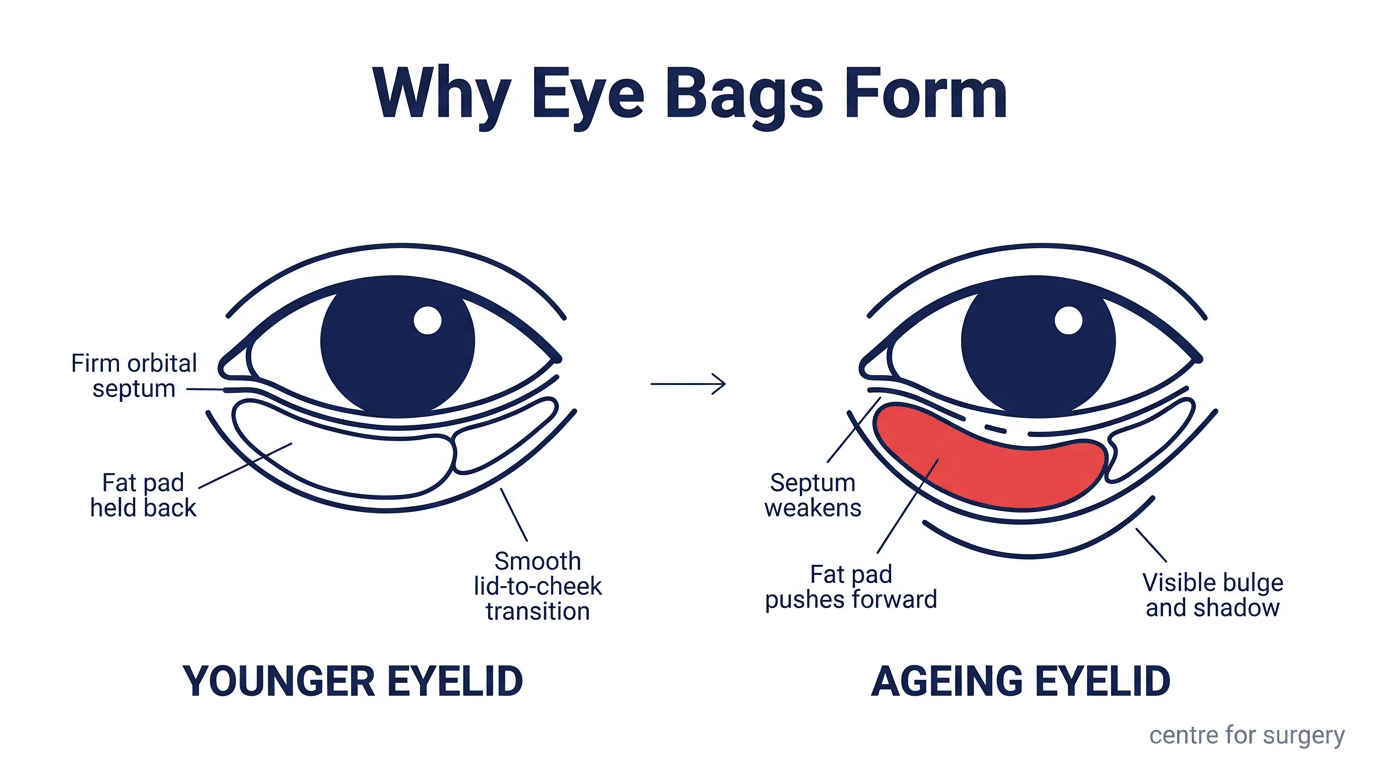
Understanding what causes eye bags makes it much easier to judge which treatments are plausible and which are marketing.
Weakening of the orbital septum
The primary mechanism. The septum is a thin fibrous sheet that retains the orbital fat behind it. It loses tensile strength with age, and once it does, normal fat is pushed forward by the pressure of the eye itself. Nothing has been added — the fat has simply moved.
Genetics
Hereditary predisposition is significant. Patients in their twenties and thirties with prominent under eye bags almost always have a parent with the same feature. If yours appeared early and your mother or father has them, this is the likely explanation, and it is not related to your lifestyle.
Loss of skin elasticity
Collagen and elastin decline steadily from the mid-twenties. Eyelid skin is the thinnest on the body, so this shows there first — the skin envelope no longer contracts smoothly over the tissue beneath it.
Descent of the cheek
Often overlooked. As the midface descends, the junction between the lower lid and cheek lengthens, which exaggerates the appearance of a bag above it even when the fat pad itself has changed very little.
Iron deficiency and other medical causes
Persistent under-eye puffiness and shadowing is occasionally the first visible sign of iron deficiency anaemia. Reduced haemoglobin oxygenation gives the thin under-eye skin a duller, bluish cast, and low iron is common enough — particularly in menstruating women and vegetarians — to be worth excluding before spending money on treatment. Thyroid disease can also produce periorbital changes. A blood test costs a fraction of a course of laser, and if it comes back abnormal, correcting it may resolve the appearance without any cosmetic intervention at all. See dark circles under eyes for the full discussion of medical causes and red flags.
Fluid, allergy and sleep
Real contributors, but to the temporary type only. Allergic inflammation, sinus congestion, high salt intake, alcohol and poor sleep all increase fluid in the periorbital tissue. They make an existing bag look worse; they do not create a structural one.
How to Get Rid of Eye Bags at Home
Sleep position is the most overlooked of these. Lying flat lets fluid pool in the lower lids overnight, which is why fluid-type bags are always worst on waking. Raising the head of the bed slightly, or adding a second pillow, lets gravity drain the area while you sleep. Consistently sleeping face-down or on one side compresses that side nightly and contributes to asymmetry over years.
If you are looking for how to get rid of bags under eyes naturally, these are the measures that genuinely work — and they work for fluid retention specifically. They are worth doing regardless, because they stop a structural bag looking worse than it needs to. They will not remove a fat pad.
- Sleep with your head elevated — an extra pillow prevents fluid pooling around the eyes overnight. This is the single most effective home measure.
- Cold compress — a chilled flannel or gel pack for ten minutes constricts blood vessels and reduces swelling. Never apply ice directly to the skin.
- Reduce salt — particularly in the evening. Processed food is the main culprit rather than the salt cellar.
- Treat allergies properly — if you have hay fever or a dust allergy, controlling it removes a genuine and reversible cause of puffiness.
- Stop rubbing your eyes — repeated friction damages thin skin and worsens both laxity and pigmentation.
- Daily SPF — UV exposure accelerates collagen breakdown in eyelid skin faster than almost anywhere else on the face.
- Limit alcohol — it dehydrates and dilates vessels, and the effect on the under-eye area is disproportionate.
What about eye creams?
Caffeine-based eye creams produce a mild, genuine, temporary tightening by constricting superficial vessels. Retinol and peptides can modestly improve skin texture over months of consistent use. Neither moves fat. If you have been using a product for three months with no change to a bulge that is present all day, the product is not failing — it is being asked to do something no topical formulation can do.
How to Get Rid of Eye Bags Overnight or Fast
It is worth being straightforward about this, because it is one of the most searched questions on the subject and one of the most over-promised.
If your bags are fluid-related, you can meaningfully reduce them in a morning: cold compress for ten minutes, head elevated, no salt or alcohol the night before, and antihistamine if allergy is a factor. Expect real but modest improvement within an hour or two.
If your bags are caused by fat herniation, nothing available will remove them overnight, and no product that claims otherwise is being honest with you. Concealer and colour-correcting makeup will disguise the shadow, which is a reasonable short-term answer before an event, but the bag itself is unchanged.
Eye Bag Treatment Options
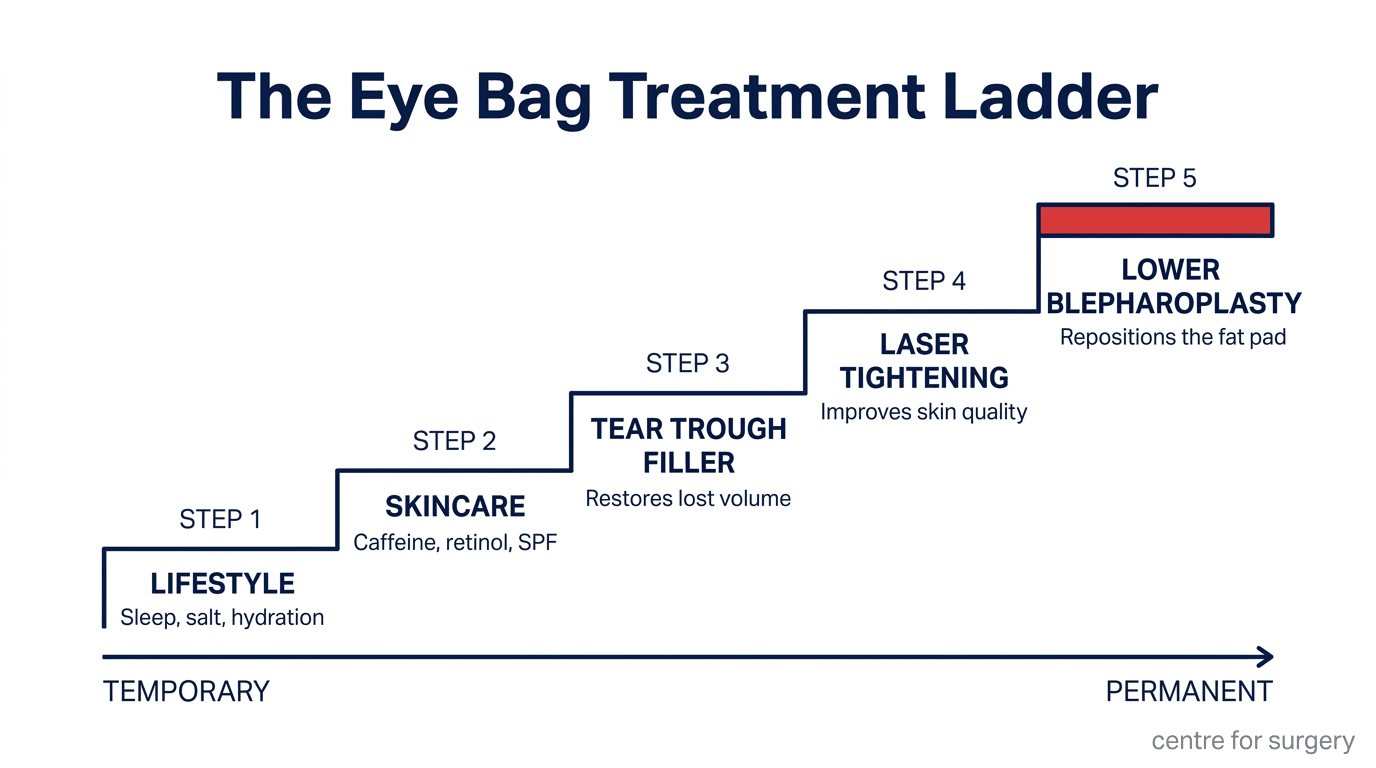
The right eye bags treatment depends on which of the four types you have, and on how permanent a result you want.
Tear trough filler
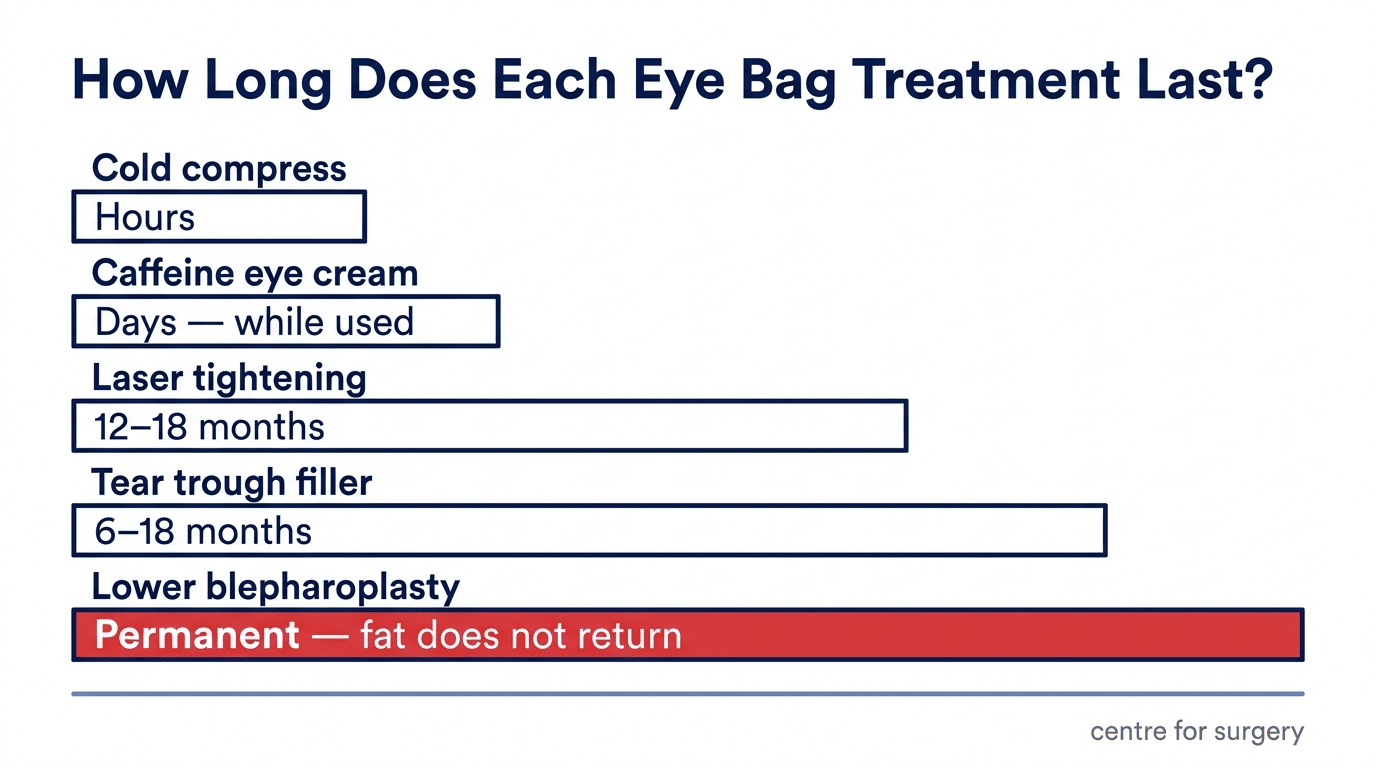
Tear trough filler uses hyaluronic acid to restore volume in the hollow beneath the eye, softening the shadow and smoothing the transition to the cheek. It is well suited to genuine hollowing with minimal fat prolapse. It is poorly suited to a prominent fat bag, where adding volume beneath an existing bulge can make the area look heavier rather than smoother. Results last approximately 6 to 18 months. This is an area that demands an experienced injector — the skin is thin and the margin for error is small.
Laser skin tightening
SmoothEye laser treatment stimulates collagen in the lower lid skin, improving crepey texture and mild laxity without surgery or downtime. It improves skin quality rather than repositioning fat, so it suits early laxity and works poorly as a standalone treatment for a defined bag.
Lower blepharoplasty
Fat repositioning rather than fat removal is the modern approach for most patients. Instead of simply excising the herniated fat, the surgeon releases it and redrapes it over the orbital rim to fill the tear trough below. This treats the bag and the hollow in one manoeuvre, and it avoids the commonest long-term complication of aggressive fat removal — a hollowed, skeletal look that is considerably harder to correct than the original bag. See sunken eyes for what over-resection produces and how it is corrected.
Surgical eye bag removal is the only treatment that addresses the underlying cause directly. Where the problem is a prolapsed fat pad, this is the option that removes it rather than disguising it.
Can You Get Rid of Eye Bags Permanently?
Yes, but only through surgery, and only for the fat component.
Once the herniated fat is removed or repositioned during lower blepharoplasty, that fat does not return. Patients are not committing to a treatment they will need to repeat, which is the meaningful difference between surgery and every other option on the ladder. Most people who have lower eyelid surgery never require a second procedure on the lower lids.
Two honest qualifications. First, surgery does not pause ageing — skin will continue to change over the following decades, even though the bag itself is gone. Second, if a tear trough hollow or pigmentation is contributing to the appearance, removing fat alone will not fully resolve it, which is why assessment matters more than the procedure name.
Anyone offering to get rid of under-eye bags permanently without surgery is describing something that is not currently possible. Creams, massage tools, patches and lymphatic drainage all act on fluid and skin surface. None of them reaches the orbital septum, and none of them will permanently remove a fat pad.
Eye Bag Surgery — What Lower Blepharoplasty Involves
Lower blepharoplasty is performed as a day case at our Baker Street clinic under TIVA (Total Intravenous Anaesthesia) administered by a consultant anaesthetist, and takes approximately 1.5 to 2 hours.
For most patients we use a transconjunctival approach — the incision is made inside the lower eyelid, so there is no external scar at all. The fat pads causing the bulge are either reduced or, more often, repositioned forward into the tear trough to smooth the step between lid and cheek. Where there is significant excess skin as well, a fine subciliary incision just beneath the lash line allows the skin to be tightened; this heals to a line that is very difficult to see once settled.
Modern practice strongly favours repositioning fat over removing it. Over-aggressive fat removal produces a hollowed, skeletonised look that ages the face and is difficult to correct afterwards.
Most patients return to desk-based work between days 8 and 10 once bruising can be covered, with the settled result apparent at around six weeks. Full detail is set out in our guide to blepharoplasty recovery, and pricing is covered in our blepharoplasty cost guide. You can also view real results in our before and after gallery.
Risks you should know about
Lower eyelid surgery is generally safe, but it is surgery. Temporary dry, gritty or watery eyes are common in the first few weeks. Chemosis — swelling of the clear membrane over the white of the eye — can occur and looks alarming but settles on its own. Ectropion, where the lower lid pulls away from the eyeball, is uncommon and usually temporary, though it is the complication most closely associated with over-resection of lower lid skin. Serious problems affecting vision are very rare. Your surgeon will go through all of this properly at consultation.
Who Is Not a Good Candidate?
The most important exclusion is festoons and malar bags. These are pouches of chronically swollen tissue sitting lower on the cheek, below the orbital rim, caused by impaired lymphatic drainage rather than herniated fat. They are frequently mistaken for eye bags — including by clinics — and lower blepharoplasty does not improve them. It can make them look worse, because the surgery adds inflammation to an area that already drains poorly, and removing fat above a festoon accentuates the step below it. If your swelling sits on the cheekbone rather than in the lid, fluctuates through the day, or is worse after salt or alcohol, read malar bags and festoons before booking any surgery.
Being told a procedure is not right for you is more useful than being sold one that is not.
- Your bags come and go — if they are markedly better by the afternoon, the cause is fluid and surgery is not the answer.
- Significant dry eye — lower blepharoplasty can worsen pre-existing dry eye, and this needs assessing before proceeding.
- Thyroid eye disease or uncontrolled glaucoma — requires ophthalmology input first.
- Active smoking — the single biggest predictor of poor wound healing. You will be asked to stop for six weeks either side.
- The problem is pigmentation, not volume — genuine dark circles from hyperpigmentation will not improve with fat removal.
- Expectations focused on looking like a different person — this procedure refreshes; it does not transform.
Eye Bag Treatment FAQs
Do eye bags go away on their own?
Fluid-related puffiness does, usually within hours. Eye bags caused by fat herniation do not — they are a structural change and tend to become gradually more prominent over the years rather than resolving.
Is there a difference between eye bags and bags under eyes?
No — they are the same thing described two ways, and both phrases usually refer to the puffiness or bulging of the lower eyelid. The clinically useful distinction is not the wording but the cause: whether what you are seeing is fluid, prolapsed fat, a hollow, or loose skin.
What is the fastest way to get rid of eye bags?
For fluid puffiness, a cold compress with the head elevated gives visible improvement within an hour. For structural bags, there is no fast option — makeup will disguise them, surgery removes them.
Can eye bags be removed without surgery?
They can be improved without surgery — tear trough filler softens the shadow, laser improves skin quality — but they cannot be removed. Only surgery addresses the fat pad itself.
Does lack of sleep really cause eye bags?
It causes and worsens fluid retention, so it makes existing bags look more pronounced. It does not cause the structural change that produces permanent bags, which is why people who sleep perfectly well still get them.
How much does eye bag removal cost in the UK?
The cost of lower blepharoplasty depends on the complexity of your case and whether it is combined with upper eyelid surgery. Full pricing is set out in our blepharoplasty cost guide. Finance is available through Chrysalis Finance on treatments over £1,500, subject to status.
Will the NHS treat eye bags?
No. Lower blepharoplasty performed for the appearance of eye bags is considered cosmetic and is not funded by the NHS. Upper eyelid surgery can occasionally be funded where heavy upper lid skin is documented to obstruct the visual field, but this does not extend to lower lid bags.
Are eye bags and dark circles the same thing?
No. Eye bags are a change in contour — swelling or bulging. Dark circles are a change in colour, caused by pigmentation, visible vessels through thin skin, or shadow cast by a hollow. They frequently occur together but need different treatments.
Can eye bags come back after surgery?
The fat that is removed does not return. Ageing continues, so skin laxity may develop over subsequent decades, but a recurrence of the original fat bag is uncommon.
Is lower eyelid surgery painful?
Most patients report surprisingly little pain — tightness, grittiness and a sensation of pressure rather than soreness. Paracetamol is usually sufficient.
Eye Bag Treatment at Centre for Surgery
The lower eyelid is one of the least forgiving areas in facial surgery. A millimetre of over-resection produces a hollowed or pulled appearance that is difficult to correct, which is why assessment and restraint matter more here than almost anywhere else.
All eyelid surgery at Centre for Surgery is performed by GMC-registered surgeons, at our own day-surgery facility at 95–97 Baker Street, Marylebone. We are regulated by the Care Quality Commission and rated Good overall.
Your surgeon will tell you directly if surgery is not the right answer — for a significant number of people who come to us about eye bags, the correct recommendation is filler, laser, or simply better management of fluid and allergy. We recommend a two-week cooling-off period before any procedure is booked, and you will not be chased.
Verified Patient Reviews
You can read our reviews in full on Google Reviews ↗, or on our own patient reviews page. We are rated 4.6 on Google.
Book a Consultation
Phone: 020 7993 4849
Email: contact@centreforsurgery.com
Address: 95–97 Baker Street, Marylebone, London W1U 6RN
Contact us to schedule your consultation
Your initial in-person consultation is £100, redeemable against the cost of surgery if you proceed.