


In this guide15 sections
- Key Points
- Does a Nose Job Change Your Smile?
- What Is the Depressor Septi Nasi Muscle and How Does It Affect Your Smile?
- Does Nose Tip Rotation Make Your Upper Lip Look Longer?
- Can a Nose Job Change How Much Gum or Teeth You Show When You Smile?
- Why Does My Upper Lip Look or Feel Different After a Nose Job?
- Is a Change in Your Smile After Rhinoplasty Permanent?
- Why Can’t I Smile Properly After a Nose Job?
- How Do Surgeons Stop a Nose Job Changing Your Smile?
- Who Is More Likely to Notice a Smile Change After Rhinoplasty?
- Can You Have a Nose Job and a Lip Lift Together?
- What to Ask Your Surgeon About Your Smile Before Rhinoplasty
- Frequently Asked Questions: Nose Job and Smile
- Nose Job Consultation in London
- References
Key Points
- Does a nose job change your smile? It can, slightly. Your nose and upper lip are linked by muscle, so surgery on the base or tip of the nose can alter how the tip moves and how long the upper lip looks when you smile. Most people notice nothing beyond the early weeks.
- The depressor septi nasi muscle pulls the nasal tip down when you smile. A hyperactive muscle can cause a drooping tip and a shortened upper lip on smiling, and surgeons sometimes release or reposition it.
- Tip rotation can lengthen the upper lip. In a retrospective study of 88 patients, every extra degree of tip rotation was associated with around 0.05 mm more upper lip length.
- Early changes are mostly swelling. A tight, stiff or longer-looking upper lip in the first weeks usually settles as swelling goes down, although the nose keeps refining for up to a year.
- Prevention starts before surgery. A good surgeon watches you smile and talk at consultation, plans the tip and columella around your lip, and avoids over-rotating the tip.
- Tell your surgeon if your smile looks lopsided, a lip movement feels weak, or the change has not eased after the swelling has settled.
Most people worry about the shape of the nose after a nose job, yet a surprising number ask a different question at consultation: will I still smile the same? It is a fair thing to ask. The nose does not sit still on the face. It moves with every smile, and the muscles that move it are attached to the upper lip. That is why a change to the nasal tip, the columella (the strip of skin between the nostrils) or the base of the nose can show up in your smile as well as your profile.
This guide answers the question directly: what changes, what does not, what is temporary and what can last, and how surgeons plan to keep your smile looking like yours. It is deliberately about the smile rather than a list of operations. If you want a refresher on the techniques themselves, our guides to the different types of rhinoplasty and open vs closed rhinoplasty cover them, and our rhinoplasty recovery guide sets out the healing timeline week by week.
Does a Nose Job Change Your Smile?
Sometimes, and usually only a little. Most nose jobs leave the smile looking the same, because most of the work is done on the bridge, which has no direct link to the lip. The smile is more likely to be affected when surgery involves the tip, the columella or the base of the nose, since these are the parts that move when the lip moves.
A smile is already a whole-face movement. In a study of 50 people photographed at rest and in a maximum smile ↗, the nose lengthened on smiling in 78%, the width of the base of the nose increased in 92% and the nostrils flared in 96%[1]. In other words, a nose that moves when you smile is normal, not a defect. What surgeons look for is movement that is exaggerated or that changes after surgery in a way you did not expect.
The changes people describe fall into a few groups:
- the nasal tip dropping or tucking in more than before when they smile
- the upper lip looking longer, flatter or tighter, at rest or on smiling
- a change in how much of the upper teeth or gum shows
- a stiff, numb or restricted feeling in the upper lip during the swelling phase
Each has a different cause and a different outlook, which the sections below take in turn.
What Is the Depressor Septi Nasi Muscle and How Does It Affect Your Smile?
The depressor septi nasi (DSN) is a small paired muscle that runs from the upper lip up to the base of the septum and the nasal tip. When you smile or speak, it can pull the tip of the nose gently downwards and, at the same time, draw the upper lip up and shorten it. In most people the effect is small enough to go unnoticed.
In a 2000 anatomical and clinical study in Plastic and Reconstructive Surgery ↗, surgeons dissected 55 fresh cadavers and found the muscle varied: in 62% it inserted fully into the muscle of the upper lip, in 22% it inserted partly into the bone covering, and in 16% it was absent or rudimentary[2]. The same team operated on 62 patients with a hyperactive DSN, identified by a descending nasal tip and shortened upper lip on smiling, and reported improvement or correction of the tip and lip relationship in 88%.
When the muscle is overactive, the result is sometimes called a smiling deformity or plunging nasal tip. A review in Facial Plastic Surgery describes it as a sharper nasal tip angle, a tip that drops and a lip that shortens on animation[3]. Another team described the lower third of the nose as a functional unit in which the cartilage framework, the muscles that lift and lower the tip, and the gliding tissue between them all work together[4]. Seen this way, a smile change after rhinoplasty is rarely a mystery. It is the result of altering one part of a system without allowing for the rest.
Smiling deformity has three elements: a nasal tip that retrudes and rotates downwards, an upper lip that moves up and shortens, and sometimes a horizontal groove in the middle of the philtrum, the dip between nose and lip[5]. If you already notice these on your own face in the mirror, mention it at your consultation. It is better planned for than discovered afterwards.
Does Nose Tip Rotation Make Your Upper Lip Look Longer?
It can. When a surgeon rotates the tip upwards, the angle between the underside of the nose and the upper lip (the nasolabial angle) opens, and the upper lip can appear longer as a result. This is the most direct link between a nose job and the upper lip, and it is the reason tip work needs to be planned around the whole lower face. Our guide to nose tip surgery explains the techniques used to refine and lift the tip.
The size of the effect has been measured. In a 2017 retrospective study in Aesthetic Surgery Journal ↗, 88 patients whose tips were rotated using either a columellar strut or a caudal septal extension graft had their faces scanned in three dimensions. Increasing tip rotation was associated with greater upper lip length, at around 0.05 mm for every one degree of extra rotation. Both the angle and the lip length reduced a little over time but stayed above pre-operative values[6].
Put plainly, a modest rotation changes the lip by a fraction of a millimetre, while a large rotation changes it more. That is one reason surgeons are careful not to over-rotate the tip. An over-rotated tip tends to show the nostrils from the front and can make a short or average lip look longer. Planning for the individual face, rather than a fixed target angle, is the safeguard. Our guide to tip rhinoplasty covers when the tip alone is treated.
Can a Nose Job Change How Much Gum or Teeth You Show When You Smile?
Potentially, and the direction depends on the technique. In a 2017 cohort study in Aesthetic Plastic Surgery ↗, surgeons compared smile photographs before and at least six months after surgery in 76 patients, measuring how much of the upper incisors showed. There was no significant difference between open and closed approaches. Incisor show was reduced after a columellar strut, an extended spreader graft and release of the DSN, but did not change significantly after a tip rotation suture, shield graft, tip suspension suture or nasal spine graft[7]. Patients who had the footplates of the nasal cartilages brought together or the base of the nostrils narrowed also showed less incisor, though that effect was not significant once DSN release was taken into account.
Two things follow from this. First, the approach (open or closed) is not what drives the lip change, so choosing one over the other is not a smile decision. Second, individual manoeuvres matter. A technique that lowers incisor show could be unwelcome if you already have a short lip and little tooth show, and welcome if you have a gummy smile. Your surgeon should explain which manoeuvres are planned and how they might affect your smile.
The finding sits alongside a 2012 series of 100 primary rhinoplasty patients, 36 of whom had a hyperdynamic drooping tip caused by an overactive DSN. In those patients, excising the muscle and placing a strong columellar strut corrected the tip, increased upper lip length and reduced gum show on smiling, with no infection or haematoma reported in the early period[10].
Why Does My Upper Lip Look or Feel Different After a Nose Job?
In the first weeks, the most common reason is swelling. The upper lip lies directly beneath the nose, and fluid from the operated area spreads into the surrounding tissue. That can make the lip feel tight, heavy or stiff, make it look fuller or slightly different in shape, and make the smile feel restricted. Numbness around the base of the nose and upper lip is also common while small sensory nerves recover. Sleeping with your head raised and following your surgeon’s aftercare advice helps; our guide to sleeping after rhinoplasty explains how.
How long does it last? In a 2016 three-dimensional imaging study in Plastic and Reconstructive Surgery ↗ that measured nasal volume in 40 people after open rhinoplasty, about two-thirds of the swelling had resolved by one month, 95% by six months and 97.5% by one year[8]. That study measured the nose rather than the lip, but the same principle applies: most of the swelling goes in weeks, and the last few per cent take months. Our guides to rhinoplasty swelling and recovery explain why the tip is last to settle.
A general guide to what to expect, which varies from person to person:
- First two weeks: the upper lip may feel tight or stiff and the smile may look restrained. You may avoid smiling widely because of the splint and tenderness.
- Weeks 3 to 6: most of the visible lip swelling has usually gone and the smile begins to look familiar, though the tip may still feel firm and slightly numb.
- Months 3 to 6: the smile should look natural to others. Subtle tightness at the base of the nose can remain.
- Around 12 months: the tip has settled, and this is the earliest point at which a change in how the nose moves with the lip can be judged as final.
Is a Change in Your Smile After Rhinoplasty Permanent?
Some changes are temporary and some are not, and it helps to separate them.
Temporary: swelling, tightness, numbness and the cautious, restricted smile of the first weeks. These ease as the tissues heal, even though the nose continues to refine for up to a year.
Potentially lasting: a structural change to the tip or columella, such as a graft that holds the tip in a new position, or a change to the DSN. If the upper lip looks longer because the tip is rotated, that relationship is part of the new shape of the nose and will not simply revert, although small relaxation over time is seen. In the 88-patient tip rotation study above, the angle and lip length reduced a little but did not return to baseline[6].
Dynamic: how the tip behaves when you smile. If the DSN was left alone and the tip was rotated upwards, the muscle can still pull the tip down on smiling after it recovers. A review from 2014 noted that once muscle function returns after surgery, undamaged dynamic forces may start to rotate the tip downwards again over the long term, which is why a smile assessment before surgery is recommended[3]. Releasing the muscle seems to reduce that risk. A 2018 outcome analysis of 27 patients who had the DSN and neighbouring nasal base muscles divided found that movement of the tip and nasal base was significantly reduced 12 months later, with only weak recovery of muscle function[11].
That same 2018 study reported something unexpected: the upper lip shortened further on smiling after the muscles were divided, a finding the authors said needs more investigation[11]. It is a reminder that moving one part of the system can change another, and that DSN surgery is not simply a way to lengthen the lip.
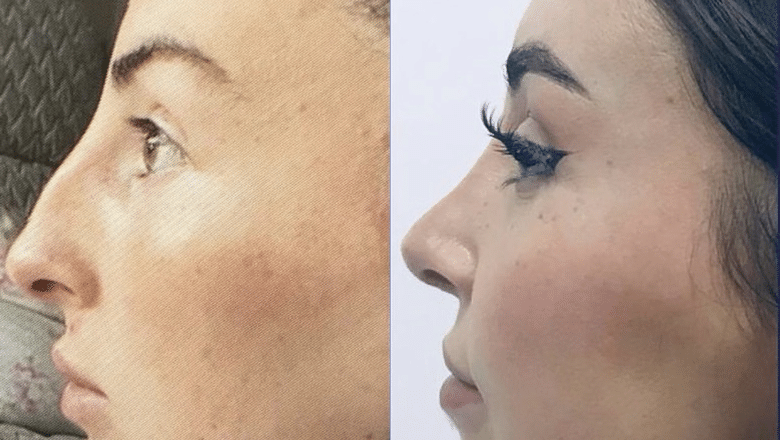
You can see more results in our rhinoplasty before and after photos.
Why Can’t I Smile Properly After a Nose Job?
If your smile feels restricted in the first few weeks, swelling and tightness around the nose and upper lip are by far the commonest explanation, along with simple caution about moving a tender face. This usually improves week by week.
Speak to your surgical team if:
- one side of your smile looks different from the other and is not improving
- a part of the lip or mouth feels weak or does not move
- numbness is spreading rather than shrinking
- you have increasing pain, redness or swelling around the nose or lip
Persistent weakness or a lopsided smile is not what rhinoplasty is expected to cause, and the muscles that move the corners of the mouth are some distance from the surgical site, so any such change deserves an assessment rather than waiting. Our rhinoplasty risks guide sets out which problems are expected, uncommon and rare.
How Do Surgeons Stop a Nose Job Changing Your Smile?
The safeguard is planning, not a single technique. A surgeon who treats smile dynamics as part of the operation will usually:
- Watch you smile and talk at consultation. Looking for a tip that drops, a lip that shortens or a crease in the philtrum on animation shows who has an active DSN. A randomised study of 100 rhinoplasty patients recommended measuring nasal length, tip projection and upper lip height at rest and in a full smile before surgery, and noted that DSN treatment should be considered where the drop in tip projection or lip height on smiling is marked or unsightly[9].
- Take photographs of your smile as well as your resting face, so that the plan is checked against how you actually look.
- Choose the amount of tip rotation to suit your lip, avoiding over-rotation, particularly if the upper lip is already long.
- Support the tip and columella with grafts or sutures matched to the strength of the muscle pull.
- Release or reposition the DSN only when indicated. In a 2014 randomised study in Plastic and Reconstructive Surgery ↗ of 100 patients, the effect of smiling on nasal length, tip projection and upper lip height was significantly reduced after rhinoplasty with either excision of the DSN or its transposition, and the two techniques performed equally[9].
- Go further in more severe cases. A 2005 series of 38 patients with smiling deformity found that repositioning the DSN helped mild cases, but patients with moderate to severe deformity needed the orbicularis oris muscle modified as well; no relapse was seen up to two years[5].
None of this is routine in every nose job. Many people do not need any DSN work. The point is that a surgeon who has looked at your smile can tell you whether you are one of the people who do. Our guide to the revision rhinoplasty service explains how smile-related problems are assessed when they appear after an operation done elsewhere.
Who Is More Likely to Notice a Smile Change After Rhinoplasty?
Nobody can predict this perfectly, but some groups are worth flagging.
- People who already have a tip that drops on smiling. A drooping tip with a long nose has static causes (the shape and position of the cartilages and ligaments) and dynamic ones (the DSN and the muscle that lifts the nostril base). A 2014 review concluded that both need to be considered together to get a satisfactory result[12].
- People with a short upper lip, or a lip that shortens a lot on smiling. A very active DSN is more likely.
- People having significant tip rotation or lengthening of the columella. These manoeuvres have the most direct effect on lip length.
- People who have a lot of gum or tooth show. Their incisor show may change after caudal rhinoplasty manoeuvres, as the cohort study above found.
- People having revision surgery. Scar tissue and prior grafts make the tip less predictable.
A common worry is that a hyperactive DSN, left alone, makes the nose grow longer with age because the tip is pulled down again and again. A 2013 study of 80 parent and child pairs found nasal length increased with age whether or not the DSN was hyperactive, so the muscle was not an effective factor in that increase[13]. The authors said longer prospective studies are needed, so this is reassuring rather than settled.
Can You Have a Nose Job and a Lip Lift Together?
Yes, and some people choose to when the upper lip looks long, or becomes more noticeable once the nose has been reshaped. A lip lift shortens the distance between the nose and the top lip, which is the opposite effect to tip rotation. In a 2026 retrospective study of 40 facial feminisation patients, philtrum length fell by an average of 4.7 mm in the 20 who had a combined rhinoplasty and lip lift, whereas it did not change significantly in the 20 who had rhinoplasty alone[14]. It was a small study in a specific group of patients, so it shows what the combination can achieve rather than what any individual will get.
The interaction works in both directions. If you are thinking about a lip lift, our guide to whether a lip lift changes your nose looks at the other side of the question. Deciding whether to treat the lip at the same time as the nose, or to wait until the nose has settled, is a conversation to have with your surgeon.
What to Ask Your Surgeon About Your Smile Before Rhinoplasty
A few questions make the consultation more useful:
- Have you looked at how my nose and lip move when I smile and talk?
- Is my depressor septi nasi muscle active, and does it need treating?
- How much will my tip be rotated, and what will happen to my upper lip length?
- Will my incisor or gum show change?
- What is temporary swelling, and what is a lasting change?
- Do you photograph my smile before surgery so we can compare afterwards?
At Centre for Surgery, your initial consultation is with the surgeon who will operate. For more on matching the right operation to your nose and face, see our guide to choosing a nose job surgeon in London.
Frequently Asked Questions: Nose Job and Smile
Can a nose job change your smile?
Yes, though most changes are small. Surgery on the tip, columella or base of the nose can alter how the tip moves and how long the upper lip looks when you smile. Many people notice only temporary swelling and tightness in the first weeks.
Why does my upper lip look longer after a nose job?
Usually either swelling or tip rotation. Rotating the tip upwards opens the angle under the nose and can make the lip look longer; one study found around 0.05 mm of extra lip length for each degree of rotation[6]. Swelling can also change how the lip looks during the first weeks.
How long does the upper lip stay swollen after rhinoplasty?
Most visible swelling around the lip eases over the first few weeks, but the nose itself continues to settle for up to a year[8]. Healing varies, so ask your surgeon what is expected for you.
Why can’t I smile properly after a nose job?
The commonest reasons are swelling, tightness and numbness around the nose and upper lip, which improve over weeks. If one side looks different or a movement feels weak and is not improving, contact your surgical team so you can be examined.
Will my smile go back to normal after rhinoplasty?
Most people find that their smile looks natural once swelling settles. A structural change, such as a rotated tip, can be a lasting part of the new nose, so the aim is a change that suits your face rather than a return to the starting point.
Does a nose job change your face?
Yes, in the sense that the nose is the central feature of the face, so reshaping it changes how the other features relate to it, including the lips, chin and eyes. A well-planned nose job should look balanced rather than obvious.
Does a nose job change your eyes?
It does not change the eyes themselves. A change in the height or width of the bridge can alter how far apart the eyes appear and how the area between them looks, so your surgeon should assess this in the planning.
What are the downsides of getting a nose job?
Downsides include swelling that takes months to settle, bruising, numbness, the chance that the result is not what you hoped, and a small risk of complications or revision. Our rhinoplasty risks guide explains each one.
Can I have lip filler after a nose job?
This is best discussed with your surgeon. Most advise waiting until swelling has settled so the new shape of the nose and lip can be judged, and so that filler does not mask the early healing phase.
Can a nose job fix a drooping nose tip when I smile?
Sometimes. When the cause is an overactive depressor septi nasi muscle, releasing or repositioning it along with supporting the tip is one of the approaches described in the surgical literature[10]. A consultation can tell you whether this applies to you.
Nose Job Consultation in London
If you are considering rhinoplasty and want to understand how it could affect your smile, a consultation at our Baker Street hospital is the right first step. We can look at how your nose and upper lip move together and talk through the options. Find out more about rhinoplasty at Centre for Surgery.
Phone: 020 7993 4849 | Address: 95–97 Baker Street, Marylebone, London W1U 6RN
Contact us to schedule a consultation
References
- Beiraghi-Toosi A, Rezaei E, Zanjani E. Relationship between hyperactivity of depressor septi nasi muscle and changes of alar base and flaring during smile. World Journal of Plastic Surgery 2016;5(1):45–50. PMID 27308240 ↗
- Rohrich RJ, Huynh B, Muzaffar AR, Adams WP, Robinson JB. Importance of the depressor septi nasi muscle in rhinoplasty: anatomic study and clinical application. Plastic and Reconstructive Surgery 2000;105(1):376–383. doi:10.1097/00006534-200001000-00059 ↗
- Benlier E, Balta S, Tas S. Depressor septi nasi modifications in rhinoplasty: a review of anatomy and surgical techniques. Facial Plastic Surgery 2014;30(4):471–476. doi:10.1055/s-0034-1383550 ↗
- Arregui JS, Elejalde MV, Regalado J, Ezquerra F, Berrazueta M. Dynamic rhinoplasty for the plunging nasal tip: functional unity of the inferior third of the nose. Plastic and Reconstructive Surgery 2000;106(7):1624–1629. doi:10.1097/00006534-200012000-00031 ↗
- Benlier E, Top H, Aygit AC. A new approach to smiling deformity: cutting of the superior part of the orbicularis oris. Aesthetic Plastic Surgery 2005;29(5):373–377. doi:10.1007/s00266-004-0137-y ↗
- Perkins K, Shah A, Patel A, Steinbacher D. The effect of nasal tip rotation on upper lip length. Aesthetic Surgery Journal 2017;37(5):504–510. doi:10.1093/asj/sjw234 ↗
- Pi H, Kurlander DE, Guyuron B. Effects of the rhinoplasty maneuvers on upper lip position and incisor show. Aesthetic Plastic Surgery 2017;41(1):135–139. doi:10.1007/s00266-016-0760-4 ↗
- Pavri S, Zhu VZ, Steinbacher DM. Postoperative edema resolution following rhinoplasty: a three-dimensional morphometric assessment. Plastic and Reconstructive Surgery 2016;138(6):973e–979e. doi:10.1097/PRS.0000000000002760 ↗
- Kalantar-Hormozi A, Beiraghi-Toosi A. Smile analysis in rhinoplasty: a randomized study for comparing resection and transposition of the depressor septi nasi muscle. Plastic and Reconstructive Surgery 2014;133(2):261–268. doi:10.1097/01.prs.0000436850.86785.24 ↗
- Tellioglu AT, Inozu E, Ozakpinar R, et al. Treatment of hyperdynamic nasal tip ptosis in open rhinoplasty: using the anatomic relationship between the depressor septi nasi muscle and the dermocartilaginous ligament. Aesthetic Plastic Surgery 2012;36(4):819–826. doi:10.1007/s00266-012-9893-2 ↗
- Bayramiçli M, Dogan ZA. Transection of the nasal base muscles for the correction of plunging tip: an outcome analysis. Aesthetic Surgery Journal 2018;38(9):951–961. doi:10.1093/asj/sjy063 ↗
- Park SG, Jeong H, Ye CH. Multifactorial approaches for correction of the drooping tip of a long nose in East Asians. Archives of Plastic Surgery 2014;41(6):630–637. doi:10.5999/aps.2014.41.6.630 ↗
- Beiraghi-Toosi A, Rezaei E, Jabbari Nooghabi M, Izadpanah S. Effect of depressor septi nasi muscle activity on nasal lengthening with time. Aesthetic Plastic Surgery 2013;37(5):984–988. doi:10.1007/s00266-013-0137-x ↗
- Moscarelli J, Kauke-Navarro M, Singh N, et al. Efficacy and morphometric outcomes of combined rhinoplasty-lip lift for facial feminization surgery. Journal of Craniofacial Surgery 2026;37(7-8):1905–1909. doi:10.1097/SCS.0000000000012538 ↗

Related Articles
- What is a Bulbous Nose? – Nose Surgery Options
- Can Nose Anatomy Influence Rhinoplasty Outcomes?
- What is a Perfect Nose?






