


In this guide13 sections
- Key Points
- Why Do Breasts Sag After Weight Loss?
- Does Losing Weight Make Your Boobs Smaller?
- What Do Breasts Look Like After Weight Loss?
- Weight-Loss Injections and “Ozempic Breasts”
- Can You Fix Saggy Breasts After Weight Loss Without Surgery?
- Surgery for Sagging Breasts After Weight Loss
- When Should You Have a Breast Lift After Weight Loss?
- Breast Lift After Weight Loss: Recovery, Scars and Results
- How Much Does a Breast Lift After Weight Loss Cost?
- Breast Surgery After Weight Loss at Centre for Surgery
- Frequently Asked Questions About Sagging Breasts After Weight Loss
- References
Key Points
- Breasts sag after weight loss because fat shrinks faster than skin. The fat inside the breast goes, but the skin and the ligaments that held it up have already stretched and don’t shrink back to match.
- Big weight loss is a proven risk factor. In a study of 132 women, losing more than about 23 kg (50 lb) independently predicted more severe sagging, alongside age, pregnancies, smoking, BMI and cup size.
- Most women’s breasts get smaller, but not all. How much size you lose depends on how much of your breast was fat rather than glandular tissue.
- “Ozempic breasts” is the same process, only faster. Weight-loss injections don’t act on the breast directly. Losing weight quickly gives the skin less time to adapt, so the change can look more dramatic.
- Nothing but surgery reverses it. Regaining weight refills the breast with fat but doesn’t restore its shape or position, and exercise can’t tighten stretched skin.
- The operation depends on your size goal. A breast lift if you’re happy with your size, a lift with implants if you want more fullness, or a reduction if your breasts are still large. Wait until your weight has been stable for at least three to six months.
Losing a large amount of weight changes almost every part of the body, and the breasts are often where it shows most. Many women find their breasts are smaller, flatter at the top and lower on the chest than before, with nipples that point down and skin that feels loose. It’s common, it isn’t a sign that anything has gone wrong, and it can be corrected with a breast lift once your weight has settled.
This guide explains why breasts sag after weight loss, whether they get smaller, what weight-loss injections do, and which operation suits which result. Sagging after weight loss is one form of breast ptosis; if you want the general picture of why breasts sag, our guide to saggy boobs covers every cause.
Why Do Breasts Sag After Weight Loss?

A breast is made of fat, glandular tissue and skin, held in shape by the Cooper’s ligaments that run through it. It has no muscle of its own. When you gain weight, the fat in the breast grows and the skin and ligaments stretch to hold it. When you lose that weight, the fat shrinks, but the stretched skin and ligaments don’t shrink back to the same degree.
The result is a skin envelope that’s now too big for what’s inside it. The remaining tissue settles to the bottom of that envelope, the upper half of the breast empties, and the nipple drops lower on the chest. That’s why breasts after weight loss often look deflated and droopy at the same time, rather than simply smaller.
How much this happens depends on several things. In a 2010 study of 132 women published in the Annals of Plastic Surgery ↗, losing more than about 23 kg (50 lb) was an independent risk factor for more severe sagging, along with age, the number of pregnancies, smoking, a higher BMI and a larger bra cup size.[1] In practice the change tends to be greater when:
- You’ve lost a lot of weight. The more fat the breast loses, the bigger the gap between skin and contents.
- You were heavier for a long time. Skin that has been stretched for years recovers less.
- You’re older. Skin loses collagen and elasticity with every decade, so it contracts less after weight loss.
- You’ve had children. Pregnancy stretches the breast too, and the effects add up. See sagging breasts after breastfeeding.
- Your weight has gone up and down repeatedly. Each cycle stretches the skin again.
Does Losing Weight Make Your Boobs Smaller?
Usually, yes. Breast tissue is a mix of fat and glandular (milk-producing) tissue, and only the fat shrinks when you lose weight. Most women’s breasts are largely fat, so they get noticeably smaller. Women whose breasts are more glandular, which is more common when you’re younger, often find their breasts change less even after a lot of weight loss.
It isn’t possible to lose weight from the breasts only, or to protect them while you lose weight elsewhere. Where your body takes fat from first is largely genetic. Some women lose breast size early in a diet; others notice it only near the end.
If you regain weight, the breasts usually get bigger again, because the fat returns. What doesn’t return is the shape. The skin has already stretched, so regained volume tends to sit low in the breast rather than restoring the fullness at the top. Breast tissue that was lost doesn’t grow back in its old shape on its own.
What Do Breasts Look Like After Weight Loss?
Weight loss changes the breasts in five main ways, and most women notice a combination:
- Size. The breast gets smaller as fat is lost, often by one or more cup sizes.
- Loose skin. The skin feels soft and slack, sometimes with new stretch marks, and can wrinkle when you lean forward.
- Empty upper breast. The upper half flattens and the remaining tissue collects at the bottom of the breast.
- Lower position. The breast and nipple sit lower on the chest, and the nipple may point downwards.
- Asymmetry. One breast often loses more volume or drops further than the other. Our guide to uneven breasts explains why.
Surgeons describe how far the breast has dropped using breast ptosis grades, based on where the nipple sits compared with the crease under the breast. In a 2015 series of 90 women having breast reshaping after bariatric surgery, published in Obesity Surgery ↗, the most common finding was grade 2 ptosis, where the nipple has dropped below the crease but still sits above the lowest point of the breast.[2]
Deflated or Sagging? Why the Difference Matters
After weight loss, some breasts have mainly lost volume and still sit reasonably high, with the nipple level with or above the crease. Others have also dropped, with the nipple below the crease. The first is mostly a volume problem; the second is a position problem, and usually both.
The difference decides the treatment. Volume loss on its own can often be treated with implants or fat transfer, while a nipple below the crease needs a lift to move it back up. Our guide to deflated breasts covers the volume side in more detail.
Weight-Loss Injections and “Ozempic Breasts”
“Ozempic breasts” is the name people use online for breasts that have emptied and dropped after weight loss with GLP-1 injections such as semaglutide or tirzepatide. The medicines don’t act on breast tissue directly. What they do is cause a lot of weight loss, often quickly, and that has the same effect on the breast as any other large weight loss: the fat goes and the stretched skin is left behind.
The speed may matter. When weight comes off over a few months rather than a few years, the skin has less time to contract, so the change can look more sudden and more marked. A 2024 review of the cosmetic effects of GLP-1 weight loss described volume loss, skin laxity and changes in body contour as common consequences, while noting that there is still very little research measuring them directly.[4] No study has yet looked specifically at the breast.
If you’re using a weight-loss injection and thinking about breast surgery, three things matter:
- Wait until your weight has stopped falling. Operating while you’re still losing weight means the breast may change again afterwards.
- Think about what happens when you stop. Many people regain some weight after coming off these medicines. Your surgeon will want to plan around the weight you expect to maintain.
- Tell your surgeon and anaesthetist. These medicines slow how quickly the stomach empties, which matters for anaesthesia.[5] You’ll be given specific instructions about whether and when to pause the medication before your operation.
The same pattern in the face is often called “Ozempic face” (or Mounjaro face when the drug is tirzepatide), and the treatment logic is the same: restore volume where it’s been lost, and remove or tighten skin where it’s been left behind.
Can You Fix Saggy Breasts After Weight Loss Without Surgery?
No. Once the skin and ligaments have stretched, nothing applied from outside the body can shorten them again or move the nipple back up. That’s frustrating to hear after the effort of losing weight, but it’s better to know than to spend money on things that won’t work.
What non-surgical measures can do is change how the breasts look while you’re using them:
- A well-fitted bra. Full cups and a firm band lift the breast and fill out the top. Get measured again after weight loss, because your size will have changed.
- Chest exercises. Press-ups and chest presses build the pectoral muscle behind the breast, which can improve the shape of the upper chest and your posture. The breast sits in front of the muscle, so it doesn’t lift.
- Creams and oils. These keep the skin comfortable but don’t tighten it.
- Energy-based skin tightening. Treatments discussed in our guide to the non-surgical breast lift can firm the skin a little in mild cases, but can’t correct a breast that has dropped below the crease.
Putting weight back on doesn’t fix it either. It refills the breast with fat, but the fat tends to sit low in the stretched skin rather than restoring the old shape.
Surgery for Sagging Breasts After Weight Loss

Breast surgery after weight loss is planned around two questions: how far has the breast dropped, and what size do you want to be? The answers point to one of five operations, sometimes combined with body contouring elsewhere. Our guide to types of breast lifts compares the incision patterns in detail.
Breast Lift After Weight Loss (Mastopexy)
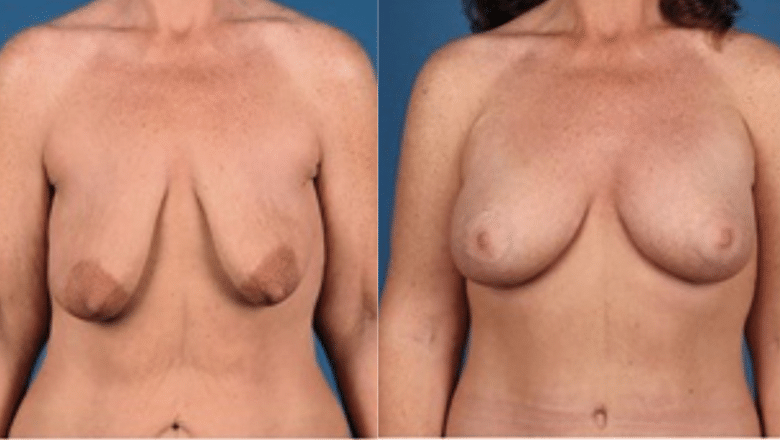
If you’re happy with your size but not your shape, a breast lift is the main operation. It removes the loose skin, moves the nipple and areola back up, and reshapes the remaining breast tissue into a higher, rounder breast. After major weight loss the reshaping matters as much as the skin removal: surgeons often fold and secure the breast tissue itself to rebuild fullness at the top, rather than only tightening the skin around it.[3]
The incision pattern depends on how far the breast has dropped. Mild sagging may need only a scar around the areola; more commonly after large weight loss, a vertical (lollipop) lift or an anchor (inverted-T) lift is needed to remove enough skin. A lift doesn’t add volume and can make the breast look slightly smaller, because skin is removed.
Breast Lift With Implants
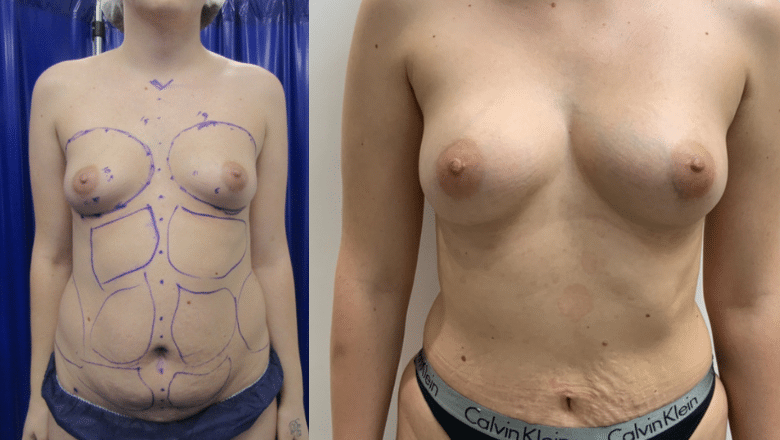
If your breasts have emptied as well as dropped and you’d like more fullness, a breast lift with implants (augmentation mastopexy) restores volume and position together. It’s often the most complete answer after large weight loss, because it deals with both the empty upper breast and the loose skin. At Centre for Surgery we use Silimed implants.
After major weight loss, surgeons are cautious about implant size. Skin that has been stretched by weight loss tends to stretch again, and a large implant adds to the load on it. A lift with a modest implant usually gives a more lasting shape than a large implant alone. Where the nipple needs to move a long way, the lift and the implants can be done as two separate operations.

Breast Augmentation After Weight Loss
Implants on their own suit a small group of women: those who have mainly lost volume, whose nipple is still level with or above the crease, and whose skin has kept reasonable elasticity. Breast augmentation fills the empty upper breast and can lift a mildly sagging nipple slightly. If the nipple is below the crease, an implant alone tends to sit high while the breast hangs over it, so a lift is needed as well. In women who have lost a very large amount of weight, sagging also tends to come back sooner when implants are used without a lift.
Fat Transfer to the Breasts
Fat transfer uses liposuction to take fat from elsewhere and inject it into the breasts. It gives a modest, natural increase, typically around one to one and a half cup sizes, and can be combined with a lift. After large weight loss, the limiting factor is often whether you still have enough spare fat to harvest.
Breast Reduction After Weight Loss
Some women still have large, heavy breasts after losing weight, particularly if their breasts were mostly glandular. A breast reduction removes tissue and skin and lifts the nipple in the same operation, so it treats sagging and size together. It can also relieve neck, back and shoulder strain.
Combining Breast Surgery With a Tummy Tuck or Arm Lift
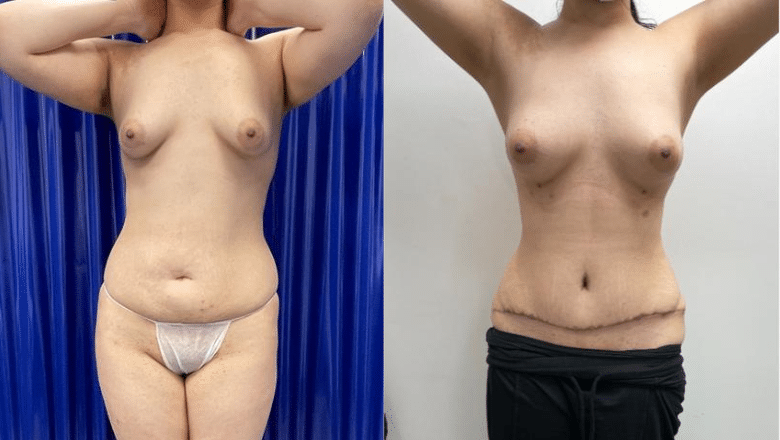
Loose skin after weight loss rarely affects the breasts alone. Many women also have loose skin on the tummy, arms or thighs, and some operations can be combined to reduce the number of recoveries. Combining breast surgery with a tummy tuck is common. Longer combinations are often split into stages for safety, and your surgeon will advise on what can be done together. Our guides to loose skin after weight loss and post weight loss surgery cover the other areas.
When Should You Have a Breast Lift After Weight Loss?
The most important rule is to wait until your weight is stable. Our surgeons recommend that your weight has been steady for at least three to six months before a breast lift, ideally at a weight you’re confident you can maintain. After bariatric surgery that usually means waiting 12 to 18 months after the operation, because weight often keeps falling for a year or more.
Operating too early risks the breast changing again. If you lose a lot more weight after a lift, the breast can empty and drop further; if you regain a lot, the skin stretches again. A future pregnancy has the same effect, so many women wait until they’ve finished having children.
Your general health matters too. Recovery and wound healing are better when any weight-related conditions such as diabetes are well controlled. If you smoke, you’ll need to stop for at least four weeks before surgery and four weeks afterwards, because smoking significantly increases the risk of wound-healing problems.
Breast Lift After Weight Loss: Recovery, Scars and Results
A breast lift at Centre for Surgery takes around one and a half to three hours, longer when combined with implants or other procedures, and is done as a day case under TIVA (total intravenous anaesthesia). You’ll need a responsible adult to take you home and stay with you for 24 hours. Most people take one to two weeks off desk-based work and avoid heavy lifting and strenuous exercise for about six weeks. Our breast lift recovery guide goes through each stage.
Scars follow the incision pattern and usually fade to fine pale lines over 12 to 18 months; our guide to breast lift scars covers how to look after them. After major weight loss the scars can be longer, because more skin needs removing.
Results are usually very satisfying. In the series of 90 women having breast reshaping after bariatric surgery, satisfaction with breast appearance and psychological and physical wellbeing all improved significantly on a validated questionnaire.[2] The most common complications were delayed wound healing, unfavourable scarring, bleeding under the skin (haematoma) and fluid collection (seroma). Skin that has been through large weight loss is less elastic, so some settling over the following years is normal. Keeping your weight stable is the best way to protect the result.
How Much Does a Breast Lift After Weight Loss Cost?
The cost depends on the operation you need: a lift on its own, a lift with implants, or a lift combined with other procedures such as a tummy tuck. Our breast lift cost guide explains what affects the price, and your exact figure is confirmed in writing after your consultation.
Breast lifts after weight loss are rarely funded by the NHS, because they’re usually classed as cosmetic. Our guide to skin removal surgery on the NHS after weight loss explains the criteria some areas use and why most people go private.
Breast Surgery After Weight Loss at Centre for Surgery
At Centre for Surgery, breast lifts, augmentations and reductions are performed by GMC-registered plastic surgeons, at our CQC-regulated hospital at 95–97 Baker Street, rated Good overall. The surgeon who assesses you at consultation is the surgeon who performs your operation. They will examine and measure both breasts, check your skin quality and ptosis grade, talk through the size you want, and recommend the least extensive operation that will give you a lasting result.
Your initial consultation fee is redeemable against the cost of surgery if you go ahead. Finance is available through Chrysalis Finance, subject to status. You can see more results in our breast lift before and after gallery.
Frequently Asked Questions About Sagging Breasts After Weight Loss
How much weight loss causes breasts to sag?
There’s no fixed amount. In one study, losing more than about 23 kg (50 lb) was an independent risk factor for more severe sagging, but smaller losses can cause noticeable change too, especially with age, after pregnancy or with repeated weight cycling.
Will my breasts go back to normal if I put weight back on?
They’ll usually get bigger again, because the fat returns, but the shape rarely goes back to how it was. The skin has already stretched, so the regained volume tends to sit low in the breast.
Can breast tissue grow back after weight loss?
The fat can come back if you regain weight, but lost volume doesn’t rebuild the breast’s old shape on its own. Implants or fat transfer are the reliable ways to restore fullness.
How can I regain breast size after weight loss?
Breast augmentation with implants is the most predictable way to restore size. Fat transfer gives a smaller, more natural increase if you have enough fat to spare. If your breasts have also dropped, a lift with implants restores size and position together.
How do I tighten breast skin after weight loss?
Stretched breast skin can only be tightened reliably by removing the excess, which is what a breast lift does. Creams, exercise and skin-tightening devices may help the skin’s texture slightly but don’t remove loose skin.
Does losing weight slowly stop breasts sagging?
It may help a little, because the skin has more time to adapt, but there’s no good evidence that slow weight loss prevents sagging. How much you lose, your age, your skin and your pregnancy history matter more.
Should I lose more weight before a breast lift?
If you’re planning to lose more, yes: have surgery once you’ve reached a weight you can maintain and it has been stable for at least three to six months. Losing a lot of weight after a lift can undo part of the result.
Do weight-loss injections make your boobs sag?
Not directly. They cause weight loss, and large or fast weight loss makes breasts smaller and saggier whatever the method. If you’re on a weight-loss injection and considering surgery, wait until your weight has stabilised and tell your surgeon and anaesthetist you’re taking it.
Will I need a tummy tuck as well?
Not necessarily, but many women who’ve lost a lot of weight have loose skin on the tummy as well as the breasts. Your surgeon can assess both at consultation and advise whether combining or staging the operations makes sense.
Can I get a breast lift on the NHS after weight loss?
Rarely. Most NHS areas class a breast lift after weight loss as cosmetic and don’t fund it, though criteria vary. Most people have the operation privately.
Can sagging breasts cause a rash underneath?
Yes. When a breast rests on the chest wall, the fold underneath traps warmth and moisture, and skin rubbing on skin there can lead to intertrigo: a red, sore or itchy rash that is often complicated by yeast (candida). A 2018 review in Clinical, Cosmetic and Investigational Dermatology ↗ notes that its pain and itching can significantly reduce quality of life[6]. Keeping the fold clean and dry and wearing a supportive cotton bra help, and our guide to rash under the breast covers treatment. A breast lift raises and reshapes the breast, but it is an elective operation and the rash itself is treated first.
Can weight loss make my breasts uneven?
Breasts are rarely a perfect match, and the difference tends to grow with size: a 2022 study measuring 65 women found that asymmetry in breast volume and nipple position increased as breasts got larger[7]. As your breasts change size with weight loss, a difference that was always there can look different, and a lift, implants or fat transfer can be planned side by side to even it out (see uneven breasts and breast asymmetry correction). One breast changing on its own, with swelling, shrinking, a lump or a nipple turning inwards, is not a weight-loss effect and should be checked by a GP[8].
References
- Rinker B, Veneracion M, Walsh CP. Breast ptosis: causes and cure. Ann Plast Surg. 2010;64(5):579-84. doi:10.1097/SAP.0b013e3181c39377 ↗
- Vindigni V, Scarpa C, Tommasini A, et al. Breast reshaping following bariatric surgery. Obes Surg. 2015;25(9):1735-40. doi:10.1007/s11695-015-1613-y ↗
- Beidas OE, Rubin JP. Breast reshaping after massive weight loss. Clin Plast Surg. 2019;46(1):71-76. doi:10.1016/j.cps.2018.08.009 ↗
- Haykal D, Hersant B, Cartier H, Meningaud JP. The role of GLP-1 agonists in esthetic medicine: exploring the impact of semaglutide on body contouring and skin health. J Cosmet Dermatol. 2025;24(2):e16716. doi:10.1111/jocd.16716 ↗
- Humphrey CD, Lawrence AC. Implications of Ozempic and other semaglutide medications for facial plastic surgeons. Facial Plast Surg. 2023;39(6):719-721. doi:10.1055/a-2148-6321 ↗
- Metin A, Dilek N, Bilgili SG. Recurrent candidal intertrigo: challenges and solutions. Clin Cosmet Investig Dermatol. 2018;11:175-185. doi:10.2147/CCID.S127841 ↗
- Kasielska-Trojan A, Zawadzki T, Antoszewski B. Breast fluctuating asymmetry in women with macromastia/gigantomastia. Int J Environ Res Public Health. 2022;19(24):16895. doi:10.3390/ijerph192416895 ↗
- NHS. Symptoms of breast cancer in women. nhs.uk ↗

If your breasts have changed after weight loss, a consultation at Centre for Surgery will tell you how much they’ve dropped, which operation would give you the shape and size you want, and when is the right time to have it. Call 020 7993 4849 or complete the form below.






