



Mummy Makeover London: Mommy Makeover Surgery in the UK

A Mummy Makeover is a combination of surgical procedures performed in a single session to address the physical changes of pregnancy and breastfeeding. It most commonly combines breast surgery — augmentation, lift, reduction or a combination — with a full abdominoplasty and liposuction. Additional procedures such as a mons lift, labiaplasty or umbilicoplasty can be included depending on individual anatomy and goals.
You will also see the procedure written as a mommy makeover — the American spelling, and the more common term internationally. Both describe exactly the same combination of procedures, and a mommy makeover cost quote and a mummy makeover cost quote are quotes for the same operation. We use the British spelling throughout this page, but patients searching either term are in the right place.
Pregnancy and breastfeeding cause a defined set of physical changes. The breasts lose volume, the nipple descends, the skin envelope stretches and the glandular tissue deflates. The abdomen undergoes permanent changes — muscle separation (diastasis recti), skin laxity, stretch marks and stubborn fat deposits that do not respond to diet or exercise. These are structural changes that cannot be reversed by non-surgical means — a pattern covered in our guide to the mummy tummy.
The primary clinical rationale for combining procedures in a single session is efficiency — one anaesthetic, one recovery period, and a surgical plan designed to balance proportions across the breast and abdomen simultaneously. A Mummy Makeover designed as a whole produces a more coherent result than the same procedures staged separately over months.
Combining procedures is not right for everyone. A longer operation carries a higher complication rate than the same procedures performed separately, and the recovery is more demanding — which matters when you have young children at home. Our guide to combining cosmetic surgery procedures sets out how that trade-off is weighed, and your surgeon will tell you honestly if staging would be safer in your case.
Timing matters too. Surgery is best undertaken once you have finished having children, are no longer breastfeeding, and your weight has been stable for at least six months, ideally twelve after major weight loss — our guide to a mummy makeover after pregnancy covers when to consider it.
Where appropriate, procedures are performed as a day case under TIVA (Total Intravenous Anaesthesia) at our CQC-regulated Baker Street facility by GMC-registered surgeons. We recommend a two-week cooling-off period. We perform mummy makeover UK-wide from our London clinic, treating patients from across the capital and the rest of the country, with virtual consultations available for those travelling from outside London — see our guide to travelling to us for surgery for how appointments, hotels and the day itself are arranged.
What the weeks afterwards involve is set out in our mummy makeover recovery guide.
Alternative names this procedure is known by: mommy makeover, mummy makeover surgery, mommy makeover surgery, post-pregnancy surgery, post-baby body surgery, and combined breast and tummy tuck surgery.
Mummy Makeover at a Glance
These are typical timeframes for a tummy tuck combined with breast surgery — recovery is governed mainly by the abdominal component, so your own timeline depends on which procedures are included. The procedure is recommended only once your family is complete, as a later pregnancy will re-stretch the muscle repair and tightened skin.
Considering a mummy makeover?Speak to a plastic surgeon about which procedures to combine, and which are better staged. No obligation, and no pressure to book.
Which body procedure is right for you?
A few short questions, including a simple pinch test you can do now. You will get a suggested procedure, realistic recovery times, and a straight answer if surgery should wait.
What Does a Mummy Makeover Include?
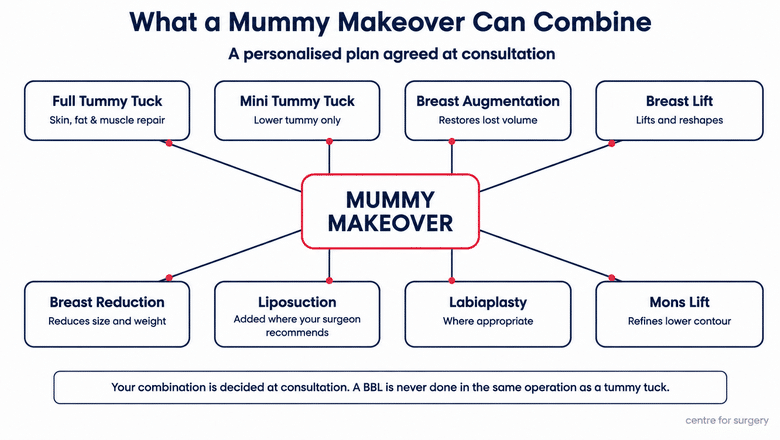
A Mummy Makeover has no fixed definition. The combination of procedures is determined at consultation based on individual anatomy, the changes you want to address, and your surgeon’s clinical assessment. The procedures most commonly included are:
Breast surgery
- Breast augmentation — restores volume lost following pregnancy and breastfeeding. Appropriate where skin envelope tone is adequate and the nipple position is acceptable.
- Breast lift (mastopexy) — repositions a descended nipple, removes excess skin and reshapes the breast. Performed with or without implants depending on whether volume restoration is also needed.
- Breast augmentation with lift — the most common breast combination in a Mummy Makeover, addressing both volume loss and nipple descent together.
- Breast reduction — for patients whose breasts enlarged significantly following pregnancy, causing back pain, posture problems or skin irritation in the breast fold.
Abdominal surgery
- Full abdominoplasty — removes excess skin from the upper and lower abdomen, repairs diastasis recti, repositions the umbilicus and can include liposuction of the abdomen and flanks where your surgeon recommends it.
- Mini abdominoplasty — removes lower abdominal skin excess below the umbilicus without belly button repositioning. No drains required.
- Liposuction — where skin elasticity is good and fat is the primary concern without significant skin laxity or muscle separation. Where your surgeon recommends it alongside an abdominoplasty, liposuction at the same session is included in your written quote.
Additional procedures
- Mons lift (monsplasty) — reduces a prominent mons pubis. Commonly added to abdominoplasty where the mons needs to be addressed simultaneously for a continuous lower contour.
- Labiaplasty — for patients who have experienced labial enlargement following pregnancy and hormonal changes.
- 360° liposuction — circumferential contouring of the waist and flanks for patients wanting a more extensive result than liposuction of the abdomen and flanks alone.
- Fat transfer to the hips — fat harvested during liposuction can be purified and reinjected into the hips to enhance and balance the hip and thigh contour, where this fits the patient’s goals.
Your surgeon will confirm the appropriate combination at consultation after a full clinical assessment. See our full mummy makeover cost guide for indicative pricing on the common combinations.
Before & After Photos
All photographs are taken with full written patient consent. They represent a selection of cases performed at Centre for Surgery — a wider range is available to view at consultation. Individual results vary.
These photos include nudity
Clinical photos of real patients, shared with their consent.
How Pregnancy Changes the Breasts — and How Each Procedure Addresses It

Breast changes following pregnancy and breastfeeding fall into two categories: volume loss and ptosis (descent and drooping). Most women experience both to varying degrees. The appropriate breast procedure depends on the relative extent of each — your surgeon will assess this at consultation.
Breast augmentation
Breastfeeding causes glandular deflation — the breast tissue shrinks as lactation ceases, often leaving the skin envelope larger than the tissue within it. This produces a flat, empty or tubular appearance rather than the rounded breast present before pregnancy. Implants restore volume within the existing skin envelope. Where the skin envelope has adequate tone and the nipple position is acceptable, augmentation alone produces a full, natural result.
At Centre for Surgery, breast augmentation is performed under TIVA through an inframammary incision — the scar sits within the natural crease of the breast. Implants are placed subpectorally or in the dual-plane position depending on tissue coverage and the preferred outcome. See: breast surgery overview.
Breast lift (mastopexy)
Where the nipple has descended to or below the inframammary fold, or sits at the lower pole of the breast, augmentation alone will not produce an acceptable result — the breast needs to be reshaped and the nipple repositioned upward. A breast lift removes the excess skin envelope, reshapes the breast mound and repositions the nipple-areola complex. It is performed with implants where volume restoration is also needed, or without implants where the volume is adequate. Where liposuction is recommended alongside the abdominoplasty, the fat removed can also be used to add modest natural volume in the upper pole at the same session.
Breast augmentation with lift
The most common breast combination in a Mummy Makeover. Pregnancy frequently causes both deflation and descent — augmentation restores volume while the lift reshapes the envelope and repositions the nipple. This is technically more complex than either procedure alone and requires careful planning of implant volume relative to skin resection.
Breast reduction
For patients whose breasts enlarged during pregnancy and did not return to a comfortable size after breastfeeding — causing back and neck pain, posture problems, bra strap grooving or skin irritation under the breast fold — breast reduction removes excess breast tissue, reshapes and lifts the breast and repositions the nipple. It is one of the highest-satisfaction procedures in plastic surgery. The functional relief from properly sized breasts is significant and immediate.
Timing matters here — our guide to how soon after pregnancy you can consider a breast lift explains why the breast needs to settle first.
How Pregnancy Changes the Abdomen — and Choosing the Right Procedure

The abdominal component of a Mummy Makeover is selected based on three factors: the extent and distribution of skin laxity, the degree of diastasis recti, and the volume and distribution of fat deposits. The right choice varies significantly between patients and is confirmed at consultation after a full physical examination.
Full abdominoplasty
The appropriate procedure where skin laxity extends above the umbilicus, where significant diastasis recti is present throughout the abdominal wall, or where the belly button needs repositioning. A full tummy tuck removes excess skin from the entire abdomen, repairs the rectus abdominis muscles at the midline, repositions the umbilicus and can include liposuction of the abdomen and flanks where your surgeon recommends it.
Procedure time: 3–4 hours standalone, 5–6 hours combined with breast surgery. Day case — patients are admitted and discharged the same day.
See: Full abdominoplasty | Tummy tuck with muscle repair | Diastasis recti after pregnancy
Mini abdominoplasty
Appropriate where skin laxity is confined to the lower abdomen below the umbilicus, BMI is below 23, and the belly button does not need repositioning. Uses progressive tension sutures — no drains required. Liposuction can be added where your surgeon recommends it.
See: Mini tummy tuck
Liposuction without a tummy tuck
Where abdominal skin elasticity is good and fat is the primary concern without significant skin excess or muscle separation, liposuction alone may be appropriate. This is less common in post-pregnancy patients but is the right choice for those whose primary abdominal change is localised fat rather than skin laxity. Where your surgeon recommends liposuction alongside a tummy tuck, it is included in your written quote.
Choosing between them
If you have any skin laxity above the umbilicus, or significant muscle separation, a full abdominoplasty will produce the most complete result. A mini tummy tuck applied to a patient who needs a full abdominoplasty will produce an incomplete result. Your surgeon will confirm which is appropriate at consultation based on clinical examination. See our full mummy makeover cost guide for indicative pricing by combination.
See: Tummy tuck vs liposuction | Loose skin after pregnancy | Stretch marks after pregnancy
Who Is Suitable for a Mummy Makeover?
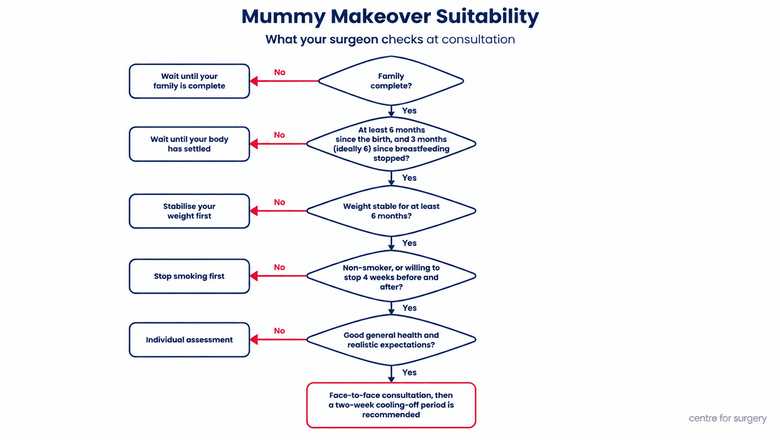
A Mummy Makeover is appropriate for women who have completed their family and have breast and abdominal changes from pregnancy that have not resolved through diet and exercise. The procedures involved are major surgical interventions — candidacy criteria apply to each component.
Core criteria
- Family complete — future pregnancy will re-stretch the repaired abdominal muscles, re-create skin laxity and can significantly alter breast surgery results. The procedure is recommended only for patients who are not planning further pregnancies.
- At least three months after completely stopping breastfeeding, ideally around six — the breasts need to settle into their post-breastfeeding state before breast surgery is planned. Their size and shape change significantly during and after lactation, and operating before they have settled increases the risk of an unsatisfactory result.
- Stable weight for at least six months, ideally twelve after major weight loss — surgery on a body that is still changing reduces the longevity of the result. Significant planned weight loss should be completed before proceeding.
- BMI of 30 or below for abdominoplasty — patients above this threshold are advised to reach a healthier weight before proceeding.
- Non-smoker, or willing to stop smoking at least four weeks before and four weeks after surgery — smoking significantly increases wound healing complications in abdominoplasty, where the risk of wound breakdown is already higher than in most procedures due to the extensive skin flap.
- Good general health — no active medical conditions that would significantly increase anaesthetic or surgical risk.
- Realistic expectations — the procedures address specific anatomical concerns from pregnancy. They produce permanent scars and cannot guarantee a specific outcome.
Timing after pregnancy
We recommend waiting at least six months after delivery before proceeding, and at least three months, ideally around six, after completely stopping breastfeeding. This ensures weight has stabilised, the abdominal wall has recovered and the breasts have settled.
Choosing the time of year
Once the core timing criteria above are met, the specific time of year is a personal scheduling decision rather than a clinical one. Some patients prefer to have surgery in winter or early spring, giving a full recovery window before summer holidays and swimwear season. Others find the school term more practical, since childcare tends to be more manageable once older children are back in school. There’s no clinically preferable time of year — it comes down to whichever arrangement gives you the most support during your recovery period.
On timing more broadly, our guides cover how soon after pregnancy a mummy makeover is sensible and whether to proceed if you plan more children.
Recovery After a Mummy Makeover

Mummy Makeover recovery is governed primarily by the abdominal component. Recovery from breast surgery alone is typically complete within two to three weeks; abdominoplasty requires six weeks before full activity resumes. Plan for the abdominoplasty recovery timeline when preparing.
All procedures are performed as a day case at our Baker Street clinic. You are discharged the same day once TIVA has fully resolved and the nursing team is satisfied with your condition.
Our fuller mummy makeover recovery guide sets out the timeline week by week, including how combining procedures changes what the first fortnight looks like.
Day of surgery and first 48 hours
A responsible adult must accompany you home and remain with you for at least 24 hours. Where a full tummy tuck is included, abdominal drains will be in place — these usually come out at the clinic within the first week, once drainage has slowed. Pain is managed with paracetamol. The abdominal tightness is the dominant sensation; a slightly bent posture when walking is normal in the first week. Avoid lifting, bending and straining. You have your surgeon’s direct number for the first 24 hours.
Weeks one and two
Most patients take two weeks away from work for desk-based roles — more for physically demanding work. Avoid driving for two weeks. Light walking from day one is encouraged to reduce DVT risk. Childcare assistance for young children should be arranged for at least the first three weeks.
Compression garments
Worn continuously for six weeks — one for the abdominal area, one for the breast area where breast surgery is included. Remove only briefly for showering.
Weeks two to six
Strenuous exercise and lifting should be avoided for six weeks. Abdominal core exercises must be avoided for three months to protect the muscle repair. Light gym activity can typically resume at six weeks subject to surgeon review.
Six-week surgeon review
Face-to-face review included in your treatment package. Most swelling will have resolved and the profile of results will be clearly visible. Scar management guidance begins at this appointment.
Final results
Initial results visible from six to eight weeks. Full results visible at 12 to 18 months, with scar maturation continuing for up to 24 months.
Two questions come up constantly in this period: how to sleep after a mummy makeover, and when exercise can resume — both covered in the recovery guide.
Risks of Mummy Makeover Surgery
A Mummy Makeover involves multiple major surgical procedures and carries the combined risk profile of each component. All risks are discussed in full at consultation and documented in your consent paperwork.
Risks specific to abdominoplasty
- Wound breakdown — the most significant risk in abdominoplasty, higher than in most cosmetic procedures due to the extensive skin flap under tension. Smoking is the single most important modifiable risk factor — you must stop smoking at least four weeks before and after surgery.
- Seroma — fluid accumulation under the skin flap; the most common complication. Drains reduce but do not eliminate this risk.
- Haematoma — blood collection; may require surgical drainage if significant.
- Venous thromboembolism (DVT/PE) — minimised by early mobilisation from day one, compression devices used during surgery, and TIVA which avoids the prolonged immobility of inhalational anaesthetic recovery.
- Scar complications — hypertrophic or widened scarring, particularly in smokers.
- Umbilicus complications — altered shape, position or, rarely, partial necrosis of the repositioned belly button.
Risks specific to breast surgery
- Implant complications (where augmentation is performed) — capsular contracture, implant displacement, implant rupture. Breast implants used at Centre for Surgery carry a 10-year manufacturer guarantee covering rupture and grade III–IV capsular contracture.
- Changes in nipple sensation — temporary or permanent altered sensitivity following mastopexy or reduction.
- Asymmetry — minor differences in breast size, shape or position.
- Scarring — more extensive with mastopexy and reduction than with augmentation alone.
- Effects on future breastfeeding — depending on incision type and extent of surgery; discussed at consultation.
General risks
- Infection — managed with antibiotics in most cases.
- Anaesthetic risks — minimised by TIVA and consultant anaesthetist involvement throughout.
- Need for revision surgery.
Centre for Surgery performs over 100 Mummy Makeover procedures per year. All patients receive anti-embolic stockings and sequential compression devices during surgery to reduce DVT risk. Four-week smoking cessation is required before all procedures — non-compliance will result in postponement.
Our full answer on how safe a mummy makeover is covers the specific risks of combining procedures rather than the generic ones.
Mummy Makeover Cost in London (Mommy Makeover Cost)
Mummy makeover at Baker Street
From£15,000
One package price, agreed with your surgeon before anything is booked. No obligation, and at least two weeks to decide.
£100 consultation, redeemed against your surgery
What your price includes
- GMC-registered consultant plastic surgeon
- Consultant anaesthetist and TIVA
- Theatre time at our CQC-regulated Baker Street clinic
- Pre-operative assessment with a nurse
- A named patient coordinator throughout
- Follow-up reviews with your surgeon
Performed under TIVA by a consultant anaesthetist
A Mummy Makeover is a premium, multi-procedure surgical investment. The combination is tailored to each patient, so pricing varies considerably — the final quotation is provided in writing following a face-to-face consultation with your surgeon.
See our full Mummy Makeover cost guide for current pricing by combination, including how a combined session compares with staging the same procedures separately. Or call 020 7993 4849 to discuss your case.
The factors that determine the total price include:
- Which breast procedure is included — augmentation only, lift only, augmentation with lift, or reduction
- Whether a full or mini abdominoplasty is appropriate
- Whether liposuction is recommended, and how extensive it is
- Whether additional procedures such as mons lift or labiaplasty are included
- Whether it is a primary or revision Mummy Makeover
The £100 consultation fee is redeemable against the cost of your procedure if you proceed.
Finance
You can pay in full or spread the cost with finance through Chrysalis Finance, subject to status. Plans and a representative example are on our finance options page, and a patient coordinator can talk you through them on 020 7993 4849.
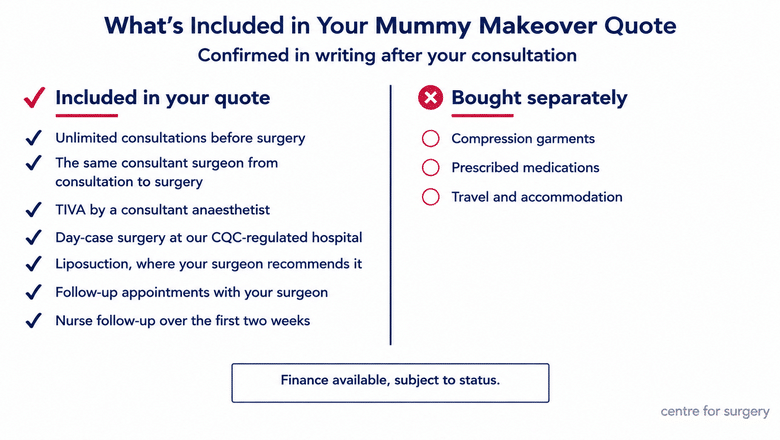
What is included in your treatment package
- As many preoperative consultations with your surgeon as required
- In-depth preoperative medical assessment
- Dedicated patient coordinator throughout
- Treatment at a CQC-regulated day surgery facility
- TIVA anaesthesia administered by a consultant anaesthetist
- Liposuction of the abdomen and flanks alongside abdominoplasty where your surgeon recommends it, included in your written quote
- Same-day discharge
- Your surgeon’s direct number for the first 24 hours
- Drain removal (where applicable), usually within the first week once drainage has slowed
- Wound check at seven to ten days
- Surgeon review at six weeks
- Further reviews at three and six months available
- Two-week cooling-off period from the date of consent
Compression garments and prescribed medications are purchased separately and confirmed with you in advance.
Why Choose Centre for Surgery for Your Mummy Makeover?
Centre for Surgery is a CQC-regulated cosmetic surgery clinic at 95–97 Baker Street, London W1U 6RN. All Mummy Makeover procedures are performed by GMC-registered surgeons. Centre for Surgery performs over 100 Mummy Makeover procedures per year.
Clinical standards
- All procedures by GMC-registered surgeons
- TIVA — administered and monitored by a consultant anaesthetist throughout every procedure
- Liposuction alongside abdominoplasty where your surgeon recommends it, included in your written quote
- Day-case abdominoplasty — one of a small number of UK providers performing full tummy tucks on a same-day discharge basis
- Sequential compression devices and anti-embolic stockings used during surgery for all patients
- Dissolvable sutures throughout
- CQC-regulated Baker Street surgical facility
Aftercare
- Your surgeon’s direct number for the first 24 hours after surgery
- Drain removal, usually within the first week once drainage has slowed
- Wound check at seven to ten days
- Face-to-face surgeon review at six weeks
- Further reviews at three and six months available
- Two-week cooling-off period from the date of consent — no obligation to proceed
- Dedicated patient coordinator throughout
Book a consultation
Phone: 020 7993 4849
Address: 95–97 Baker Street, London W1U 6RN
Consultation fee: £100, redeemable against your procedure cost. Finance available through Chrysalis Finance, subject to status. See our full Mummy Makeover cost guide for prices.
Further reading
- NHS — Considering cosmetic surgery: guidance on choosing a provider and understanding risks.
- BAPRAS — Abdominoplasty surgery guide: patient information from BAPRAS.
- Royal College of Surgeons — Professional Standards for Cosmetic Surgery
- The risks of seeking a Mummy Makeover abroad
- How do I choose the right surgeon for a Mummy Makeover?
Our honest assessment of whether a mummy makeover is worth it weighs the recovery against what the operation actually delivers.
Why combination surgery — and how CFS plans a mummy makeover
Pregnancy typically changes multiple areas of the body simultaneously. Addressing each change as a separate procedure is possible — but it means multiple anaesthetics, multiple recovery periods of 4 to 6 weeks each, and multiple periods away from work and family. A well-planned mummy makeover addresses the full picture in one session.
The case for combination surgery
- One anaesthetic — the cumulative risks of multiple anaesthetics are avoided. TIVA (Total Intravenous Anaesthesia) at Centre for Surgery is extremely well tolerated, but minimising exposure where possible is always sensible.
- One recovery — patients recover from a combined tummy tuck and breast procedure in broadly the same timeframe as a tummy tuck alone. Staggered procedures mean staggered disruption to work, childcare, and daily life.
- Lower overall cost — theatre time, anaesthetist fees, and facility costs are shared across the combined procedure rather than duplicated across two separate operations.
- Coherent aesthetic outcome — changes to the breasts and abdomen in the same session allow your surgeon to plan the overall result as a whole rather than in two disconnected stages.
When combination surgery is not appropriate
Safety limits operating time. A combined tummy tuck, breast augmentation, and breast lift typically takes 5 to 6 hours — within safe limits. Where additional procedures would push operating time beyond this, staging is recommended. Your surgeon will plan the combination at consultation based on what you need, not a fixed package.
The CFS approach to mummy makeover planning
Centre for Surgery does not offer a fixed mummy makeover “package.” Every combination is planned individually at consultation based on your specific anatomy, your recovery timeline, and what procedures will actually address your concerns. Some patients need a full tummy tuck with breast augmentation and lift. Others need only a mini tummy tuck and a modest volume top-up. Where your surgeon recommends it, liposuction of the abdomen and flanks is carried out during the abdominoplasty to improve waist definition, and is included in your written quote.
We do not operate on patients who are still breastfeeding, who have stopped breastfeeding within the last 3 months, or who are planning further pregnancies. The body needs to have fully stabilised before surgical results can be accurately assessed and maintained long-term.
Timing guidance
The general guidance is to wait at least 3 months after completely stopping breastfeeding (ideally around 6), and at least six months after your last delivery, before proceeding. Weight should be stable for at least six months and at or close to your target. Most surgeons also recommend that patients are not planning another pregnancy — a subsequent pregnancy will re-stretch the repaired muscles and tightened skin, reversing the result.
Does the specific combination affect timing?
Yes — which procedures you’re combining can change the recommended waiting period. Breast surgery in particular depends on breastfeeding having fully finished: if a breast lift or augmentation is part of your combination, your surgeon will ask you to wait at least 3 months, and ideally around 6, after stopping breastfeeding specifically, since breast tissue continues settling for months after lactation ends — this is measured from when breastfeeding stopped, not from the birth itself. Abdominal procedures are governed more by general post-pregnancy recovery and weight stability than by breastfeeding. Your surgeon will confirm the appropriate timing for your specific combination of procedures at consultation.
Both questions are covered in full: how soon after pregnancy surgery is sensible, and what changes if you plan more children.
Mummy Makeover — Related Reading
From our blog
- Can you have a mummy makeover if you plan to have more children?
- Will a mummy makeover remove stretch marks?
- Is a mummy makeover safe?
- Mummy Makeover after pregnancy — how soon can I get one?
- Loose skin after pregnancy
- How to get rid of mummy tummy overhang
- How soon after pregnancy can you consider a breast lift?
- Tummy tuck regrets — what they are and how to avoid them
Component procedures
What To Expect
Your Consultation
A 45 to 60 minute consultation at Baker Street with a GMC-registered plastic surgeon, longer for combined procedures.
- Your abdomen: skin laxity, diastasis recti, skin quality and fat, to choose between a full abdominoplasty, a mini abdominoplasty or liposuction alone.
- Your breasts: volume loss, drooping, skin quality and nipple position, to choose between augmentation, a lift, augmentation with lift or reduction.
- Combine or stage: a longer single operation has a higher complication rate than staging, and your surgeon will say if staging is safer for you.
- No pressure: we recommend a two-week cooling-off period, and further consultations are free.
Before Your Procedure
Once the cooling-off period has passed, our pre-op team assesses you and sends written instructions. See preparing for surgery.
- Smoking: stop at least four weeks before and four weeks after; it is the biggest avoidable risk to wound healing.
- Medicines: stop oestrogen-containing contraceptive pills four weeks before, as they raise DVT risk; use a non-hormonal method instead. Stop aspirin, ibuprofen and other anti-inflammatories two weeks before.
- Fasting: no food for six hours; still water, black tea or coffee up to two hours before.
- At home: two compression garments, childcare help for at least three weeks, and a responsible adult to take you home and stay at least 24 hours.
The Day of Your Procedure
A nurse fits anti-embolic stockings and compression devices to prevent clots, your anaesthetist confirms you are fit for TIVA, and your surgeon marks you standing.
- The operation: five to six hours for the most common combination, a full abdominoplasty with breast augmentation.
- Abdomen first: liposuction where recommended, skin removal, muscle repair and belly button repositioning, then two drains and a compression garment.
- Breasts second: implants through the crease under the breast, or a lift or reduction, as planned.
- Going home: after one to three hours of monitoring, once you are comfortable and eating and drinking. No driving on the day.
After Your Procedure
Abdominal tightness is the main sensation in week one; paracetamol manages the pain. Drains usually come out at the clinic within the first week, once drainage has slowed.
- Activity: walk from day one and wear your compression garments continuously for six weeks. No driving for two weeks, no lifting or strenuous exercise for six, no core exercise for three months.
- Support and reviews: your surgeon’s direct number for 24 hours; wound check at 7–10 days, surgeon review at six weeks, and further reviews at three and six months are available.
- Call us at once: for calf pain, sudden one-sided swelling, worsening pain, spreading redness, offensive discharge, fever above 38°C or darkening skin along an incision. Breathlessness or chest pain: call 999.
FAQs
-
A mummy makeover, also spelled mommy makeover, is breast and tummy surgery combined in one operation to restore your body after pregnancy and breastfeeding. It usually pairs a tummy tuck with a breast augmentation, breast lift or breast reduction, so you have one anaesthetic and one recovery instead of two. It is sometimes described as a tummy tuck and boob job in one. Our guide to plastic surgery after pregnancy compares the options.
-
A mummy makeover includes the breast and tummy procedures your body needs, chosen at consultation rather than sold as a fixed package. The breast part is an augmentation, a lift, an augmentation with lift or a reduction. The tummy part is usually a full tummy tuck, which removes loose skin and repairs separated muscles (diastasis recti), or a mini tummy tuck. Liposuction is not included as standard: it is added where your surgeon recommends it, and then appears in your written quote. A mons lift or labiaplasty can also be added.
-
Neither is better, because they treat different problems. A tummy tuck deals only with loose skin, fat and separated muscles on the abdomen, while a mummy makeover adds breast surgery in the same operation. A flatter tummy on its own can make breasts that pregnancy has deflated look more noticeable, which is why the two are often treated together. If only your abdomen bothers you, a tummy tuck alone is enough.
-
No. The changes a mummy makeover treats are structural: stretched skin, separated tummy muscles and breasts that have deflated or dropped. They cannot be reversed by non-surgical means, and separated muscles cannot be repaired without surgery. Diet and exercise can reduce fat but not loose skin. Our mummy tummy guide explains which post-pregnancy changes respond to exercise and which need surgery.
-
You are a good candidate for a mummy makeover if you have finished having children, stopped breastfeeding at least three months ago (ideally around six) and have kept a stable weight for at least six months. A BMI of 30 or below is needed for the tummy tuck part. You also need to be in good general health and a non-smoker, or able to stop smoking for four weeks before and four weeks after surgery. Consultations and surgery are for adults aged 18 and over.
-
There is no best age for a mummy makeover, because timing matters more than age. We recommend waiting at least six months after your last delivery and at least three months, ideally around six, after you stop breastfeeding, with your weight stable for at least six months, so your tummy muscles and breasts have settled. It should also wait until your family is complete. Our guide to a mummy makeover after pregnancy covers timing in more detail.
-
Most mummy makeovers are done in one operation, which means one anaesthetic, one recovery and a lower overall cost than separate operations. Staging is safer if the combined operation would run too long, a health condition makes a long anaesthetic riskier, or recovery would be hard with young children. A combined tummy tuck, breast augmentation and lift usually takes five to six hours. Our guide to combining cosmetic surgery procedures explains how surgeons decide.
-
The cost of a mummy makeover depends on which procedures you combine: the breast operation, a full or mini tummy tuck, whether liposuction is recommended and any extras such as a mons lift. You receive a written quote after a face-to-face consultation, and combining procedures usually costs less than staging them. Guide prices are in our mummy makeover cost guide. Finance is available through Chrysalis Finance, subject to status.
-
No. A mummy makeover is cosmetic surgery, so it is not funded by the NHS or by private medical insurance. There are narrow exceptions where a functional problem is being treated rather than an appearance one, and our guide to whether insurance covers a tummy tuck explains where that line falls.
-
Most of the discomfort after a mummy makeover comes from the tummy tuck, and it is managed with paracetamol. The main sensation is tightness across the abdomen, and walking slightly bent for the first week is normal. The operation itself, usually five to six hours for a tummy tuck with breast augmentation, is done under TIVA (total intravenous anaesthesia), so you are asleep throughout and go home the same day.
-
Healing after a mummy makeover takes about six weeks before full activity, the time the tummy tuck needs. Most women return to desk work after two weeks and avoid driving for two weeks. You need help with young children for at least three weeks, as lifting them is not allowed, and you wear compression garments for six weeks. Core exercises wait three months. Our mummy makeover recovery guide sets out each week.
-
You will see an initial mummy makeover result from six to eight weeks, once most of the swelling has settled. The final result takes 12 to 18 months as the skin settles, implants (if used) find their position and scars soften, and scars keep maturing for up to 24 months. You are reviewed at six weeks and again at three months. Our mummy makeover before and after photos show real results.
-
A mummy makeover carries the risks of each procedure it combines, and a longer operation adds to them. A US insurance database study of 25,478 tummy tucks by Winocour and colleagues (2015) ↗ found major complications in 3.1% after a tummy tuck alone and 4.3% when breast surgery was added. Common problems include seroma (fluid under the skin), haematoma and wound healing problems, especially in smokers; blood clots are rare but serious. Our guide to how safe a mummy makeover is covers this in full.
-
A mummy makeover is long-lasting, because removed skin does not grow back and the muscle repair and any implants stay in place. Your body still ages, and a later pregnancy or a big change in weight will stretch the skin and muscle repair again and change your breasts. That is why surgery is recommended once your family is complete. Our guide to having more children after a mummy makeover explains what changes.