


In this guide15 sections
- Key Points
- Is a Mummy Makeover Worth It? What the Research Shows
- What Are the Pros of a Mummy Makeover?
- What Are the Cons of a Mummy Makeover?
- Is a Mummy Makeover Safe? Risks and Complications
- Who Is a Good Candidate for a Mummy Makeover?
- Mummy Makeover Before and After: What Results Can You Expect?
- How Long Is Mummy Makeover Recovery?
- Is a Mummy Makeover Worth the Cost?
- Are There Alternatives to a Mummy Makeover?
- How Do You Decide Whether a Mummy Makeover Is Worth It for You?
- What Happens at a Mummy Makeover Consultation in London?
- Frequently Asked Questions
- Mummy Makeover in London
- References
Key Points
- Is a mummy makeover worth it? For many women who have finished having children and have changes that diet and exercise cannot fix, studies report better body image, self-esteem and quality of life afterwards[1][2]. It is major surgery, though, and it does not suit everyone.
- The pros: one operation and one recovery instead of two or three, loose skin removed, separated tummy muscles repaired, breasts reshaped and, for some women, less back pain and urinary leakage[3].
- The cons: several weeks of recovery, permanent scars, a higher complication rate than a single operation and results that another pregnancy or a large weight change can undo[4].
- Timing matters: at least 6 months after your last delivery, at least 3 months (ideally around 6) after you stop breastfeeding, and a stable weight for 6 months.
- What usually decides whether it was worth it: a complete family, a stable weight, realistic expectations and honest advice about which procedures you actually need.
- Costs are confirmed in writing after a face-to-face consultation, and finance is available subject to status.
Is a mummy makeover worth it? It is one of the questions we hear most often at consultation, and it deserves a straight answer rather than a sales pitch. A mummy makeover (also spelled mommy makeover) combines a tummy tuck with breast surgery in one operation, and sometimes liposuction as well. It asks a lot of you in time, money and recovery, so this guide sets out the pros and cons, the risks, what results look like and who tends to feel it was worth it.
Our other guides cover the surrounding questions in depth, including how safe a mummy makeover is, and we link to them where they help. This article stays on the decision itself: what you would gain against what you would go through. If you are still working out what has changed in your body, the guides to the mum tum and loose skin after pregnancy are a good place to start.
Nothing here replaces an assessment in person. Whether a mummy makeover is worth it for you depends on your anatomy, your health, your family plans and what you hope to change, and that is exactly what a consultation with a GMC-registered plastic surgeon is for.
Is a Mummy Makeover Worth It? What the Research Shows
Most research on mummy makeovers measures how patients feel afterwards, so it helps to be clear about what it can and cannot tell you. A 2025 prospective study in Aesthetic Plastic Surgery ↗ followed 42 women having a mummy makeover (a tummy tuck, breast surgery and liposuction) and their partners for 12 months. Body image, self-esteem, sexual wellbeing and relationship satisfaction all improved, and over 90% of the women reported a better quality of life and said they would have the surgery again[2]. It was a small observational study with no comparison group, so it shows what was typical for those patients rather than what will happen for you.
A 2018 multicentre study in Plastic and Reconstructive Surgery ↗ followed 214 women having a tummy tuck with repair of separated muscles after pregnancy. Back pain disability scores fell from an average of 21.6% before surgery to 3.2% six months later, and bladder leakage scores fell from 6.5 to 1.6[1]. The study looked at tummy surgery only, not breast surgery, and it was not a randomised trial, so it shows improvement after surgery rather than proving the operation caused every change.
Is a mummy makeover worth it for everyone?
No, and the research cannot tell you which group you fall into. A published review of postpartum reshaping noted that most women seeking tummy surgery want pregnancy-related changes corrected, and that multiple procedures can be combined safely and effectively in the appropriate patient[5]. The key words are “appropriate patient”. The women who tend to be glad they had surgery are those whose concerns are structural, whose families are complete and whose expectations match what surgery can deliver.
What Are the Pros of a Mummy Makeover?
Does a mummy makeover fix what diet and exercise cannot?
For structural changes, yes. Pregnancy can stretch the tummy skin beyond what it can recover, and the two halves of the stomach muscles can drift apart (diastasis recti). Exercise and weight management can improve strength and the fat layer, but they cannot remove stretched skin or reliably close a wide muscle gap. A tummy tuck with muscle repair treats both. On the breasts, a 2008 study of women who had been pregnant found that age, body mass index, number of pregnancies, bra size and smoking were linked to sagging, while breastfeeding itself was not[8]. That is why breast changes can persist whatever you do afterwards, and why a breast lift, breast augmentation or breast reduction may be on the table.
Is one operation better than several?
For many patients it is more practical. Combining procedures means one anaesthetic and one recovery period rather than two or three, which matters when you are also looking after children. At Centre for Surgery a mummy makeover is a day-case operation under TIVA (total intravenous anaesthesia), so you are asleep throughout and go home the same day. Our guide to combining cosmetic surgery procedures explains how surgeons decide what can safely go together.
Can a mummy makeover help with back pain and urinary leakage?
Sometimes, as a welcome extra rather than the reason to operate. In a prospective study of 78 women having a tummy tuck with diastasis repair, back pain, urinary symptoms and quality of life scores improved at 3 and 12 months, regardless of how wide the muscle gap had been[3]. The systematic review above reported similar patterns[1]. A tummy tuck is not a treatment for incontinence or back pain, and pelvic floor problems should be assessed separately by your GP or a women’s health physiotherapist.
Do mummy makeover results last?
They are long-lasting rather than permanent. Skin that has been removed does not grow back, and a muscle repair and any implants stay in place. Your body will still age, and a later pregnancy or a large change in weight can stretch the result again. Our guide to how long mummy makeover results last goes through what affects them.
What Are the Cons of a Mummy Makeover?
A fair answer to “is a mummy makeover worth it” has to include the downsides, and they are real:
- It is major surgery. You need help at home, and full activity returns after about six weeks. With young children, planning for that period is half the battle.
- It leaves permanent scars. They are placed where underwear and clothing usually cover them and fade over many months, but they do not disappear. Our guide to scars after a mummy makeover shows what to expect.
- Risks rise with the number of procedures. Longer operations carry more risk of problems such as fluid collections, wound healing difficulties and blood clots (see below).
- It is not pregnancy-proof or weight-proof. Another pregnancy or a large weight change can undo part of the result, which is why surgery is advised once your family is complete.
- It is not a weight loss operation. It reshapes and tightens. It does not replace diet and exercise.
- It is a financial commitment. It costs more than one procedure alone, although usually less than having the same procedures separately.
Is a Mummy Makeover Safe? Risks and Complications
Safety is the part of the decision people most often under-weigh. A 2015 cohort study of 25,478 tummy tucks in Plastic and Reconstructive Surgery ↗ found major complications in 3.1% of patients having a tummy tuck alone and 4.3% when breast surgery was added. Adding liposuction and breast surgery took the figure to 4.6%. Higher body mass index (30 or above), age 55 or over and having multiple procedures were all linked to more complications[4]. Those figures are from a US insurance database, but they show the direction of travel: more procedures, more risk.
More recent single-centre work is more reassuring about combining operations. A review of 726 tummy tuck patients, 15% of whom had breast surgery as well, found that adverse events did not differ between a mummy makeover and a tummy tuck alone once other factors were accounted for[6]. In a series of 194 women having a breast lift with implants, the complication rate was 8.2% and the reoperation rate 4.6%[9]. Retrospective studies like these cannot prove that combined surgery is risk-free.
Are blood clots a risk after a mummy makeover?
Yes, and it is the reason surgeons plan the length of the operation carefully. A review of 1,370 consecutive tummy tucks found venous thromboembolism in 2.3% of patients whose muscles were tightened and 0.36% of those whose muscles were not[7]. Risk is reduced by assessing you beforehand, limiting the operating time, using clot-prevention measures and getting you walking early. Staging the operations is sometimes the safer choice. Our full guide to how safe a mummy makeover is covers complications and how they are managed.
Can you have a mummy makeover in stages?
Yes. If the combined operation would run too long, a health condition makes a long anaesthetic riskier or recovery would be difficult with small children, the work can be divided into two operations. It adds a second recovery, which is the trade-off against the lower risk of a shorter operation.
Who Is a Good Candidate for a Mummy Makeover?
Our suitability criteria are specific, and meeting them is a large part of whether the surgery will be worth it:
- Your family is complete.
- At least 6 months have passed since your last delivery.
- At least 3 months (ideally around 6) have passed since you stopped breastfeeding.
- Your weight has been stable for at least 6 months (12 months after major weight loss).
- Your BMI is 30 or below for the tummy tuck part.
- You do not smoke, or can stop for four weeks before and four weeks after surgery.
- You are in good general health and aged 18 or over.
After a face-to-face consultation we recommend a two-week cooling-off period from the date of consent, so that nobody feels rushed. Our guide to a mummy makeover after pregnancy explains the timing checks in more detail.

Mummy Makeover Before and After: What Results Can You Expect?
Photographs are the most useful way to judge results, with one caution: they show what was achieved for that patient, not a promise for the next. These are real Centre for Surgery patients, and individual results vary. Our full gallery of mummy makeover before and after photos shows more combinations.
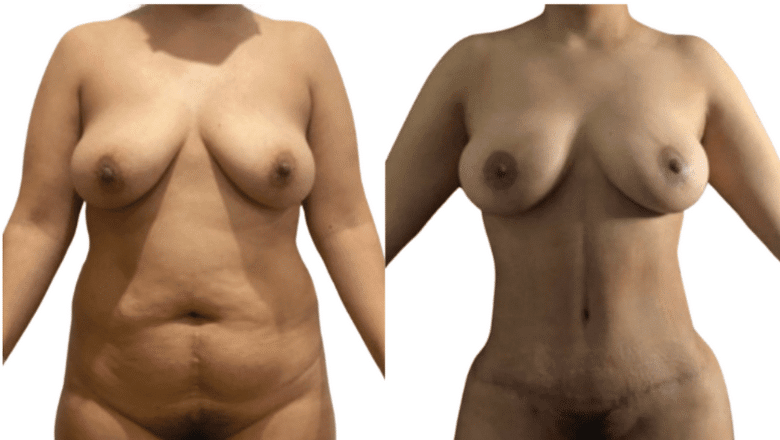

When do you see mummy makeover results?
You will see an initial result from six to eight weeks, once most of the swelling has settled. The final result takes 12 to 18 months as the skin settles, any implants find their position and scars soften, and scars keep maturing for up to 24 months. You are reviewed at six weeks and again at three months.

How Long Is Mummy Makeover Recovery?
Recovery is where the “worth it” question is often won or lost, so it helps to know the shape of it. You go home the same day with a compression garment, and the first week is for rest and gentle walking, often slightly bent over until the tummy tightness eases. Most women return to desk work after about two weeks and avoid driving for the same period. You will need help with young children for at least three weeks, as lifting them is not allowed. Compression garments are worn for six weeks, full activity returns at around six weeks and core exercises wait for three months.
Discomfort is mostly from the tummy tuck, with tightness across the abdomen the main sensation, and it is managed with simple painkillers. Our mummy makeover recovery guide and tummy tuck recovery guide set out each week. If you are weighing up the practicalities, planning childcare for the first three weeks is the single most useful step.
Is a Mummy Makeover Worth the Cost?
Costs depend on which operations you combine: the breast procedure, a full or mini tummy tuck, whether liposuction is recommended and any extras. You receive a written quote after a face-to-face consultation, which includes your consultations, the same consultant surgeon throughout, TIVA, day-case surgery and follow-up, while compression garments, medications and travel are bought separately. Our mummy makeover cost guide explains what drives the quote, and finance options are available subject to status.
Is a mummy makeover cheaper than having each operation separately?
Usually, yes. One operating session, one anaesthetic and one hospital stay cost less than the same operations done separately, and you recover once. The saving is only worth having if the combined operation is safe for you, which is why length of surgery is a safety decision first and a cost decision second.
What about having a mummy makeover abroad?
Lower prices abroad are the usual reason women consider it, but the real questions are who assesses you in person, who operates, how the facility is regulated and who looks after you if something goes wrong at home. Flying soon after major surgery also raises the clot risk. Our guide to a mummy makeover abroad compares the two journeys.
Are There Alternatives to a Mummy Makeover?
Not every woman needs the whole operation. Depending on what bothers you, the alternatives include:
- A tummy tuck alone, if the main concern is loose skin and separated muscles. Our guide to liposuction vs tummy tuck explains which suits which body.
- Breast surgery alone, if the tummy is not the problem.
- Liposuction alone, for a small pocket of resistant fat with good skin tone.
- Physiotherapy and exercise, which help core strength and can narrow a mild muscle gap, though they do not remove loose skin.
There is no non-surgical mummy makeover. Stretched skin, separated muscles and deflated breasts do not respond to creams, devices or compression garments. Other body contouring procedures, such as arm or thigh surgery, are usually considered separately.
How Do You Decide Whether a Mummy Makeover Is Worth It for You?
A few honest questions are more useful than any statistic:
- Is what bothers you structural (skin, muscle, breast shape), or would weight loss or fitness help?
- Is your family complete, and is your weight settled?
- Can you arrange three weeks of help with children and a couple of weeks off work?
- Are you comfortable with permanent scars in exchange for a different shape?
- Would you still want it if the result were good but not perfect?
Do women regret a mummy makeover?
The research we found measured satisfaction rather than regret, so there is no reliable regret rate to quote. The 12-month study reported that over 90% of women would choose surgery again[2], but it was small and the women had chosen surgery. In practice, doubts tend to come from rushing the decision, having more done than was needed, or expecting a result surgery cannot deliver. That is why we recommend the two-week cooling-off period, and why leaving a consultation feeling talked into more than you came for is a reason to pause.
What Happens at a Mummy Makeover Consultation in London?
Your surgeon examines your tummy, skin, muscles and breasts, and asks about your pregnancies, breastfeeding, health, medicines and plans for more children. They explain which operations would help, which would not and what you can realistically expect, and you receive a written quote afterwards. The surgeon who assesses you is the surgeon who operates, and our guide to choosing a mummy makeover surgeon lists what to check wherever you go. Surgery takes place at our CQC-regulated hospital at 95–97 Baker Street, and our surgeons are registered with the General Medical Council.
Frequently Asked Questions
What is a plastic surgery mummy makeover?
A mummy makeover is breast and tummy surgery combined in one operation to restore the body after pregnancy and breastfeeding. It usually pairs a tummy tuck with a breast augmentation, lift or reduction, so you have one anaesthetic and one recovery. It is planned individually rather than sold as a fixed package.
What is a mini mummy makeover?
A mini mummy makeover usually means a smaller combination, such as a mini tummy tuck with a breast lift or augmentation. A mini tummy tuck suits women whose loose skin and muscle separation sit below the belly button. Your surgeon decides at consultation whether a mini or full tummy tuck will give you the result you want.
On a scale of 1 to 10, how painful is a tummy tuck?
Pain is personal, so there is no single score. Most women describe tightness across the abdomen and some soreness rather than sharp pain, and walking slightly bent for the first week is normal. It is managed with simple painkillers, and you are asleep throughout the operation under TIVA.
What happens 10 years after a tummy tuck?
Removed skin does not grow back, and the muscle repair generally holds, so most of the improvement remains. Your body still ages, and a later pregnancy or a significant weight gain or loss can stretch the result. Keeping a stable weight is the biggest thing you can do to protect it.
Will my stomach ever be flat after a tummy tuck?
It will usually be much flatter, but “flat” depends on the fat inside the abdomen, your posture and your weight, none of which a tummy tuck changes. Swelling hides the final shape for several weeks, and the result continues to improve for 12 to 18 months.
Is a breast augmentation worth it?
For women who have lost breast volume after pregnancy and want it restored, many are very happy with the result, but implants are not permanent and may need replacing or revising in future. They are also a long-term commitment to monitoring. Our breast augmentation page explains the options, and a consultation is where you can weigh them up.
How much does a mummy makeover cost in the UK?
The cost depends on which procedures you combine, so we give a written quote only after a face-to-face consultation. Combining operations usually costs less than staging them, and finance is available subject to status. Our mummy makeover cost guide explains what shapes the quote.
What is the best age to have a mummy makeover?
There is no best age. What matters is that your family is complete, at least 6 months have passed since your last delivery, at least 3 months (ideally around 6) have passed since breastfeeding ended and your weight has been stable for 6 months. If you are unsure about more children, our guide on having a mummy makeover if you plan to have more children explains why waiting is usually wiser.
Mummy Makeover in London
If you are asking yourself whether a mummy makeover is worth it, a consultation with a plastic surgeon will tell you what would and would not change for your body, and you are under no obligation to proceed. Find out more about mummy makeover surgery at Centre for Surgery.
Phone: 020 7993 4849 | Address: 95–97 Baker Street, Marylebone, London W1U 6RN
Contact us to schedule a consultation
References
- Taylor DA, Merten SL, Sandercoe GD, et al. Abdominoplasty improves low back pain and urinary incontinence. Plastic and Reconstructive Surgery 2018;141(3):637–645. doi:10.1097/PRS.0000000000004100 ↗
- Bruno A, Foti R. Impact of mommy makeover surgery on couple relationship quality and female sexual wellbeing: a prospective dyadic study. Aesthetic Plastic Surgery 2025;50(9):3478–3484. doi:10.1007/s00266-025-05346-1 ↗
- Marangi GF, Gratteri M, Romano FD, et al. Perception of changes in functional symptoms and psychological aspects related to rectus muscle diastasis in women who have undergone reparative abdominoplasty. Aesthetic Surgery Journal 2025;45(8):814–820. doi:10.1093/asj/sjaf057 ↗
- Winocour J, Gupta V, Ramirez JR, Shack RB, Grotting JC, Higdon KK. Abdominoplasty: risk factors, complication rates, and safety of combined procedures. Plastic and Reconstructive Surgery 2015;136(5):597e–606e. doi:10.1097/PRS.0000000000001700 ↗
- Matarasso A, Smith DM. Strategies for aesthetic reshaping of the postpartum patient. Plastic and Reconstructive Surgery 2015;136(2):245–257. doi:10.1097/PRS.0000000000001410 ↗
- Wolf Y, Fainzilber-Goldman Y, Skorochod R. A comparative analysis of the complication rate in “mommy makeover” procedures and abdominoplasty. Israel Medical Association Journal 2025;27(8):526–530. PMID:40819205 ↗
- Restifo RJ. An in-depth analysis of 1370 consecutive abdominoplasties: fascial plication increases risk of venous thromboembolism, and scoring for plication improves the Caprini risk assessment model. Aesthetic Surgery Journal 2024;44(12):NP870–NP882. doi:10.1093/asj/sjae139 ↗
- Rinker B, Veneracion M, Walsh CP. The effect of breastfeeding on breast aesthetics. Aesthetic Surgery Journal 2008;28(5):534–537. doi:10.1016/j.asj.2008.07.004 ↗
- Buccheri EM, Villanucci A, Montemurro P, Rocco N, de Vita R. Tailor-made mastopexy plus implant, a safe journey toward breast reshaping and augmentation. Aesthetic Plastic Surgery 2024;48(23):4986–4993. doi:10.1007/s00266-024-04099-7 ↗





