


In this guide18 sections
- Key Points
- How Should You Sleep After a Mummy Makeover?
- How to Sleep After a Tummy Tuck: Why Back Sleeping and a Raised Position Matter
- How to Sleep After a Tummy Tuck and Breast Augmentation, Breast Lift or Breast Reduction
- Is a Recliner, a Wedge Pillow or an Adjustable Bed Better After a Tummy Tuck?
- How Do You Get In and Out of Bed After a Tummy Tuck?
- How Do You Sleep With Drains and a Compression Garment After a Tummy Tuck?
- How Long Do You Have to Sleep Elevated After a Mummy Makeover?
- When Can I Sleep on My Side After a Mummy Makeover or Tummy Tuck?
- When Can I Sleep on My Stomach After a Tummy Tuck?
- Why Can’t I Sleep After a Mummy Makeover?
- How Should I Prepare My Bed and Bedroom Before a Mummy Makeover?
- When Should I Call My Surgeon About Pain or Swelling at Night?
- Is a Mummy Makeover Safe, and What Do the Results Look Like?
- What Does a Mummy Makeover Involve at Centre for Surgery?
- Frequently Asked Questions
- Mummy Makeover Aftercare in London
- References
Key Points
- How to sleep after a mummy makeover: on your back, with your upper body raised on a wedge or pillows and a pillow under your bent knees. This takes strain off the tummy tuck incision and muscle repair, and stops you rolling onto your breasts.
- How long: for about four to six weeks after a mummy makeover, and around four weeks after a full tummy tuck on its own (about six after an extended tummy tuck). Your surgeon confirms when you can change position.
- Side sleeping: not at first. Most people wait until at least four weeks, and only once their surgeon says the tummy tuck and any breast surgery are ready for it.
- Front sleeping: last to return, and often not until after your six-week review, or later after implants or muscle repair.
- A recliner or adjustable bed makes it easier to stay raised and to get up without using your tummy muscles. A wedge pillow, a knee pillow and rolled towels at your sides work well in an ordinary bed.
- Poor sleep in the first fortnight is common. Tightness, drains, a compression garment and a new position all play a part, and it improves as swelling settles.
Sleep is one of the first things mums ask about before a mummy makeover. The answer for how to sleep after a mummy makeover (also called a mommy makeover) is simple to state and harder to live with: on your back, upper body raised, knees bent, for about four to six weeks. The tummy tuck sets the rules, because the abdominal incision and muscle repair are under the most tension of any part of the operation, and breast surgery adds its own reasons to stay off your front and sides.
This guide sets out how to sleep after a mummy makeover and a tummy tuck, what to sleep on, how to get in and out of bed, when you can sleep on your side or your stomach, and what to do if sleep will not come. It follows the advice in our mummy makeover recovery guide and our tummy tuck recovery guide. If you are comparing recovery after different operations, our guide to sleeping positions after cosmetic surgery covers the rest.
How Should You Sleep After a Mummy Makeover?
Sleep on your back with your upper body raised, your head supported and a pillow under your knees. Think of a gentle recliner shape: your hips and knees slightly bent, your shoulders higher than your waist. That is the position surgeons ask for after a tummy tuck, and it is the same position that protects breast augmentation, breast lift or breast reduction in the same operation.
The raised upper body keeps the front of your abdomen relaxed, the bent knees stop the skin being pulled flat, and back sleeping keeps weight and twisting off the incisions, the muscle repair and your breasts.
It is worth being straightforward about the evidence. No trial has compared sleeping positions after a tummy tuck, so this advice rests on surgical principles and on what patients find comfortable rather than on a study. Some surgeons point out that lying flat will not tear a well-made repair. Even so, nearly every surgical team recommends a raised, bent position for the first weeks because it is more comfortable and reduces tension on the wound, and following your own surgeon’s written instructions is always the rule.
How to Sleep After a Tummy Tuck: Why Back Sleeping and a Raised Position Matter
A full tummy tuck removes loose skin and fat and, in most women who have had children, repairs separated stomach muscles (diastasis recti). The skin is pulled down and stitched along a low scar, and the muscles are stitched together along the midline. In the first weeks, the whole area is tight, swollen and held under tension.
Sleeping on your back with your hips and knees bent lets the tissue relax. Sleeping flat, or stretching your legs out straight, pulls on the repair. That is why most people walk slightly bent for the first week and feel most comfortable semi-reclined. Our guide to how long you will be hunched over after a tummy tuck explains why that stooped posture is normal and how it passes.
The length of time depends on the operation. After a full tummy tuck on its own, most people stay raised for around four weeks. After an extended tummy tuck, which treats more tissue around the sides, it is nearer six. A mini tummy tuck involves less skin and a shorter scar, but you still follow your surgeon’s instructions rather than switching position early.
How to Sleep After a Tummy Tuck and Breast Augmentation, Breast Lift or Breast Reduction
A mummy makeover usually pairs a tummy tuck with one breast operation, and the breast surgery gives you two more reasons to stay on your back.
- Breast augmentation. Lying on your front or side puts pressure on the healing implant pocket. Our breast augmentation recovery guide advises sleeping on your back with your upper body raised for at least the first two weeks, with side sleeping usually waiting until around four to six weeks.
- Breast lift. The reshaped breast is held by internal stitches and by a supportive bra. Pressure and twisting should be avoided until your surgeon says otherwise; our breast lift recovery guide explains how the breasts heal.
- Breast reduction. Combined with a tummy tuck, this is a larger combination, and recovery is usually longer, so the sleeping rules last longer too.
Wear the surgical bra and the abdominal compression garment as your surgeon instructs, including overnight. Garments are purchased separately and confirmed with you before surgery. The slowest-healing part of the operation sets the pace, so the tummy tuck usually decides how long you stay on your back. Our guide to combining cosmetic surgery procedures explains how surgeons choose combinations.
Is a Recliner, a Wedge Pillow or an Adjustable Bed Better After a Tummy Tuck?
All three give the raised, bent position, so the right choice is the one you will actually stay in all night.
- Recliner chair. Many people find it the easiest option for the first nights. The shape is built in, you cannot roll over, and standing up is easier because you are already semi-upright. The drawbacks are that you sleep in one place and some chairs are too low or too flat.
- Adjustable bed. The most comfortable option if you already own one, because you can change the angle for the head and knees separately.
- Wedge pillow plus knee pillow in your own bed. A firm foam wedge under your back, one or two pillows under your head and a pillow or bolster under your knees. Loose pillows slide, so a wedge is more stable.
- Rolled towels or body pillows. Place them along each side of your body so that if you drift in your sleep you meet a soft barrier rather than turning over.
Whichever you choose, test it before surgery for a night or two. If you share a bed, a wedge on your side only may be easier than rearranging the mattress.

How Do You Get In and Out of Bed After a Tummy Tuck?
Getting up is the part most people dread, because sitting straight up uses the abdominal muscles that have just been repaired. The technique is the same for most people:
- Bend your knees and roll gently onto your side as one piece, keeping your shoulders and hips together.
- Let your legs drop over the edge of the bed as you push yourself up with your arms.
- Sit for a moment on the edge of the bed before you stand, to check you are not light-headed.
- To get back in, sit on the edge, lower yourself onto your side, then swing your legs up and roll onto your back.
For the first few days, have someone nearby, particularly at night. Support your tummy with a small pillow when you cough, sneeze or laugh, and keep your steps short and slightly bent until you feel able to stand upright. Our exercising after cosmetic surgery guide explains how activity builds back up.
How Do You Sleep With Drains and a Compression Garment After a Tummy Tuck?
After a full tummy tuck, you go home the same day with two drains in place and a compression garment fitted. The drains are usually removed at the clinic within the first week, once the fluid has slowed. Never remove them yourself.
To sleep comfortably with them:
- Fasten the drain bulbs to your garment or clothing with the clips provided, so they do not pull when you move.
- Keep the tubing free of kinks, and avoid lying on it.
- Empty and record the drains as you were shown.
The compression garment is usually worn continuously for six weeks, day and night, and is taken off only as your team tells you. It supports the skin, reduces swelling and gently stops you shifting. Our guides to compression garments after a tummy tuck and tummy tuck seroma explain how the garment and drains reduce the chance of fluid collecting.
How Long Do You Have to Sleep Elevated After a Mummy Makeover?
For most people, about four to six weeks. The exact period depends on the tummy tuck you have and on which breast operation is combined with it. Treat the timings below as a guide, and let your surgeon’s written instructions and your reviews decide:
- Weeks 1 to 4: back sleeping, upper body raised, knees bent. No side or front sleeping.
- Weeks 4 to 6: many people stay raised, and some begin to experiment with a more reclined position, if their surgeon agrees.
- After the six-week review: your surgeon decides when you can sleep flatter, and when side sleeping can begin.
- Three months: core exercises can restart, which is also a useful marker for returning to your usual sleep habits.
Do not move on early because you feel better. A mummy makeover is a long operation, and recovery is governed mainly by the tummy tuck. Our mummy makeover before and after photos show settled results, and our recovery after cosmetic surgery hub covers advice that applies to every operation.
When Can I Sleep on My Side After a Mummy Makeover or Tummy Tuck?
You can usually start sleeping on your side from around four weeks after a full tummy tuck, and from about six weeks after an extended tummy tuck or a larger combination, but only once your surgeon confirms it. With breast implants, side sleeping typically waits until around four to six weeks as well. The check is how you feel: if lying on your side pulls on the scar, or presses on a breast that is still tender, you are not ready.
When you do try it:
- Start with short periods and come back to your raised back position if it hurts.
- Keep your knees bent, with a pillow between them, and hug a pillow against your chest and tummy.
- Roll in one piece rather than twisting your waist.
- Stay in your compression garment and bra.
People often ask whether they can sleep on their side two weeks after a tummy tuck. For most, it is too early: side sleeping twists the repair. If you wake up on your side and feel pulling, simply roll back and mention it at your next review.

When Can I Sleep on My Stomach After a Tummy Tuck?
Front sleeping comes last. It presses directly on the tummy tuck scar, the muscle repair and your breasts, so many surgeons wait until at least the six-week review, and longer after implants, extended tummy tuck or a large muscle repair. Your surgeon will tell you when. If you are a lifelong front sleeper, this is the hardest habit to break, and it helps to practise back sleeping before surgery (see below).
Why Can’t I Sleep After a Mummy Makeover?
Broken sleep in the first one to two weeks is normal. The reasons are mostly practical: tightness across the abdomen, tenderness in the breasts, a new position, drains and a garment, and the after-effects of a long anaesthetic. You may feel tired all day and still lie awake at night.
Sleep and pain affect each other. A 2026 narrative review in the Journal of Pain Research ↗ concluded that pain disturbs sleep and sleep loss in turn increases pain sensitivity, and that disturbed sleep is common around surgery[1]. Sleep disturbance is described as the main complaint among people with acute postoperative pain[2]. That is why taking the pain relief you have been given on schedule, rather than waiting until you are in discomfort, matters at bedtime.
Sleep may matter for healing too, although the evidence in cosmetic surgery is limited. A 2026 retrospective analysis of 344 people having flap reconstruction, a different kind of operation, found that poor sleep was a risk factor for flap necrosis[3]. That does not prove that a bad night harms a tummy tuck, but it is a reason to protect your sleep, rest in the day and not to worry if you are tired.
What helps:
- Take your prescribed pain relief about 30 to 60 minutes before bed, as your team advised.
- Keep the room cool and dark, and set up your pillows before you get in.
- Avoid caffeine in the afternoon and evening. Herbal tea or a light snack is a better choice.
- Take short walks during the day, building gently from day one. Daytime movement helps you sleep at night.
- Nap when you need to. Healing is tiring.
- Ask your team before taking any over-the-counter sleep aid or sedating antihistamine, and avoid alcohol while taking strong painkillers; our guide to alcohol after cosmetic surgery explains why.
There is also good news for the longer term. In a 2018 multicentre study of 214 women having abdominoplasty after pregnancy ↗, low back pain scores fell significantly by six weeks and again by six months[4]. Many women find sleep is better once the muscle repair has settled.
How Should I Prepare My Bed and Bedroom Before a Mummy Makeover?
Preparation is the single biggest thing you can do for good sleep afterwards. Our preparing for surgery page lists the full routine; for sleep, this is the checklist:
- Practise back sleeping for a week or two before surgery, especially if you normally sleep on your side or front.
- Set up your sleep station: a wedge pillow, a pillow for your knees, two or three rolled towels, and a bedside table within reach for water, tablets, a phone and a lamp.
- Arrange childcare: you will need help with young children for at least three weeks, and you should not lift them for about six, which also protects your night sleep. Ask a partner or relative to take night wake-ups where you can.
- Stop smoking at least four weeks before and four weeks after surgery. In a 2003 retrospective study of 132 abdominoplasties ↗, wound healing problems needing treatment occurred in 47.9% of smokers compared with 14.8% of non-smokers[5]. Our guide to smoking and cosmetic surgery explains the risk.
- Plan to keep moving. Walking little and often from the first day, wearing your garment and avoiding long periods lying still all help lower the risk of blood clots, which are a recognised risk after abdominoplasty[6]. Move your feet and ankles in bed.
- Have your garments ready and keep a second set to change into.
Our mummy makeover after pregnancy guide covers when to have surgery, and the guide to having more children after a mummy makeover explains why it is recommended once your family is complete.
When Should I Call My Surgeon About Pain or Swelling at Night?
Discomfort and tightness are expected. Call your surgical team straight away, using the direct number on your discharge summary, if you notice:
- pain that your prescribed painkillers do not control, or sudden severe abdominal pain
- a tense, rapidly growing or painful swelling on one side of your tummy or in one breast
- spreading redness, heat, a bad-smelling or yellow-green discharge, or a wound opening up
- a temperature above 38°C
- a painful, swollen calf
Chest pain or breathlessness is an emergency: call 999. Outside office hours, NHS 111 can advise. Our guide to the signs of a bad tummy tuck explains what is and is not normal.
Is a Mummy Makeover Safe, and What Do the Results Look Like?
Any operation carries risk, and a longer operation carries more. In a 2015 US insurance database study of 25,478 abdominoplasties ↗, major complications occurred in 3.1% of tummy tucks done alone and 4.3% when a breast procedure was added, compared with 1.4% for other aesthetic operations[7]. That is why surgeons screen carefully, plan the combination around you and ask you to follow aftercare closely. Our guide to how safe a mummy makeover is explains the risks in full.
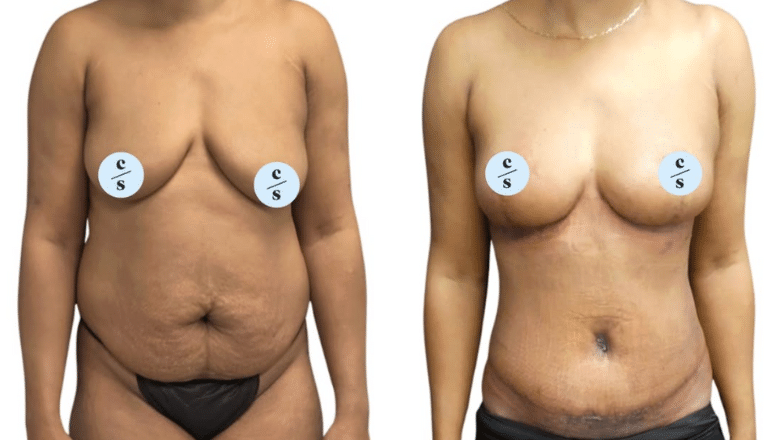
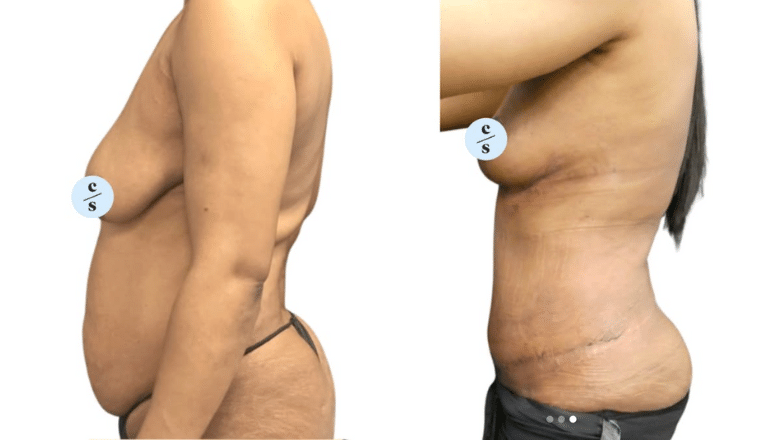
Results develop slowly. You will see an initial change within six to eight weeks, and the final result takes 12 to 18 months as swelling settles and scars mature. The photographs below show a patient before and after a mummy makeover at Centre for Surgery.
What Does a Mummy Makeover Involve at Centre for Surgery?
A mummy makeover has no fixed formula. It is planned at a face-to-face consultation, and most commonly pairs a tummy tuck with breast augmentation, a breast lift or a breast reduction. Liposuction can be added where your surgeon recommends it. The operation takes around five to six hours for the most common combination, is done as a day case under TIVA (total intravenous anaesthesia) and you go home the same day with a responsible adult.
Our surgeons are GMC-registered, the Baker Street hospital is CQC-regulated, and the surgeon who assesses you is the surgeon who operates. We recommend a two-week cooling-off period from the date you consent. Costs are confirmed in writing after consultation and are set out in our mummy makeover cost guide, and finance options are available. If you are weighing up surgery overseas, our guide to mummy makeover abroad explains why aftercare close to home matters.
Frequently Asked Questions
How do you sleep after a tummy tuck and BBL?
A tummy tuck needs you on your back with your upper body raised, while a BBL needs you off your back. The two pull in opposite directions, which is why a BBL is never done in the same operation as a tummy tuck or breast surgery at Centre for Surgery. It is staged several months apart, so you only follow one set of sleeping rules at a time. Our guide to how to sleep after a BBL covers that operation.
When can I sleep on my side after a mummy makeover?
Usually from around four weeks after a tummy tuck, and six weeks after an extended tummy tuck or larger combination, and only when your surgeon agrees. With breast implants, side sleeping typically waits until about four to six weeks. Start with a pillow between your knees and one hugged to your front.
How long do you have to sleep elevated after a tummy tuck?
About four weeks after a full tummy tuck and around six after an extended tummy tuck. After a mummy makeover, plan on four to six weeks. Your surgeon confirms the date at your review.
Can I sleep flat after a tummy tuck?
Most people find it uncomfortable, because lying flat with straight legs pulls on the abdominal skin and muscle repair. Raised and bent is the position you are asked to use in the early weeks, so follow your written instructions rather than testing it yourself, and ask your surgeon when you can lie flatter.
How do I know if I damaged my tummy tuck?
Tightness, bruising and swelling are normal. Warning signs are sudden severe pain, a wound that opens, spreading redness, discharge, a temperature above 38°C, or a swelling that grows quickly on one side. Call your surgeon’s direct number straight away rather than waiting for the next review, and call 999 for chest pain or breathlessness.
Can you sleep in a recliner after a tummy tuck?
Yes, and many people do for the first nights. A recliner holds you raised with your knees bent and stops you rolling over, and it makes standing easier. Add a pillow under your knees if the footrest is too flat, and move to a wedge in bed when you are comfortable.
Is it normal not to sleep well after a mummy makeover?
Yes. Tightness, a new position and a long anaesthetic all disturb sleep in the first one to two weeks, and most people sleep better as swelling settles. Take pain relief as advised, keep walking in the day and speak to your team if sleep stays poor or pain is worsening.
Mummy Makeover Aftercare in London
If you are considering a mummy makeover, a consultation will set out the combination that suits you, what recovery will involve and how we support you at night and in the first weeks. Our patient coordinators can book your consultation.
Phone: 020 7993 4849 | Address: 95–97 Baker Street, Marylebone, London W1U 6RN
Contact us to schedule a consultation
References
- Liu J, Liang Z, Wang H, Chen S, Xie Y, Xing F, et al. The bidirectional relationship between perioperative sleep deprivation and postoperative pain: mechanisms and clinical implications. A narrative review. Journal of Pain Research 2026;19:590177. doi:10.2147/JPR.S590177 ↗
- Huang NC, Wong CS. Melatonin as an integrative adjunct in multimodal analgesia: linking circadian regulation, anti-inflammatory modulation, and opioid-sparing mechanisms. International Journal of Molecular Sciences 2026;27(4):2046. doi:10.3390/ijms27042046 ↗
- Jiang X, Wang Y, Zhang X, Deng H, Fang L, Tafadzwa C, et al. Melatonin-engineered MSCs-exosomes deliver USP4 to stabilise ARNTL and inhibit clock rhythmic ferroptosis for enhanced flap survival. Clinical and Translational Medicine 2026;16(1):e70565. doi:10.1002/ctm2.70565 ↗
- Taylor DA, Merten SL, Sandercoe GD, Gahankari D, Ingram SB, Moncrieff NJ, et al. Abdominoplasty improves low back pain and urinary incontinence. Plastic and Reconstructive Surgery 2018;141(3):637–645. doi:10.1097/PRS.0000000000004100 ↗
- Manassa EH, Hertl CH, Olbrisch RR. Wound healing problems in smokers and nonsmokers after 132 abdominoplasties. Plastic and Reconstructive Surgery 2003;111(6):2082–2087. doi:10.1097/01.PRS.0000057144.62727.C8 ↗
- Sousa Oliveira LA, Helena Mendes L, Cabette Filho NN, da Costa Sacksida Valladão V. Thromboprophylaxis in intermediate and major plastic surgery procedures: a narrative review and proposal of the TROMBO-PLAST integrated decision-making model. Cureus 2026;18(6):e110817. doi:10.7759/cureus.110817 ↗
- Winocour J, Gupta V, Ramirez JR, Shack RB, Grotting JC, Higdon KK. Abdominoplasty: risk factors, complication rates, and safety of combined procedures. Plastic and Reconstructive Surgery 2015;136(5):597e–606e. doi:10.1097/PRS.0000000000001700 ↗





