


In this guide15 sections
- What Is Diastasis Recti?
- What Causes Diastasis Recti?
- How Common Is Diastasis Recti?
- Symptoms of Diastasis Recti
- How to Tell If You Have Diastasis Recti: The Self-Test
- How Is Diastasis Recti Diagnosed?
- Diastasis Recti Severity: Mild, Moderate and Severe
- Does Diastasis Recti Go Away on Its Own?
- Can Diastasis Recti Be Prevented?
- What Happens If Diastasis Recti Is Left Untreated?
- Treatment Options for Diastasis Recti
- Am I a Candidate for Diastasis Recti Surgery?
- Recovery After Diastasis Recti Surgery
- Frequently Asked Questions
- Diastasis Recti Treatment at Centre for Surgery
Diastasis recti — also called abdominal separation, abdominal muscle separation, or divarication of recti — is a condition in which the two bands of the rectus abdominis (the “six-pack” muscles) separate down the midline of the abdomen. It is extremely common after pregnancy, affecting well over half of women in the postnatal period, but it can also occur in men and in people who have not been pregnant.
That “well over half” figure is worth putting a number to. In a randomised controlled trial of 175 first-time mothers published in Physical Therapy, 55% were diagnosed with diastasis at six weeks postpartum — 55.2% in one group and 54.5% in the other (Gluppe et al., 2018 — read the abstract on PubMed, doi:10.1093/ptj/pzy008).
That same trial produced a finding most postnatal advice does not mention. The women were randomised to a four-month supervised exercise programme — weekly classes with strength training of the pelvic floor and abdominal muscles, plus daily home exercises — or to no intervention at all. The programme did not reduce the prevalence of diastasis at six months or at twelve months postpartum. The relative risk between groups was 0.99 at six months and 1.04 at twelve: essentially no difference.
This does not mean exercise is pointless — core and pelvic floor work has clear benefits for function, continence and back pain, and the trial was not designed to test targeted diastasis-specific rehabilitation. But it does mean that a generalised postnatal exercise class should not be presented as something that reliably closes the gap, and that a woman whose separation persists despite consistent effort has not failed at anything. This guide explains what diastasis recti is, what causes it, how to recognise the symptoms, how to test for it yourself, and the full range of treatments — from exercises for mild cases to a tummy tuck with muscle repair for severe separation.
Where separation is significant and hasn’t resolved with time or exercise, surgical repair — usually a tummy tuck with muscle repair, and often part of a mummy makeover — is the definitive solution. At Centre for Surgery in London, diastasis recti is assessed and treated by GMC-registered plastic surgeons at our CQC-regulated Baker Street clinic.
What Is Diastasis Recti?

Diastasis recti is the separation of the rectus abdominis muscles, which run vertically down the front of the abdomen. These two muscle bands are normally held together along the midline by a strip of connective tissue called the linea alba. When the linea alba is stretched and thinned — most often by pregnancy — the two muscle bands drift apart, creating a gap. This is why the condition is also known as abdominal separation or divarication of recti.
A degree of separation during pregnancy is completely normal and expected, as the growing uterus pushes the abdominal wall outwards. In most women the gap narrows again in the weeks and months after birth. But for a significant proportion, the muscles stay separated — and this persistent gap is what is meant by diastasis recti as a condition needing attention.
What Causes Diastasis Recti?
The underlying cause is stretching and weakening of the linea alba combined with increased pressure on the abdominal wall. The most common trigger is pregnancy, but it is not the only one.
Pregnancy
During pregnancy, the enlarging uterus expands outwards and pushes against the abdominal wall, while pregnancy hormones (particularly relaxin) soften the connective tissue. Together these cause the linea alba to thin and widen, separating the two parallel abdominal muscles. This most commonly develops in the third trimester. Ab separation in pregnancy is so common that some degree of it is considered normal.
Other Causes
Diastasis recti is not exclusive to pregnancy. It can also result from significant or rapid weight gain, obesity, improper exercise technique (repeatedly straining the abdominal wall), heavy lifting, and — occasionally — in newborns. Ageing and the natural weakening of connective tissue can also contribute.
Can Men Get Diastasis Recti?
Yes. While it is most associated with post-pregnancy women, men can develop diastasis recti too. In men it is usually linked to obesity, frequent heavy lifting, or improper core exercise. The symptoms of diastasis recti in men are the same — a midline abdominal bulge, weakened core, and sometimes back pain — and treatment options, including male abdominoplasty, are the same too.
Who Is Most at Risk?
Certain factors increase the likelihood of developing diastasis recti after pregnancy:
- Being aged 35 or over at the time of pregnancy
- Having had multiple pregnancies, or pregnancies close together
- Carrying twins or multiples, or a high-birth-weight baby
- Having a petite frame
- A previous pregnancy that resulted in diastasis recti
- Poor abdominal muscle tone, or being overweight before pregnancy
How Common Is Diastasis Recti?
It is very common. Estimates suggest that around 60% of women experience some degree of diastasis recti during pregnancy or in the immediate postnatal period. For many, the gap closes on its own within the first eight weeks to a few months after birth. However, studies suggest roughly a third of women still have diastasis recti six months or more after delivery — the point at which it is unlikely to resolve without intervention.
Symptoms of Diastasis Recti

The most recognisable sign is a persistent abdominal bulge or “pooch” in the midline that makes some people look as though they are still pregnant, months or even years after giving birth. But diastasis recti often causes more than an aesthetic change. Common symptoms include:
- A visible bulge or pooch along the midline of the abdomen, above or below the belly button
- Doming or coning — a ridge that appears down the centre of the abdomen when you strain, sit up, or engage your core
- A visible or palpable gap between the abdominal muscles, sometimes described as an upper diastasis recti bulge when it sits above the navel
- Lower back pain, as the weakened core can no longer properly stabilise the spine
- Poor posture and a forward pelvic tilt
- Core weakness and difficulty lifting, twisting, or performing everyday tasks
- Bloating and digestive issues such as constipation, due to reduced abdominal support
- Pelvic floor dysfunction, sometimes including urinary incontinence
- In some cases, a soft, spongy feeling in the gap, or mild tenderness and discomfort along the midline
Does Diastasis Recti Hurt?
Diastasis recti itself is often not painful — many people have no pain at all. However, the core weakness it causes can lead to secondary discomfort, most commonly lower back pain, and some people experience tenderness along the midline. Significant pain is not typical and should always be assessed by a healthcare professional to rule out a hernia, which can occur alongside diastasis recti.
What Does a Torn Stomach Muscle Feel Like?
Diastasis recti is sometimes described as “torn stomach muscles,” though the muscles aren’t actually torn — they’ve separated. Many people describe a distinct feeling of weakness in the core, most obvious during everyday tasks that involve lifting or straining, such as picking up a laundry basket or a child. Some also notice a soft, jelly-like texture in the gap between the separated muscles, and a conical or dome-shaped ridge that appears when they tense the abdomen or lean back.
How to Tell If You Have Diastasis Recti: The Self-Test
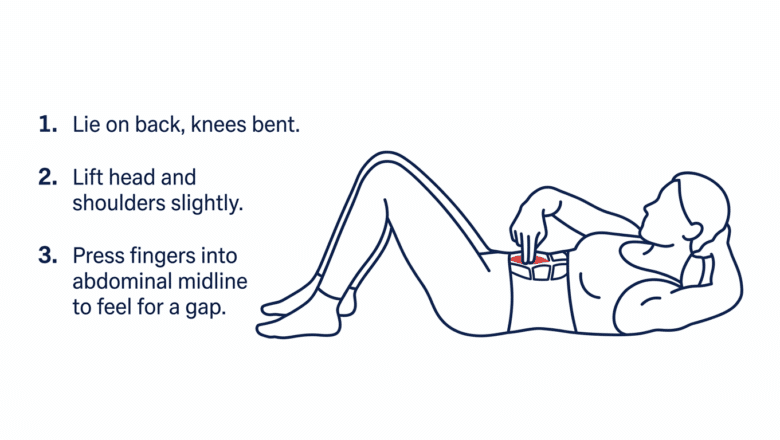
You can perform a simple self-test at home to check for abdominal separation. It’s best to wait until at least a few months after childbirth, giving your body time to recover naturally, before relying on the result. Three primary signs suggest the muscles may have separated: a visible gap along the midline of more than two finger-widths; a gap that doesn’t shrink when you tense your abdominal muscles; and a protruding mound or ridge along the midline.
- Lie on your back with your knees bent and feet flat on the floor.
- Place one hand behind your head and rest the fingers of your other hand across the midline of your abdomen, just above the belly button, pointing down towards your toes.
- Gently lift your head and shoulders slightly off the floor (like the top of a small crunch), tucking your chin towards your chest.
- As you lift, press your fingertips gently into your midline and feel for a gap between the two muscle bands.
- Note how many fingers fit into the gap, and check above the navel, at the navel, and below it.
A gap of two or more finger-widths suggests diastasis recti. A gap that feels soft and spongy, rather than firm, is another sign. Repeat the check above and below the belly button, as separation can occur in any of these areas. While the self-test is a useful indicator, an in-person assessment with a consultant is the reliable way to confirm the diagnosis and measure its severity.
How Is Diastasis Recti Diagnosed?
While the self-test is a useful first check, a professional diagnosis confirms the condition and measures it accurately. Diagnosis usually begins with a hands-on examination by a healthcare provider — often at your postpartum check-up, before you are cleared to exercise again. The clinician uses their fingers to feel for the gap and assess the muscle tone along the abdominal midline, checking above, at, and below the belly button, since separation can occur in any of these areas.
In some cases, additional tools such as ultrasound, a measuring tape, or callipers may be used to measure the gap more precisely. The separation is recorded either as a distance in centimetres or in finger-widths (for example, a two- or three-finger separation). A gap wider than around three centimetres is generally classified as diastasis recti. Based on the measurement, your provider may recommend specific exercises, refer you to a specialist physiotherapist, or — for a wide or persistent gap — discuss surgical assessment.
Diastasis Recti Severity: Mild, Moderate and Severe

The right treatment depends heavily on how wide the separation is. Severity is generally described as follows:
- Mild diastasis recti: a small gap, often around one to two finger-widths (roughly 1–2cm wide). This frequently improves with time and targeted core exercise after birth.
- Moderate diastasis recti: a wider gap of around two to three finger-widths. Exercise and physiotherapy may improve it but often won’t fully close it.
- Severe diastasis recti: a gap wider than three finger-widths (generally more than about 3cm), or one that does not respond to conservative measures. Severe separation typically will not resolve with exercise alone and usually requires surgical repair for a full correction.
A gap wider than around two to three centimetres is generally the threshold at which surgery becomes the most effective option.
Does Diastasis Recti Go Away on Its Own?
In the first weeks after birth, mild diastasis recti often does improve on its own as the connective tissue recovers. Whether it fully closes depends on factors including your skin quality and elasticity, how many pregnancies you’ve had, the number and size of babies, and how much weight was gained and lost. Where the gap persists beyond around six months and is moderate or severe, it is unlikely to close naturally, and healthy eating and exercise alone will not rejoin significantly separated muscles. At that stage, the options are targeted physiotherapy (for milder cases) or surgical repair (for severe cases).
Can Diastasis Recti Be Prevented?
Some degree of abdominal separation during pregnancy is normal and can’t always be avoided, but a few sensible measures can reduce the risk and limit how far the muscles separate:
- Manage pregnancy weight gain by following a balanced diet and staying appropriately active, keeping gain within the range advised by your midwife.
- Maintain good posture — standing and sitting tall keeps the core engaged and reduces strain on the abdominal wall.
- Lift carefully — use your legs rather than your core, and avoid lifting anything heavier than necessary, especially in later pregnancy.
- Practise deep breathing that expands the ribcage and belly, which engages the diaphragm and supports the abdominal wall.
- Use the leg-roll technique to get out of bed — roll onto your side and push up with your arms rather than sitting straight up, which strains the abs.
- Avoid high-pressure core exercises such as crunches and sit-ups, particularly in the later stages of pregnancy and the early postnatal period.
The same day-to-day modifications help during recovery: avoid lifting anything heavier than your baby, get up using the leg-roll technique, and steer clear of movements that make the abdominal wall bulge outward.
What Happens If Diastasis Recti Is Left Untreated?
Diastasis recti is not dangerous in itself, and many people live with mild separation without problems. However, if a significant separation is left untreated, it can contribute to ongoing issues over time, including chronic lower back pain, persistent poor posture, core instability, pelvic floor dysfunction (including urinary incontinence), digestive discomfort, and in some cases the development of an umbilical or ventral hernia where the weakened abdominal wall gives way. There can also be a lasting psychological impact from the persistent change in abdominal appearance. Early assessment allows these risks to be managed before they develop.
Treatment Options for Diastasis Recti

Treatment falls into two broad categories: non-surgical management for mild to moderate cases, and surgical repair for severe or persistent separation.
Non-Surgical Treatment: Exercise and Physiotherapy
For mild to moderate diastasis recti, targeted exercise that strengthens the deep core — particularly the transverse abdominis — can help narrow the gap and rebuild function. It’s best done under the guidance of a physiotherapist experienced in postnatal recovery, who can build a plan that starts gently and progresses as you improve. Beneficial exercises include:
- Pelvic tilts
- Heel slides
- Toe taps
- Cat-cows and bird-dog
- Modified planks
- Deep abdominal bracing and breathing
Just as important is knowing what to avoid. Traditional crunches, sit-ups, full planks, and heavy lifting can worsen the separation by pushing the abdominal wall outward, and should be avoided until cleared by a professional. When exercising, keep the navel drawn in towards the spine rather than pushed out, and if you notice doming or coning during a movement, stop. Bear in mind that exercise strengthens the core but won’t rejoin muscles that are significantly separated — for severe cases, surgery is the only way to fully close the gap.
Support Garments
Abdominal support garments or binders can provide temporary support and improve posture during recovery. They don’t cure diastasis recti but can help manage symptoms while the core is rebuilt.
Surgical Treatment: Tummy Tuck with Muscle Repair
For severe diastasis recti, or where the gap has not responded to months of conservative treatment, surgery is the most effective and lasting solution. The procedure is an abdominoplasty (tummy tuck) with muscle repair, carried out under TIVA and typically taking around two to three hours. During the operation, the surgeon makes an incision low on the abdomen (near the bikini line), tightens and stitches the separated rectus abdominis muscles back together along the midline to restore the abdominal wall, and removes any excess loose skin. In some cases the belly button is repositioned. Where there is also stubborn fat, liposuction may be combined with the procedure. Our surgeons offer a drain-free tummy tuck for selected patients, which can mean a more comfortable recovery and a thinner scar.
Where there is a large amount of excess skin — common after significant weight loss or multiple pregnancies — a Fleur-de-Lis abdominoplasty may be recommended. For many women, diastasis recti repair is carried out as part of a mummy makeover, which combines it with other procedures to restore the post-pregnancy body in a single stage. Our guide on the tummy tuck with muscle repair explains the surgical approach in detail.
Am I a Candidate for Diastasis Recti Surgery?
Surgical repair is generally suitable if you are physically and mentally healthy, over 18, a non-smoker (or willing to stop before surgery), close to your target weight, and have tried conservative measures without full success. A few timing points matter in particular:
- Wait at least a year after childbirth before considering surgery, to allow natural recovery and for exercise and physiotherapy to take effect.
- Complete your family first. A future pregnancy can re-separate repaired muscles, undoing the results — so surgery is best once you are sure you are not planning more children.
- Consider breastfeeding. Hormone fluctuations while nursing can affect the abdominal muscles, so it’s usually recommended to wait a few months after you have stopped breastfeeding before having surgery.
A tummy tuck removes excess skin as well as repairing muscle, so it is best done at a stable weight — if you plan further weight loss, it’s usually advised to reach your goal first. A tummy tuck is not a weight-loss procedure; its purpose is to repair the muscle and remove excess skin.
Recovery After Diastasis Recti Surgery
Recovery from a tummy tuck with muscle repair takes time. You’ll wear a compression garment to support the abdomen and reduce swelling. Most people take around two weeks off work and must avoid heavy lifting and core exercise for at least six weeks — worth planning around if you have young children, as you’ll need help with lifting during this period. Swelling settles over several weeks to months, and full results continue to refine for up to a year as the tissues heal. See our tips on exercising after a tummy tuck.
Frequently Asked Questions
Do I have diastasis recti or is it just belly fat?
They can look similar, but diastasis recti is a muscle separation, not fat. The tell-tale sign is doming or coning — a ridge down the midline when you engage your core — and a palpable gap on the self-test. Belly fat is soft and even, and doesn’t produce a midline ridge. A professional assessment can distinguish the two with certainty.
Can diastasis recti be painful?
Often it isn’t painful at all. When discomfort does occur, it’s usually secondary — lower back pain from core weakness, or mild tenderness along the midline. Significant pain should be assessed to rule out a hernia.
Can diastasis recti cause bloating?
Yes, it can. A weakened abdominal wall provides less support for the abdominal organs, which can contribute to bloating and digestive issues such as constipation.
Can diastasis recti come back after treatment?
After surgical repair, the main risk of recurrence is a further pregnancy, which can separate the muscles again. Significant weight gain and heavy improper lifting can also strain a repair. This is why completing your family and maintaining a stable weight are advised.
Can diastasis recti affect future pregnancies?
Having had diastasis recti once makes it more likely — and potentially more pronounced — in a future pregnancy. If you’re planning more children, it’s worth discussing a monitoring and management plan.
When should I start diastasis recti exercises?
It’s generally advised to begin targeted exercises in the first 6 to 12 months after childbirth, but only after a healthcare professional has confirmed the diagnosis and cleared you to start. Beginning too early, or with the wrong exercises, can make the separation worse.
How long does it take to recover from diastasis recti surgery?
Most people return to desk work within about two weeks, avoid strenuous activity and core exercise for at least six weeks, and see final results settle over up to a year.
Is diastasis recti surgery available on the NHS?
Diastasis recti repair is usually considered cosmetic and is not routinely funded by the NHS, though funding is occasionally available where there is significant functional impairment or an associated hernia. Most patients have treatment privately. Finance is available through Chrysalis Finance for procedures over £1,500.
Diastasis Recti Treatment at Centre for Surgery
Centre for Surgery is an experienced provider of abdominoplasty and mummy makeover surgery in the UK, with particular expertise in diastasis recti repair. Treatment is carried out by GMC-registered plastic surgeons at our CQC-regulated clinic at 95–97 Baker Street, London. Your journey begins with a thorough consultation, where your surgeon assesses the degree of separation, discusses whether conservative or surgical treatment is right for you, and builds a tailored plan. Our clinic holds a “Good” rating from the Care Quality Commission (CQC).
Finance options are available through our partner Chrysalis Finance — visit our Finance Options page for details.
Phone: 020 7993 4849 | Email: contact@centreforsurgery.com | Address: 95-97 Baker Street, London W1U 6RN



