


In this guide13 sections
- Key Points
- What Is Lipoedema (Lipedema)?
- Lipoedema or Just Fat Legs? Signs That Tell Them Apart
- Early Signs of Lipoedema (Lipedema)
- Lipoedema Pinch Test: How to Do It at Home
- Lipoedema vs Cellulite, Lymphoedema and Obesity
- Will Lipedema Go Away If I Lose Weight?
- What Causes Lipoedema?
- How Is Lipoedema Diagnosed? What Will the NHS Do?
- When to See a Specialist About Lipoedema
- Frequently Asked Questions
- Speak to a Specialist About Lipoedema in London
- References
Key Points
- Lipoedema (lipedema) is a chronic fat disorder, not a weight problem. It causes a symmetrical build-up of painful, easily bruised fat on the hips, thighs and often the lower legs, and sometimes the arms.
- The clues that separate it from ordinary leg fat are disproportion (a smaller upper body), feet that are spared, tenderness, easy bruising and legs that barely change with weight loss.
- A pinch test at home is not a diagnosis. It can show tenderness or small nodules worth mentioning to your GP, but lipoedema has no blood test and is diagnosed clinically.
- Lipoedema is often mistaken for obesity, lymphoedema or cellulite, and the conditions can co-exist.
- Diet and exercise are still worthwhile for general health, but the evidence suggests they do not shrink lipoedema fat in the legs.
- If your legs hurt, bruise easily and look out of proportion to the rest of you, ask your GP about lipoedema rather than assuming it is your weight.
Many women spend years being told that their legs are simply a weight problem. Lipoedema (also spelt lipedema) is a different condition: a chronic disorder of fat tissue that mainly affects women and does not respond to diet and exercise in the way ordinary fat does. Knowing the difference matters, because it changes what you ask your doctor and what help is realistic. Our main guide to lipoedema treatment covers diagnosis and management in depth, and this article focuses on the question that comes first: is it lipoedema or just fat legs?
Below you will find the signs that tend to separate the two, how a pinch test works and what it cannot tell you, how lipoedema differs from cellulite, lymphoedema and obesity, and how to get a diagnosis. If you are already confident that what you have is stubborn fat rather than lipoedema, our guides to thigh liposuction and how to lose thigh fat may be a better starting point.
What Is Lipoedema (Lipedema)?
Lipoedema is a chronic condition in which fat builds up abnormally and symmetrically, usually on the hips, buttocks, thighs and lower legs, and sometimes on the arms. A 2012 systematic review in Clinical Obesity described it as a disproportionate fatty deposition syndrome and noted that it is usually painful, bruises easily and typically appears around puberty[1]. Both spellings are in common use: lipoedema is the British spelling, lipedema the American one, and you will see both in research and in patient groups.
How common is it? Estimates vary widely. A 2020 review in Deutsches Ärzteblatt International put the figure at around 10% of women, but also stressed that the condition is under-recognised and has no biomarker, which makes true prevalence hard to pin down[2]. It is much rarer in men. A small case series from Brazil described five men with the condition, which the authors noted is thought to affect around 0.2% of men worldwide[3].
What lipoedema is not is the result of eating too much or moving too little. People of any size can have it, including women who are slim from the waist up, which is why searches such as “lipedema skinny” are so common. We cover the full picture, including stages and types, on our lipoedema treatment page.
Lipoedema or Just Fat Legs? Signs That Tell Them Apart
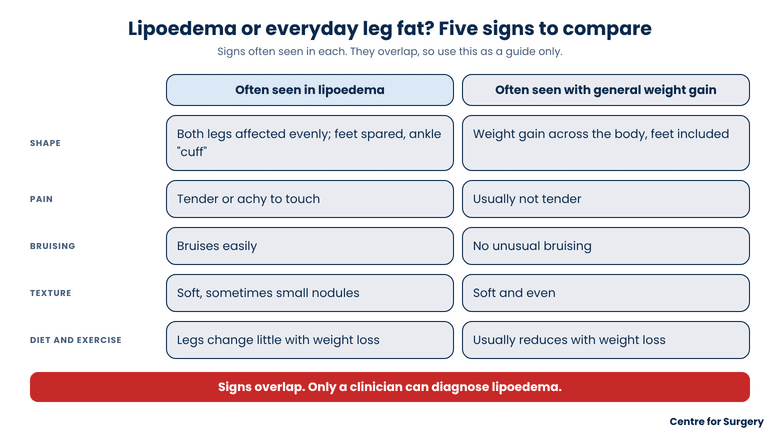
No single feature settles it, but a pattern does. The diagram below sets out the five signs clinicians commonly look at. Treat it as a guide to what to discuss with your GP, not a way of diagnosing yourself, because the signs overlap and both conditions can be present together.
Shape and proportions: is lipedema just in the thighs?
No. Lipoedema usually affects both legs evenly, from the hips down through the thighs and calves, and often the upper arms too. The classic feature is disproportion: a noticeably smaller waist and upper body sitting on much larger hips and legs. The feet are typically spared, so the fat stops abruptly at the ankle and can form a “cuff” or bracelet of tissue above the foot. A 2018 review describes the same pattern, with the hands and feet typically spared[4].
Fat that simply reflects weight gain tends to be spread across the body, including the abdomen, face, arms and feet, and the proportions between top and bottom change little. Fat that sits on the outer thigh in a different way, such as saddlebags or bulky cankles, is common without lipoedema, so shape alone is not enough.
Is lipoedema painful? Tenderness and heavy legs
Pain is one of the strongest clues. Women with lipoedema often describe legs that ache, feel heavy and are tender to touch, sometimes out of proportion to the pressure applied. Ordinary leg fat is not usually sore. A review of standards of care published in Phlebology in 2021 lists pain among the defining features[5]. Pain levels vary, though, and not everyone with lipoedema has significant pain, so its absence does not rule the condition out.
Does lipoedema cause bruising?
Easy bruising, with marks appearing after a light knock that you do not remember, is typical of lipoedema and not of general weight gain. In a 2025 prospective cohort study in International Angiology ↗, researchers compared 138 women with lipoedema and 111 with lymphoedema. Symmetrical involvement, disproportion between the upper and lower body, spared feet, bruising and pain were all significantly more common in the lipoedema group, and bruising, disproportion and spared feet were the three features that most clearly separated the two conditions[6].
Lumpy legs: what lipoedema nodules feel like
Lipoedema fat often feels different from ordinary fat. It can be soft and doughy at first, then develop small, firm nodules under the skin that are sometimes compared to rice grains, peas or walnuts as the condition progresses. The 2021 Phlebology review describes nodular and fibrotic fat[5]. If your skin has a lumpy feel to the touch that goes beyond surface dimpling, that is worth reporting.
Why do my legs stay the same size when I lose weight?
This is often the most telling sign for the person living with it. If your upper body slims down with weight loss but your hips and legs barely change, or your legs stay painful and disproportionate however you eat and train, lipoedema becomes more likely. A 2019 review in Obesity concluded that weight loss has little effect on lipoedema fat distribution[7]. Our guide to loose skin vs fat explains why other kinds of stubborn tissue also behave this way.
How do I know if I have lipoedema? Body shape and “lipedema skinny”
You cannot know for certain without an examination, but body shape gives the strongest hint. Lipoedema typically combines a smaller waist and upper body with wider hips and legs, which is why it is sometimes described as “lipedema skinny” when the top half is slim and the legs are not. A normal BMI therefore does not rule it out. Put the shape together with pain, easy bruising and legs that resist weight loss, and take that pattern to your GP.
Early Signs of Lipoedema (Lipedema)
Lipoedema often starts quietly. The usual triggers are hormonal: puberty, pregnancy and the menopause were all described as common times of onset in a 2018 review[4], and the 2021 Phlebology review makes the same point[5]. In a 2024 cross-sectional study of 115 women in Saudi Arabia, published in Plastic and Reconstructive Surgery Global Open ↗, the most common age at onset was around 20 to 29 years[8].
Early signs you might notice include:
- Hips and thighs that have grown out of proportion to your waist and upper body.
- Legs that feel tender or achy, particularly at the end of the day.
- Bruises that appear without a clear cause.
- A cuff of fat at the ankle, with slim feet.
- Fat on the legs that did not reduce when you lost weight elsewhere.
- A family history of similar legs, because the condition often runs in families[1].
Why is one leg fatter than the other?
Lipoedema is usually symmetrical, so noticeable one-sided swelling points elsewhere. Sudden swelling in one leg, especially with pain, warmth or redness, needs urgent medical attention to rule out a clot or infection.
Does lipoedema get worse with age?
It can, although it does not progress at the same speed in everyone. The tissue may become more nodular and the legs heavier, particularly after hormonal changes such as pregnancy or the menopause[5]. Some women notice little change for years. This variation is one reason an early diagnosis is useful: it gives you the chance to manage symptoms before they affect mobility.
Lipoedema Pinch Test: How to Do It at Home
The lipoedema pinch test is a simple self-check. It will not diagnose anything, but it can help you notice what to describe to your GP.
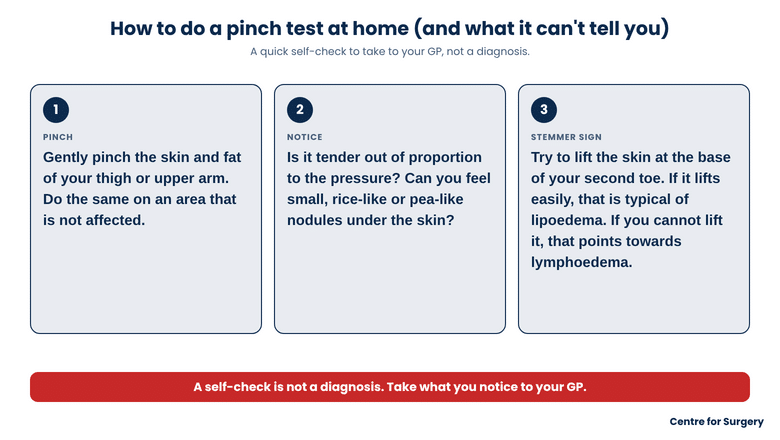
- Pinch. Sit comfortably and gently pinch the skin and fat on your outer thigh, then on the inner thigh or upper arm. Repeat on an area that is not affected, such as the skin on your abdomen or forearm, and compare.
- Notice. Is the area tender, with more pain than the pressure would suggest? Can you feel small, separate nodules beneath the skin?
- Check the Stemmer sign. Try to pinch and lift the skin at the base of your second toe. If it lifts easily, that is the usual finding in lipoedema. If the skin is thick and cannot be lifted, that is a positive Stemmer sign, which points towards lymphoedema.
The Stemmer sign matters because it helps separate the two conditions. In the 2025 International Angiology study, a positive Stemmer sign, along with pitting and fibrosis, was more characteristic of lymphoedema[6]. In the Saudi cohort, only 2% of women assessed had a positive Stemmer sign[8].
What the pinch test cannot tell you
A pinch test cannot confirm or rule out lipoedema. Tenderness can come from other causes, a negative Stemmer sign is also normal in people without any condition, and the two diseases can co-exist. Lipoedema has no blood test, and a review in the Journal of Plastic, Reconstructive & Aesthetic Surgery notes that diagnosis rests on clinical assessment, with the value of imaging still unclear[9]. Research into the role of ultrasound is continuing[10]. Think of the test as a way to structure what you tell your doctor.
Lipoedema vs Cellulite, Lymphoedema and Obesity
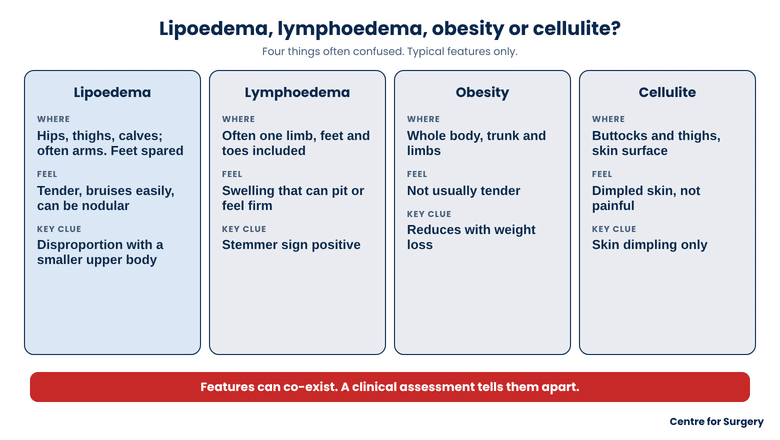
Lipoedema is regularly confused with three other things. The diagram below shows the typical features; real patients can have more than one at the same time.
What is the difference between lipedema and lymphedema?
Lymphoedema is swelling caused by a build-up of lymph fluid. It often affects one limb, includes the foot and toes, can pit when pressed, and feels firmer as it progresses. Lipoedema is a fat disorder that affects both legs and spares the feet. The 2012 systematic review lists lymphoedema, obesity, lipohypertrophy and venous swelling as the main conditions to consider when diagnosing lipoedema[1]. The two can overlap. Our guide on whether liposuction can treat lymphoedema explains where the boundaries lie.
Lipedema vs cellulite
Cellulite is dimpling of the skin surface, common in women of every size, and not usually painful. Lipoedema involves the deeper fat, with tenderness, bruising and disproportion. The two can sit side by side, and having cellulite does not mean you have lipoedema. Our guides to cellulite treatment and stubborn fat, skin laxity and cellulite explain how to tell those apart.
Lipedema vs obesity
Obesity usually involves weight gain across the whole body, including the trunk, and generally responds to weight loss. A 2012 review in Acta Pharmacologica Sinica described lipoedema as one of a group of rare adipose disorders that can masquerade as obesity[11]. The two can still occur together, which can make the picture confusing: a woman with lipoedema who also gains weight will find her legs harder to assess. Where the fat sits is also relevant, and our explanation of visceral vs subcutaneous fat shows why not all fat behaves alike.
Will Lipedema Go Away If I Lose Weight?
No, and this is one of the most important points for anyone deciding whether they have it. Weight loss is still sensible for general health and can reduce the load on joints and the overall size of the body, but the evidence suggests it does not eliminate lipoedema fat in the hips and legs[5],[7]. Many women find that their upper body slims while their legs stay the same, which can feel deeply frustrating and, understandably, fuels the sense of having been blamed.
Is there a lipoedema diet?
Researchers are still asking this question. A 2023 review in Current Obesity Reports examined whether a ketogenic diet might be a useful tool for lipoedema, and the topic is still being explored[12]. No diet has been shown to cure the condition. In the meantime, a balanced diet supports general health and weight stability, which is a reasonable aim whether or not you have lipoedema.
What helps lipoedema symptoms?
Conservative care can reduce symptoms for some people. In a randomised controlled trial of 33 women with severe lipoedema published in Lymphatic Research and Biology ↗, all groups improved after exercise-based rehabilitation, but complete decongestive therapy (compression and lymphatic drainage techniques) added to exercise produced greater reductions in limb volume and pain than exercise alone[13]. The trial was small, so the results should be seen as encouraging rather than conclusive. Our guide to lymphatic drainage massage explains how that technique works.
Would Ozempic help lipoedema?
Probably not directly. A 2026 review in Dermatologic Surgery found that GLP-1 medicines, the class used in many weight-loss injections, have not been proven to affect lipoedema progression. Only a very small case series of five patients, treated with a related drug, reported improvements in pain and limb volume, and the authors suggested these medicines might be an adjunct at most[14]. Weight-loss injections may still reduce overall body size, but they are not a treatment for lipoedema itself.
What Causes Lipoedema?
The honest answer is that nobody knows for certain. The strongest clues are genetic and hormonal. It often runs in families[1], and a 2019 review in Obesity described a likely polygenic susceptibility, meaning many genes each add a small contribution[7]. The tendency to start at puberty, pregnancy or the menopause points to a role for hormones[4]. Research into how the fat tissue itself differs is ongoing, and none of the proposed mechanisms has yet been turned into a test or a cure.
How Is Lipoedema Diagnosed? What Will the NHS Do?
Diagnosis is clinical. A doctor takes a history, looks at the pattern of fat distribution, feels the tissue for tenderness and nodules, checks for bruising and examines the feet and the Stemmer sign. They may also rule out other causes of leg swelling. There is no blood test[2], which is why a clinician who knows the condition matters.
Start with your GP. To make the appointment as useful as possible:
- Take clear photographs of your legs from the front, side and back, standing and relaxed.
- Write down when the changes began and whether they followed puberty, pregnancy or the menopause.
- Note where it hurts, how easily you bruise and whether any relatives have similar legs.
- Say plainly that you would like lipoedema considered, and ask for a referral to a service with experience of the condition.
The NHS lipoedema page ↗ explains the condition and what care is available, and the charity Lipoedema UK ↗ offers patient information and support. Access to specialist lipoedema services on the NHS varies across the country, so it is worth asking what is available locally. Living with a condition that is so often dismissed can take its own toll, and being believed is a real part of the process.
When to See a Specialist About Lipoedema
Consider a specialist opinion if your legs are painful, bruise easily, look out of proportion to your upper body and have not responded to weight loss, or if you are unsure whether what you have is lipoedema, lymphoedema or something else. An accurate diagnosis comes first; treatment decisions follow from it.
Once lipoedema has been confirmed, options range from compression, exercise and manual lymphatic drainage to surgery in selected patients. Our lipoedema treatment service explains how a consultation works, who may be suitable for lipoedema liposuction and what recovery involves. Surgery is not suitable for everyone and does not cure the condition, and a specialist will go through this honestly with you. If you are curious about treating particular areas, the guides to thigh liposuction, knee liposuction and arm liposuction are good places to start, and our overview of liposuction covers the technique in general.
Frequently Asked Questions
Is lipedema just in the thighs?
No. Lipoedema commonly affects the hips, buttocks, thighs and lower legs, and often the arms too. The feet and hands are usually spared, and the upper body can look much smaller than the lower body.
How do I know if I have lipedema or am just fat?
Look at the pattern rather than the size. Disproportion between your upper and lower body, spared feet, tenderness, easy bruising and legs that do not change with weight loss all point towards lipoedema. Only a clinician can confirm it, so take what you notice to your GP.
What are the early signs of lipedema?
Early signs include hips and thighs growing out of proportion to your waist, achy or tender legs, unexplained bruises and a cuff of fat above the ankle. It often begins around puberty, pregnancy or the menopause. A family history of similar legs is common.
Will lipedema go away if I lose weight?
No. Losing weight helps general health, but the evidence suggests it has little effect on lipoedema fat in the hips and legs. Many women find their upper body slims down while their legs stay the same size.
What is the difference between lipedema and lymphedema?
Lymphoedema is swelling from trapped lymph fluid. It often affects one leg, includes the foot and toes and may pit when pressed. Lipoedema is a fat disorder affecting both legs symmetrically, with the feet spared. A positive Stemmer sign points towards lymphoedema.
Would Ozempic help lipedema?
They have not been shown to treat lipoedema directly. A 2026 review found no proof that GLP-1 medicines affect lipoedema progression, although they may help with overall weight. Speak to your doctor before starting any weight-loss medication.
Does lipedema get worse with age?
It can. Some women notice the tissue becoming heavier and more nodular over time, particularly after pregnancy or the menopause, while others notice little change for years. An early diagnosis helps you plan how to manage symptoms.
Can lipedema be cured completely?
There is currently no cure. Conservative care such as compression, exercise and lymphatic drainage can ease symptoms, and in selected patients surgery may reduce the volume of affected fat. A specialist can explain what is realistic for you.
What will the NHS do for lipedema?
Your GP can assess your symptoms, rule out other causes of leg swelling and advise on self-care such as skin care, exercise and compression. Whether you can be referred to a specialist lipoedema service depends on where you live, so ask about local pathways.
Speak to a Specialist About Lipoedema in London
If you are unsure whether you have lipoedema or fat legs, a consultation can help you understand what is going on and what your options are. Find out more about lipoedema treatment at Centre for Surgery.
Phone: 020 7993 4849 | Address: 95–97 Baker Street, Marylebone, London W1U 6RN
Contact us to schedule a consultation
References
- Forner-Cordero I, Szolnoky G, Forner-Cordero A, Kemény L. Lipedema: an overview of its clinical manifestations, diagnosis and treatment of the disproportional fatty deposition syndrome – systematic review. Clinical Obesity 2012;2(3-4):86–95. doi:10.1111/j.1758-8111.2012.00045.x ↗
- Kruppa P, et al. Lipedema—pathogenesis, diagnosis, and treatment options. Deutsches Ärzteblatt International 2020;117(22-23):396–403. doi:10.3238/arztebl.2020.0396 ↗
- Amato AC, Amato JS, Benitti D, Santos KD. Lipedema in men: a retrospective case series of five patients from a Brazilian referral center. Cureus 2025;17(7):e87332. doi:10.7759/cureus.87332 ↗
- Sanchez-De la Torre Y, et al. Lipedema: friend and foe. Hormone Molecular Biology and Clinical Investigation 2018;33(1). doi:10.1515/hmbci-2017-0076 ↗
- Herbst KL, et al. Standard of care for lipedema in the United States. Phlebology 2021;36(10):779–796. doi:10.1177/02683555211015887 ↗
- Forner-Cordero I, Muñoz-Langa J, Morilla-Bellido L. Building evidence for diagnosis of lipedema: using a classification and regression tree (CART) algorithm to differentiate lipedema from lymphedema patients. International Angiology 2025;44(1):71–79. doi:10.23736/S0392-9590.25.05207-1 ↗
- Buso G, et al. Lipedema: a call to action! Obesity 2019;27(10):1567–1576. doi:10.1002/oby.22597 ↗
- Alosaimi K, Mortada H, Alshomer F. Characteristics and clinical features of patients with lipedema in Saudi Arabia: a cross-sectional comprehensive assessment. Plastic and Reconstructive Surgery Global Open 2024;12(9):e6173. doi:10.1097/GOX.0000000000006173 ↗
- van la Parra RFD, et al. Lipedema: what we don’t know. Journal of Plastic, Reconstructive & Aesthetic Surgery 2023;84:302–312. doi:10.1016/j.bjps.2023.05.056 ↗
- Bruno A, et al. The utility of ultrasound in the management of lipedema. Aesthetic Plastic Surgery 2026;50(15):6170–6178. doi:10.1007/s00266-026-05988-9 ↗
- Herbst KL. Rare adipose disorders (RADs) masquerading as obesity. Acta Pharmacologica Sinica 2012;33(2):155–172. doi:10.1038/aps.2011.153 ↗
- Verde L, et al. Ketogenic diet: a nutritional therapeutic tool for lipedema? Current Obesity Reports 2023;12(4):529–543. doi:10.1007/s13679-023-00536-x ↗
- Atan T, Bahar-Özdemir Y. The effects of complete decongestive therapy or intermittent pneumatic compression therapy or exercise only in the treatment of severe lipedema: a randomized controlled trial. Lymphatic Research and Biology 2021;19(1):86–95. doi:10.1089/lrb.2020.0019 ↗
- Mohseni Y, Vazirnia A, Minokadeh A, Amron DM, Coleman WP. Targeting inflammation and fibrosis in lipedema: the potential role of glucagon-like peptide-1 receptor agonist therapies. Dermatologic Surgery 2026;52(6S):S72–S75. doi:10.1097/DSS.0000000000005172 ↗