


In this guide13 sections
- Key Points
- Loose Skin vs Fat: The Differences at a Glance
- How to Tell If It’s Loose Skin or Fat
- Loose Skin on Stomach or Fat?
- Loose Skin on Arms or Fat?
- What Is Loose Skin, and Why Doesn’t It Shrink Back?
- Stubborn Fat: The Kind You Can Pinch and the Kind You Can’t
- Can You Have Loose Skin and Fat at the Same Time?
- How to Get Rid of Loose Skin
- How to Get Rid of Stubborn Fat
- Frequently Asked Questions
- Why Choose Centre for Surgery for Loose Skin or Stubborn Fat?
- References
Key Points
- Loose skin vs fat, the quick test: pinch the area. Loose skin feels thin and papery, folds like fabric and is slow to settle back. Subcutaneous fat feels soft, thick and spongy and springs back. If the area is firm and there is little to pinch, the fat is probably visceral fat, sitting beneath the muscle.
- They need different treatments. Significant loose skin only goes with surgical removal, such as a tummy tuck or arm lift. Pinchable fat responds to weight loss or liposuction. Visceral fat responds to weight loss, not surgery.
- Liposuction does not tighten loose skin, and removing fat from under loose skin can make it hang more. Skin-tightening devices produce a small and variable amount of contraction.
- Losing more weight will not fix loose skin. Skin stretched for years loses collagen and elastin, and studies of skin after major weight loss show the damage persists long after the weight has gone.
- Most people have some of both. After weight loss or pregnancy, a fold of loose skin often contains a layer of stubborn fat, which is why a hands-on assessment matters before any treatment is chosen.
Loose skin and excess fat are two of the most commonly confused body concerns we see at consultation, and understandably so: both can leave an area looking softer, fuller or less toned than you would like. Is it loose skin or fat? Getting the answer right matters. Months spent dieting to shift what is actually loose skin after weight loss, or booking liposuction for skin that has lost its elasticity, both end in disappointment.
This guide explains how to tell loose skin from fat at home, why the two behave so differently, what the evidence says about each treatment, and why so many people have a combination of both.
Loose Skin vs Fat: The Differences at a Glance
| Loose skin | Subcutaneous fat | Visceral fat | |
|---|---|---|---|
| Where it sits | The skin itself, stretched and hanging | Directly under the skin, above the muscle | Deep inside the abdomen, around the organs |
| How it feels | Thin, papery or crepey | Soft, thick and spongy | Firm and tight, with little to pinch |
| Pinch test | Folds like fabric and is slow to settle back | A thick roll that springs back | Cannot be pinched |
| Lying down | Flattens or slides to the sides | Keeps much of its volume | The belly stays rounded and firm |
| Does weight loss help? | No, and it can make it more visible | Yes, though stubborn areas may be last to go | Yes, it responds well to weight loss |
| What treats it | Surgical skin removal | Weight loss or liposuction | Weight loss and lifestyle change |
How to Tell If It’s Loose Skin or Fat

You can get a good idea at home in a couple of minutes, ideally in front of a mirror. Use all four of these checks, because each one shows you something different.
The pinch test
Take the area between your thumb and forefinger. Loose skin feels thin, almost like fabric, often wrinkles like crepe paper as you gather it, and is slow to settle back when you let go. Subcutaneous fat gives you a thicker, soft, spongy roll that springs straight back. If what you pinch feels thin on the surface but substantial underneath, you are likely dealing with both. If the area feels firm and there is very little to pinch at all, the fullness is probably visceral fat beneath the muscle wall.
The lean-forward test
Bend forward from the hips and watch the area in a mirror. Loose skin hangs down like a curtain and moves somewhat independently of the body beneath it. Fat moves with the body and keeps a more rounded shape.
The lying-down test
Lie flat on your back. Loose skin tends to flatten or slide to the sides, often leaving creases and folds. Subcutaneous fat keeps much of its volume. A stomach that stays domed and firm when you are lying flat suggests visceral fat is a large part of the picture.
Look at the surface of the skin
Stretch marks, a crepey texture and fine wrinkling when you push the skin together are signs that it has been stretched beyond its ability to recover. Fat on its own is usually covered by smoother, fuller skin, sometimes with the dimpling of cellulite over it.
Loose Skin on Stomach or Fat?
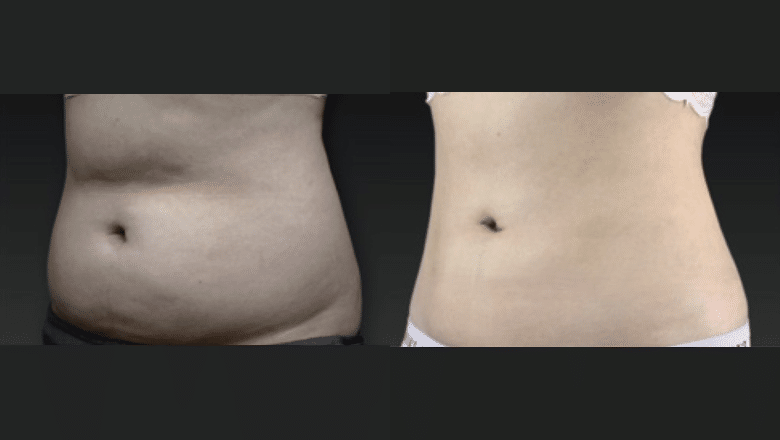
The stomach is where the question comes up most often, and where the answer is most often “both”. An overhang that hangs over the waistband or pubic area when you stand, lifts away when you lie down and carries stretch marks or creases is mostly loose skin. A stomach that is rounded evenly above and below the belly button, and stays that shape lying down, is mostly fat. A low fold that covers the pubic area is often called an apron belly, and our guide on how to get rid of apron belly covers it in detail. After pregnancy, separated stomach muscles can add a bulge that is neither skin nor fat, which we explain in our guide to the mum tum.
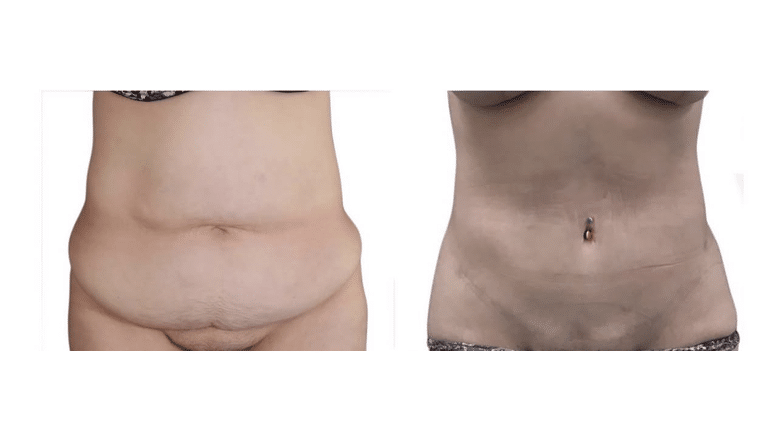
Where the skin still sits snugly over a layer of stubborn fat, the picture is different, and removing the fat alone can give a flatter result.
Loose Skin on Arms or Fat?
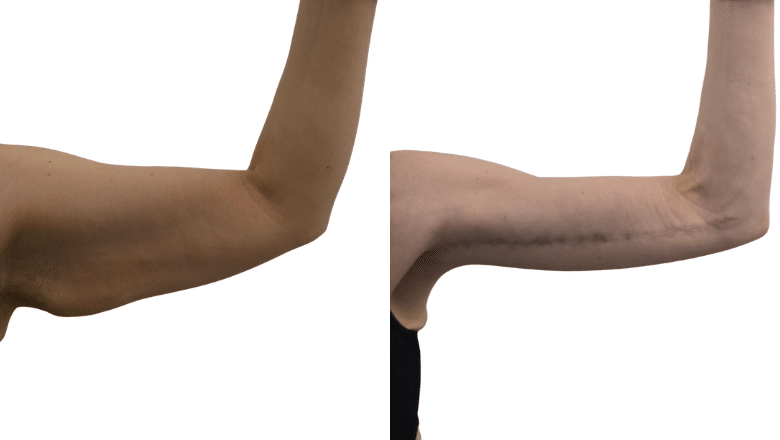
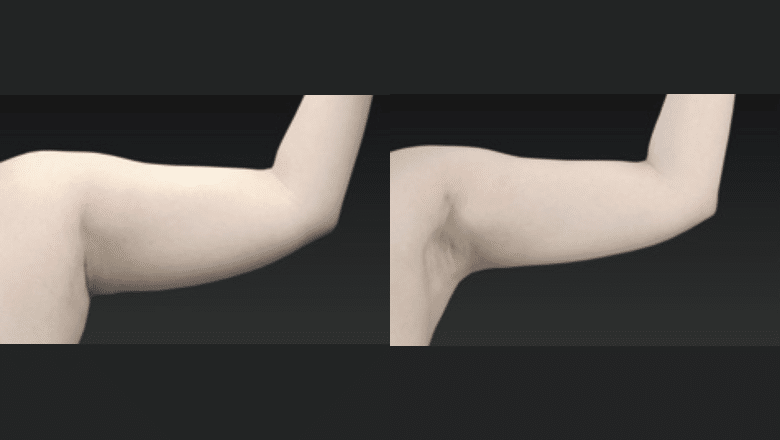
For the upper arms, hold your arm out to the side with the palm facing up. Loose skin hangs in a curtain between the armpit and elbow, feels thin and sways independently of the arm. Fat gives a fuller, rounder arm all the way round and feels thick when pinched. Often it is a mixture, and our guide on how to get rid of bingo wings explains how each is treated. Where the skin hangs, an arm lift removes it; where the skin has kept its elasticity, arm liposuction is usually enough.
What Is Loose Skin, and Why Doesn’t It Shrink Back?
Loose skin is skin that has lost its elasticity and no longer sits closely against the tissue beneath it. Rather than moving with your body as firm skin does, it hangs and can move somewhat independently of the muscle and fat underneath. It is most common on the abdomen, upper arms, inner thighs, buttocks and breasts. In a survey of people after weight-loss surgery, 78% of those who responded reported excess skin, most often on the abdomen (70%) and upper arms (61%)[1].
Loose skin is not dangerous in itself, but it can cause chafing, rashes and hygiene problems where folds rub together, as we explain in our guide to skin irritation after weight loss, and it understandably affects confidence and how clothes fit.
What causes loose skin?
- Ageing: collagen and elastin, the proteins that keep skin firm and able to spring back, are produced more slowly with age. Skin cells taken from people over 80 made about a third less collagen than cells from people aged 18 to 29[2].
- Weight loss: when significant weight is lost, the skin that stretched to accommodate it often cannot retract fully. A 2010 study in Plastic and Reconstructive Surgery ↗ examined skin removed from patients around 20 months after weight-loss surgery, after an average loss of about 60 kg, and found disorganised collagen and broken-down elastin even in skin that looked normal[3]. This is the most common cause of loose skin we see at consultation.
- Pregnancy: the abdomen expands considerably during pregnancy, and afterwards the skin does not always retract fully. Our guide on loose skin after pregnancy covers this cause in detail.
Stubborn Fat: The Kind You Can Pinch and the Kind You Can’t

Excess fat is an accumulation of fatty tissue that can sit almost anywhere, most commonly on the abdomen, waist, hips, thighs, arms and buttocks. Some fat is essential, but fat that resists diet and exercise is a common and frustrating concern. It sits in two distinct layers, and the difference matters for both health and treatment.
Subcutaneous fat sits directly beneath the skin and above the muscle. This is the soft fat you can pinch, and it is what liposuction and surgical body contouring remove. Visceral fat sits deeper, packed around the internal organs beneath the muscle wall. You cannot pinch it and it cannot be removed surgically, and it matters for health: an international position statement concluded that visceral fat is an independent risk marker for type 2 diabetes, heart disease and death from them[4]. Our guide to visceral vs subcutaneous fat explains how to tell which you have, with a calculator to estimate your own risk.
What causes excess fat?
- Genetics: plays a real role in where the body stores fat, and a family history of stubborn fat in the same areas is common.
- Underlying health conditions: an underactive thyroid, polycystic ovary syndrome (PCOS) and Cushing’s syndrome can all cause fat to build up regardless of diet. If any of these might apply to you, see your GP first, because treating the condition is the right first step.
- Calorie intake: consistently taking in more energy than the body uses leads to fat storage, often disproportionately around the abdomen.
It is also possible to be a normal weight and still carry too much fat and too little muscle, which can look like loose skin when it is not. Our guide to skinny fat covers this in detail.
Can You Have Loose Skin and Fat at the Same Time?
Yes, and very commonly. When you do, the loose skin is usually the more obvious concern, because it is not filled out and hangs whatever is underneath. Often it is only on pinching that a layer of stubborn fat inside the fold becomes apparent, sometimes unevenly across the area. This combination is exactly why an accurate assessment at consultation matters more than guessing from a mirror: the right treatment plan depends on how much of each is present, and many operations, such as a tummy tuck combined with liposuction, treat both together.
How to Get Rid of Loose Skin

Surgical removal is the only treatment that gets rid of significant loose skin. Our full guide on how to get rid of loose skin covers every option in detail, but the right procedure depends on the area affected:
- Abdomen: a tummy tuck, mini tummy tuck or extended tummy tuck, depending on how much skin there is
- Arms: an arm lift (brachioplasty)
- Thighs: a thigh lift
- Buttocks: a buttock lift
- Breasts: a breast lift
- Several areas after major weight loss: excess skin removal surgery, or after pregnancy a mummy makeover
The benefit goes beyond appearance. A meta-analysis of 15 studies and 7,339 patients found that people who had body contouring after weight-loss surgery scored substantially better for body image and for physical, psychological, sexual and social function than those who did not[5].
Can loose skin tighten without surgery?
Only to a limited degree. For mild looseness, BodyTite passes a radiofrequency probe beneath the skin through a small incision to heat the tissue and stimulate contraction. The measured effect is real but modest: in one study the skin of the abdomen contracted by an average of about 8% over 12 weeks, and the arms by about 2%[6], and in a series of 97 patients independent surgeons rated the skin tightening good or excellent in 58.5% of cases, compared with 74.5% for the improvement in contour[7]. It suits mild to moderate cases. Our guide to what radiofrequency skin tightening can and cannot do covers the evidence for each type of RF device. Exercise builds the muscle beneath the skin, which can make an area look firmer, but it cannot shrink skin that has been stretched, and creams cannot either.
How to Get Rid of Stubborn Fat
Where pinchable subcutaneous fat is the main concern and the skin above it still has good elasticity, liposuction removes fat cells directly through a fine cannula. It is a contouring procedure rather than a weight-loss treatment, and it works best for people close to their target weight with localised fat that has not responded to diet and exercise.
Two studies show what liposuction does and does not do. In a study published in the New England Journal of Medicine ↗, large-volume abdominal liposuction removed 9 to 10 kg of fat from women with obesity, yet 10 to 12 weeks later their insulin sensitivity, blood pressure, cholesterol and inflammatory markers were unchanged[8]: liposuction changes shape, not metabolic health, and it does not touch visceral fat. And in a randomised trial of liposuction in women of normal weight ↗, the treated thighs stayed slimmer at one year, but the difference in total body fat had disappeared, with the regain appearing on the abdomen[9]. Keeping your weight stable afterwards protects the result. Our comparison of liposuction vs tummy tuck explains which suits which body.
Where visceral fat is the main concern, surgery is not the answer; sustained weight loss through diet and exercise is, and your GP is the right first port of call, particularly if an underlying condition may be contributing. Some people are prescribed weight-loss medication by their GP or a specialist weight-management service as part of that process. We do not prescribe it at Centre for Surgery, but it is worth knowing that large or rapid weight loss, whatever the method, is one of the most common causes of loose skin.
Frequently Asked Questions
How do I tell if it’s fat or loose skin?
Pinch it. Loose skin feels thin and papery and is slow to settle back; fat feels soft, thick and spongy and springs back. Then lie down: loose skin flattens or slides to the side, while fat keeps more of its volume. If you are still unsure, or suspect a combination, a face-to-face assessment gives a definitive answer.
Can loose skin tighten up again?
A little, in some people. Mild looseness after modest weight loss, particularly in younger people, can improve over the following months as the skin adapts. Skin that has been stretched for years or after very large weight loss has lost collagen and elastin[3], so it does not go away on its own, and non-surgical devices tighten it only modestly. Significant loose skin needs surgical removal.
Does losing 20 kg cause loose skin?
It can, but it depends on more than the number. Your starting size, age, genetics, sun damage and how long the skin was stretched all matter. The best single predictor is how much overhang there was to begin with: in one study, every extra centimetre of abdominal overhang before weight-loss surgery roughly doubled the chance of an overhang of more than 3 cm afterwards[10]. On a large frame, 20 kg may leave little loose skin; on a smaller frame it can leave much more.
Is jiggly fat better than hard fat?
From a health point of view, usually yes. Soft, jiggly fat is mostly subcutaneous fat sitting under the skin, which is largely a cosmetic concern. A hard, tight stomach that you cannot pinch tends to mean more visceral fat around the organs, which carries a higher risk of type 2 diabetes and heart disease[4].
Why do I still look flabby at a low body fat percentage?
Usually for one of three reasons: loose skin left after weight loss, too little muscle beneath the skin, or fat that remains in a stubborn area such as the lower stomach, hips or arms while the rest of the body is lean. The pinch test tells you which, and our guide to skinny fat covers the muscle side of the picture.
Are bingo wings fat or loose skin?
Often both. Loose skin hangs and moves somewhat independently of the arm, while fat feels thicker and springs back when pinched. An assessment at consultation determines whether an arm lift, arm liposuction or both is the right approach.
Will losing weight fix loose skin?
No, and this is one of the most common misconceptions we see. Weight loss reduces fat, not skin laxity. Losing more weight on top of existing loose skin usually makes it more noticeable, because there is less fat filling it out.
Does liposuction tighten loose skin?
No. Liposuction removes fat, and taking volume out from under skin that has lost its elasticity can leave it hanging more. Where there is significant loose skin, a skin-removal procedure is needed, sometimes combined with liposuction.
Can loose skin turn into fat, or fat into loose skin?
No. They are different tissues and one cannot become the other. Weight gain after skin has become loose can make an area look fuller without fixing the laxity underneath, which is part of why the two get confused.
Why Choose Centre for Surgery for Loose Skin or Stubborn Fat?
Every procedure for loose skin or stubborn fat at Centre for Surgery is performed by a GMC-registered plastic surgeon, at our CQC-regulated hospital on Baker Street, rated Good overall by the CQC. We offer both skin-removal and fat-removal procedures, so your surgeon can recommend what your anatomy actually needs rather than whichever procedure happens to be on offer, and the surgeon who assesses you is the surgeon who performs your surgery.
Your initial consultation fee is redeemable against the cost of your procedure if you go ahead. Finance is available through Chrysalis Finance, subject to status. See our finance options page for details.
Phone: 020 7993 4849 | Address: 95–97 Baker Street, Marylebone, London W1U 6RN
Contact us to schedule a consultation
References
- Jiang Z, Zhang G, Du X, et al. Experience of excess skin and attitude to body contouring surgery of a Chinese post-bariatric population. Obesity Facts 2021;14(5):501–509. doi:10.1159/000517587 ↗
- Varani J, Dame MK, Rittie L, et al. Decreased collagen production in chronologically aged skin: roles of age-dependent alteration in fibroblast function and defective mechanical stimulation. American Journal of Pathology 2006;168(6):1861–1868. doi:10.2353/ajpath.2006.051302 ↗
- Light D, Arvanitis GM, Abramson D, Glasberg SB. Effect of weight loss after bariatric surgery on skin and the extracellular matrix. Plastic and Reconstructive Surgery 2010;125(1):343–351. doi:10.1097/PRS.0b013e3181c2a657 ↗
- Neeland IJ, Ross R, Després JP, et al. Visceral and ectopic fat, atherosclerosis, and cardiometabolic disease: a position statement. Lancet Diabetes & Endocrinology 2019;7(9):715–725. doi:10.1016/S2213-8587(19)30084-1 ↗
- Mokhtar J, Akbarpoor F, Hadi M, et al. Patient-reported outcome measures following postbariatric body contouring: a systematic review and meta-analysis. Plastic and Reconstructive Surgery 2026;157(5):698e–711e. doi:10.1097/PRS.0000000000012544 ↗
- Hurwitz D, Smith D. Treatment of overweight patients by radiofrequency-assisted liposuction (RFAL) for aesthetic reshaping and skin tightening. Aesthetic Plastic Surgery 2012;36(1):62–71. doi:10.1007/s00266-011-9783-z ↗
- Theodorou SJ, Paresi RJ, Chia CT. Radiofrequency-assisted liposuction device for body contouring: 97 patients under local anesthesia. Aesthetic Plastic Surgery 2012;36(4):767–779. doi:10.1007/s00266-011-9846-1 ↗
- Klein S, Fontana L, Young VL, et al. Absence of an effect of liposuction on insulin action and risk factors for coronary heart disease. New England Journal of Medicine 2004;350(25):2549–2557. doi:10.1056/NEJMoa033179 ↗
- Hernandez TL, Kittelson JM, Law CK, et al. Fat redistribution following suction lipectomy: defense of body fat and patterns of restoration. Obesity 2011;19(7):1388–1395. doi:10.1038/oby.2011.64 ↗
- Biörserud C, Olbers T, Staalesen T, Elander A, Fagevik Olsén M. Understanding excess skin in postbariatric patients: objective measurements and subjective experiences. Surgery for Obesity and Related Diseases 2016;12(7):1410–1417. doi:10.1016/j.soard.2016.01.033 ↗







