

In this guide15 sections
- Key Points
- What Is Radiofrequency Skin Tightening?
- Types of Radiofrequency Skin Tightening
- Does Radiofrequency Skin Tightening Work? What the Evidence Shows
- Radiofrequency Skin Tightening Before and After: What Results Look Like
- RF Skin Tightening for the Face, Jowls and Neck
- Radiofrequency Skin Tightening for the Stomach, Arms and Body
- How Many RF Sessions Do You Need, and How Long Do Results Last?
- Radiofrequency Skin Tightening Side Effects and Dangers
- At-Home Radiofrequency Skin Tightening: Do Devices Work?
- Radiofrequency vs HIFU, Lasers and Surgery: What Is the Strongest Skin Tightening Treatment?
- Choosing Where to Have Radiofrequency Skin Tightening
- Radiofrequency Skin Tightening FAQs
- Radiofrequency Skin Tightening in London
- References
Key Points
- What is radiofrequency skin tightening? A treatment that heats the deeper layers of the skin with radiofrequency (RF) energy. The heat makes collagen contract straight away and prompts the skin to lay down new collagen over the next three to six months.
- Does radiofrequency skin tightening work? Yes, for mild to moderate loose skin. A 2022 systematic review found measurable tightening on the face and body, but the change is modest and it is not a substitute for a facelift when skin hangs in folds.
- There are three main types. Surface RF heats through the skin with no needles; RF microneedling such as Morpheus8 places heat 0.5–4 mm deep; and minimally invasive RF such as FaceTite and BodyTite heats from a probe under the skin.
- Deeper heat means more tightening and more recovery. Surface RF has almost no downtime and the smallest effect; probe-based RF gives the most tightening of the three but is a procedure performed by a surgeon.
- Radiofrequency skin tightening side effects are usually redness and swelling for a day or two. Burns, scarring and fat loss are uncommon but real, which is why the device, the settings and the practitioner matter.
- Who should not have RF: anyone pregnant or breastfeeding, with an active skin infection or cold sore, a pacemaker or metal implant in the area, or a history of keloid scarring.
Radiofrequency skin tightening is one of the most searched non-surgical treatments in the UK, and also one of the most loosely used terms. It covers everything from a home gadget you glide over your face, to the RF microneedling sold as Morpheus8, to FaceTite and BodyTite, where a surgeon passes a fine probe under the skin. They all use the same kind of energy, but they heat different depths and produce very different results.
This guide explains how RF skin tightening works, what the evidence actually shows, what results and side effects to expect, and which type suits which problem. If you are not yet sure whether your concern is loose skin or fat, start with our guide to loose skin vs fat, and for an overview of every option we offer, see our skin tightening treatments in London.
What Is Radiofrequency Skin Tightening?
Radiofrequency skin tightening uses electrical energy at radio frequencies to heat tissue. The current itself is not felt as a shock: as it passes through the skin, the tissue’s resistance turns it into heat, in the same way that a wire warms when current runs through it. The aim is to raise the temperature of the dermis, the thick middle layer of the skin, and the fibrous strands beneath it, without burning the surface.
Two things then happen. First, the heat makes existing collagen fibres shorten and contract, which is why some people notice a little firmness straight after treatment. Second, the heat causes a controlled injury that the skin repairs over the following weeks. In a study of skin treated with fractional RF and examined under the microscope, the heated zones were completely replaced by new collagen by ten weeks, with new elastin fibres forming as well[1]. That repair process is why the main result of radiofrequency skin tightening appears gradually, over three to six months, rather than on the day.
What does radiofrequency do for the skin?
Depending on the device and depth, RF can firm mildly lax skin, soften fine lines, improve texture and acne scarring, and, with the probe-based devices, tighten the skin over areas where fat is removed at the same time. It does not remove loose skin that hangs in a fold, lift the deeper muscle layer of the face, or restore lost volume.
Types of Radiofrequency Skin Tightening
The single most useful thing to understand about RF is depth. The heat has to reach the layer that has loosened, and the deeper the heat goes, the more tightening is possible and the more recovery is involved.

Surface RF: monopolar, bipolar and multipolar devices
Surface devices heat the skin from the outside through a handpiece that is moved over the skin or pulsed onto it. Monopolar devices send the current from the handpiece to a pad elsewhere on the body and can heat quite deeply; bipolar and multipolar devices pass the current between electrodes in the same handpiece, so the heat stays more superficial. There are no needles and little or no downtime, but the change is the most modest of the three types, and several sessions are usually needed. Low-powered versions of this technology are what at-home RF devices use.
RF microneedling (Morpheus8)
RF microneedling combines fine needles with radiofrequency. Insulated needles enter the skin to a set depth, and the RF energy is released at the tips, so the heat is delivered precisely into the dermis or the top of the fat rather than having to pass through the surface. At Centre for Surgery this is Morpheus8, which treats from 0.5 mm to 4 mm deep on the face and deeper on the body, usually as a course of three sessions. It also improves texture, acne scars and stretch marks, which surface RF does much less well. Our guide to Morpheus8 or FaceTite compares it with the probe-based option.
Minimally invasive RF: FaceTite, AccuTite and BodyTite
With these devices, a fine probe is passed under the skin through a tiny incision, and an electrode sits on the surface above it. The current flows between the two, heating the fat and the underside of the dermis from below, while sensors cut the energy when the target temperature is reached. FaceTite treats the lower face, jawline and neck; AccuTite is the smaller version for areas such as the lower eyelids; and BodyTite treats the body, removing fat at the same time. These are procedures performed by a surgeon, under local anaesthetic with sedation or, for larger BodyTite treatments, TIVA (total intravenous anaesthesia). They bring the most tightening of the three types, with a few days of recovery.
Argo Plasma works in a similar place, under the skin, but uses argon plasma together with radiofrequency, and is usually added after liposuction to tighten the skin over the treated area.
Does Radiofrequency Skin Tightening Work? What the Evidence Shows
The fair answer is yes, within limits. The clearest summary comes from a 2022 systematic review in Plastic and Reconstructive Surgery ↗, which looked at 23 clinical studies of monopolar and bipolar RF devices on the face and body. It concluded that these devices produce measurable improvement in skin laxity with an acceptable safety record, that most complications are minor and short-lived, and that major complications were more common with monopolar devices than with bipolar ones[2].
The word “measurable” matters. In one of the original multicentre studies of a single surface monopolar treatment around the eyes, independent assessors looking at blinded photographs found at least a one-point improvement in wrinkles in 83% of treated areas, yet the treating doctors noted visible improvement in only 29%, and half of the patients were satisfied[3]. Surface RF can work, but the change is often subtle.
Is RF microneedling effective?
RF microneedling has a larger evidence base. A 2026 systematic review of 41 studies, 15 of them randomised trials, found that it improved wrinkle scores, dermal density and the contour under the chin in people treated for laxity and photoageing, with high satisfaction and little downtime[4]. Two caveats are worth knowing: the review was written partly by a device manufacturer’s medical team, and the authors themselves noted that studies reported their settings inconsistently and rarely followed patients for long.
Does FaceTite or BodyTite work better than surface RF?
Heating from under the skin produces more tightening. In a 2020 multicentre study of 247 patients ↗ treated with FaceTite combined with fractional RF for the lower face and neck, almost all under local anaesthetic, the face and neck laxity grade improved by an average of 1.4 points and 93% of patients said they were pleased and would have it again[5]. It was a retrospective study by surgeons experienced with the device, and the authors were clear that it does not replace a facelift or neck lift in people who need one.
On the body, a randomised split-abdomen study compared liposuction alone with liposuction plus RF on the opposite side of the same patients. The skin over the RF side shrank in surface area by 25.8%, against 10.4% with liposuction alone at six weeks and 8.3% at one year[6]. A 2025 systematic review found the same pattern across 19 studies, with average skin retraction of 31% after RF-assisted liposuction against 12% after standard liposuction, while warning that half the studies carried a serious risk of bias and that firm conclusions were not yet possible[7].
So who does radiofrequency work for?
RF works best for people with mild to moderate laxity, good skin quality and realistic expectations, typically from their late thirties to their fifties. It works least well for skin that hangs in folds, after major weight loss, or where the deeper muscle layer of the face has descended. In those situations a facelift, neck lift, tummy tuck or arm lift will do what no energy device can.
Radiofrequency Skin Tightening Before and After: What Results Look Like
Results from radiofrequency skin tightening build slowly. Swelling in the first days can make the skin look tighter than it is, and that early effect settles. The real change comes from new collagen, which develops over three to six months after a course of RF microneedling or a single FaceTite or BodyTite treatment, and can continue to improve for up to a year. Photographs are therefore most useful when the “after” is taken at least three months after the last session.
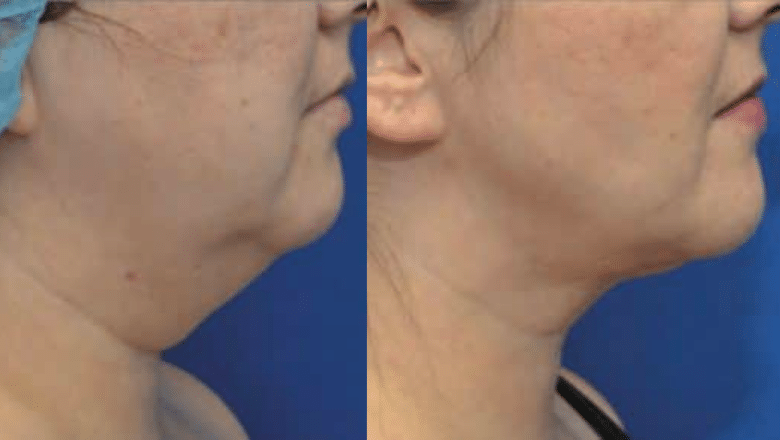
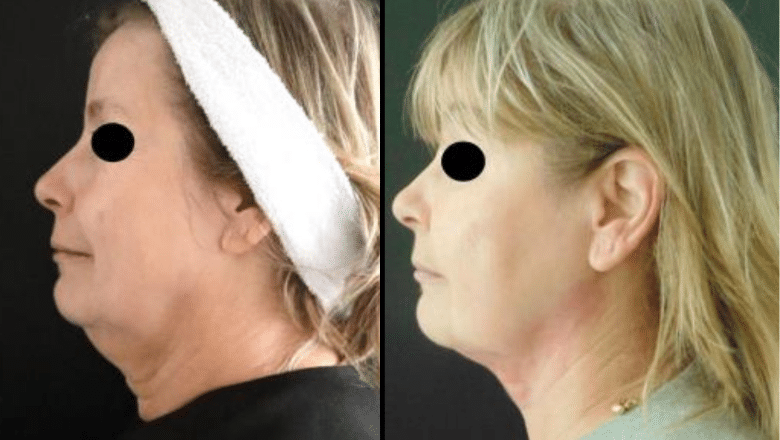
More cases are in our Morpheus8 before and after gallery. When you look at RF before and after photos anywhere, check that both pictures were taken with the same lighting, angle and expression, without make-up, and months rather than days after treatment.
RF Skin Tightening for the Face, Jowls and Neck
The face and neck are where RF is most often used. For early softening of the jawline, slightly crepey skin under the chin and fine lines, a course of RF microneedling is the usual starting point. Where early jowls and a looser neck are the main concern, FaceTite heats the tissue from beneath and tightens more, often combined with Morpheus8 or with liposuction under the chin in the same session.
The limits are clear. Heavy jowls, vertical neck bands and a neck that hangs in a fold come from descent of the deeper tissues and the platysma muscle, which RF cannot reposition. Our guides to sagging jowls and turkey neck explain where each treatment fits, and our comparison of facial skin tightening treatments sets RF alongside lasers, injectables and surgery.
Radiofrequency Skin Tightening for the Stomach, Arms and Body
On the body, RF is used for loose skin on the stomach, upper arms, inner thighs, knees and above the bra line. The choice depends on whether there is fat to remove as well:
- Loose skin with little fat: Morpheus8 body treatments tighten and improve texture and stretch marks over a course of sessions. Our guide to Morpheus8 body treatments covers the areas treated.
- Fat with mild loose skin over it: BodyTite removes the fat and heats the skin from below in one procedure, which is where the split-abdomen evidence above applies.
- Loose skin after liposuction: Argo Plasma can tighten the skin over the treated area as part of the same operation.
- Skin that hangs in a fold: after pregnancy or major weight loss, surgery that removes the excess is the only reliable answer.

Our guide to stomach skin tightening compares the options for the tummy in more detail.
Does RF work on crepey arms?
It can help mildly crepey skin on the upper arms, especially with RF microneedling, which improves both firmness and the crinkled texture. It will not remove a hanging fold of skin, often called bingo wings, which needs an arm lift. If there is fat in the upper arm as well, BodyTite treats both at once.
How Many RF Sessions Do You Need, and How Long Do Results Last?
The number of treatments depends on the type:
- Surface RF: usually a series of sessions, with maintenance to keep the effect.
- Morpheus8: usually three sessions four to six weeks apart, sometimes a fourth on the body, with a yearly maintenance session to help preserve the result. Our guide to how many Morpheus8 sessions you need explains why.
- FaceTite and BodyTite: usually a single treatment.
How long does radiofrequency skin tightening last? The new collagen is your own and does not disappear, but the skin carries on ageing from its new starting point, and sun exposure and smoking speed that up. RF microneedling results typically last a year or more with maintenance, while the deeper probe-based treatments last longer; our guide to how long FaceTite lasts covers this in detail.
How long does it take for radiofrequency to tighten skin?
Some firmness may be noticeable within days, but most of the tightening appears between one and six months after the last treatment, as new collagen forms.
Radiofrequency Skin Tightening Side Effects and Dangers
After surface RF or RF microneedling, most people have redness, warmth and some swelling for one to two days, and RF microneedling leaves fine pinpoint marks that clear within a few days. FaceTite and BodyTite involve bruising, swelling and some temporary numbness, as with any minor surgical procedure. Our guide to Morpheus8 side effects sets out the full picture for RF microneedling.
Can RF skin tightening go wrong?
Yes, occasionally, and almost always because of too much heat in the wrong place. The main risks are:
- Burns and scarring. In the early multicentre surface RF study, second-degree burns occurred in 0.36% of pulses[3], while a later review of 290 patients treated in one practice found them in 2.7% of sessions, which the authors linked to overlapping pulses[8].
- Fat loss. Heat in the fat layer can reduce it, which is welcome under the chin but not in a thin face. In a 2024 randomised split-face trial ↗ of a vacuum-assisted RF microneedling device, the treated side of the midface lost about 0.55 ml of volume at six months compared with 0.10 ml on the untreated side[9]. It is one reason people search for “radio frequency ruined my face”, and why depth and energy should be lower over lean areas of the face.
- Nerve injury. With probe-based RF, temporary weakness of the corner of the mouth from irritation of the marginal mandibular nerve occurs in around 1% of face and neck treatments. A 2025 review of over 3,700 cases put overall complication rates at about 5% on the face and neck and 9% on the body, mostly minor[10].
- Pigment changes. Temporary darkening of the skin can follow, especially in darker skin.
In October 2025 the US Food and Drug Administration issued a safety communication on RF microneedling ↗ after reports of burns, scarring, fat loss, disfigurement and nerve damage. Its advice is to treat RF microneedling as a medical procedure rather than a beauty treatment, to choose a licensed provider trained in the device, and not to use RF microneedling devices at home.
Is radiofrequency safe for darker skin?
Generally, yes, with appropriate settings. RF does not target pigment in the way many lasers do, so it is thought to carry a lower risk of pigment change. A 2023 review of 35 studies in Fitzpatrick skin types III to VI found transient darkening in seven studies, prolonged mild darkening in one and permanent scarring in one, while noting that many of the studies were of limited quality[11].
Who should not have radiofrequency skin tightening?
RF is not suitable if you:
- are pregnant or breastfeeding
- have an active skin infection or cold sore in the area
- have a pacemaker, or metal implants in the treatment area
- have a history of keloid scarring
- have a bleeding disorder, take medication that significantly affects clotting, or have a condition that impairs healing
- have recently tanned or sunburnt skin on the area
Treatment is for adults aged 18 and over.
At-Home Radiofrequency Skin Tightening: Do Devices Work?
At-home RF devices use far lower energy than clinic devices, so that they are safe to use unsupervised. That also limits what they can do. The published studies tend to be small and short: in one randomised split-face trial, 36 women who used a home device combining low-level RF with light, microcurrent and ultrasound for eight weeks had better hydration, elasticity and fine lines on the treated side, but with four energies in one device it is impossible to say what the RF itself contributed[12]. At best, home devices give a mild, temporary improvement in how the skin looks and feels; they do not tighten loose skin in the way clinic treatments can. Home RF microneedling devices are a different matter, and the FDA advises against them altogether.
Radiofrequency vs HIFU, Lasers and Surgery: What Is the Strongest Skin Tightening Treatment?
Surgery remains the strongest skin tightening treatment, because it removes the excess skin and repositions the deeper tissues. Among non-surgical and minimally invasive options, the order of strength broadly follows depth:
- Surface RF and HIFU: both heat from the outside without breaking the skin. HIFU (high-intensity focused ultrasound) focuses heat at set depths; our comparison of Morpheus8 vs Ultherapy explains the differences.
- Lasers: the Fotona 4D laser heats the skin from the surface and inside the mouth, and suits fine laxity and texture with little downtime.
- RF microneedling: deeper and more precise, with improvement in texture as well as firmness.
- FaceTite, BodyTite and Argo Plasma: heat delivered from under the skin, with the most tightening short of surgery.
Many patients do best with a combination, for example Morpheus8 for skin quality alongside FaceTite for tightening, or RF before or after surgery to improve the skin itself.
Why do some plastic surgeons not like RF microneedling?
Usually because of the gap between how it is marketed and what it can do. RF microneedling cannot lift heavy jowls or remove excess skin, and it is sometimes sold to people who need surgery. When it is done badly, too deep or too hot over a thin face, it can cause the fat loss and burns described above. Used for the right patient, at the right depth, by a trained practitioner, it is a useful treatment with good evidence behind it.
Choosing Where to Have Radiofrequency Skin Tightening
The NHS advice on what to consider before a cosmetic procedure ↗ applies to RF as much as to anything else: choose a practitioner who is trained and experienced in the procedure you are having, ask about the device and what could go wrong, and take time to decide. You can check a doctor’s registration on the GMC medical register ↗ and a nurse’s on the NMC register ↗.
At Centre for Surgery, Morpheus8 is delivered by an NMC-registered aesthetic practitioner on the genuine InMode platform, with a new sterile tip for every session, and FaceTite, BodyTite and Argo Plasma are performed by GMC-registered surgeons at our Baker Street hospital, which is rated Good overall by the CQC. Prices for skin treatments are on our Skin & Aesthetics price list, and our Morpheus8 cost guide explains what affects the cost of a course.
Radiofrequency Skin Tightening FAQs
Is RF skin tightening effective?
For mild to moderate loose skin, yes. Systematic reviews show measurable tightening on the face and body, with the greatest effect from treatments that deliver the heat deeper, such as RF microneedling and FaceTite or BodyTite. It is less effective for heavy sagging, which needs surgery.
Does radiofrequency skin tightening hurt?
Surface RF feels like intense warmth. Morpheus8 is done after numbing cream has been applied for 45 to 60 minutes and feels hot and prickly in places. FaceTite and BodyTite are performed under local anaesthetic with sedation, or TIVA (total intravenous anaesthesia) for larger body areas, so you are comfortable during the procedure.
How much downtime is there after RF?
There is little or none after surface RF. Most people return to work within one to two days after Morpheus8, and within a few days to a week after FaceTite or BodyTite, depending on the area treated and whether liposuction was included.
Can radiofrequency make you look older?
It can if it removes too much fat from an already thin face, which is a recognised risk when the energy or depth is too high. A careful assessment of your face, and conservative settings over lean areas, keep this risk low.
Is radiofrequency better than HIFU?
Neither is better for everyone. Both heat the deeper layers of the skin. RF microneedling also improves texture and scarring, while HIFU treats at set depths without breaking the skin. The right choice depends on your skin, the area and how much tightening you need.
Can you combine RF with other treatments?
Yes. RF is often combined with liposuction under the chin or on the body, with laser treatments for skin quality, and with anti-wrinkle injections or fillers for lines and volume. Your plan is set out at consultation.
Radiofrequency Skin Tightening in London
If you are considering radiofrequency skin tightening, a consultation will establish whether your concern is loose skin, fat or deeper descent, and which depth of treatment, if any, will help. Find out more about Morpheus8 at Centre for Surgery.
Phone: 020 7993 4849 | Address: 95–97 Baker Street, Marylebone, London W1U 6RN
Contact us to schedule a consultation
References
- Hantash BM, Ubeid AA, Chang H, et al. Bipolar fractional radiofrequency treatment induces neoelastogenesis and neocollagenesis. Lasers in Surgery and Medicine 2009;41(1):1–9. doi:10.1002/lsm.20731
- Rohrich RJ, Schultz KP, Chamata ES, et al. Minimally invasive approach to skin tightening of the face and body: systematic review of monopolar and bipolar radiofrequency devices. Plastic and Reconstructive Surgery 2022;150(4):771–780. doi:10.1097/PRS.0000000000009535
- Fitzpatrick R, Geronemus R, Goldberg D, et al. Multicenter study of noninvasive radiofrequency for periorbital tissue tightening. Lasers in Surgery and Medicine 2003;33(4):232–242. doi:10.1002/lsm.10225
- Kumar N, Kim HM, Nishikawa A, et al. Effectiveness of radiofrequency microneedling in the treatment of dermatological conditions: a systematic review. Aesthetic Plastic Surgery 2026;50(13):5282–5317. doi:10.1007/s00266-026-05834-y
- Dayan E, Rovatti P, Aston S, et al. Multimodal radiofrequency application for lower face and neck laxity. Plastic and Reconstructive Surgery Global Open 2020;8(8):e2862. doi:10.1097/GOX.0000000000002862
- Irvine Duncan D. Nonexcisional tissue tightening: creating skin surface area reduction during abdominal liposuction by adding radiofrequency heating. Aesthetic Surgery Journal 2013;33(8):1154–1166. doi:10.1177/1090820X13505862
- Faustino LD, Cruciol FS, Motoki THC, et al. Comparative efficacy of adjuvant technologies for skin tightening in liposuction: a systematic review and quantitative analysis. Aesthetic Plastic Surgery 2026;50(4):1556–1570. doi:10.1007/s00266-025-05334-5
- de Felipe I, Del Cueto SR, Pérez E, Redondo P. Adverse reactions after nonablative radiofrequency: follow-up of 290 patients. Journal of Cosmetic Dermatology 2007;6(3):163–166. doi:10.1111/j.1473-2165.2007.00322.x
- Liu Y, Yu W, Zhu J, et al. Facial tightening using a novel vacuum-assisted microneedle fractional radiofrequency system: a prospective, randomized, split-face study. Journal of Cosmetic Dermatology 2024;23(10):3248–3255. doi:10.1111/jocd.16414
- Guo X, Yan M, Zhao M, et al. Temporary orbicular oculi palsy after radio-frequency assisted liposuction (RFAL) combined with transconjunctival lower blepharoplasty: case report and systematic review of complication. Aesthetic Plastic Surgery 2025;49(13):3605–3617. doi:10.1007/s00266-025-04901-0
- Syder NC, Chen A, Elbuluk N. Radiofrequency and radiofrequency microneedling in skin of color: a review of usage, safety, and efficacy. Dermatologic Surgery 2023;49(5):489–493. doi:10.1097/DSS.0000000000003733
- Choi S, Kim J, Lee YI, et al. Efficacy and safety of a home-use handheld multi-energy-based device for skin rejuvenation: clinical, ex vivo, and histological studies. Lasers in Medical Science 2024;39(1):38. doi:10.1007/s10103-024-03982-8