

In this guide9 sections
- What Causes Sagging Facial Skin?
- What You Can Do Yourself First
- Non-Surgical Facial Skin Tightening Treatments
- FaceTite for Facial Skin Tightening
- Surgical Facial Skin Tightening Treatments
- Choosing the Right Facial Skin Tightening Treatment
- Our Expert Recommendation
- Facial Skin Tightening FAQs
- Facial Skin Tightening Treatments: Discover Excellence at Centre for Surgery
Sagging, loose facial skin is one of the most common concerns patients raise with us — and one of the most heavily marketed. Anyone researching skin tightening on face options will find creams, devices, and in-clinic treatments that all promise to tighten face skin, but the honest picture is that effectiveness varies enormously by method, and the right answer depends on how much laxity you actually have. It’s worth being sceptical of any single treatment marketed as a universal solution: a firming cream cannot replicate what a facelift does, and equally, surgery is unnecessary overkill for skin that would respond perfectly well to a course of chemical peels or RF microneedling. This guide covers the full spectrum of facial skin tightening treatments available in the UK, from lifestyle measures through to surgery, with a clear, evidence-led view on what works for which level of concern — and, just as importantly, what genuinely doesn’t.
What Causes Sagging Facial Skin?

Facial skin sagging isn’t a single process — it’s several changes happening at once beneath the surface:
Collagen and Elastin Loss
Collagen and elastin are the structural proteins that keep skin firm and able to spring back into shape. Collagen provides tensile strength — it’s what stops skin tearing or stretching permanently under normal movement — while elastin allows skin to stretch and then return to its original shape. Production of both declines with age, roughly 1% per year from your mid-20s onward, and accelerates further with UV exposure and smoking. As these fibres thin, fragment, and cross-link abnormally, skin gradually loses both its tensile strength and its ability to spring back, which is why sagging tends to become noticeable relatively suddenly once a threshold of cumulative loss is reached, even though the underlying decline has been gradual for years.
Fat Pad Descent and Deflation
The face isn’t uniformly padded with fat — it sits in discrete compartments that, in youth, sit high and full. With age, these fat pads both shrink and slide downward, leaving hollows where there was once volume and excess skin where there was once support.
Genetics
Skin thickness, natural collagen density, and the strength of the underlying retaining ligaments are all significantly inherited. Some people show visible jowling in their late 30s; others retain a defined jawline into their 60s with a similar lifestyle.
Sun Exposure and Smoking
UV radiation directly breaks down collagen and elastin (photoageing) and is the single most preventable cause of premature facial skin laxity. Smoking compounds this by restricting blood flow to the skin and introducing enzymes that degrade collagen directly.
Poor Nutrition, Dehydration, and Repetitive Expression
Diets low in vitamin C, vitamin E, and omega-3 fatty acids reduce the raw materials skin needs for collagen synthesis. Chronic dehydration reduces skin plumpness. Repetitive facial expressions (frowning, squinting) create dynamic lines that become etched into lax skin over time.
What You Can Do Yourself First
Before considering in-clinic treatments to tighten face skin, a few genuinely evidence-backed lifestyle measures slow the rate of laxity — they won’t reverse established sagging, but they meaningfully change how quickly it progresses:
- Daily broad-spectrum SPF 30+ — the single highest-impact preventive measure available. Applied consistently, it substantially reduces photoageing-driven collagen breakdown.
- Hydration — aim for roughly 1.5–2 litres of water daily; skin plumpness is directly affected by hydration status.
- Retinoids — topical retinol or prescription tretinoin are among the few over-the-counter ingredients with genuine clinical evidence for stimulating collagen production.
- Stop smoking — smoking cessation measurably slows further collagen degradation, and is a prerequisite for most surgical procedures in any case.
- Vitamin C and omega-3s — both support collagen synthesis; a diet rich in oily fish, citrus, and leafy greens gives skin the raw materials it needs.
- Facial massage and “face yoga” — evidence is limited, but facial exercises may offer a modest, temporary firming effect through improved circulation and muscle tone. It won’t substitute for medical treatment on established laxity.
These measures are genuinely worth doing regardless of what else you pursue — but when tightening skin on face that has already lost meaningful elasticity, in-clinic or surgical treatment is what actually reverses the visible change.
Non-Surgical Facial Skin Tightening Treatments

Non-surgical face skin tightening treatments — sometimes searched for as skin tightening procedures for face use — apply targeted energy or controlled chemical exfoliation to stimulate collagen production, or add volume directly, without incisions. Generally, more invasive or higher-energy options produce more significant, longer-lasting results — but the right treatment depends entirely on your specific concern.
RF Microneedling (Morpheus8)
Morpheus8 combines fractional radiofrequency with microneedling, delivering controlled thermal energy into the dermis to stimulate collagen remodelling at a depth that topical products and mechanical exfoliation simply cannot reach. It’s effective for jawline and neck laxity, texture, and mild-to-moderate scarring, typically over a course of 3 sessions. Our guide to radiofrequency skin tightening explains how the different RF treatments compare.
Fotona4D
Fotona4D is a non-ablative laser treatment that tightens skin from both inside the mouth and outside the face in the same session, stimulating collagen without breaking the skin surface. It’s particularly well suited to early laxity and fine lines, with minimal downtime.
Focused Ultrasound (Ultherapy)
Focused ultrasound treatments such as Ultherapy heat the deep dermis and SMAS layer without affecting the surface, producing a gradual, no-downtime lift over 2–3 months as new collagen forms. We don’t perform Ultherapy directly at Centre for Surgery, but our specialists regularly advise patients comparing it against Morpheus8 — broadly, ultrasound reaches deeper with a single treatment but produces a slower, more modest result than RF microneedling.
Chemical Peels
Customised medical-grade chemical peels remove the outer skin layer at a controlled, predictable depth, stimulating cell turnover and, at medium depths, genuine collagen remodelling. Different acids (glycolic, salicylic, mandelic, TCA) suit different skin concerns and tones. We deliberately don’t offer microdermabrasion — mechanical exfoliation can’t match the depth control or secondary benefits of a properly selected peel, and it carries real pigmentation risk on darker skin tones. Chemical peels, alongside Morpheus8 and Fotona4D, cover the full range of concerns microdermabrasion is typically marketed for, with better evidence behind them.
Cosmetic Injectables
Injectable treatments address facial skin tightening from a different angle — adding volume or relaxing the muscles that contribute to dynamic lines:
- Anti-wrinkle injections — temporarily relax the muscles responsible for expression lines.
- Dermal fillers — hyaluronic acid gels that restore lost volume and provide a subtle lift, particularly in the cheeks.
- Skin booster injectables, such as Profhilo — hydrating micro-injections that improve skin texture, elasticity, and radiance over a course of treatment.
How Long Do Results Last?
Duration is one of the biggest differences between treatment categories, and it’s often the deciding factor once severity has been assessed:
- Chemical peels and skin boosters: 3–6 months per treatment (maintenance course typically recommended)
- RF microneedling (Morpheus8): 12–18 months, longer with maintenance sessions
- Fotona4D: 12–18 months, annual top-up recommended
- Focused ultrasound (Ultherapy): approximately 12 months
- FaceTite: 2–5 years
- Surgical facelift and neck lift: 10 years or more
This is why comparing cost per session across categories can be misleading — a course of non-surgical treatments repeated annually over a decade can end up costing more, cumulatively, than a single surgical procedure with a far longer-lasting result.
FaceTite for Facial Skin Tightening
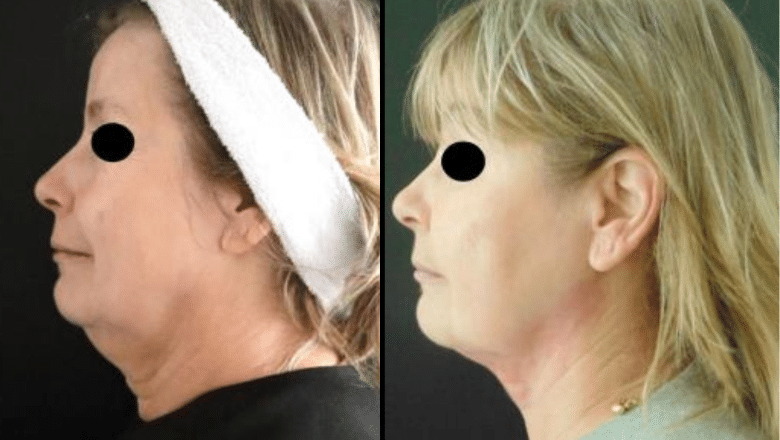
FaceTite sits between non-surgical devices and full surgery. It uses radiofrequency-assisted lipolysis (RFAL) — an internal probe delivers RF energy directly beneath the skin, contracting tissue and stimulating substantially more collagen production than surface-level devices can achieve, through tiny puncture-point access rather than a surgical incision. It’s a strong option for jawline, cheek, and neck laxity in patients who want more than Morpheus8 or Fotona4D can offer, without committing to a facelift.
Surgical Facial Skin Tightening Treatments

For established, moderate-to-severe skin laxity, surgical face tightening procedures produce the most dramatic and durable results by physically removing excess skin and repositioning the deeper SMAS layer — something no non-surgical treatment can replicate.
Eyelid Surgery (Blepharoplasty)
Blepharoplasty removes excess skin and fat around the eyes, an area where skin is thinnest and laxity shows earliest. It can also address functional drooping that obstructs vision.
Brow Lift
A brow lift corrects the descent and flattening of the eyebrow that occurs as forehead skin loses elasticity, addressing an area facelift surgery alone doesn’t reach.
Facelift
A facelift (rhytidectomy) is the most comprehensive surgical skin tightening option, repositioning the SMAS layer and removing excess skin to correct jowls, deep nasolabial folds, and mid-to-lower face laxity. Facelift surgery at Centre for Surgery is performed under TIVA (total intravenous anaesthesia) as standard, an anaesthetic technique well suited to day-case facial surgery.
Cheek Volumising
Cheek implants are offered at Centre for Surgery by Mr Shehab Jabir, our Consultant Facial Plastic Surgeon. For most patients with cheek flattening or hollowing, facial fat transfer or dermal fillers restore volume and lift more naturally, with far less downtime and no implant-related risk. Our surgeons will advise honestly at consultation on which approach fits your anatomy.
Facial Fat Transfer
Facial fat transfer restores lost volume using your own harvested fat, addressing the deflation component of ageing that skin-tightening alone can’t fix — particularly effective in the cheeks, temples, and under-eye hollows.
Neck Lift
A neck lift tightens neck skin and platysma banding, and is very frequently combined with a facelift for a fully consistent result across the lower face and neck.
Chin Augmentation
Chin augmentation (genioplasty) improves jawline projection and profile balance in patients with a weak or receding chin, and is often combined with a facelift for a more defined overall jawline.
Choosing the Right Facial Skin Tightening Treatment

The right treatment depends on where your skin laxity sits on the severity spectrum:
- Mild — early fine lines, good underlying elasticity: lifestyle measures, skin boosters, and chemical peels are usually sufficient.
- Moderate — visible laxity, early jowling: RF microneedling, Fotona4D, or FaceTite provide meaningful, non-surgical tightening.
- Significant — established jowling, loose neck skin, volume loss: facelift, neck lift, and facial fat transfer are the only treatments that reliably correct advanced laxity.
Choosing a treatment based on price or marketing rather than the actual severity of your concern is the most common reason patients end up disappointed — an energy device won’t correct what needs surgery, and surgery is unnecessary for concerns a peel or Morpheus8 course can resolve.
A useful rule of thumb: if you can lift the sagging area back into position with a finger and it looks meaningfully better, a non-surgical treatment is likely to help. If lifting with a finger doesn’t recreate a younger appearance — because the underlying structure, not just the skin, has changed — surgery is usually what’s actually needed. This is exactly the kind of judgement a proper in-person consultation is for, rather than guessing from marketing claims alone.
Our Expert Recommendation
For patients with genuine, established skin laxity who want the most complete correction, we most often recommend combining facelift surgery with facial fat transfer. This addresses both problems that separately drive an aged appearance — skin and SMAS laxity, and volume loss — in a single recovery period, smoothing nasolabial folds, marionette lines, and hollowing that skin-tightening alone can’t fully correct.
Facial Skin Tightening FAQs
How Do You Fix Saggy Cheeks?
Depending on severity: dermal fillers or fat transfer for volume loss, or a lower facelift for significant skin laxity. Fillers and fat transfer suit hollowing; surgery suits skin that has genuinely stretched.
Does Fat Grafting Help With Wrinkles?
Yes — facial fat grafting improves the appearance of wrinkles caused by volume loss (particularly nasolabial folds and marionette lines) by restoring the underlying support the skin was resting on.
Does Facial Fat Grafting Leave Scars?
Fat grafting uses tiny cannula access points rather than incisions, so visible scarring is minimal.
How Long Does Fat Transfer Last in the Face?
A meaningful proportion of transferred fat survives permanently once it establishes its own blood supply, typically giving results that last several years.
What’s the Best Non-Surgical Skin Tightening Treatment for the Face?
There isn’t a single universal answer — it depends on your degree of laxity. For early concerns, Fotona4D or chemical peels; for moderate laxity, Morpheus8 or FaceTite. A consultation will identify which is actually appropriate for you rather than the most heavily marketed option.
Is Facial Skin Tightening Surgery Painful?
Surgical facial skin tightening (facelift, neck lift) is performed under TIVA, so you’re unaware during the procedure itself. Post-operative discomfort is generally mild-to-moderate and well controlled with standard pain medication.
How Much Does Facial Skin Tightening Cost?
Cost varies enormously by category. Non-surgical treatments such as a single chemical peel or skin booster session typically start from a few hundred pounds; a Morpheus8 or Fotona4D course runs higher given multiple sessions are usually needed. FaceTite and surgical procedures represent a larger one-off investment but with a far longer-lasting result. We don’t publish a universal price list, since the right treatment — and therefore the cost — depends entirely on your individual assessment. Call 020 7993 4849 for an indicative price before your consultation.
Can Non-Surgical and Surgical Treatments Be Combined?
Yes, and it’s common. Patients often have a facelift or blepharoplasty to correct structural laxity, then use skin boosters or a light Morpheus8 course some months later to refine skin quality and texture. The two approaches address different problems — one repositions structure, the other improves the skin surface — so they’re complementary rather than redundant.
What Is the Best Skin Tightening Procedure for the Face?
There’s rarely one single best skin tightening procedure for face concerns across all patients — the best skin tightening procedures for face laxity depend on severity. RF microneedling, Fotona4D, and FaceTite are generally considered the best non-surgical options for moderate concerns, while a facelift remains the best face tightening treatment for established, more significant sagging. The best skin tightening treatments for face laxity are the ones actually matched to your degree of laxity, not the most heavily advertised.
Is a Spa Facial the Best Way to Tighten Skin?
If you’re searching for the best facial for skin tightening, it’s worth knowing that a standard spa facial isn’t the same as a medical skin tightening treatment. Spa facials cleanse and hydrate the surface but don’t reach the dermis or SMAS layer, so they won’t meaningfully tighten sagging skin. The closest equivalent to the best facial for tightening skin in a medical setting is RF microneedling, a chemical peel, or FaceTite — all of which work at a depth a spa facial simply can’t reach.
Facial Skin Tightening Treatments: Discover Excellence at Centre for Surgery
At Centre for Surgery, we offer a genuinely evidence-led range of facial skin tightening treatments, from lifestyle guidance through to advanced surgical procedures. Every treatment recommendation is made at a face-to-face consultation, based on what your skin actually needs — not a fixed menu.
Reviewed by a Specialist
Why Choose Centre for Surgery?
We are a CQC-regulated cosmetic clinic on Baker Street, rated Good overall. Our surgeons are registered with the General Medical Council, and every patient receives a personalised consultation before any treatment — surgical or non-surgical — is recommended. We’d rather tell a patient that a lower-intensity treatment will serve them just as well as recommend an unnecessary procedure, which is why some treatments frequently marketed elsewhere, such as microdermabrasion and cryolipolysis, simply aren’t on our menu — not because they’re unsafe, but because the treatments we do offer cover the same concerns more effectively.
Book Your Consultation Today
Phone: 020 7993 4849
Email: contact@centreforsurgery.com
Address: 95-97 Baker Street, London W1U 6RN
Please visit our About Us page for more information about our clinic and the treatments we offer. Explore our plastic surgery blog for insights and advice on various cosmetic procedures. Learn about our finance options with Chrysalis Finance, here. For answers to common questions, check out our Clinic FAQs. Discover more about our Baker Street clinic and the exceptional care we provide.
Related Articles
- How a Lip Lift Can Transform Your Face Without Fillers
- What is a Vertical Restore Facelift?
- The Best Treatments for Turkey Neck
- What Is the Best Facial Rejuvenation Treatment?
- Facial Skin Ageing Over Time: What to expect at 30, 40, 50
- What Lifestyle Factors Can Affect Signs of Facial Ageing?
- Morpheus8 vs Ultherapy: Honest Comparison of Skin Tightening
- Is Facial Fat Transfer Permanent?