


In this guide17 sections
- Key Points
- How Many Types of Facelift Are There?
- Types of Facelift by Depth: Skin-Only, SMAS and Deep Plane
- Types of Facelift by Area of the Face
- Short-Scar Facelift Types: Mini Facelift, MACS Lift and One Stitch Facelift
- Other Types of Facelift You May Hear About
- Non-Surgical Facelift Options
- What Is the Best Type of Facelift?
- What Is the Most Natural-Looking Facelift?
- How Long Does Each Type of Facelift Last?
- Facelift Recovery Time by Type
- Facelift Risks by Type
- What Is the Best Age for a Facelift?
- Which Type of Facelift Is Right for You?
- Frequently Asked Questions
- Why Choose Centre for Surgery for Your Facelift?
- References
Key Points
- Three things define every type of facelift: which area of the face it treats (brow, cheeks, jowls or neck), how deep the lift goes (skin only, the SMAS layer, or the deep plane) and how long the incision is.
- Most people mean the lower face. A mini facelift suits early jowls with a good neck, a SMAS facelift suits jowls with neck changes, and a deep plane facelift suits more advanced change or heavier tissue.
- There is no single best type. Split-face and identical-twin studies have not shown any one technique beating the others when each is matched to the right patient.
- The neck often decides it. Short-scar lifts work well on the jawline, but loose neck skin or neck bands usually need a full facelift with a neck lift.
- Recovery varies by type, from about a week for a one stitch facelift to around three weeks before public-facing work after a deep plane facelift.
- Non-surgical facelifts are different treatments. Fillers, threads and energy devices improve volume and skin quality, but they do not reposition sagging tissue the way surgery does.
There are more types of facelift than most people expect: mini, SMAS, deep plane, endoscopic, mid, lower, one stitch, ponytail and more. Many of these names describe the same small group of operations, and some are marketing labels rather than recognised surgical techniques. This guide sorts the different types of facelift by what they actually do, so you can see which ones fit the changes in your own face.
At Centre for Surgery we perform the full range of facelift surgery, from the mini facelift to the deep plane facelift, along with neck lift surgery. If you are already deciding between the two most common options, our guide to facelift vs mini facelift compares them in detail.
How Many Types of Facelift Are There?
There is no fixed number, because surgeons name facelifts in different ways. It is easier to think of every face lift type as a combination of three choices:
- Area: the upper face (brow and forehead), the mid face (cheeks), the lower face (jowls and jawline) or the neck.
- Depth: whether the surgeon lifts only the skin, the firmer SMAS layer beneath the fat, or the deeper plane below the SMAS.
- Incision length: a short scar in front of the ear, a full incision running from the temple around the ear into the hairline behind it, or small keyhole incisions inside the hairline.
Area-specific lifts exist because the face does not age as one block. Anatomical studies show that facial fat sits in separate compartments, and that these compartments shrink and slide at different rates.[1] One person’s brow drops early while their neck stays firm; another person’s jowls and neck change together. That is why the right type of facelift depends on your own pattern of ageing rather than on your age alone.

Types of Facelift at a Glance
| Type of facelift | Main area treated | Incision | Back to desk work | Usually suits |
|---|---|---|---|---|
| One stitch (micro) facelift | Very early mid-face drift | Short, in front of the ear | About a week | Minimal change, 30s to 40s |
| Mini facelift | Jowls and jawline | In front of the ear and around the earlobe | Day 5 to 7 from home, about 2 weeks for public-facing roles | Early jowls with a good neck, late 30s to 50s |
| SMAS facelift | Lower two-thirds of the face, often with the neck | Temple hairline, around the ear and into the hairline behind it | From about week 2 | Jowls with neck changes, 40s to 70s |
| Deep plane facelift | Full face, including the mid face and deep folds | As for a SMAS facelift, with a deeper dissection | Day 12 to 14, closer to 3 weeks for public-facing roles | Advanced change, heavier tissue, revision cases |
| Endoscopic facelift | Cheeks, mid face and outer brow | 1 to 2 cm keyhole cuts in the hairline | Day 10 to 14 | Early cheek descent, 40s to 50s |
| Neck lift | Neck and the jaw-neck angle | Under the chin and behind the ears | About 2 weeks | Loose neck skin and neck bands |
Types of Facelift by Depth: Skin-Only, SMAS and Deep Plane
The name on a facelift tells you less than the layer the surgeon lifts. Depth is what determines how strong and how lasting the correction is, and how long your recovery takes.
Skin-Only Facelift
The oldest type of facelift lifts and trims the skin alone. Skin stretches, so the result fades quickly, and because the skin carries all the tension it can look pulled or windswept. This is behind many of the results people describe as a botched facelift. Modern facelift surgery lifts the deeper layers and lets the skin sit back over them without tension.
SMAS Facelift
The SMAS (superficial musculoaponeurotic system) is a firm sheet of fibrous tissue and muscle lying under the facial fat. It was first described in 1976,[2] and lifting it changed facelift surgery. In a SMAS facelift, the surgeon raises the skin, then tightens the SMAS by folding it (plication), removing a strip (SMASectomy) or lifting it as a separate flap. The SMAS carries the lift, so the jowls and jawline are corrected without stretching the skin. For most people with jowls and early neck changes, this is the standard full facelift.
Deep Plane Facelift
A deep plane facelift goes beneath the SMAS and releases the retaining ligaments that hold sagging tissue down. Skin, fat and SMAS then move together as one composite flap. The technique was described in 1990 for patients whose nasolabial folds did not improve enough with standard lifts.[3] It gives stronger correction of the mid face and deep folds, but swelling in the cheeks lasts longer, often up to three months. Our guide to the deep plane vs SMAS facelift explains the anatomy in detail.
Deeper does not automatically mean better. In a 1996 randomised split-face study in Plastic and Reconstructive Surgery, 21 patients had a less extensive SMAS lift on one side of the face and a more extensive lift on the other. The extended side looked better on the operating table, but the difference had gone by the next day, and independent surgeons could not tell the sides apart at six and twelve months.[4] The authors concluded that the extra risk and recovery of the more extensive techniques were not warranted for the average patient. Deep plane surgery earns its place in patients with thicker skin, heavier facial tissue, deep folds or a previous facelift that has relaxed.
Types of Facelift by Area of the Face
Upper Facelift and Brow Lift
An upper facelift treats the forehead, brow and outer eye area. A brow lift raises a heavy or low brow that makes you look tired or cross, and it is often combined with eyelid surgery when the upper lids are also hooded.
Mid Facelift and Endoscopic Facelift
A mid facelift lifts the cheek pads that have slipped downwards, which softens the hollows under the eyes and the top of the nasolabial folds. An endoscopic facelift does this through 1 to 2 cm incisions inside the hairline, guided by a small camera. It suits people in their 40s and 50s whose cheeks have started to fall before the jowls and neck have changed much.
Lower Facelift (Jowl Lift)
A lower facelift targets sagging jowls, a blurred jawline and the marionette lines that run down from the corners of the mouth. This is the area most people mean when they ask about a facelift, and the mini, SMAS and deep plane techniques all treat it.
Neck Lift
A neck lift tightens the platysma muscle, removes loose skin and restores a clean angle between the jaw and neck. It is usually done with a facelift, because the face and neck age together and lifting one without the other can leave a sharp jawline above a loose neck. Our guides to the different types of neck lift and platysmal bands cover the options, and if the problem is mainly fat rather than loose skin, chin and neck liposuction may be enough.

Short-Scar Facelift Types: Mini Facelift, MACS Lift and One Stitch Facelift
“Short scar facelift” is an umbrella term for lifts that use a shorter incision, usually in front of the ear only. They trade some lifting power, particularly in the neck, for a smaller scar and a quicker recovery.
Mini Facelift
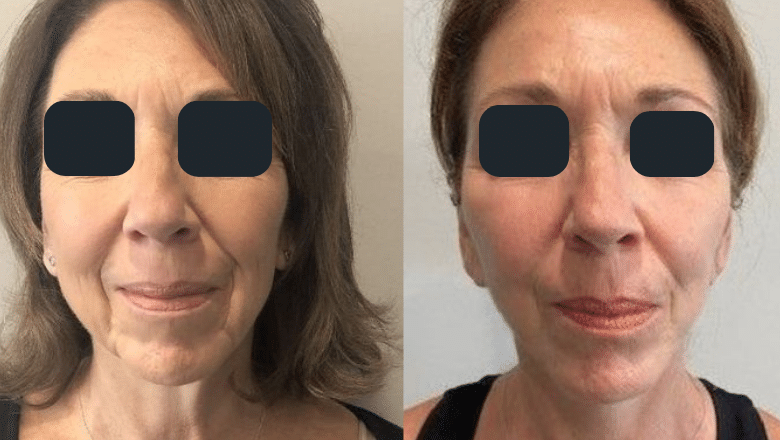
A mini facelift uses an incision in the natural fold in front of the ear, curving around the earlobe and ending a short distance behind it. It still lifts the SMAS, so it is genuine surgery rather than a skin tuck, but over a smaller area. It treats early jowls and a softening jawline, typically in the late 30s to 50s, and takes about one to two hours. Our mini facelift vs full facelift guide explains how to tell which one you need.
MACS Lift
The MACS lift (minimal access cranial suspension) is a well-documented short-scar technique. Through a short incision in front of the ear, the surgeon places strong permanent purse-string sutures in the SMAS and anchors them to firm tissue above the ear, lifting the face vertically rather than backwards. The original series of 88 patients, operated on under local anaesthetic, reported a very low complication rate, with the main effect on the jowls and upper neck.[5]
One Stitch Facelift (Micro Facelift)
A one stitch facelift, also called a micro facelift, uses a single permanent SMAS suture through a short incision in front of the ear. It takes 45 to 90 minutes under local anaesthetic with sedation, and most people need about a week off work. It only suits very early mid-face drift, and the result is the most modest of the surgical options.
Ponytail Lift and Vertical Restore Facelift
A ponytail lift lifts the mid and lower face through small incisions around the hairline and ears, mimicking the effect of pulling your hair back. It is aimed at younger patients with early change. A vertical restore facelift lifts the tissue upwards rather than backwards, which is designed to avoid the swept-back look of older techniques.
Other Types of Facelift You May Hear About
Male Facelift
A male facelift follows the same principles, but the incisions are planned around the beard and a male hairline, and the aim is a firm jaw rather than a softer contour. Men have thicker skin and a richer blood supply in the face, and in a database of 11,300 facelifts men had almost four times the risk of a haematoma (a collection of blood under the skin).[6] Our guide to the differences between male and female facelifts explains the planning.
Revision Facelift
A revision facelift corrects a previous facelift that has relaxed with time, left visible scars or produced a pulled look. Scar tissue makes it more complex than a first facelift. If you are wondering whether a second operation is possible, see our guide can I get a facelift twice?
Facelift with Fat Transfer
A facelift lifts tissue but does not add volume. When the cheeks, temples or under-eye area have hollowed, facial fat transfer can be done at the same time, using your own fat taken by gentle liposuction from elsewhere in the body.
Non-Surgical Facelift Options
A “non-surgical facelift” is not a type of facelift in the surgical sense. These treatments improve volume, lines and skin quality, but they cannot reposition descended tissue the way surgery can. They suit people with early change, or anyone not ready for surgery.
- Liquid facelift: a liquid facelift uses dermal filler at set points to support the cheeks and jawline. It lasts months rather than years.
- Radiofrequency and laser: Morpheus8 and the 4D laser facelift tighten and resurface the skin, while FaceTite works under the skin through tiny entry points and sits between non-surgical treatments and a mini facelift.
- Thread lifts: barbed threads are passed under the skin to hook and lift it. A 2018 systematic review found little good evidence for them, with at best very limited durability, and the only two positive studies were sponsored by thread manufacturers.[7] Our comparison of thread lift vs FaceTite vs facelift sets out the trade-offs.
The newest non-surgical facelift treatments are mostly energy devices, which keep improving at tightening skin. None of them lifts a fallen jowl back into place. Our guide to facelift alternatives without surgery explains what each one can realistically do.
What Is the Best Type of Facelift?
The honest answer is the type that matches your anatomy, done by a surgeon experienced in it. The research does not crown a winner. A 2011 systematic review in Plastic and Reconstructive Surgery searched the literature for studies comparing facelift techniques and found only ten that directly compared results and five that compared complications, too few and too varied to name a best technique.[8]
Identical twins offer one of the fairest tests, because they start with the same face. In an identical-twin study of eight sets of twins in 2007, four different SMAS techniques were compared, and no technique produced a better result than another when it was performed on the right patient.[9] A separate study of two sets of identical twins, operated on by four surgeons using four techniques and photographed at one, six and ten years, reached a similar conclusion.[10]
So beware any clinic that sells one technique as best for everyone. A good consultation should explain why a particular type of facelift suits your face, and when a smaller or larger operation would serve you better.

What Is the Most Natural-Looking Facelift?
A natural result comes from how the lift is done rather than from its name. The features of a natural-looking facelift are:
- Tension on the deeper layers, not the skin. When the SMAS or deep plane carries the lift, the skin closes without stretch, so the face does not look tight and scars heal as fine lines.
- The right direction of lift. Lifting upwards along the line the tissue fell, rather than straight back towards the ears, avoids the windswept look.
- Treating the neck when it needs it. A lifted jawline above an untreated loose neck looks odd.
- Restoring volume where it has gone, rather than pulling a hollow face tighter.
- Careful incision placement behind the small flap of cartilage in front of the ear and along the hairline. Our guide to facelift scars explains what to expect.
How Long Does Each Type of Facelift Last?
Every type of facelift resets the clock rather than stopping it. You keep ageing from your new starting point, at a rate set by your genes, skin quality, sun exposure, smoking and weight.

As a guide, a thread lift lasts 12 to 18 months, a one stitch facelift 3 to 5 years, a mini facelift around 8 to 10 years, a SMAS facelift 10 years or more and a deep plane facelift 10 to 15 years. Long-term data are limited: the ten-year twin photographs show the face continuing to age after every technique.[10] Our guides to how long a facelift lasts and what happens to your face 10 years after a facelift go into more detail.
Facelift Recovery Time by Type
Most facelifts at Centre for Surgery are done with you fully asleep under intravenous anaesthesia, and most patients go home the same day with a responsible adult who stays with them for 24 hours. Some mini and one stitch facelifts can be done under local anaesthetic with sedation.
- One stitch facelift: about a week off work.
- Mini facelift: desk work from day 5 to 7 if you work from home, closer to two weeks for public-facing roles, light cardio from week 2.
- SMAS facelift: desk work from around week 2, gentle cardio from week 3, weights and contact sport from week 6.
- Deep plane facelift: desk work from day 12 to 14, closer to three weeks for public-facing roles, with cheek swelling that can take up to three months to settle fully.
Whatever the type, you sleep with your head raised for two weeks, and numbness around the ears settles over three to six months. Our facelift recovery guide sets out the week-by-week timeline.
Facelift Risks by Type
Facelift surgery is generally safe when done by a specialist plastic surgeon. In a large database of 11,300 facelifts, 1.8% had a major complication needing a hospital visit, admission or further surgery. Haematoma was the most common at 1.1%, and the rate rose when the facelift was combined with other operations (up to 3.7%, against 1.5% for a facelift alone).[6]
Technique changes the risk profile a little. A 2019 meta-analysis of 183 studies found temporary facial nerve weakness was most common after high lateral SMAS and composite lifts (around 1.5 to 1.9%), while the risk of permanent nerve injury did not differ between techniques. Major haematoma was slightly more common after deep plane surgery, at 1.22%.[11] Our guide to facelift complications covers each risk in detail. Smoking sharply raises the risk of poor healing, so we ask all patients to stop nicotine for four weeks before and four weeks after surgery.
What Is the Best Age for a Facelift?
There is no best age, only a best match between the changes in your face and the type of lift. A mini facelift usually suits people in their late 30s to 50s with early jowls, and a full facelift people in their 40s to 70s with jowls and neck changes. Age alone is not a barrier: in one study of 216 facelift patients, those aged 65 and over had major complication rates similar to younger patients (2.9% against 2.0%).[12] General health, smoking and realistic expectations matter more. Our facelift age guide explains how to judge your timing.
Which Type of Facelift Is Right for You?
| Your main concern | Types of facelift usually considered |
|---|---|
| Heavy brow, hooded upper eyelids, forehead lines | Brow lift or upper facelift, often with eyelid surgery |
| Flattened cheeks, deep nasolabial folds | Mid facelift, endoscopic facelift, deep plane facelift, fat transfer |
| Early jowls with a firm neck | Mini facelift |
| Jowls with loose neck skin or neck bands | SMAS facelift with neck lift |
| Advanced laxity, heavy facial tissue or a previous facelift | Deep plane facelift or revision facelift |
| Mainly fat under the chin with good skin | Chin and neck liposuction |
| Skin texture and fine lines rather than sagging | Non-surgical skin treatments |
A quick self-check: stand in front of a mirror and gently lift the skin in front of your ears upwards and backwards. If your jawline sharpens and your neck looks fine, a shorter lift may be enough. If your neck still looks loose, or you have to lift a long way, you are likely to need a full facelift with a neck lift. Your surgeon will confirm this at consultation, and we recommend a two-week cooling-off period before any surgery.
Frequently Asked Questions
What is the least expensive type of facelift?
Among surgical options, the one stitch facelift and the mini facelift cost the least because they are shorter operations, while the SMAS and deep plane facelifts cost more. Non-surgical treatments cost less up front but need repeating. Our facelift cost guide sets out current prices for each technique.
What is a Cinderella facelift?
Cinderella facelift is a marketing name rather than a recognised surgical technique. It is usually used for a short-scar or suture-suspension lift with a quick recovery. If you are offered one, ask which layer is lifted, how long the incision is and how long the result is expected to last.
Can different types of facelift be combined?
Yes. A facelift is often combined with a neck lift, a brow lift, eyelid surgery or fat transfer, so you have one recovery rather than several. For example, many people have blepharoplasty and a mini facelift at the same time. Combining procedures lengthens the operation and slightly raises the risk of complications, which your surgeon will discuss with you.
Is a facelift done under TIVA?
Most full facelifts at Centre for Surgery are done with you fully asleep under intravenous anaesthesia, which tends to cause less sickness afterwards than gas anaesthesia. Some mini and one stitch facelifts can be done under local anaesthetic with sedation.
Do I need to dissolve filler before a facelift?
Not always. It depends on how much filler you have, where it is and whether it has moved. Our guide on whether fillers need to be dissolved before a facelift explains how surgeons decide.
Which type of facelift is best after weight loss?
After large weight loss, the face and neck often have more loose skin and less volume, so a full facelift with a neck lift, sometimes with fat transfer, usually works better than a short-scar lift. See our guide to face and neck lift surgery after weight loss.
What is the newest type of facelift?
Most newer facelift names are refinements of the deep plane or short-scar approaches, such as different ways of releasing ligaments or anchoring sutures. Among non-surgical treatments, radiofrequency and laser devices are developing fastest, but they tighten skin rather than reposition fallen tissue.
How do I choose a facelift surgeon?
Check that your surgeon is on the GMC Specialist Register for plastic surgery, ask which layer they lift and why that type suits you, and ask to see before-and-after photos taken at least three months after surgery. Our facelift before and after photos show what to look for.
Why Choose Centre for Surgery for Your Facelift?
Every facelift at Centre for Surgery is performed by a GMC-registered plastic surgeon, at our CQC-regulated hospital at 95–97 Baker Street, which has been caring for patients for over 10 years. The surgeon who assesses you at consultation is the surgeon who performs your surgery. We offer every type of facelift, from the one stitch and mini facelift to the SMAS, deep plane and endoscopic facelift, so your surgeon can recommend the technique that fits your face rather than the one they happen to offer, and will tell you plainly if a smaller operation, or none at all, would serve you better. We publish our clinical outcomes and patient safety data.
Finance is available through Chrysalis Finance, subject to status. See our finance options page for details.
Phone: 020 7993 4849 | Address: 95–97 Baker Street, Marylebone, London W1U 6RN
Contact us to schedule a consultation
References
- Rohrich RJ, Pessa JE. The fat compartments of the face: anatomy and clinical implications for cosmetic surgery. Plastic and Reconstructive Surgery 2007;119(7):2219–2227. doi:10.1097/01.prs.0000265403.66886.54
- Mitz V, Peyronie M. The superficial musculo-aponeurotic system (SMAS) in the parotid and cheek area. Plastic and Reconstructive Surgery 1976;58(1):80–88. doi:10.1097/00006534-197607000-00013
- Hamra ST. The deep-plane rhytidectomy. Plastic and Reconstructive Surgery 1990;86(1):53–61. PubMed 2359803
- Ivy EJ, Lorenc ZP, Aston SJ. Is there a difference? A prospective study comparing lateral and standard SMAS face lifts with extended SMAS and composite rhytidectomies. Plastic and Reconstructive Surgery 1996;98(7):1135–1143. doi:10.1097/00006534-199612000-00001
- Tonnard P, Verpaele A, Monstrey S, et al. Minimal access cranial suspension lift: a modified S-lift. Plastic and Reconstructive Surgery 2002;109(6):2074–2086. doi:10.1097/00006534-200205000-00046
- Gupta V, Winocour J, Shi H, Shack RB, Grotting JC, Higdon KK. Preoperative risk factors and complication rates in facelift: analysis of 11,300 patients. Aesthetic Surgery Journal 2016;36(1):1–13. doi:10.1093/asj/sjv162
- Gülbitti HA, Colebunders B, Pirayesh A, Bertossi D, van der Lei B. Thread-lift sutures: still in the lift? A systematic review of the literature. Plastic and Reconstructive Surgery 2018;141(3):341e–347e. doi:10.1097/PRS.0000000000004101
- Chang S, Pusic A, Rohrich RJ. A systematic review of comparison of efficacy and complication rates among face-lift techniques. Plastic and Reconstructive Surgery 2011;127(1):423–433. doi:10.1097/PRS.0b013e3181f95c08
- Antell DE, Orseck MJ. A comparison of face lift techniques in eight consecutive sets of identical twins. Plastic and Reconstructive Surgery 2007;120(6):1667–1673. doi:10.1097/01.prs.0000288016.24950.20
- Alpert BS, Baker DC, Hamra ST, Owsley JQ, Ramirez O. Identical twin face lifts with differing techniques: a 10-year follow-up. Plastic and Reconstructive Surgery 2009;123(3):1025–1033. doi:10.1097/PRS.0b013e31819ba755
- Jacono AA, Alemi AS, Russell JL. A meta-analysis of complication rates among different SMAS facelift techniques. Aesthetic Surgery Journal 2019;39(9):927–942. doi:10.1093/asj/sjz045
- Martén E, Langevin CJ, Kaswan S, Zins JE. The safety of rhytidectomy in the elderly. Plastic and Reconstructive Surgery 2011;127(6):2455–2463. doi:10.1097/PRS.0b013e3182131da9



