


In this guide15 sections
- Key Points
- What Is Mewing?
- How to Mew: Correct Mewing Tongue Posture
- Does Mewing Actually Work?
- Mewing Before and After: Why the Photos Mislead
- How Long Does Mewing Take to Work?
- Is Mewing Bad for You? The Downsides of Mewing
- Does Mewing Work for Kids and Teenagers?
- Benefits of Mewing: Where Tongue Posture Does Matter
- Mewing Exercises vs Jawline Exercises
- Mewing, Looksmaxxing and Body Image
- How to Get a Jawline: What Actually Works
- Frequently Asked Questions
- Jawline and Chin Treatment at Centre for Surgery
- References
Key Points
- Mewing means resting your whole tongue on the roof of your mouth. It is named after John Mew, a British orthodontist who developed a theory called orthotropics in the 1970s, and it spread on social media in the 2010s.
- There is no good evidence that mewing reshapes an adult jaw. No clinical trial has shown it changes bone, and even the method’s founder acknowledged that long-term tongue posture cannot be measured with any precision.
- Adult facial bones have stopped growing. The suture in the roof of the mouth fuses during the teens, which is why adults who need a wider upper jaw usually need surgically assisted expansion.
- Mewing before and after photos are unreliable. Head tilt, camera angle, lighting, weight loss and normal growth in teenagers explain most of the changes people post.
- Tongue exercises do have a proven role, but not for jawlines. In a meta-analysis, tongue and throat exercises reduced breathing pauses in sleep apnoea by about 50% in adults.
- A jawline is shaped by bone, fat, muscle and skin. When one of these is the problem, treatments such as chin augmentation, chin liposuction or a neck lift change it in a way that tongue posture cannot.
Mewing is the practice of resting your whole tongue flat against the roof of your mouth, with your lips closed and your teeth lightly together, in the hope of sharpening your jawline and reshaping your face over time. It is one of the most searched facial trends online, spread largely through looksmaxxing communities, and the claims are bold: a more defined jaw, a stronger chin, even straighter teeth, all without treatment. If you are researching mewing because you are unhappy with a weak jawline or a receding chin, it is worth knowing what it can and cannot do before you spend months on it.
This guide explains what mewing is and where it came from, how to mew with correct tongue posture, what the research says about whether it works, why mewing before and after photos mislead, the downsides of hard mewing, and what actually changes the shape of a jawline. It is written by a surgical team that treats jawline and chin concerns every week, including chin augmentation and chin liposuction, so we will be honest about where surgery is and is not the answer.
What Is Mewing?
Mewing is a tongue posture technique. The idea is that holding the whole tongue against the palate, all day, applies gentle upward and outward pressure that will, over time, widen the upper jaw, bring the face forward and define the jawline. It takes its name from John Mew, a British orthodontist who in the 1970s developed orthotropics, a theory that poor oral posture during childhood causes crooked teeth and a long, receding face. His son, also an orthodontist, later popularised the ideas online, and the word “mewing” was coined by followers on forums and social media.
The theory rests on posture rather than proof. In a 2004 review in the American Journal of Orthodontics and Dentofacial Orthopedics, John Mew himself wrote that long-term oral posture cannot be measured with any precision. The evidence was missing or conflicting, so he argued for “philosophical reasoning” rather than the traditional demand for proof.[1] That candour is important. Mewing began as a theory about how children’s faces grow, not as a tested treatment for adults.
Mewing Meaning in Slang: Mewing Face, Meme and Emoji
Online, “mewing” has also become a meme. A finger raised to the lips and then traced along the jaw is used to signal “I can’t talk, I’m mewing”. The “mewing face”, with the jaw pushed forward and the lips pressed shut, became a meme in its own right, and in messages the joke is often sent with a shushing-face emoji. It is a joke, but it has carried the term to millions of teenagers and young adults, many of whom now practise it seriously.
How to Mew: Correct Mewing Tongue Posture

Proper tongue posture, as described by people who teach mewing, looks like this:
- Close your lips and let your back teeth touch lightly, or sit just apart. Do not clench.
- Place the tip of your tongue on the roof of your mouth just behind your upper front teeth, without pressing on the teeth themselves.
- Bring the rest of your tongue up, including the back third, so the whole tongue rests flat against the palate. Many people only raise the tip; the back of the tongue is the hard part.
- Breathe through your nose. If you cannot comfortably breathe through your nose with your mouth closed, that is worth getting checked.
- Swallow with your tongue up, keeping it against the palate rather than pushing it forward against your teeth.
The aim is a relaxed, natural resting position rather than an exercise. This resting posture is broadly the same one speech and language therapists and orthodontists consider normal, and there is nothing wrong with it. The disagreement is about what it can achieve.
What Is Hard Mewing?
Hard mewing means pressing the tongue forcefully into the palate, often for long periods, in the belief that more force means faster results. There is no evidence that it works better, and it carries more risk. Constant force can strain the jaw muscles and the jaw joint, and pressure in the wrong place can push the front teeth forward. If mewing causes jaw pain, clicking, headaches or tooth soreness, stop.
Does Mewing Actually Work?
What does mewing do? It trains a resting position for your tongue. For adults hoping it will reshape their jaw, the honest answer is no. There are no clinical trials showing that mewing changes the bones of the face or the jawline in adults, and no study has measured mewing before and after with proper controls.
There is a kernel of truth behind it. Orthodontists have accepted since the 1970s that the resting pressure of the tongue and lips is one of the main forces that decides where the teeth sit, and that breathing influences the posture of the head, jaw and tongue.[2] That is why tongue habits matter in children, and why orthodontists watch for mouth breathing. But moving teeth slightly over years is very different from reshaping a fully grown jawbone, and the pressure of a resting tongue is far too small to do the second.

Does Mewing Work After 20?
Very unlikely. By your early 20s the facial skeleton has essentially finished growing. The midline suture in the roof of the mouth, which is what mewing claims to widen, starts closing in adolescence, and its closure varies widely between people.[3] A 2013 CT study of 140 people in the American Journal of Orthodontics and Dentofacial Orthopedics mapped how the suture matures. Fusion was complete in some girls from the age of 11, and part of the suture had already fused in almost a quarter of boys aged 14 to 17.[4] That is why orthodontists treating late teenagers and adults often need surgically assisted expansion to widen the upper jaw. If a fitted expander appliance cannot widen a fused palate on its own, a resting tongue will not.
Can Mewing Fix Your Jawline?
It can make your jawline look slightly sharper while you are doing it, because raising the tongue lifts the tissues under the chin and tightens the muscles of the floor of the mouth. That is a postural effect, like standing up straight, and it disappears when you relax. It does not change the bone, remove fat or tighten skin. A jawline is defined by the shape of the jawbone and chin, the amount of fat along the jaw and under the chin, the size of the chewing muscles and the firmness of the skin. Our guide to the ideal jawline explains how these combine.
Can Mewing Fix a Recessed Chin?
No. A recessed or receding chin is a matter of bone: the lower jaw is short or sits further back. Mewing cannot lengthen an adult jaw or bring the chin forward. When a receding chin bothers you, the options that work are a chin implant, a sliding genioplasty or, for a temporary result, chin fillers. Our guide to solutions for a receding chin compares them.
Does Mewing Help a Double Chin?
Only cosmetically, and only while you hold it. Lifting the tongue tightens the area under the chin, so a double chin can look smaller in a photo. It does not remove fat. If you have a fat pad under the chin, weight loss reduces it, and chin liposuction removes it permanently. Our guide on how to get rid of a double chin explains the options by cause.
Mewing Before and After: Why the Photos Mislead
Search for mewing before and after and you will find dramatic side-by-side photos. Almost all of them can be explained without any change in bone:
- Head position: tilting the head down softens the jaw and tilting it slightly up sharpens it. A small change between photos looks like a new face.
- Tongue and neck posture: the “after” photo is often taken while actively mewing, which tightens the area under the chin for the moment.
- Camera and lighting: distance, lens and light from above or the side all change how defined a jaw looks.
- Weight loss: losing fat from the face and neck sharpens the jawline, and many people lose weight during the same months.
- Normal growth: teenagers’ faces lengthen and their jaws grow forward naturally until the late teens, mewing or not.
None of this means the people posting are dishonest. It means that without standardised photographs, measurements and a comparison group, a before-and-after photo cannot show that mewing caused the change.
How Long Does Mewing Take to Work?
Advocates usually say months to years, which makes it impossible to prove either way. There is no evidence that mewing changes adult bone, so there is no reliable timeline for results. Any change you notice in the first few weeks is postural or down to weight and photography.
How Long Should You Mew a Day?
Mewing is meant to become your natural resting posture rather than a timed exercise. There is no evidence-based number of minutes or hours. If you choose to practise it, keep the pressure light, do not force it, and stop if it causes discomfort.
Is Mewing Bad for You? The Downsides of Mewing
Gentle mewing, done as a relaxed resting posture, is unlikely to cause harm. The risks come from doing it forcefully or obsessively:
- Jaw pain and jaw joint strain from constant pressure or clenching.
- Tooth movement, because tongue pressure against the front teeth can push them forward over time.
- Headaches and muscle tension in the face and neck.
- Delayed treatment, when someone spends years mewing instead of seeing an orthodontist or surgeon about a problem that needs one.
- Fixation on appearance, which we cover below.
Is Mewing All Day Bad?
Resting your tongue on the palate all day is not harmful in itself, since that is a normal resting position. Pressing hard all day is a different matter and can strain the jaw. If you find yourself thinking about your tongue position constantly, or checking your jaw in mirrors and photos, it is worth stepping back.
Who Should Not Do Mewing?
Speak to a professional before trying mewing if you:
- have jaw pain, clicking or locking, or a diagnosed jaw joint problem
- are having orthodontic treatment, or have finished it and wear a retainer
- snore loudly, stop breathing in your sleep or cannot breathe comfortably through your nose, which should be checked by your GP
- are a parent wondering whether mewing will help your child’s teeth or jaw, in which case an orthodontic assessment is the right first step
Does Mewing Work for Kids and Teenagers?
Children are the one group where tongue posture may genuinely influence growth, because their bones are still developing. Even so, there are no good trials showing that mewing on its own changes a child’s face. When a child has a narrow palate, orthodontists widen it with a fitted expander appliance. In a 2022 study of 60 children aged 5 to 15, expansion also reduced the size of enlarged adenoids and tonsils and improved sleep-related breathing symptoms.[5] If you are worried about your child’s bite, mouth breathing or snoring, see a dentist, orthodontist or GP rather than relying on mewing.
Benefits of Mewing: Where Tongue Posture Does Matter
Tongue and throat exercises are a recognised treatment, just not for jawlines. Myofunctional therapy, a structured programme of tongue, lip and throat exercises taught by a trained therapist, is used for tongue thrust and as an add-on treatment for obstructive sleep apnoea. In a 2015 systematic review and meta-analysis in the journal Sleep, these exercises reduced the number of breathing pauses per hour of sleep by about 50% in adults and 62% in children. They also improved snoring and daytime sleepiness.[6] That is real, measurable benefit, and it is a world away from the jaw transformations claimed for mewing.
Mewing Exercises vs Jawline Exercises
Jawline exercises, “mewing gum” (very hard chewing gum) and jaw exerciser devices are often sold alongside mewing. They work the masseter, the main chewing muscle at the angle of the jaw. Building it can make the lower face look wider and squarer, which some men want, but it does not remove fat or create definition under the chin, and overuse can strain the jaw joint. Some people with large masseters choose the opposite: anti-wrinkle injections to relax the muscle and slim the lower face.
Mewing, Looksmaxxing and Body Image
Mewing is one of the best-known techniques in looksmaxxing, an online movement in which mostly young men try to maximise their attractiveness. Some of it is harmless advice about sleep, skin and fitness. Some is not. A 2025 study analysed more than 8,000 comments on a looksmaxxing forum with around six million visitors a month. It found that users harshly judged men’s faces for features such as asymmetry and brow ridges, and encouraged drastic changes ranging from mewing to leg-lengthening surgery. Other looksmaxxing ideals, such as hunter eyes, come from the same communities. The authors concluded that these communities can harm the health of the men who take part.[7]
Most faces are mildly asymmetrical, and our guide to facial asymmetry explains why that is normal. If worries about your face are taking over your day, affecting your mood or stopping you going out, please speak to your GP. A good surgeon will always ask about this, and will not operate when surgery is unlikely to make you happier.
How to Get a Jawline: What Actually Works
If mewing will not reshape an adult jaw, what will? The answer depends on which part of the jawline is the problem:
- Fat under the chin or along the jaw: weight loss if you are carrying extra weight, and chin and neck liposuction for fat that will not shift. Our guide on how to get rid of a fat neck covers the whole neck.
- A weak or receding chin: chin augmentation with an implant, or male chin surgery for a stronger masculine profile. Our jaw implant vs chin implant guide explains the difference.
- A soft jaw angle: dermal fillers along the jaw for a temporary result.
- Loose skin or jowls: a neck lift or a lower facelift, usually from the 40s onwards.
- The whole profile: combining nose surgery with chin surgery, known as profileplasty, balances the nose, lips and chin together.
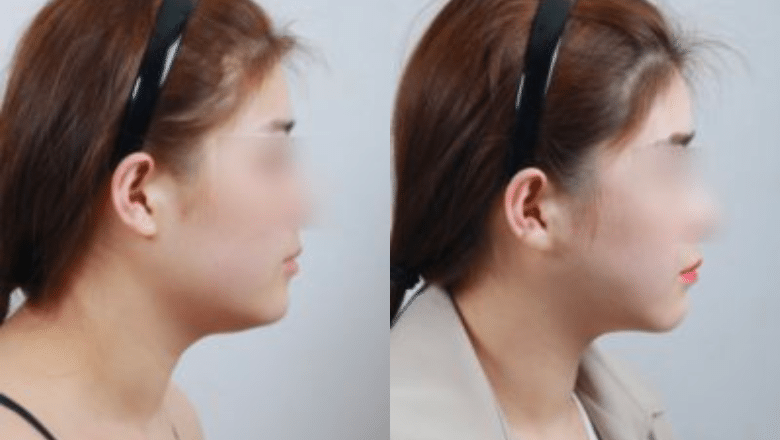
Many people who come to us after trying mewing have a combination: some fat under the chin and a chin that sits a little far back. In that case chin liposuction combined with a chin implant sharpens the angle between the jaw and the neck more than either alone. Our guide to the weak jawline helps you tell fat from bone.

Frequently Asked Questions
Who invented mewing?
Mewing is named after John Mew, a British orthodontist who developed the theory of orthotropics in the 1970s. The word “mewing” itself was coined later by his followers online, after his son popularised the ideas on social media.
Is mewing real?
Mewing is a real technique with a real origin in orthodontics, but its claims are not supported by evidence. Resting your tongue on the roof of your mouth is a normal posture; the idea that it reshapes an adult jaw is unproven.
Does mewing change your face shape?
Not in adults. It can change how your jaw looks while you hold the posture, but it does not change the bones of the face. In growing children, oral posture may influence development, but mewing on its own has not been shown to do so.
Can mewing fix crooked teeth?
No. Straightening teeth needs controlled, sustained force from braces or aligners, planned by an orthodontist. Uncontrolled tongue pressure is more likely to push teeth in the wrong direction than to straighten them.
Can mewing make your face more symmetrical?
There is no evidence that it can. Slight asymmetry is normal in almost everyone. Marked asymmetry usually comes from the jaw, teeth or soft tissues and needs a professional assessment.
Is mewing safe?
Gentle mewing as a resting posture is generally safe. Hard mewing, constant clenching or pressing on the teeth can cause jaw pain, joint strain and tooth movement. Stop if you notice any of these.
Is mewing better than surgery?
They do different things. Mewing is a habit that may help oral posture and costs nothing, but it will not change an adult jaw. Surgery such as chin augmentation or chin liposuction changes the structure directly, but it is an operation with recovery and risks, and it is only worth considering when a specific feature bothers you.
Jawline and Chin Treatment at Centre for Surgery
At Centre for Surgery, jawline and chin treatment starts with a consultation with a GMC-registered plastic surgeon, who examines your face to work out whether the issue is bone, fat, muscle or skin, and tells you honestly whether treatment is likely to help. The surgeon who assesses you is the surgeon who performs your surgery. We offer chin augmentation, male chin surgery, chin and neck liposuction, chin fillers, neck lift and lower facelift. We recommend a two-week cooling-off period before any surgery.
Surgery takes place at our CQC-regulated hospital at 95–97 Baker Street, London, which is rated Good overall and has been caring for patients for over 10 years. We publish our clinical outcomes and patient safety data, and finance is available through Chrysalis Finance, subject to status (see our finance options).
Phone: 020 7993 4849 | Address: 95–97 Baker Street, Marylebone, London W1U 6RN
Contact us to schedule a consultation
References
- Mew JRC. The postural basis of malocclusion: a philosophical overview. American Journal of Orthodontics and Dentofacial Orthopedics 2004;126(6):729–738. doi:10.1016/j.ajodo.2003.12.019
- Proffit WR. Equilibrium theory revisited: factors influencing position of the teeth. The Angle Orthodontist 1978;48(3):175–186. PMID: 280125
- Persson M, Thilander B. Palatal suture closure in man from 15 to 35 years of age. American Journal of Orthodontics 1977;72(1):42–52. doi:10.1016/0002-9416(77)90123-3
- Angelieri F, Cevidanes LHS, Franchi L, Gonçalves JR, Benavides E, McNamara JA. Midpalatal suture maturation: classification method for individual assessment before rapid maxillary expansion. American Journal of Orthodontics and Dentofacial Orthopedics 2013;144(5):759–769. doi:10.1016/j.ajodo.2013.04.022
- Yoon A, Abdelwahab M, Bockow R, et al. Impact of rapid palatal expansion on the size of adenoids and tonsils in children. Sleep Medicine 2022;92:96–102. doi:10.1016/j.sleep.2022.02.011
- Camacho M, Certal V, Abdullatif J, et al. Myofunctional therapy to treat obstructive sleep apnea: a systematic review and meta-analysis. Sleep 2015;38(5):669–675. doi:10.5665/sleep.4652
- Halpin M, Gosse M, Yeo K, Handlovsky I, Maguire F. When help is harm: health, lookism and self-improvement in the manosphere. Sociology of Health & Illness 2025;47(3):e70015. doi:10.1111/1467-9566.70015



