

In this guide12 sections
- What is looksmaxxing? Meaning and origins
- Softmaxxing vs hardmaxxing — looksmaxxing terms explained
- Is looksmaxxing dangerous?
- Bone smashing: does it work, and is it safe?
- The looksmaxxing scale, PSL ratings and looksmaxxing charts
- Looksmaxxing before and after photos — why they mislead
- Looksmaxxing for women
- Safe Alternatives: What Regulated Surgery Actually Offers
- Who Can Actually Have These Procedures?
- How to Find Genuinely Safe Facial Surgery
- Frequently Asked Questions
- Centre for Surgery’s Position
Quick answer: Looksmaxxing is an online trend, most visible on TikTok and Reddit, in which people — predominantly young men — pursue an idealised facial appearance through methods ranging from ordinary self-care (“softmaxxing”) to extreme, unregulated, and sometimes dangerous practices (“hardmaxxing”). Centre for Surgery does not endorse looksmaxxing as a framework. Where genuine aesthetic concerns exist, the safe path is always a face-to-face consultation with a GMC-registered surgeon — never an unregulated procedure, a supplement of unknown origin, or advice from an anonymous online forum.
You may have come across the term “looksmaxxing” — searched online as “what is looksmaxxing” over a thousand times a month in the UK alone — through TikTok, Reddit, or a conversation with a younger family member. It’s a genuine cultural phenomenon, and it’s worth understanding properly: partly because some of what falls under the looksmaxxing umbrella is entirely reasonable, and partly because some of it is genuinely dangerous and worth being able to recognise.
What is looksmaxxing? Meaning and origins
Looksmaxxing is an online trend, most active on platforms like TikTok and Reddit, that involves people — the community is overwhelmingly young men — trying to optimise their facial appearance against a fairly narrow, specific set of ideals. Common goals discussed within looksmaxxing communities include:
- A highly defined jawline
- Hollowed lower cheeks with more prominent upper cheekbones
- A “positive canthal tilt” — where the outer corner of the eye sits higher than the inner corner, one of the features behind the hunter eyes vs prey eyes sorting used in these forums
- Fuller, more defined lips
What distinguishes looksmaxxing from ordinary interest in appearance is the intensity and structure around it: participants often rate and compare their own faces against others, follow detailed “protocols,” and engage heavily in online communities that can become genuinely isolating and psychologically unhealthy, regardless of whether any physical changes result.
Softmaxxing vs hardmaxxing — looksmaxxing terms explained
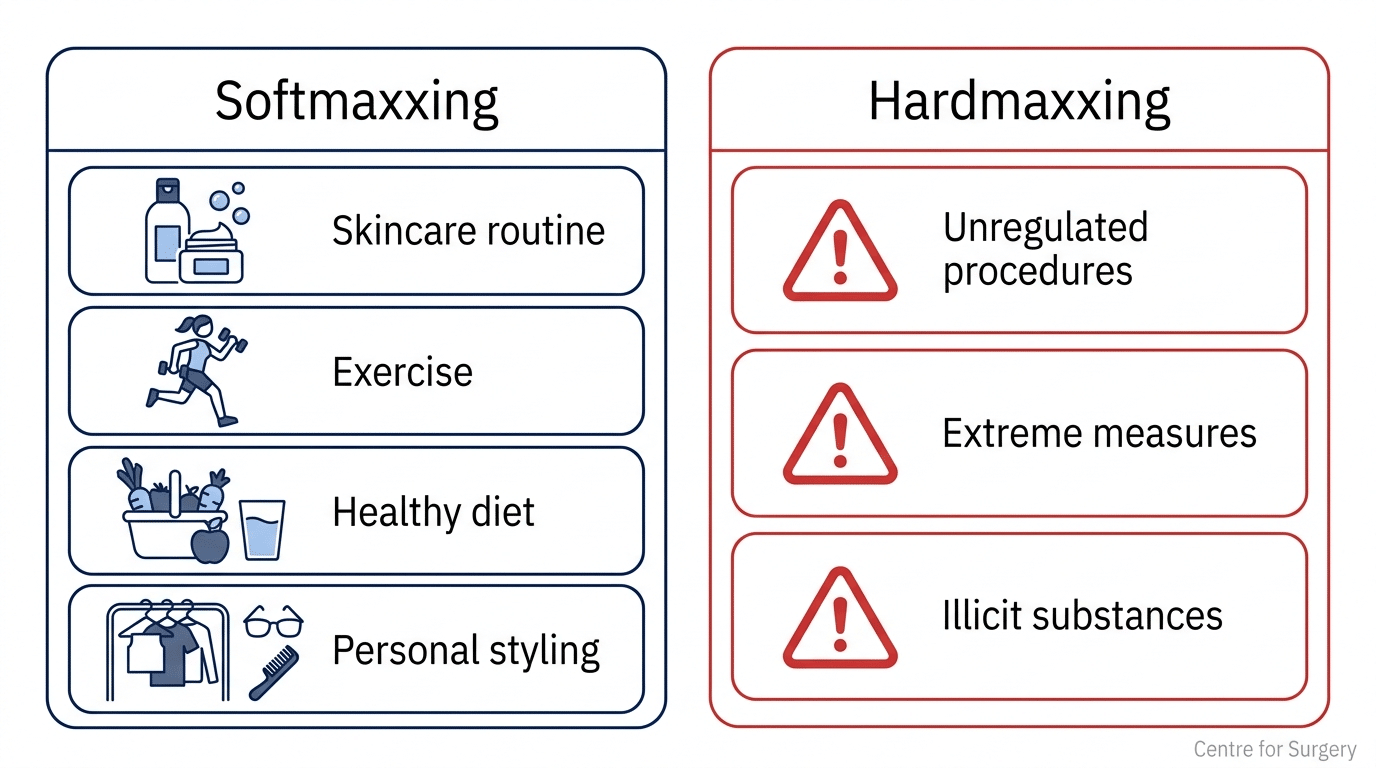
Softmaxxing covers genuinely safe self-improvement; hardmaxxing covers the unregulated, high-risk end of the looksmaxxing spectrum — Centre for Surgery, London.
Within looksmaxxing communities, methods are typically split into two categories, and the distinction matters a great deal:
Softmaxxing
Softmaxxing covers ordinary, genuinely sustainable self-improvement — the kind of thing most people already do without thinking of it as “looksmaxxing” at all:
- Skincare routines
- Regular exercise
- A healthy, balanced diet
- Grooming and personal styling
- Mewing (resting the tongue against the roof of the mouth), which is harmless done gently but cannot reshape an adult jaw
There’s nothing inherently concerning about softmaxxing on its own — it’s simply reasonable self-care, relabelled with trend terminology.
Hardmaxxing
Hardmaxxing is where real concern begins. It covers drastic, sometimes irreversible, sometimes illegal, and often high-risk approaches, including unregulated self-administered or informal “procedures” performed outside any medical setting, and the use of unprescribed or illicit substances to alter appearance or suppress appetite.
We name the practices below because people are actively searching for them and deserve an evidenced answer rather than a forum thread. What we will not do is repeat method detail or instructions — some of what circulates carries genuine risk of serious, permanent injury, and describing how it is done isn’t something a responsible clinic should publish. If you’re a parent and you’re concerned your child may be exploring this territory, it’s worth having a direct, calm conversation, and involving your GP if you have genuine concern about their physical or mental wellbeing.
Is looksmaxxing dangerous?
Looksmaxxing sits at the intersection of two separate problems, and it’s worth understanding both.
The Psychological Dimension
The comparison-heavy, scoring-based culture within looksmaxxing communities can contribute to or worsen body dysmorphic tendencies — a preoccupation with perceived appearance flaws that’s disproportionate to how noticeable they actually are to others. This isn’t unique to looksmaxxing, but the specific structure of these communities — rating systems, before/after comparison culture, constant exposure to curated “ideal” faces — appears to amplify it. A 2025 study in Sociology of Health & Illness analysed 8,072 discussion comments from a looksmaxxing community receiving six million unique visitors a month, and found that users were subjected to what the authors termed masculine demoralisation — treated as failed men and, in some cases, encouraged toward self-harm (Halpin et al., 2025). Dermatologists have raised the same concern from a clinical standpoint, noting the ethical difficulty of treating patients whose motivation originates in this culture (Moraga et al., 2026). Anyone who finds that thoughts about their appearance are becoming intrusive, distressing, or are affecting daily life is better served by speaking to a GP than by any online forum.
The Physical Dimension
The hardmaxxing end of the spectrum carries real physical risk precisely because it operates entirely outside medical regulation. There’s no consultation, no assessment of individual anatomy or suitability, no informed consent process, no sterile environment, and no one qualified to manage a complication if something goes wrong. This is the single biggest difference between anything discussed in looksmaxxing communities and any procedure performed at a registered UK clinic.
Bone smashing: does it work, and is it safe?
Bone smashing — also written bonesmashing, and sometimes called the “bone smashing trend” — is the practice of repeatedly striking the facial bones in the belief that the bone will heal denser and more defined, producing a sharper jaw or more prominent cheekbones. It is the most widely searched hardmaxxing practice, and the honest answer to whether it works is no.
The idea is usually justified by a misreading of Wolff’s law, the principle that bone adapts to the loads placed on it. Wolff’s law describes gradual remodelling in response to normal physiological loading — the reason weight-bearing exercise builds bone density. It does not describe what happens when bone is struck repeatedly. That is simply trauma, and the facial skeleton responds to trauma by fracturing.
What follows a facial fracture is not a sharper jawline. Healing bone forms callus, which is irregular rather than sculpted, and it heals in whatever position the fragments happen to sit. The realistic outcomes are asymmetry rather than definition, permanent numbness where the infraorbital or mental nerve is injured, damage to tooth roots and the tooth-bearing bone, chronic pain, sinus injury, and in the periorbital region a genuine risk to the eye. Correcting a malunited facial fracture is a far larger operation than any cosmetic procedure the person was originally interested in.
The practice has been documented in the surgical literature since 2024, when maxillofacial surgeons in Dijon published a warning about it in the Journal of Stomatology, Oral and Maxillofacial Surgery (Pacquelet et al., 2024). A 2026 analysis in the same journal found searches for the term had risen roughly 5,000% year on year, that the content was approximately 98% male, and that tutorial-style posts attracted the highest engagement of all — with “pseudoscientific legitimacy” and “risk minimisation” identified as two of the four dominant narratives used to promote it (Grillo et al., 2026).
If you have already been striking your face and have pain, swelling, numbness, a change in your bite, or any change in vision, that needs assessing in person — your GP or an emergency department, not an online forum. If the underlying wish is a stronger jaw — the concern usually described as a weak jawline — the regulated procedures below achieve it predictably and reversibly, and a surgeon will tell you honestly whether you are a suitable candidate.
The looksmaxxing scale, PSL ratings and looksmaxxing charts
Much of the culture runs on numbers. Faces are scored out of ten on what the community calls the PSL scale — named after the forums the system came from — and looksmaxxing charts circulate showing which features supposedly move a looksmaxxing rating up or down. Related terms like “mogging”, “failo” and “halo” describe how one feature is said to lift or sink an overall rating.
It is worth being clear about what these scales actually are. They are not clinical tools, they have no evidence base, and they were not devised by anyone with training in facial anatomy. They are informal rankings invented on internet forums, applied to photographs taken at unflattering angles, and scored by anonymous strangers. No surgeon assesses a face this way, because a number out of ten tells you nothing about whether a specific change would suit a specific person.
The scoring itself is a large part of the harm. Repeatedly rating your own face against strangers, and inviting strangers to rate it back, is a reliable way to become more distressed about your appearance rather than less — regardless of what the number says.
Looksmaxxing before and after photos — why they mislead
Before and after images are the currency of looksmaxxing content, and they are among the least reliable things circulating in it. The same face can look dramatically different between two photographs through lighting, camera lens, head tilt, jaw position, hair, weight change, and the difference between a relaxed and a deliberately tensed jaw. None of that requires a procedure.
Where a genuine procedure has taken place, the images shared online usually come without the information that would make them meaningful: what was actually done, by whom, under what regulation, how long after surgery the photograph was taken, and whether any complication followed. A striking before and after tells you almost nothing about whether the same operation would suit your anatomy.
Legitimate before and after photographs from a regulated clinic are taken in standardised lighting and positions, with the procedure named and consent obtained. That is a very different thing from an anonymous progress post.
Looksmaxxing for women
Looksmaxxing is usually described as a young men’s trend, and the largest communities are male. Looksmaxxing women’s communities also exist, built around a similar set of ideals — a defined jawline, high cheekbones, a positive canthal tilt, fuller lips — and the same rating and comparison culture.
The concerns are identical. The scoring is no more valid, the unregulated end is no less risky, and the psychological effect of scoring your own face against strangers does not change with sex. Where a woman has a genuine, considered concern about a specific feature, the answer is the same as it is for men: a face-to-face assessment with a GMC-registered surgeon who will tell you honestly whether a procedure is appropriate for your anatomy.
Safe Alternatives: What Regulated Surgery Actually Offers
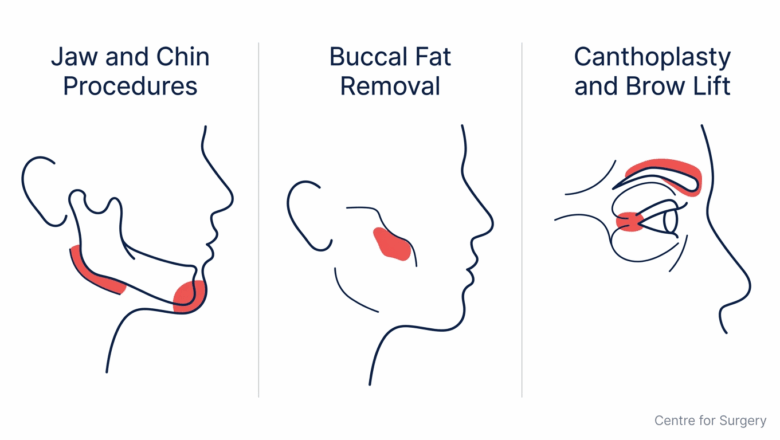
Common looksmaxxing goals mapped to their genuine, regulated surgical equivalents — Centre for Surgery, London.
It’s worth being direct about something: many of the specific aesthetic goals discussed in looksmaxxing communities — a defined jawline, contoured cheeks, a particular eye shape — are entirely legitimate things people can want for themselves, and entirely achievable through safe, evidence-based, regulated surgery. The problem was never the goal; it’s the unregulated route some people take to get there.
If any of these are genuine, considered concerns for you as an adult, here’s what the safe, regulated equivalent actually looks like:
Jawline Definition
Chin augmentation surgery uses a precisely sized implant to strengthen and better define the chin and jawline. For excess fullness beneath the chin specifically, chin and neck liposuction removes localised fat to sharpen the jaw contour. For patients wanting a non-surgical route first, jaw slimming injections offer a temporary, reversible option.
Cheekbone Definition
Buccal fat removal removes the fat pad in the lower cheeks, creating the hollowed lower-cheek, more prominent upper-cheekbone look frequently discussed in looksmaxxing communities — performed as a proper surgical procedure with full pre-operative assessment.
Eye Shape and Canthal Tilt
Canthoplasty (almond eye surgery) can adjust the shape and position of the outer corner of the eye. Many people asking about eye shape in looksmaxxing communities are really describing hunter eyes, a look set mostly by the brow and the depth of the eye socket rather than the corner of the eye, which limits how much surgery can change it. A temporal brow lift can also lift the outer brow and eye area, contributing to the “positive canthal tilt” appearance some patients specifically ask about.
“What I’d want anyone exploring looksmaxxing to understand is that a defined jawline or a particular eye shape isn’t a template that gets stamped onto every face the same way. It only looks right when it’s in proportion with everything else — the chin, the cheekbones, the forehead, the rest of the face. Chasing one feature in isolation, especially through anything unregulated, tends to produce results that look overdone or simply wrong for that person’s anatomy, even when the individual change was technically ‘successful.’ Good facial surgery is about harmony, not a checklist.” — Mr Shehab Jabir, Consultant Facial Plastic Surgeon, GMC 7083880
None of these procedures are offered, or should be considered, as a response to trend pressure alone. They exist because they’re established, well-understood surgical techniques that happen to address some of the same underlying aesthetic interests — safely, with proper assessment, and only where a surgeon agrees it’s an appropriate and realistic option for your individual anatomy.
Who Can Actually Have These Procedures?
Every surgical procedure mentioned above is available at Centre for Surgery only to adults aged 18 and over, in line with UK law on elective cosmetic surgery and our own clinic policy. This isn’t a technicality — it reflects both the legal reality and the clinical reality that facial development, and the maturity to make a considered, informed decision about permanent surgical change, both matter.
If you’re under 18 and have genuine concerns about your appearance, the right first step is speaking with your GP, not pursuing any surgical or self-administered route. If you’re a parent of a teenager who’s expressed interest in looksmaxxing, the same applies — a GP conversation is a far more productive starting point than anything found online. Paediatricians now treat this as a recognised clinical concern in adolescents, spanning everything from jaw-posture techniques to unregulated peptides (Mekhail et al., 2026), and unregulated tanning peptides sold through social media have been flagged separately as a dermatological and public health risk (Sidhu et al., 2026).
For adult patients, being genuinely suitable for surgery involves more than simply wanting a specific look. Your surgeon will assess your overall facial proportions, skin and bone anatomy, general health, and — just as importantly — whether your expectations are realistic and whether the motivation behind the request is well-considered rather than driven by short-term trend pressure or online comparison culture.
How to Find Genuinely Safe Facial Surgery
If you’re considering any facial procedure — whether or not it was originally prompted by something you saw online — a few things are worth checking before you commit to any clinic:
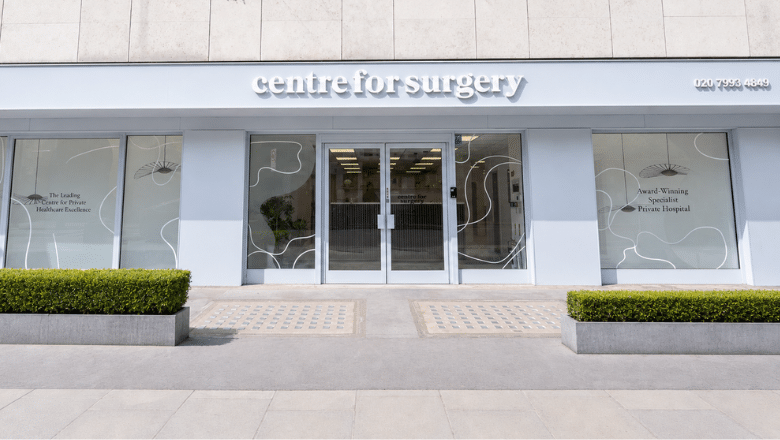
- Regulation — is the facility CQC-regulated? Centre for Surgery’s Baker Street clinic is inspected by the CQC and rated “Good”.
- Surgeon credentials — is your surgeon a plastic surgeon on the GMC Specialist Register, not simply “cosmetic doctor” or an unregulated practitioner?
- A genuine consultation — does the process involve a proper face-to-face assessment of your anatomy, medical history, and goals, or does it feel rushed toward a sale?
- Honest advice — will the surgeon tell you if a procedure isn’t right for you, or if your expectations aren’t realistic for your anatomy? A surgeon who agrees with everything you ask for isn’t necessarily the right one.
- Real aftercare — is there a structured follow-up plan, with genuine access to your surgical team if something doesn’t feel right during recovery?
Frequently Asked Questions
Does looksmaxxing actually work?
The softmaxxing end — skincare, exercise, grooming — can genuinely improve how you look and feel, in the same way general self-care always has. The claims made about more extreme hardmaxxing techniques are far less reliable, often unsupported by any real evidence, and carry meaningful risk of harm. Where a genuine, specific aesthetic concern exists, a proper consultation with a qualified surgeon is a far more reliable route than anything found in an online forum.
Is looksmaxxing dangerous?
Softmaxxing generally isn’t. Hardmaxxing can be — precisely because it typically involves unregulated practices performed outside any medical setting, with no proper assessment, informed consent, or safety oversight. The psychological culture around looksmaxxing communities, particularly the intense comparison and scoring, can also contribute to genuine distress or body dysmorphic tendencies regardless of whether any physical technique is attempted at all.
What is a canthal tilt, and can it be changed safely?
Canthal tilt refers to the angle of the outer corner of the eye relative to the inner corner. It’s genuinely possible to influence this through surgery — most commonly canthoplasty or a temporal brow lift — performed by a qualified oculoplastic or facial plastic surgeon after a full assessment of your individual eye anatomy. This is an entirely different proposition to any unregulated technique discussed online.
My teenager seems interested in looksmaxxing — what should I do?
Try to have a calm, non-judgemental conversation about what’s drawing their interest — often it’s ordinary teenage self-consciousness rather than anything more serious, and an open conversation goes further than confrontation. If you have genuine concern about their physical or mental wellbeing, your GP is the right first point of contact. No surgical procedure is available to anyone under 18 at a properly regulated UK clinic.
Centre for Surgery’s Position
Centre for Surgery does not endorse looksmaxxing as a framework for approaching your appearance. We do recognise that many of the specific aesthetic interests it surfaces — jawline definition, facial contour, eye shape — are entirely legitimate things an adult patient might genuinely want, and we’re able to help safely where that’s the case, through properly regulated surgery, honest consultation, and realistic expectations.
If you have a genuine, considered concern about a specific aspect of your facial appearance, the right next step is a face-to-face consultation with a GMC-registered plastic surgeon — not an online forum, an unregulated practitioner, or a supplement of unknown origin.
To book a consultation: 95-97 Baker Street, London W1U 6RN | 020 7993 4849 | contact@centreforsurgery.com