

In this guide12 sections
- Start With the Surgeon, Not the Clinic
- Check CQC Registration
- Regulated vs Unregulated Providers — The Key Differences
- Who Will Be in the Room During Your Surgery?
- The Consultation Must Be With the Operating Surgeon
- Allow Two Weeks Between Consultation and Surgery
- Five Red Flags to Walk Away From
- Post-Operative Aftercare Standards
- Questions to Ask Before Booking
- Before and After Photographs
- Frequently Asked Questions
- At Centre for Surgery
Choosing the right cosmetic surgery clinic is one of the most consequential decisions you will make in the entire process. The quality of your outcome, your safety during surgery, and your experience of aftercare all depend primarily on this choice — not on the procedure itself, not on the price, and not on how impressive the before-and-after photographs look on Instagram. Getting this decision right requires knowing what to look for and what the absence of certain standards should tell you.
This guide explains the specific criteria that distinguish reputable, properly regulated cosmetic surgery providers from those operating to lower standards, and gives you the tools to assess any clinic you are considering with confidence.
Start With the Surgeon, Not the Clinic
The single most important factor in choosing a cosmetic surgery provider is the qualifications and experience of the surgeon who will actually perform your procedure. The clinic is the environment; the surgeon is the person whose skill, judgement, and hands determine your outcome. These are not always the same thing — a well-appointed clinic can employ surgeons of widely varying qualifications.
The most important question to ask is whether the surgeon performing your procedure is on the GMC Specialist Register for plastic surgery. The GMC Specialist Register is the definitive list of doctors who have completed the full curriculum of specialist training in their field and have been assessed as competent to practise as consultants in the UK. Being on the specialist register for plastic surgery requires completion of a minimum six-year surgical training programme following medical school, assessed by the Royal College of Surgeons. It is not self-declared — it is verified by the GMC.
The distinction between a plastic surgeon (on the GMC specialist register for plastic surgery) and a cosmetic surgeon (a title with no regulatory definition, which any doctor can use regardless of their training) is one of the most misunderstood and important issues in cosmetic surgery practice. As covered in our post on plastic surgeon vs cosmetic surgeon, the title “cosmetic surgeon” provides no information about the doctor’s actual training, qualifications, or competence to perform surgery. You can check any UK doctor’s GMC registration and specialist register status at the GMC website at gmcuk.org.
Check CQC Registration
Any clinic or hospital in England providing surgical procedures under anaesthesia is required by law to be registered with and regulated by the Care Quality Commission (CQC). CQC registration is not a quality mark — it is a legal minimum. But its absence is a significant red flag.
CQC-registered providers are subject to unannounced inspections, required to meet fundamental standards of care, and their inspection reports are publicly available. A CQC Good rating — the rating achieved by Centre for Surgery — indicates that inspectors have assessed the service as meeting the required standards across safety, effectiveness, care, responsiveness, and leadership. As covered in our post on what a CQC Good rating means for cosmetic surgery patients, this rating provides meaningful independent verification of the standards a clinic operates to.
You can check any provider’s CQC registration and inspection history at the CQC website at cqc.org.uk. If a clinic offering surgical procedures is not listed there, do not proceed until you understand why.
Regulated vs Unregulated Providers — The Key Differences

Who Will Be in the Room During Your Surgery?
The standard of anaesthetic care provided during your surgery is one of the most safety-critical aspects of the entire process, and one that is least visible to patients at the research stage. There is significant variation in UK cosmetic surgery practice in this area.
In a well-run clinic, a consultant anaesthetist, a GMC-registered doctor who specialises in anaesthesia, is present and actively managing your anaesthetic throughout the procedure. At lower standards, anaesthetic care may be provided by a non-consultant grade doctor or an anaesthetic practitioner.
At Centre for Surgery, a consultant anaesthetist is present throughout all general anaesthetic procedures, and all general anaesthetics are delivered using TIVA (Total Intravenous Anaesthesia), which produces significantly better outcomes in terms of nausea, recovery speed, and comfort compared to traditional inhaled gas anaesthesia. As explained in our post on what TIVA anaesthesia is and why we use it, this is a deliberate clinical choice based on patient outcome evidence, not a standard feature of all cosmetic surgery providers.
The Consultation Must Be With the Operating Surgeon
At a reputable provider, the consultation before your surgery is conducted by the surgeon who will perform the procedure — not by a patient coordinator, a sales representative, or a non-surgical clinician. The consultation is the moment at which your anatomy is assessed, your suitability is determined, the risks are explained, and the surgical plan is established. None of this can be adequately done by someone other than your operating surgeon.
If you attend a consultation and the surgeon is not present, or appears only briefly while a coordinator handles most of the meeting, this is a concern. As covered in our post on what to expect from enquiry to consultation, the consultation should be a substantive clinical conversation — not a sales presentation.
Allow Two Weeks Between Consultation and Surgery
Any reputable cosmetic surgery provider will recommend a two-week cooling-off period between consultation and surgery. This is a professional standard recommended by the Keogh Review and by BAAPS and BAPRAS membership. It exists to ensure that patients have adequate time to reflect on their decision, ask further questions, and confirm that they wish to proceed — without commercial pressure.
If a clinic offers or encourages same-day booking — allowing you to book your surgery on the day of your consultation — treat this as a serious red flag. As explained in our post on what the two-week cooling-off period is and why it matters, this waiting period is one of the most important patient protections in UK cosmetic surgery practice.
Five Red Flags to Walk Away From

As covered comprehensively in our post on how to avoid botched cosmetic surgery, the following should all raise serious concern: a surgeon who is not on the GMC specialist register; a clinic that is not CQC-registered; pressure to book surgery on the day of consultation; a consultation conducted primarily by a non-surgical coordinator; promises of results that seem unrealistically dramatic; absence of a clear aftercare plan; and prices that are substantially lower than comparable providers without a clear explanation.
Post-Operative Aftercare Standards
What happens after your surgery matters as much as the procedure itself. Complications, when they occur, most commonly present in the days and weeks following surgery — and how quickly and effectively they are managed affects both your safety and your outcome. You should be able to speak to a clinical team member at any point during your recovery if you have concerns. There should be a clearly documented pathway for managing post-operative complications, including access to the operating surgeon, and the nurse-led aftercare contact number should be genuinely available outside business hours.
As covered in our post on how to reduce complications after plastic surgery, the quality of post-operative guidance and follow-up is a significant determinant of outcomes.
Questions to Ask Before Booking

As detailed in our post on 10 questions to ask your surgeon before cosmetic surgery, asking the right questions at consultation is the most effective way to assess a provider’s standards. Key questions include: Is the surgeon on the GMC specialist register for plastic surgery? Is the clinic CQC-registered and what is its rating? Who provides the anaesthetic? Is there a two-week cooling-off period? What does aftercare consist of and who provides it? What happens if I am unhappy with my results? Our dedicated post on what happens if you are not happy with your cosmetic surgery results covers this last question in full.
Before and After Photographs
Before and after photographs are an important part of assessing a surgeon’s results, but they require careful interpretation. As detailed in our post on how to read plastic surgery before and after photos, photographs can be selected, lit, and presented in ways that flatter the result. Be cautious of galleries that show only highly dramatic transformations or lack consistency in how photos are taken.
Our post on cosmetic surgery before and after photos on social media explains the specific red flags to look for in socially-presented results, where the standards of presentation are even less consistent.
Frequently Asked Questions
How do I check if a surgeon is on the GMC Specialist Register?
Visit gmcuk.org and search for the surgeon by name. Their registration entry will show whether they hold a Certificate of Completion of Training (CCT) with a specialist designation. Look specifically for plastic surgery as the specialty — being GMC-registered as a doctor is not the same as being on the specialist register.
How do I check if a clinic is CQC-registered?
Visit cqc.org.uk and search for the provider by name or location. You can see their registration status, their most recent inspection rating, and the full inspection report. Ratings of Outstanding or Good indicate a provider that has met or exceeded the required standards.
Is price a reliable indicator of quality in cosmetic surgery?
Not directly — but very low prices relative to comparable providers are a warning sign rather than a bargain. The cost of providing surgery safely with a surgeon, a consultant anaesthetist, a CQC-regulated theatre, and genuine aftercare is not infinitely compressible. Prices that are dramatically lower than the market rate typically reflect compromises somewhere in that chain.
Should I get more than one consultation before choosing a surgeon?
Yes, absolutely. Consulting with more than one surgeon before making a decision gives you a basis for comparison, a second clinical opinion, and a more informed basis for choosing who to trust with your surgery.
What should I do if I feel pressured during a consultation?
Walk away. A reputable surgeon and a reputable clinic will never apply pressure to book. If you feel that a booking decision is being encouraged before you are ready, this tells you something important about how that provider operates.
At Centre for Surgery
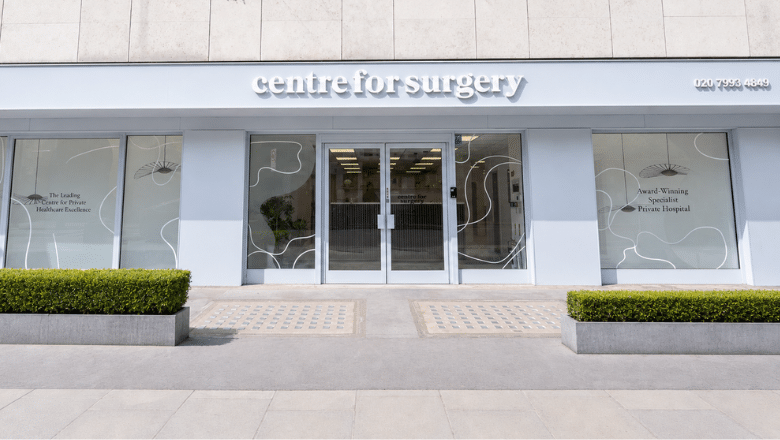
Centre for Surgery is a CQC-registered cosmetic surgery clinic at 95-97 Baker Street, London W1U 6RN. All procedures are performed by GMC-registered plastic surgeons. If you are put to sleep for surgery, a consultant anaesthetist gives you TIVA. We recommend a two-week cooling-off period for every surgical patient. Post-operative review appointments are included as standard, and you have your surgeon’s direct number for the first 24 hours after surgery. Finance options are available through our partner Chrysalis Finance, subject to status, — visit our Finance Options page for details.
Phone: 020 7993 4849 | Email: contact@centreforsurgery.com | Address: 95-97 Baker Street, London W1U 6RN