


In this guide12 sections
- Summary
- What Causes Poor Jawline Definition
- Is My Jawline Fat or Bone? Two Self-Tests
- Neck Liposuction — Removing What Hides the Jawline
- Chin Augmentation — Building What Was Never There
- Treating a Weak Jawline — The Options Compared
- When Skin Is the Real Problem
- Non-Surgical Options and Their Limits
- Scars
- How Long the Results Last
- Weak Jawline Treatment at Centre for Surgery
- Weak Jawline: Frequently Asked Questions
Summary
- A weak jawline is almost always one of two problems — too much fat below it, or too little bone behind it. They need opposite operations.
- Two self-tests separate them. Drop an imaginary vertical line from your lower lip: if your chin sits behind it, that is a bone problem. Pinch under your chin: if you can grasp soft fullness, that is a fat problem.
- Liposuction removes what is hiding the jawline. Augmentation builds what was never there. Using the wrong one produces a disappointing result at full price.
- Plenty of people have both, and the two procedures combine well in a single operation.
- Neither treats loose skin. If laxity is the main issue, tightening or a lift is the honest answer and no amount of fat removal will substitute.
A weak jawline is one of the most common reasons people look at their profile and feel something is off, without being able to say what. The good news is that identifying the cause takes about ten seconds in front of a mirror — and the cause determines everything about how to improve jawline definition.
What Causes Poor Jawline Definition

Jawline definition comes from the angle where the underside of the chin meets the front of the neck — the cervicomental angle. A sharp angle reads as a defined jawline; a shallow or filled-in one reads as weak, heavy or undefined.
Two entirely different things blur that angle.
Fat. The chin is in the right position, but a pad of tissue beneath it fills the space that should be empty. The bone structure is fine — it is simply hidden. This is why some lean people still have no jawline definition, and why others notice it appearing in their thirties without any weight change.
Bone. The neck is lean and there is nothing to remove, but the chin sits too far back, so there is no forward point for the jawline to define against. The profile reads as soft or bottom-heavy regardless of how slim the neck is. This is the same underlying issue described in our guide to a weak chin, seen from the side rather than the front.
There is a third contributor — skin laxity — which behaves differently again and is covered further down.
Is My Jawline Fat or Bone? Two Self-Tests

Test one — the lower lip line
Look at yourself in profile and drop an imaginary vertical line straight down from your lower lip. In a balanced profile the chin reaches roughly to that line. If it sits noticeably behind it, your chin is under-projected and no amount of fat removal will create a jawline, because there is nothing for the jawline to run toward.
Test two — the pinch
Tip your head back slightly and pinch the tissue directly under your chin between finger and thumb. If you can grasp a soft, mobile roll, that is fat. If there is almost nothing to hold but the area still looks full or slack, the issue is more likely skin or muscle than fat.
How to improve jawline definition — what each answer means
- Chin behind the line, little to pinch — a bone problem. Chin augmentation.
- Chin reaches the line, soft fullness to pinch — a fat problem. Neck liposuction.
- Chin behind the line and fullness to pinch — both, and they are commonly combined.
- Neither, but the area looks loose — skin laxity, which needs a different approach entirely.
This is an orientation, not a diagnosis. Surgeons also assess skin elasticity by pinching and releasing, bite and jaw relationship, and how the platysma muscle behaves — none of which you can judge reliably on yourself.
Neck Liposuction — Removing What Hides the Jawline
Neck liposuction targets the fat beneath the chin and along the upper neck. It suits people with reasonable skin elasticity whose bone structure is already adequate — the jawline exists, it is simply obscured.
Small incisions are placed under the chin or behind the ears, and a fine cannula breaks up and removes the fat. It is performed under local anaesthetic or TIVA (total intravenous anaesthesia) as a day case.
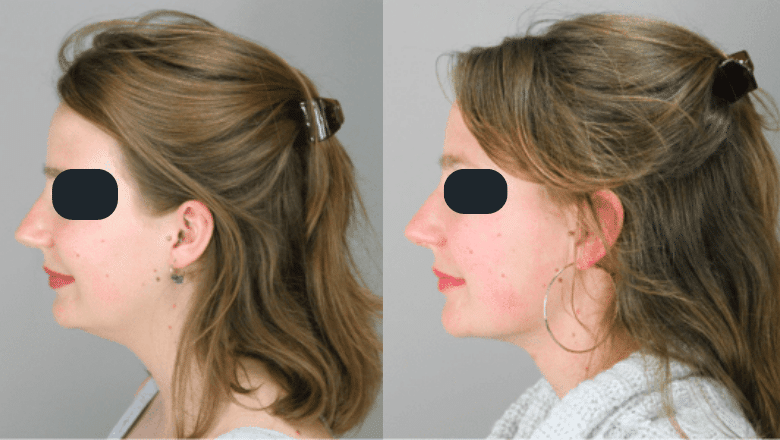
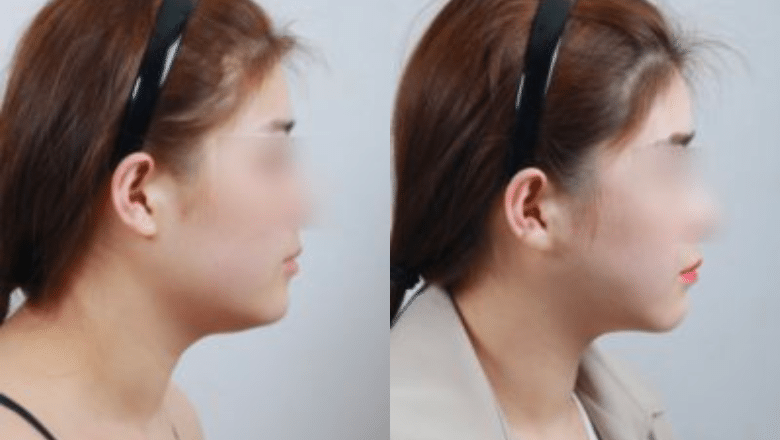
Recovery is short. Swelling and bruising settle over a couple of weeks and most people return to work within a few days, wearing a compression garment during healing. The final contour emerges over two to three months as swelling resolves.
Fat cells removed do not return, so the result is durable provided weight stays stable. See how to get rid of a double chin for the non-surgical options and where they fall short.
Chin Augmentation — Building What Was Never There

Chin augmentation adds projection to a chin that sits too far back. Nothing is removed — structure is added, either with an implant placed over the existing chin bone, or by sliding genioplasty, in which your own bone is cut and repositioned forward.
The choice between them matters. An implant is quicker, simpler and reversible, and suits mild to moderate under-projection. Sliding genioplasty moves your own bone, can advance the chin further, and can correct vertical height and asymmetry at the same time — which an implant cannot. See chin implant vs jaw implant for how these differ from jaw angle implants, which address width rather than projection.
Performed under TIVA as a day case, with incisions inside the mouth or discreetly beneath the chin. Recovery takes longer than liposuction — swelling is more noticeable in the first week and most people return to work after seven to ten days, with the final shape settling over several weeks.
Treating a Weak Jawline — The Options Compared

When both are needed
A recessed chin and submental fullness frequently occur together, and they compound each other — a chin that sits back makes a normal amount of neck fat look worse, because there is no projection to contrast it against. Combining the two in one operation transforms the lower face more than either alone, with a single recovery.
When Skin Is the Real Problem
Both procedures depend on skin retracting over the new contour. Where skin has lost elasticity through age or significant weight loss, removing fat can leave the area looking loose rather than sharp.
In those cases liposuction alone will disappoint, and the honest answer is skin tightening or a lower facelift — see facial skin tightening treatments for the full comparison. Chin augmentation stretches the overlying skin slightly and can help marginally, but it is not a treatment for laxity.
If jowling has developed alongside the loss of jawline definition, that is a descent problem rather than a fat or bone one — see sagging jowls.
Non-Surgical Options and Their Limits
For milder cases, or for anyone not ready for surgery, there are two non-surgical routes.
Dermal filler can add projection to the chin and definition along the jaw angle, mimicking some of what an implant achieves. It is immediate and reversible, but temporary and less dramatic — see jawline contouring with fillers.
Fat-dissolving injections can reduce modest submental fullness over several sessions. They suit mild cases and are considerably less effective than liposuction where the volume is significant.
Both can be useful for testing a change before committing surgically. What does not work — despite being promoted heavily online — is mewing, chewing devices or facial exercise as a route to jaw definition, none of which alters bone in an adult. Our guide to looksmaxxing covers those claims and the evidence against them. Neither produces the structural, permanent result surgery does, and neither helps at all if the underlying issue is bone position.
Scars
Both procedures are designed around discreet incisions. Liposuction incisions are a few millimetres, hidden under the chin or behind the ears, and typically fade to near-invisibility — see liposuction scars.
For chin implants placed through the mouth there is no external scar at all. Where the incision is made under the chin, it sits within the natural crease and is usually inconspicuous once mature. How any individual scars is partly constitutional — see types of scars.
How Long the Results Last
Both are permanent in the sense that matters. Liposuction removes fat cells, which do not regenerate; the result holds provided weight remains stable. Chin implants are not routinely replaced, and sliding genioplasty reshapes your own bone, so the change is structural — see how long chin augmentation lasts.
Ageing continues regardless. Skin and soft tissue will change over the years, but an improved bone platform and a cleaner angle give the lower face a better foundation to age from.
Weak Jawline Treatment at Centre for Surgery
We assess the jawline as a whole rather than fitting you to a procedure. At consultation your surgeon will establish whether the issue is fat, bone, skin or a combination, and will say plainly where a single operation will not achieve what you are hoping for.
Both procedures are performed at our CQC-registered facility on Baker Street as day cases under TIVA, with aftercare included and review by the team that operated on you.
Why Choose Centre for Surgery?
We are a CQC-regulated cosmetic surgery clinic at 95–97 Baker Street, rated Good overall. Our surgeons are registered with the General Medical Council. We invite you to read verified feedback on Google Reviews, or on our own patient reviews page, which brings together verified reviews from Google and Trustpilot.
- Phone: 020 7993 4849
- Email: contact@centreforsurgery.com
- Address: 95-97 Baker Street, London W1U 6RN
We offer finance options with Chrysalis Finance on procedures over £1,500.
Weak Jawline: Frequently Asked Questions
What causes a weak jawline?
Usually one of three things: fat beneath the chin obscuring the angle, a chin that sits too far back, or skin laxity. Genetics determine the bone position; weight and age influence the other two. Identifying which applies decides the treatment.
How do I know if my jawline problem is fat or bone?
Drop a vertical line from your lower lip in profile. If your chin sits behind it, that is bone. Then pinch under your chin — if you can grasp soft fullness, that is fat. Many people have both.
Can exercise improve a weak jawline?
Losing weight can reduce submental fat and improve definition. Facial or jaw exercises do not — there is no evidence they change jawline contour, and chewing devices marketed for the purpose can aggravate jaw joint problems.
Will filler fix a weak jawline?
It can add projection and definition temporarily, and it is a reasonable way to preview a change. It cannot remove fat, and where under-projection is significant the volume required becomes both expensive and unnatural-looking. Surgery is the durable answer.
Can I have neck liposuction and chin augmentation together?
Yes, and it is common. The two address different causes of the same complaint and combine well in one operation with a single recovery.
Is one procedure more painful than the other?
Liposuction generally involves less discomfort and a quicker recovery. Chin augmentation produces more swelling and tightness for the first week or two, particularly with sliding genioplasty.
Will either fix jowls or sagging skin?
No. Loose skin needs tightening or a lift. Removing fat from beneath lax skin can make the area look emptier rather than sharper, which is why assessment matters before choosing.
How soon will I see my new jawline?
Some change is visible within days, but swelling masks the result for weeks. Liposuction settles over two to three months; chin augmentation takes a similar period for the final shape to emerge.
Is a weak jawline the same as a weak chin?
They overlap but are not identical. A weak chin describes poor forward projection of the chin itself; a weak jawline describes poor definition along the whole lower border. A recessed chin usually produces both — see weak chin.
Related Articles
- Weak Chin: Causes and How to Fix It
- How to Get Rid of a Double Chin
- What Is the Ideal Female Jawline?
- The Best Treatment for Sagging Jowls
- Chin Implant vs Jaw Implant



