


In this guide10 sections
Summary
- A jaw implant adds width and definition at the angle of the jaw. A chin implant adds forward projection at the front. They solve different problems.
- Look at yourself in profile and from the front. If the profile is the issue — a chin that sits back — that is a chin implant. If the front view lacks width and the jaw corners are soft, that is a jaw implant.
- They are frequently combined, because a recessed chin and a narrow jaw angle often occur together.
- Both are permanent and both are reversible. Silicone implants do not need routine replacement, and they can be removed if you change your mind — unlike bone surgery.
- Neither treats fat or loose skin. If the problem beneath your chin is fullness rather than structure, an implant will not fix it.
Jaw Implant vs Chin Implant — The Difference
Both add structure to the lower face using a shaped silicone implant placed directly onto bone. What differs is where, and therefore what changes.
Chin implant — forward projection
A chin implant, also called chin augmentation, sits over the front of the chin bone and pushes the chin forward. It changes your profile. Where the chin sits behind the plane of the lower lip, this brings it into balance with the nose and forehead, and often makes the nose look smaller by comparison without touching it.
It does little for the width of your face from the front.
Jaw implant — width and angle
A jaw implant sits along the back portion of the mandible, at and around the angle where the jaw turns upward. It changes your front view — broadening the lower face, sharpening the corner of the jaw, and creating the defined angle that reads as a strong jawline.
It does little for a chin that sits too far back.
Which one you need
Photograph yourself in profile and from the front, relaxed and looking straight ahead.
In profile, drop an imaginary vertical line from your lower lip. If your chin sits noticeably behind it, that is under-projection — a chin implant question. See weak chin for the full assessment.
From the front, look at the corners of your jaw below the ears. If they taper away with no definable angle and the lower face looks narrow relative to your cheekbones, that is a jaw implant question.
Both can be true. A narrow jaw angle combined with a recessed chin is a common pattern, and correcting only one can make the other more obvious. Our guide to a weak jawline covers how to tell whether your issue is structural at all, or whether fat or skin is responsible.
How the Surgery Works

Chin implant
- Anaesthesia. Performed under TIVA (total intravenous anaesthesia) as a day case, or under local anaesthetic in selected cases.
- Incision. Either inside the lower lip or in the natural crease beneath the chin. The intraoral approach leaves no external scar; the submental approach gives more direct access and a very discreet scar.
- Pocket. A precise pocket is created directly on the bone, sized to the implant so it cannot migrate.
- Placement. The implant is positioned centrally and fixed, commonly with a screw, to prevent movement.
- Closure. Closed in layers, with a supportive dressing.
Around an hour, home the same day.
Jaw implant
- Anaesthesia. TIVA as a day case.
- Incision. Inside the mouth, along the lower gum, so there is no visible scar.
- Pocket. A pocket is dissected along the mandible toward the angle, with care taken around the mental nerve.
- Placement. Implants are placed on both sides and secured. Symmetry is checked repeatedly during the procedure.
- Closure. Dissolvable sutures inside the mouth.
Around an hour to ninety minutes for both sides, home the same day.
Preparing for Surgery
- Stop smoking several weeks beforehand. Smoking impairs healing and raises infection risk, which matters more when an implant is involved.
- Avoid blood-thinning medication and herbal supplements as directed, to reduce bleeding and bruising.
- Complete any pre-operative blood tests well in advance.
- Arrange someone to take you home. You cannot drive after TIVA.
- Plan soft food for the first few days, particularly after a jaw implant placed through the mouth.
Recovery
After a chin implant
Most people take about a week off and are back to normal routines within one to two weeks. Discomfort is generally mild and managed with prescribed pain relief. Sleeping propped up for the first fortnight reduces swelling, and cold compresses help in the first few days.
Numbness of the lower lip and chin is common initially and usually settles. Early changes are visible within a month; the final shape takes three to four months as swelling fully resolves. See chin implant and genioplasty recovery for the week-by-week picture.
After a jaw implant
Swelling and bruising are more pronounced for the first two weeks, and the lower face can look considerably wider than the eventual result. Most people return to work within one to two weeks.
The incision is inside the mouth, so oral hygiene matters — you will be given specific rinsing instructions. Early changes appear around a week, with the true contour emerging over two to three months.
Risks
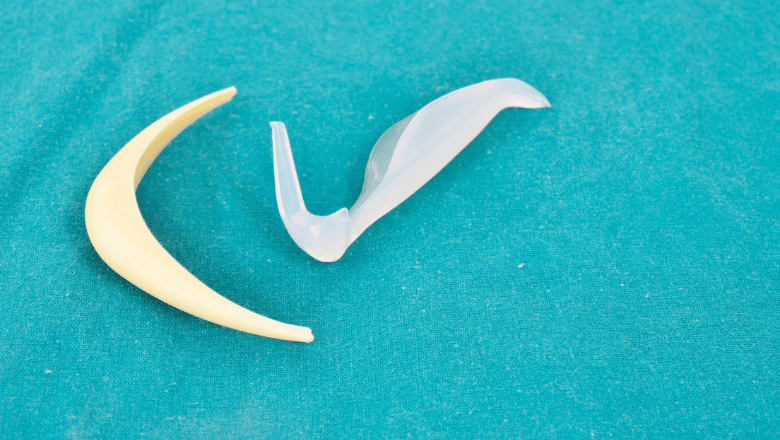
Both are established procedures, but any implant carries specific risks worth understanding before you agree to one.
- Infection. The main implant-specific risk. Where infection takes hold around an implant, antibiotics often will not clear it and removal may be necessary, with replacement some months later.
- Malposition or shift. An implant can sit asymmetrically or move, particularly if the pocket is oversized. Fixation reduces this considerably.
- Nerve injury. The mental nerve runs close to the operative field. Temporary numbness of the lip and chin is common; permanent change is uncommon but possible.
- Bone resorption. Long-term pressure from an implant can cause slight thinning of the bone beneath it. Usually of no consequence, occasionally relevant if the implant is later removed.
- Asymmetry. Faces are never perfectly symmetrical to begin with, and an implant can make an existing difference more noticeable.
- Swelling, bruising and bleeding — expected, and settling within weeks.
The reassuring part: unlike bone-cutting surgery, an implant can be removed. If you dislike the result or a problem develops, the anatomy returns close to its starting point.
Implant or Bone Surgery?
For the chin there is an alternative to an implant — sliding genioplasty, in which the chin bone is cut and repositioned forward using your own bone.
An implant is quicker, technically simpler, reversible, and well suited to mild or moderate under-projection where the chin simply needs to come forward.
Sliding genioplasty can advance the chin further than an implant safely allows, and can correct vertical height or asymmetry at the same time — which an implant cannot. There is no foreign material, so no implant-related infection risk, but it is a larger operation and is not reversible.
For the jaw angle, implants are the usual route; bone augmentation of the jaw angle is uncommon.
Non-Surgical Alternatives
Chin filler and jawline filler add projection and definition temporarily, lasting nine to eighteen months. They are immediate, reversible and a sensible way to preview a change before committing to an implant — though the volume needed for significant under-projection makes filler an expensive way to maintain the result long term.
Where a wide, square jaw is the complaint rather than a narrow one, the answer is the opposite — jaw slimming injections relax the masseter muscle to reduce width.
If fullness beneath the chin is obscuring the jawline, no implant will help — see chin and neck liposuction and how to get rid of a double chin.
Jaw and Chin Implants at Centre for Surgery
Both procedures are performed at our CQC-registered facility on Baker Street as day cases under TIVA. At consultation your surgeon will assess your profile and front view together, and will say plainly where an implant is not the answer — including where the issue is fat, skin, or nothing at all.
Why Choose Centre for Surgery?
We are a CQC-regulated cosmetic surgery clinic at 95–97 Baker Street, rated Good overall. Our surgeons are registered with the General Medical Council. We invite you to read verified feedback on Google Reviews, or on our own patient reviews page, which brings together verified reviews from Google and Trustpilot.
- Phone: 020 7993 4849
- Email: contact@centreforsurgery.com
- Address: 95-97 Baker Street, London W1U 6RN
We offer finance options with Chrysalis Finance on procedures over £1,500.
Jaw and Chin Implants: Frequently Asked Questions

What is the difference between a jaw implant and a chin implant?
A chin implant adds forward projection at the front of the chin and changes your profile. A jaw implant adds width and definition at the angle of the jaw and changes your front view. Different problems, different implants.
Can I have both at the same time?
Yes, and it is common. A narrow jaw angle and a recessed chin frequently occur together, and correcting only one can make the other more noticeable.
How do I know if my chin is weak?
Take a profile photograph and drop a vertical line from your lower lip. If your chin does not reach it, it is under-projected.
Is chin augmentation the same as a chin implant?
Chin augmentation is the broader term and includes both implants and sliding genioplasty, where your own bone is repositioned. A chin implant is one way of achieving chin augmentation.
What is sliding genioplasty?
The chin bone is cut and moved forward, then fixed with plates. It uses your own bone rather than an implant, can advance the chin further, and can correct vertical height and asymmetry — but it is a larger operation and is not reversible.
How long do jaw and chin implants last?
Silicone implants are not routinely replaced and can last indefinitely. Replacement is only needed if a complication such as infection or malposition occurs.
Can an implant be removed?
Yes. This is one of the main advantages over bone surgery — if you dislike the result or a problem develops, the implant can be taken out and the anatomy returns close to its starting point.
Will a chin implant change my smile?
Temporarily, sometimes. The implant sits beneath muscles involved in smiling, and swelling can alter your smile for a few weeks. It settles as healing completes.
Do implants look natural?
When appropriately sized and correctly positioned, yes. Unnatural results usually come from an implant that is too large for the face rather than from implants as such.
Can the body reject an implant?
Silicone is inert and true rejection does not occur. Infection around an implant is the relevant risk, and if it develops the implant may need removing.
Will a jaw implant make my face look wider?
Yes — that is the intention. If your concern is that your lower face is already too wide, a jaw implant is the wrong procedure and jaw slimming injections or jaw reduction is what you are looking for.
Are implants covered by private medical insurance?
Not usually. These are cosmetic procedures and fall outside most policies unless there is a reconstructive indication following trauma or congenital difference.
Will an implant fix a double chin?
No. An implant adds structure; it does not remove fat. A chin implant can improve how a double chin reads by improving the angle it sits against, but if fullness is the main problem the answer is liposuction.
Related Articles
- Weak Chin: Causes and How to Fix It
- Weak Jawline: Is It Fat or Bone?
- The Ideal Female Jawline
- Chin Implant and Genioplasty Recovery
- Facial Asymmetry: Causes and Treatments