


In this guide12 sections
- Key Points
- What Is the Best Age for a Facelift?
- Facelift Age by Decade
- Is There an Age Limit for a Facelift?
- Does Age Change Which Type of Facelift You Need?
- Does Age Affect How Long a Facelift Lasts?
- Why Some People Need a Facelift Earlier Than Others
- Not Ready for a Facelift Yet? The Alternatives
- Facelift Before and After
- Frequently Asked Questions
- References
- Talk to a Surgeon About the Right Time for a Facelift
Key Points
- There is no single best age for a facelift. Most people who have one are in their 50s and 60s, but a facelift can suit someone in their 40s with early jowls or someone in their 70s who is fit and well.
- In a study of more than 11,000 facelifts, the average patient was 59. In a 2026 series of 541 facelifts, a quarter of patients were over 70.
- Age on its own does not raise the risk of complications. A 2026 study found no link between age and complications, even in patients over 75, when health was carefully checked first.
- Age does shape which operation suits you: a mini facelift for early jowls, a full facelift with neck lift once the neck loosens, and often fat transfer as well later on.
- Having a facelift younger usually means a subtler change and a fresher starting point as you keep ageing. Having it later gives a bigger visible change.
- Your health, how much your face and neck have changed, and what you want to fix matter more than the number on your birth certificate.
“What is the best age for a facelift?” is one of the first questions people ask about facelift surgery. The short answer is that the right time is when your face has changed enough to benefit and you are healthy enough for surgery, which for most people falls somewhere between the late 40s and the early 70s. This guide goes through facelift age decade by decade: what usually changes, which type of facelift tends to suit, and whether you might be too young or too old.
Age is only one part of the decision. If you are trying to work out whether you are a good candidate at all, or whether you are ready, our guide to deciding whether a facelift is right for you covers that in detail. For an overview of the operations themselves, see our guide to the types of facelift.
What Is the Best Age for a Facelift?
There is no best age that applies to everyone. Faces age at very different speeds, so two people of the same age can need completely different things. Surgeons judge timing by what they see: how far the jowls have dropped, how loose the neck is, how much volume has been lost from the cheeks and how good the skin quality is.
That said, most facelifts are done in the 50s and 60s. In a large American database of 11,300 facelifts, the average patient was 59.2 years old[1]. A 2026 series of 541 facelifts gives a fuller picture of the spread: 28% of patients were 60 or younger, 48% were between 60 and 70, and 24% were over 70[2].
Facelift Age by Decade

These are typical patterns, not rules. Your surgeon’s examination always matters more than your age.
Facelift in your 30s: is it too young?
For most people in their 30s, yes. Skin is usually still elastic and the deeper tissues have not dropped much, so the early signs of ageing, such as fine lines, a little volume loss and slightly tired eyes, respond well to non-surgical treatment. Surgery is occasionally right in the 30s, for example after major weight loss, where loose skin and lost fat cannot be fixed any other way, or where strong family traits mean jowls appear early. Our guide to face and neck lift surgery after weight loss explains when that applies.
Facelift at 40: is 40 too young?
Not if the changes are there. In the 40s, many people first notice the jawline softening and small jowls forming, while the neck is still fairly firm. A mini facelift or lower facelift often suits this stage. It lifts the jowls and lower cheeks through shorter incisions around the ear, and at Centre for Surgery it is done under local anaesthetic, with or without sedation, according to your choice. A ponytail lift is another option for younger patients whose main concern is the mid-face and brow. The change is subtle, which is often what people in their 40s want.
Facelift in your 50s
This is when many people decide to go ahead. Jowls are usually clearer, the neck has started to loosen and the folds between the nose and mouth deepen. A full facelift that lifts the deeper SMAS layer, usually combined with a neck lift, treats the jawline and neck together. Skin quality is often still good, which helps the result look natural. Our article on deep plane vs SMAS facelift explains how the techniques differ.
Facelift in your 60s
By the 60s, most people have jowls, loose skin under the chin, visible neck bands and more volume loss in the cheeks and temples. A face and neck lift gives a larger visible change at this stage, and fat transfer is often added to restore lost volume. Other procedures, such as eyelid surgery or a brow lift, are frequently done at the same time. Our guide to procedures that complement a facelift covers the common combinations.
Facelift at 70 and over
Many people in their 70s are good candidates if they are fit and well. The skin is thinner and less elastic, so the surgeon may favour techniques that rely on lifting the deeper layers rather than pulling on the skin, and healing can take a little longer. The deciding factor is general health, which is assessed carefully before surgery, not the date of birth.
Is There an Age Limit for a Facelift?
There is no upper age limit. Consultations and treatment at Centre for Surgery are for adults aged 18 and over, but beyond that, suitability depends on health rather than age.
The evidence supports this. A 2026 study of 541 facelifts in Aesthetic Surgery Journal ↗[2] divided patients into five age groups, from 60 and under to 76 and over. Major complications were rare (0.4%) and minor ones affected 7.6% of patients, and neither was linked to age, even in patients over 75. The authors concluded that chronological age alone does not predict problems after a facelift, provided patients are screened carefully before surgery.
What matters more is what you bring with you: smoking, high blood pressure, diabetes, blood-thinning medicines and being overweight all raise the risk at any age. In the database of 11,300 facelifts, being male, a body mass index of 25 or more and combining several procedures were the factors linked to more complications, not age[1]. Our article on age limits for cosmetic surgery covers this across all procedures.
Does Age Change Which Type of Facelift You Need?
Yes, because the changes in your face follow a rough pattern with age:
- Mainly early jowls and a softer jawline: a mini facelift, lower facelift or one-stitch facelift. Our article on facelift vs mini facelift compares the two.
- Jowls plus a loose neck: a full SMAS or deep plane facelift with neck lift.
- Jowls, neck and hollow cheeks: a face and neck lift with fat transfer.
- A loose neck but a fairly firm face: a neck lift on its own may be enough at any age.
Two people of 55 can need completely different operations, which is why the plan comes from the examination rather than from an age chart.
Does Age Affect How Long a Facelift Lasts?
A facelift does not stop ageing, so your face keeps changing from its new starting point. Having surgery earlier means you start from a firmer base, and the result tends to look natural for longer because there is less to correct. Having surgery later gives a more noticeable change, because there is more to lift.
A 2024 study of 48 facelift patients in Aesthetic Plastic Surgery ↗[3] measured how old people looked before and a year after surgery. Patients who looked older than their real age before surgery tended to come back to looking their age, while those who already looked their age or younger tended to look younger than their age afterwards. In other words, a facelift resets the clock from wherever you start.
In a study where 483 members of the public rated photographs, people were judged younger, healthier and more attractive after a facelift than before[4]. Our article on what happens to your face 10 years after a facelift describes how results change over the following decade.
Why Some People Need a Facelift Earlier Than Others
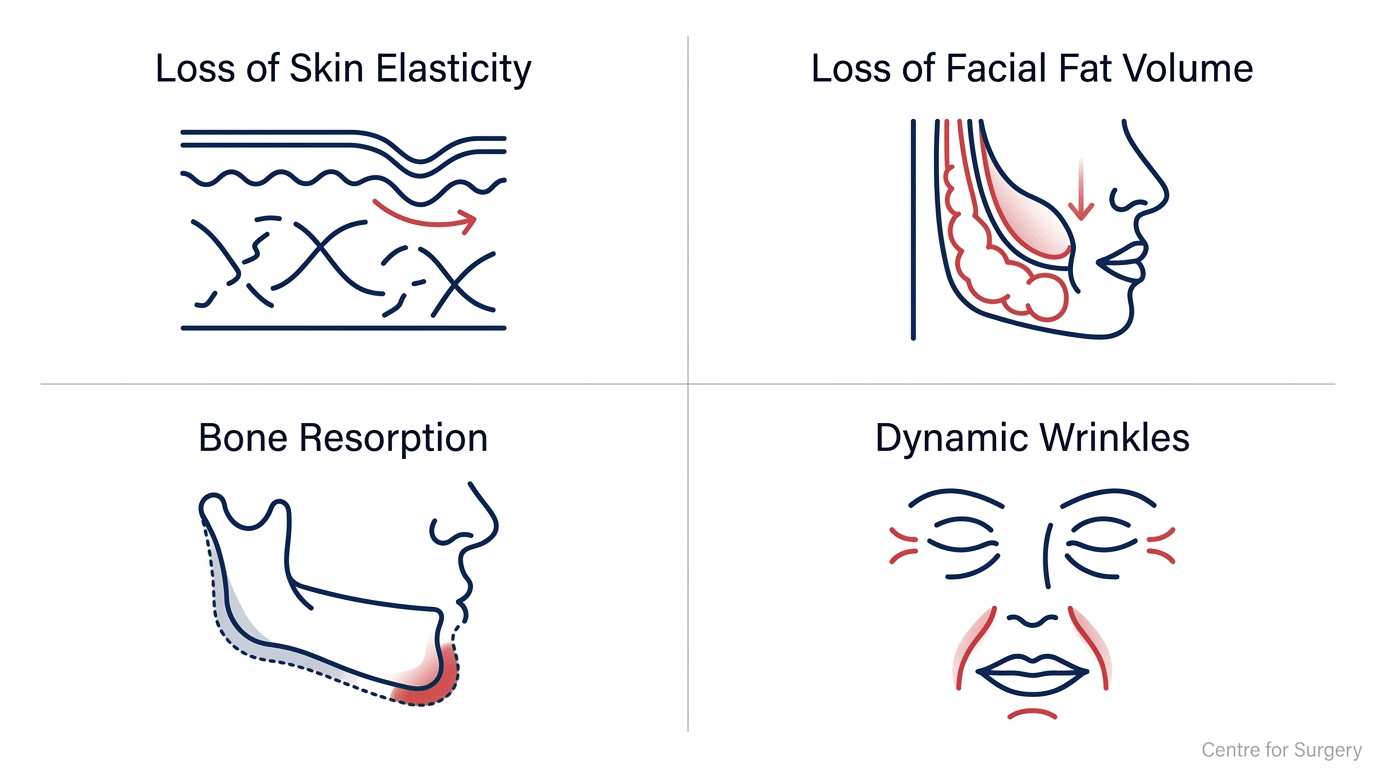
The face ages through four linked processes: skin loses elasticity, fat pads shrink and drop, the facial bones slowly lose volume, and repeated expressions etch lines into the skin. How quickly this happens varies a great deal. The main reasons some people show jowls and a loose neck earlier are:
- Genetics, including skin thickness and the shape of the jaw and chin.
- Sun exposure, which breaks down collagen and elastin.
- Smoking, which speeds up skin ageing and also raises surgical risk. At Centre for Surgery, we ask patients to stop all nicotine four weeks before and four weeks after surgery.
- Weight changes, especially large weight loss, which can leave loose skin at any age.
Our guide to the signs of ageing in the face over time describes these changes in more detail.
Not Ready for a Facelift Yet? The Alternatives
If your changes are mild, or you are not ready for surgery, non-surgical treatments can soften the early signs and delay the point at which a facelift is worthwhile. At Centre for Surgery, injectable treatments are given only by surgeons. The options include:
- Dermal fillers to restore lost volume, including the liquid facelift (8-point lift).
- Radiofrequency skin tightening such as FaceTite for mild loosening of the jawline and neck.
- Skin treatments that improve texture and fine lines.
None of these can lift dropped tissue the way surgery does, and the effect is smaller and shorter-lived. Our guide on how to tighten sagging skin on your face explains where non-surgical treatment stops working.
Facelift Before and After

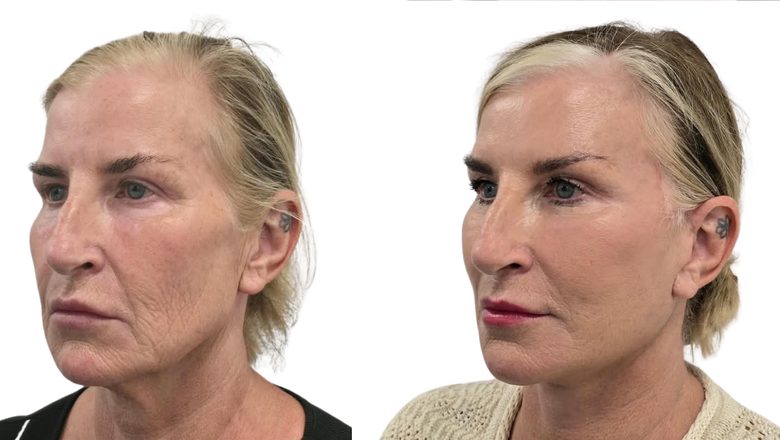
Real Centre for Surgery patients, photographed at least six months after surgery. See more results in our facelift before and after photos. Our surgeons carry out more than 100 facelift and neck lift procedures a year.
Frequently Asked Questions
What is the most common age to get a facelift?
The 50s and 60s. In a database of more than 11,000 facelifts, the average patient was 59, and in a 2026 series most patients were between 60 and 70. People in their 40s and 70s also have facelifts when their face and health suit it.
Is 40 too young for a facelift?
Not if you have visible jowls or loosening along the jawline that bothers you. In the 40s, a mini facelift or lower facelift is often the right size of operation. If the changes are mainly fine lines or mild volume loss, non-surgical treatment usually makes more sense for now.
Is 67 too old for a facelift?
No. Many people have a facelift in their late 60s and 70s, and research shows age alone does not increase complications when patients are healthy and carefully assessed. What matters is your general health, any medicines you take and whether you smoke.
What age should you get a mini facelift?
Most often in the 40s and 50s, when the jowls have started to form but the neck is still fairly firm. Once the neck is loose, a full facelift with neck lift usually gives a better result than a mini facelift at any age.
What happens 10 years after a facelift?
Your face keeps ageing, but from a younger starting point. Most people still look younger at 10 years than they would have without surgery, although some softening of the jawline and neck returns. Some choose a smaller top-up procedure later.
What is the next best thing besides a facelift?
For mild changes, a combination of fillers to restore volume, radiofrequency skin tightening and skin treatments can help. For loose neck skin with a firm face, a neck lift on its own may be enough. None of the non-surgical options lifts dropped tissue the way a facelift does.
References
- Gupta V, Winocour J, Shi H, et al. Preoperative risk factors and complication rates in facelift: analysis of 11,300 patients. Aesthet Surg J. 2016;36(1):1-13. doi:10.1093/asj/sjv162 ↗
- Vishwanath N, Mandelbaum M, Williams-Medina E, et al. Effect of age on complications in facelift surgery. Aesthet Surg J. 2026;46(9):NP99-NP109. doi:10.1093/asj/sjag084 ↗
- Du H, Liang H, Peng B, et al. Age reduction after face-lift surgery in Chinese population: an outcome study using artificial intelligence and objective observer-based assessment. Aesthetic Plast Surg. 2024;48(23):4760-4768. doi:10.1007/s00266-024-04258-w ↗
- Nellis JC, Ishii M, Papel ID, et al. Association of face-lift surgery with social perception, age, attractiveness, health, and success. JAMA Facial Plast Surg. 2017;19(4):311-317. doi:10.1001/jamafacial.2016.2206 ↗
Talk to a Surgeon About the Right Time for a Facelift
If you would like to know whether now is the right time for a facelift, or which type would suit your face, you can book a consultation at our Baker Street clinic by calling 020 7993 4849 or using the form below. Our article on questions to ask at a facelift consultation will help you prepare, and our facelift cost guide explains what affects the price.







