


In this guide18 sections
- Key Points
- Mini Facelift vs Full Facelift: The Differences at a Glance
- What Is a Mini Facelift?
- What Is a Full Facelift?
- Does a Mini Facelift Get Rid of Jowls?
- Mini Facelift vs Full Facelift Results
- How Long Does a Mini Facelift Last Compared With a Full Facelift?
- Mini Facelift vs Full Facelift Recovery
- Mini Facelift vs Full Facelift Scars
- Is a Mini Facelift Safer Than a Full Facelift?
- What Are the Downsides of a Mini Facelift?
- Mini Facelift or Full Facelift: Which Do You Need?
- What’s the Best Age for a Mini Facelift?
- Short Scar Facelift, MACS Lift and Weekend Facelift: Are They the Same as a Mini Facelift?
- Alternatives to a Mini Facelift or Full Facelift
- Frequently Asked Questions
- Why Choose Centre for Surgery for a Mini Facelift or Facelift?
- References
Key Points
- The core difference: a mini facelift is a shorter-scar lift for the jowls and jawline, while a full facelift treats the lower face and the neck together through a longer incision.
- Your neck usually decides. If your neck skin is loose or you have visible neck bands, a mini facelift is unlikely to be enough on its own.
- Both are real surgery. A properly performed mini facelift still lifts the deeper SMAS layer. “Mini” describes the incision length and the area treated, not a skin-only tuck.
- Results look similar at first. In an identical-twin study, short-scar and full-incision facelifts looked the same at about a year, but the full incision gave a better neck at five years.
- Recovery is shorter after a mini facelift: desk work from around day 5 to 7 if you work from home, against around two weeks after a full facelift.
- Longevity differs: a SMAS-based mini facelift typically lasts around 8 to 10 years and a full facelift 10 years or more. Much shorter figures usually refer to skin-only “weekend” lifts.
Facelift vs mini facelift is the question most people ask once they start looking into lower-face surgery. Both operations lift sagging jowls and sharpen the jawline, both leave scars hidden around the ear, and both are performed by the same surgeons. The differences lie in how far the lift reaches, especially into the neck, how long the recovery takes and how long the result lasts.
This guide compares a mini facelift with a full facelift point by point, explains the simple neck test that usually settles the decision, and covers what the research says about results. If you are still at the stage of working out which area of your face needs treatment, start with our overview of the types of facelift.
Mini Facelift vs Full Facelift: The Differences at a Glance
| Mini facelift | Full facelift | |
|---|---|---|
| Main areas treated | Jowls, jawline and lower cheeks | Jowls, jawline, lower and mid face, usually with the neck |
| Incision | In front of the ear, around the earlobe and a short way behind it | From the temple hairline, around the ear and into the hairline behind it |
| Layer lifted | SMAS, over a smaller area | SMAS or deep plane, over a wider area |
| Neck | Upper neck only | Full neck, usually with a neck lift |
| Operation time | About 1 to 2 hours | Usually 3 to 5 hours with a neck lift |
| Anaesthetic | Asleep as standard, local with sedation possible in limited cases | Asleep |
| Back to desk work | Day 5 to 7 from home, around 2 weeks for public-facing roles | From about week 2, longer for public-facing roles |
| Typical age | Late 30s to 50s | 40s to 70s |
| How long results last | Around 8 to 10 years | 10 years or more |
What Is a Mini Facelift?
A mini facelift, also called a mini face lift, mini lift, S-lift or short scar facelift, lifts the lower face through a shorter incision. The cut sits in the natural fold in front of the ear, curves around the earlobe and ends a short distance behind it, without the long extension into the hairline that a full facelift needs.
Through this incision the surgeon raises a small area of skin and tightens the SMAS underneath, either by folding it on itself or removing a narrow strip, then lifts it upwards and backwards. The skin is then closed without tension. The operation takes about one to two hours, and at Centre for Surgery it is usually done with you asleep, with local anaesthetic and sedation an option for more limited cases.
One of the best-documented versions is the MACS lift (minimal access cranial suspension), which uses strong permanent sutures anchored to firm tissue above the ear to lift the jowls and upper neck vertically.[1] Its developers describe it as a short-scar lift for the lower and middle face that can be done under local anaesthetic in two to two and a half hours.[2]

What Is a Full Facelift?
A full facelift, sometimes called a traditional facelift, treats the lower two-thirds of the face and usually the neck in one operation. The incision runs from inside the temple hairline, down in front of the ear, around the earlobe and back into the hairline behind the ear. A small extra incision under the chin is added when the neck is tightened.
The surgeon lifts the SMAS, the firm layer of fibrous tissue and muscle beneath the facial fat that was first described in 1976,[3] over a much wider area than in a mini facelift. In a deep plane facelift, the surgeon goes one layer deeper and releases the ligaments that hold the cheeks down. With a neck lift, the platysma muscle is tightened and loose neck skin is removed, restoring the angle between the jaw and neck.
Does a Mini Facelift Get Rid of Jowls?
Yes, for early to moderate jowls, which are what it is designed for. Jowl fat sits in the lowest of the face’s separate fat compartments,[4] and as the SMAS and the ligaments that support it loosen, this fat slides below the jawline. A mini facelift lifts the SMAS back up, which tucks the jowl above the jaw again and restores a cleaner line.
Where a mini facelift struggles is heavy jowls that run into a loose neck. Lifting the jowl alone then leaves a sharp jawline sitting above sagging neck skin. Our guide to sagging jowls covers every option from fillers to surgery, and the lower facelift guide explains the full jowl lift.
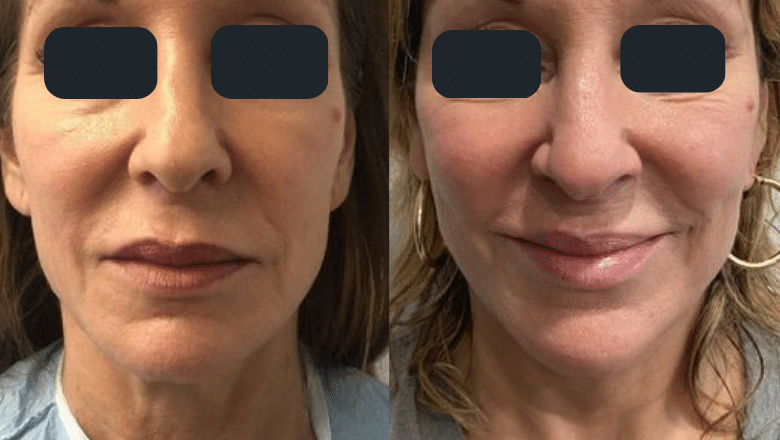
Mini Facelift vs Full Facelift Results
On the jawline, a well-performed mini facelift and a full facelift can look very similar in the first year. The real difference shows in the neck, and over time.
The clearest evidence comes from an identical-twin study published in Plastic and Reconstructive Surgery in 2016. Four sets of identical twins and one set of triplets had facelifts from the same surgeon, with the incision type assigned at random: one twin had a full incision and the other a short scar. Eight experienced plastic surgeons graded the photographs. At about one year there was no difference between the two techniques. At about five years, the full-incision faces scored significantly better in the neck, while the rest of the face remained comparable.[5]
A 1996 randomised split-face trial points the same way for the face itself. Patients had a less extensive SMAS lift on one side and a more extensive lift on the other, and independent surgeons could not tell the sides apart at six and twelve months.[6] A systematic review has since noted that good comparative studies of facelift techniques are scarce,[7] so these small studies are among the best evidence available.
In practice, that means a mini facelift can give an excellent jawline result for the right face, but if your neck is part of the problem, the full facelift is more likely to hold up there over the years.

How Long Does a Mini Facelift Last Compared With a Full Facelift?
A SMAS-based mini facelift typically lasts around 8 to 10 years, and a full SMAS or deep plane facelift 10 years or more. Neither stops ageing: you continue to age from your new starting point, at a pace set by your genes, sun exposure, smoking and weight.
You may see much shorter figures online, such as three to five years for a mini facelift. These usually describe skin-only “weekend” or “lunchtime” lifts, where the skin carries the tension and stretches back quickly. A mini lift that tightens the SMAS lasts considerably longer. The developers of the MACS lift report results as stable as more extensive facelifts,[2] although the twin study above suggests the neck is where a short-scar lift is most likely to relax first.[5] Our guide to how long a facelift lasts explains what affects longevity.
Mini Facelift vs Full Facelift Recovery
After either operation at Centre for Surgery, most patients go home the same day with a responsible adult who stays with them for 24 hours. The main differences are how long the swelling lasts and when you can be seen in public.
After a mini facelift:
- Swelling and bruising peak over days 1 to 3, then ease noticeably within the first week.
- Stitches are removed at about a week.
- Desk work from day 5 to 7 if you work from home, closer to two weeks for public-facing roles.
- Gentle walking from day 1 and light cardio from week 2.
After a full facelift:
- Swelling lasts longer, and you sleep with your head raised for two weeks.
- Desk work from about week 2, longer for physical or public-facing roles.
- Gentle cardio from week 3, weights and contact sport from week 6.
- After a deep plane facelift, cheek swelling can take up to three months to settle fully.
For both, numbness around the ears settles over three to six months and scars keep fading for 6 to 12 months. Our facelift recovery guide has the full week-by-week timeline.
Mini Facelift vs Full Facelift Scars
A mini facelift scar runs in the crease in front of the ear, around the earlobe and a short way behind it, with no scar in the hair behind the ear. A full facelift scar starts inside the temple hairline and continues behind the ear into the hairline at the back, which is what allows the neck to be lifted properly.
In both, the front incision can be placed just behind the small flap of cartilage in front of the ear, where it is hard to see once healed, and the hairline sections are angled so hair grows back through the scar. The deeper layer carries the lift, so the skin closes without tension, which is the single biggest factor in a fine, pale scar. Our guide to facelift scars shows how they mature.
Is a Mini Facelift Safer Than a Full Facelift?
A mini facelift is a shorter operation with less dissection, so there is less swelling and a smaller area at risk. Both are safe in the hands of a specialist plastic surgeon. A 2019 meta-analysis of 183 studies in Aesthetic Surgery Journal found that the risk of permanent facial nerve injury did not differ between SMAS techniques, while temporary nerve weakness was most common after the more extensive high lateral SMAS and composite lifts.[8]
In a database of 11,300 facelifts, 1.8% had a major complication needing a hospital visit, admission or further surgery. Haematoma, a collection of blood under the skin, was the most common at 1.1%, and the risk was higher in men and when the facelift was combined with other operations (up to 3.7%, against 1.5% for a facelift alone).[9] Our guide to facelift complications explains each risk. Stopping nicotine four weeks before and four weeks after surgery lowers the risk of poor healing after either operation.
What Are the Downsides of a Mini Facelift?
- Limited neck correction. It lifts the upper neck only, and loose skin or bands lower down are left untreated.
- Less effect on the mid face and deep folds than a full or deep plane facelift.
- A shorter-lasting result than a full facelift, especially in the neck, as the twin study found at five years.
- It may be the first of two operations. Some people have a mini facelift in their 40s and a full facelift later. That is a reasonable plan, but it means two recoveries.
- It still leaves a scar and still needs some time off. It is a smaller operation, not a non-surgical treatment.
Mini Facelift or Full Facelift: Which Do You Need?
A mini facelift usually suits you if:
- your main concern is early jowling and a softening jawline
- your neck skin is still reasonably firm, without obvious bands
- your skin is of normal thickness with reasonable elasticity
- you want a shorter recovery and accept a more modest, shorter-lasting change
A full facelift usually suits you if:
- your jowls are heavier and run into loose neck skin
- you have visible platysmal bands or a turkey neck
- your cheeks have dropped and your nasolabial folds have deepened
- your skin is thick or heavy, or you have had a previous facelift that has relaxed
The Neck Test
Look at your profile in a mirror with your chin level. If the angle between your jaw and neck is still clean, and only the jawline has softened, a mini facelift is likely to be enough. Now look down slightly: if loose skin gathers under your chin, or you can see vertical bands when you grimace, you will probably need a full facelift with a neck lift. If the problem is mainly fat under the chin rather than loose skin, chin and neck liposuction may be all you need. Your surgeon will confirm this at consultation.
What’s the Best Age for a Mini Facelift?
A mini facelift is most often done in the late 30s to 50s, once jowls have appeared but the neck is still good. A full facelift is more common from the 40s to the 70s. Age itself is less important than the pattern of change, your skin quality and your general health. In one study of 216 facelift patients, those aged 65 and over had major complication rates similar to younger patients (2.9% against 2.0%).[10] Our facelift age guide explains how to judge your timing.
Short Scar Facelift, MACS Lift and Weekend Facelift: Are They the Same as a Mini Facelift?
Largely, yes. “Short scar facelift”, “mini lift”, “S-lift” and “MACS lift” all describe lifts that use an incision mainly in front of the ear and work on the jowls and upper neck.[1] The MACS lift is a specific, well-described version with a vertical direction of lift.
“Weekend facelift” and “lunchtime facelift” are marketing names. Some describe a genuine SMAS mini facelift; others describe a skin-only tuck or even a thread lift, which lasts far less. If you are offered one, ask which layer is lifted, how long the incision is and how long the result should last. A one stitch facelift sits below the mini facelift: a single SMAS suture for very early mid-face drift, with around a week off work.
Alternatives to a Mini Facelift or Full Facelift
If you are not ready for surgery, or your changes are still mild, there are options that tighten skin or restore volume, though none lifts a fallen jowl back into place:
- FaceTite, radiofrequency under the skin, sits between non-surgical treatments and a mini facelift. Our FaceTite vs mini facelift guide compares them.
- Morpheus8 improves skin texture and mild laxity.
- Dermal filler or a liquid facelift supports the cheeks and jawline for months rather than years.
- Thread lifts are widely marketed, but a 2018 systematic review found at best very limited durability.[11]
Our guide to facelift alternatives without surgery explains what each can realistically achieve.
Frequently Asked Questions
Is a mini facelift worth it?
For the right face, yes: early jowls, a good neck and normal skin. It gives a genuine, natural lift with a quicker recovery. It is less worthwhile if your neck is already loose, because you may need a full facelift within a few years anyway.
Can I have a mini facelift now and a full facelift later?
Yes. Many people have a mini facelift when jowls first appear and a full facelift years later as the neck changes. Previous surgery makes the second operation a little more complex, so tell your surgeon about any earlier procedures. See our guide can I get a facelift twice?
How much does a mini facelift cost compared with a full facelift?
A mini facelift costs less than a full facelift because it is a shorter operation, and adding a neck lift or another procedure increases the price of either. Our facelift cost guide sets out current prices for each technique.
Can a mini facelift be combined with other procedures?
Yes. A mini facelift is often combined with a neck lift, eyelid surgery or facial fat transfer, so you have a single recovery. See whether you can have blepharoplasty and a mini facelift at the same time.
Is a mini facelift done under local anaesthetic?
At Centre for Surgery, a mini facelift is usually done with you fully asleep under intravenous anaesthesia. Local anaesthetic with sedation is an option for more limited cases, and your surgeon will discuss which suits you.
Will people be able to tell I’ve had a mini facelift?
Once the swelling has settled, a good mini facelift should look as though you are well rested rather than operated on. The scars sit in the natural creases around the ear, and because the deeper layer is lifted, the skin is not pulled tight.
Do men have mini facelifts?
Yes. The principles are the same, but the incisions are planned around the beard and sideburns. Men have a higher risk of bleeding after facelift surgery, which your surgeon will plan for. See our male facelift page.
What should I look for in before-and-after photos?
Look at the side view, where the jaw-neck angle shows most clearly, and check the photos were taken at least three months after surgery. Our facelift before and after photos include both mini and full facelift results.
Why Choose Centre for Surgery for a Mini Facelift or Facelift?
Every facelift at Centre for Surgery is performed by a GMC-registered plastic surgeon, at our CQC-regulated hospital at 95–97 Baker Street, which has been caring for patients for over 10 years. The surgeon who assesses you at consultation is the surgeon who performs your surgery. We offer both the mini facelift and the full facelift, along with the deep plane, endoscopic and one stitch techniques, so your surgeon will recommend the operation your face needs rather than steering you towards one option, and will tell you plainly if a mini facelift will not be enough or if you do not need surgery at all. We recommend a two-week cooling-off period before any surgery. We publish our clinical outcomes and patient safety data.
Finance is available through Chrysalis Finance, subject to status. See our finance options page for details.
Phone: 020 7993 4849 | Address: 95–97 Baker Street, Marylebone, London W1U 6RN
Contact us to schedule a consultation
References
- Tonnard P, Verpaele A, Monstrey S, et al. Minimal access cranial suspension lift: a modified S-lift. Plastic and Reconstructive Surgery 2002;109(6):2074–2086. doi:10.1097/00006534-200205000-00046
- Tonnard P, Verpaele A. The MACS-lift short scar rhytidectomy. Aesthetic Surgery Journal 2007;27(2):188–198. doi:10.1016/j.asj.2007.01.008
- Mitz V, Peyronie M. The superficial musculo-aponeurotic system (SMAS) in the parotid and cheek area. Plastic and Reconstructive Surgery 1976;58(1):80–88. doi:10.1097/00006534-197607000-00013
- Rohrich RJ, Pessa JE. The fat compartments of the face: anatomy and clinical implications for cosmetic surgery. Plastic and Reconstructive Surgery 2007;119(7):2219–2227. doi:10.1097/01.prs.0000265403.66886.54
- Antell DE, May JM, Bonnano MJ, Lee NY. A comparison of the full and short-scar face-lift incision techniques in multiple sets of identical twins. Plastic and Reconstructive Surgery 2016;137(6):1707–1714. doi:10.1097/PRS.0000000000002229
- Ivy EJ, Lorenc ZP, Aston SJ. Is there a difference? A prospective study comparing lateral and standard SMAS face lifts with extended SMAS and composite rhytidectomies. Plastic and Reconstructive Surgery 1996;98(7):1135–1143. doi:10.1097/00006534-199612000-00001
- Chang S, Pusic A, Rohrich RJ. A systematic review of comparison of efficacy and complication rates among face-lift techniques. Plastic and Reconstructive Surgery 2011;127(1):423–433. doi:10.1097/PRS.0b013e3181f95c08
- Jacono AA, Alemi AS, Russell JL. A meta-analysis of complication rates among different SMAS facelift techniques. Aesthetic Surgery Journal 2019;39(9):927–942. doi:10.1093/asj/sjz045
- Gupta V, Winocour J, Shi H, Shack RB, Grotting JC, Higdon KK. Preoperative risk factors and complication rates in facelift: analysis of 11,300 patients. Aesthetic Surgery Journal 2016;36(1):1–13. doi:10.1093/asj/sjv162
- Martén E, Langevin CJ, Kaswan S, Zins JE. The safety of rhytidectomy in the elderly. Plastic and Reconstructive Surgery 2011;127(6):2455–2463. doi:10.1097/PRS.0b013e3182131da9
- Gülbitti HA, Colebunders B, Pirayesh A, Bertossi D, van der Lei B. Thread-lift sutures: still in the lift? A systematic review of the literature. Plastic and Reconstructive Surgery 2018;141(3):341e–347e. doi:10.1097/PRS.0000000000004101



