


In this guide12 sections
- Key Points
- Can You Get a Facelift Without Surgery?
- What Causes the Changes a Facelift Treats?
- The Best Alternatives to a Facelift, by Problem
- Thread Lifts and HIFU: Alternatives Centre for Surgery Does Not Offer
- How Do Facelift Alternatives Compare?
- What Is the Best Non-Surgical Facelift for Jowls?
- When Is Surgery the Better Answer?
- Choosing Between a Facelift and Its Alternatives
- Frequently Asked Questions
- References
- Talk to a Surgeon About Facelift Alternatives
Key Points
- A facelift without surgery is possible for some problems but not others. Non-surgical treatments improve skin quality, lines, lost volume and mild laxity; they cannot remove loose skin that has started to hang.
- The face ages in layers: the skin thins, the fat pads shrink and slip, and the deeper tissues loosen. Fat in the face sits in separate compartments that change independently with age[1], which is why one treatment rarely fixes everything.
- For skin quality, the options are skin boosters such as Profhilo, polynucleotides and Fotona 4D laser. For lines, anti-wrinkle injections. For lost volume, dermal fillers. For early jowls and neck laxity, Morpheus8 or FaceTite.
- FaceTite is the strongest of the alternatives: a minimally invasive radiofrequency treatment under local anaesthetic. In one series, 85% of patients were satisfied with the tightening of the neck and jowls[3].
- Thread lifts and HIFU (including Ultherapy) are widely sold as facelift alternatives. Centre for Surgery does not offer either; a 2018 systematic review found thread lifts give at best a very limited, short-lived lift[5].
- When the skin hangs along the jaw or in the neck, a mini facelift under local anaesthetic, a deep plane facelift or a neck lift will do more than any non-surgical option, and often for less money over ten years.
People look for alternatives to a facelift for good reasons: they are not ready for surgery, they cannot take the time off, or their changes are early and surgery feels like too much. This guide is an honest comparison of what each facelift alternative can and cannot do, matched to the problem it treats. It covers dermal fillers, anti-wrinkle injections, Profhilo and polynucleotides, Morpheus8, FaceTite, Fotona 4D and Argo Plasma, and explains when a mini facelift or facelift is the better answer.
If you want to know how the clinic combines several treatments into a single plan, our guide to non-surgical facelift procedures in London covers that in detail. This article is about choosing: which alternative, if any, suits your face.
Can You Get a Facelift Without Surgery?
Yes and no. A surgical facelift lifts the deeper layer of the face (the SMAS, or superficial musculoaponeurotic system), repositions it and removes excess skin. No injection, laser or device can remove skin. What non-surgical treatments can do is improve the quality of the skin, replace lost volume, relax lines and tighten mild laxity by stimulating collagen. For many people in their 40s and early 50s that is enough. For someone whose jowls hang below the jawline, it usually is not.
The honest answer to “can you get a facelift without surgery?” is that you can get a fresher face without surgery, sometimes a firmer one, but not a lifted one in the surgical sense. Anyone promising a non-surgical facelift that matches surgery is overselling.
Can you get a facelift without being put under?
Yes. This is a different question, and a common one. Many people who say they want to avoid surgery really want to avoid being asleep. At Centre for Surgery, a mini facelift is usually a day case under local anaesthetic, with or without sedation, and FaceTite and Argo Plasma are performed the same way. You stay awake but comfortable, and a responsible adult needs to stay with you for 24 hours if you have sedation.
What Causes the Changes a Facelift Treats?
Facial ageing is not one process. Matching the treatment to the cause is the single most useful thing you can do before spending money:
- Skin quality. The skin becomes thinner, drier and less elastic, with fine lines, uneven tone and enlarged pores. Sun exposure and smoking speed this up.
- Dynamic lines. Repeated muscle movement creates frown lines, forehead lines and crow’s feet.
- Volume loss. In a cadaver study published in Plastic and Reconstructive Surgery in 2007 ↗[1], the fat of the face was shown to sit in separate compartments that age independently. As the cheek compartments shrink and descend, the cheeks flatten, the nasolabial folds deepen and the jowl fat becomes more visible.
- Laxity. The skin and the deeper supporting tissues loosen. Early on this shows as a softer jawline; later as jowls, a heavy lower face and loose neck skin.
Most faces have some of all four. The aim of a good assessment is to work out which one is doing most of the damage. Our guide to sagging jowls goes into the jawline in more detail.

The Best Alternatives to a Facelift, by Problem
The sections below take each concern in turn. At Centre for Surgery, all injectable treatments (fillers, anti-wrinkle injections, Profhilo and polynucleotides) are given by surgeons.
For lines and wrinkles: anti-wrinkle injections
Anti-wrinkle injections (botulinum toxin) relax the muscles that crease the forehead, the frown area and the skin around the eyes. They soften lines within one to two weeks and last around three to four months. Small doses into the muscles of the jaw and neck can give a slight lift to the jawline and soften neck bands, but the effect on sagging is modest.
What they can do: smooth dynamic lines, soften a frown that makes you look tired or cross, and slightly raise the outer brow.
What they cannot do: replace lost volume, tighten skin or lift jowls.
For lost volume: dermal fillers and the liquid facelift
Hyaluronic acid dermal fillers restore support where fat has been lost: the cheeks, temples, chin and jawline. Placing filler over the cheekbone and along the jaw can make jowls less obvious by improving the structure around them. When several areas are treated in one plan, it is often called a liquid facelift (8-point lift). Results last roughly 9 to 18 months depending on the product and area, and hyaluronic acid filler can be dissolved if needed.
What fillers can do: restore cheek volume, sharpen the jawline and chin, soften folds and hollows.
What they cannot do: lift heavy jowls or tighten loose neck skin. Overfilling a sagging face to compensate for laxity makes it look heavy and unnatural, which is one of the commonest reasons people come to see a surgeon afterwards. Our article on dermal fillers vs facelift surgery explains where that line falls.
For skin quality: Profhilo, skin boosters and polynucleotides
Profhilo is a very fluid hyaluronic acid injected at a few points on each side of the face. It spreads under the skin and improves hydration and firmness rather than adding shape. It is usually given as two sessions about a month apart, then maintained. Other skin booster injectables work in a similar way.
Polynucleotides are purified DNA fragments injected into the skin to support repair and improve texture, particularly around the eyes and neck. The evidence is still early. A small randomised split-face study in the Journal of Cosmetic Dermatology found improvements in skin texture and wrinkles on the treated side compared with saline[7], but it involved 20 women, and the authors themselves called it exploratory.
What skin boosters can do: make the skin look better hydrated, smoother and slightly firmer.
What they cannot do: lift, contour or replace volume. Our guide to Profhilo vs dermal fillers compares the two directly.
For texture and early laxity: Fotona 4D laser facelift
The Fotona 4D laser facelift uses the Fotona SP Dynamis Pro to combine four laser steps in one 60 to 90 minute session, one of them from inside the mouth to heat and tighten the tissues of the cheeks and lower face. It suits early sagging, fine lines and dull skin, with little or no downtime, and is usually given as a short course.
What it can do: firm and smooth the skin and give a subtle tightening of the lower face.
What it cannot do: lift established jowls. Results are gradual and usually modest.
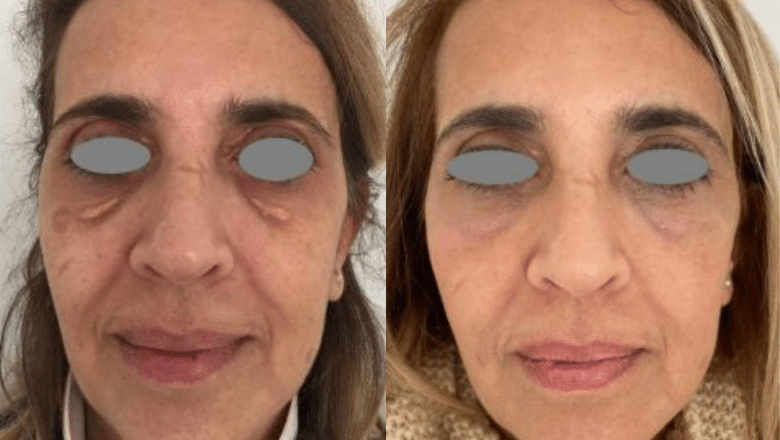
Before and after a course of Fotona 4D laser. Results are gradual and vary between individuals.
For mild jowls, jawline and texture: Morpheus8
Morpheus8 is radiofrequency microneedling: fine needles deliver heat into the deeper layers of the skin to trigger new collagen. It treats skin quality, acne scarring and mild laxity along the jawline and neck. Most people need a course of three sessions, with a day or two of redness and swelling after each, and the result builds over several months. In a randomised split-face trial in the Journal of Cosmetic and Laser Therapy, deep microneedle radiofrequency improved the nasolabial folds significantly more than superficial treatment, with the benefit still present at one year[2].
What it can do: tighten and thicken the skin, refine texture and soften early jowls.
What it cannot do: lift heavy jowls or remove loose skin. Our comparison of Fotona 4D vs Morpheus8 helps if you are choosing between the two.
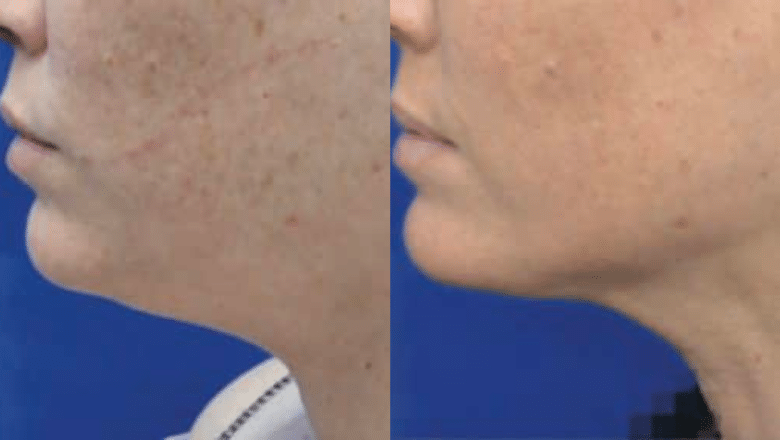
Before and after Morpheus8 to the lower face and jawline. Results vary between individuals.
For mild to moderate jowls and neck: FaceTite
FaceTite sits between non-surgical treatment and surgery. A fine radiofrequency probe passes under the skin through 2 to 3 mm entry points under the chin and behind the earlobes, while an electrode on the surface tracks it. The tissue in between is heated so it contracts, and small amounts of fat can be removed at the same time. It is done under local anaesthetic with an oral sedative, and most people are back at a desk in three to five days.
The evidence is mainly case series rather than randomised trials. In a 2016 series of 55 patients in Plastic and Reconstructive Surgery Global Open ↗[3], 85% were satisfied with the contour and skin tightening of the neck and jowls at six months, and independent surgeons rated the improvement good to excellent in 52 of 55 cases. A 2025 systematic review of radiofrequency-assisted liposuction in the face and neck, covering 1,181 cases, found an overall complication rate of about 5%, including temporary weakness of the lower lip nerve in under 1%[4].
What it can do: tighten mild to moderate laxity along the jawline and neck and define the angle under the chin.
What it cannot do: match a facelift where skin hangs in folds. Our guides to how long FaceTite lasts and Morpheus8 or FaceTite cover it in more depth.
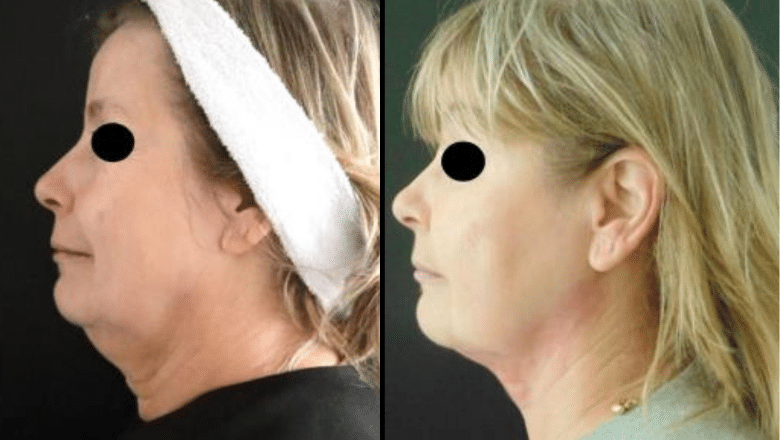
Before and after FaceTite to the jawline and neck. Results vary between individuals.
For loose neck skin after liposuction: Argo Plasma
Argo Plasma is another minimally invasive treatment that tightens from beneath, using argon plasma energy delivered through a probe placed under the skin through small incisions. It is used mainly on the body, but can treat mild looseness of the neck, often straight after neck liposuction. It is performed by a surgeon under local anaesthetic, sedation or TIVA (total intravenous anaesthesia). Like FaceTite, it suits mild to moderate laxity, not skin that hangs.
Thread Lifts and HIFU: Alternatives Centre for Surgery Does Not Offer
You will see thread lifts and HIFU (high-intensity focused ultrasound, including the Ultherapy brand) advertised as the best facelift alternatives. Centre for Surgery does not offer either, and it is worth knowing what the evidence says before booking them elsewhere.
Thread lifts place dissolvable barbed threads under the skin that are pulled up to lift sagging tissue. The change is visible straight away, but a 2018 systematic review in Plastic and Reconstructive Surgery ↗[5] found that almost all published studies showed at best a very limited duration of lift, and the only two positive studies were sponsored by thread manufacturers. Threads can also become visible, cause dimpling or migrate. Our article on thread lift vs FaceTite vs facelift compares the options.
HIFU and Ultherapy deliver focused ultrasound through the skin to heat the deeper layers, with no incisions. A 2023 systematic review of 16 studies ↗[6] found it does tighten mildly to moderately lax skin, with brow lifts of around 0.5 to 1.7 mm, but patients themselves rated the improvement as mild, and results declined as laxity and body mass index increased. Our comparison of Morpheus8 vs Ultherapy explains why the clinic prefers radiofrequency.
How Do Facelift Alternatives Compare?
- Anti-wrinkle injections: lines; no downtime; around 3–4 months.
- Dermal fillers / liquid facelift: volume and contour; minimal downtime, possible bruising; around 9–18 months.
- Profhilo and polynucleotides: skin quality; small bumps for a day; maintenance treatments needed.
- Fotona 4D: texture and early laxity; little or no downtime; course of sessions, then maintenance.
- Morpheus8: texture, scarring, mild laxity; a day or two of redness per session; course of three.
- FaceTite / Argo Plasma: mild to moderate laxity of the jaw and neck; local anaesthetic; three to five days off work.
- Mini facelift: established jowls; local anaesthetic, with or without sedation; around one to two weeks of social downtime.
Prices for every non-surgical treatment are on our skin and aesthetics price list, and surgical prices are in our facelift cost guide. Finance is available, subject to status: see our finance options.
What Is the Best Non-Surgical Facelift for Jowls?
For early jowls, where the jawline has softened but the skin does not hang, Morpheus8 or FaceTite are the most effective options the clinic offers, sometimes with filler along the jaw or over the cheekbone to improve support. FaceTite gives the larger change, at the cost of a few days of swelling. For jowls that sit clearly below the jawline, no non-surgical treatment will give a satisfying result; a mini facelift is usually the better choice. Our guide to the best non-surgical treatments for jowls goes through each option.
What is the best non-surgical facelift for over 60?
After 60, most people have some genuine skin excess, so the non-surgical options work best as a way to improve skin quality and support rather than as a lift. Skin boosters, Fotona 4D and carefully placed filler can make a real difference to how fresh the face looks. If the main complaint is jowls or the neck, a surgical lift is usually more effective and more economical over time. Age alone is not a barrier to surgery; our article on the best age for a facelift explains why.
What about the neck?
The neck is where non-surgical treatment is most limited. Fat under the chin and early skin laxity respond to FaceTite, Morpheus8 or Argo Plasma. Vertical bands (platysmal bands) can be softened with anti-wrinkle injections. Loose skin that hangs or folds, the so-called turkey neck, needs a neck lift. Our guide to the non-surgical neck lift covers the options for the neck alone.
When Is Surgery the Better Answer?
Surgery becomes the better choice when the main problem is excess skin and descended deeper tissue rather than skin quality or volume. Signs that you have reached that point include jowls that hang below the jawline, a lost angle between the jaw and the neck, loose skin or folds in the neck, and having already tried fillers or energy treatments with little lasting effect. Repeated non-surgical treatment for these problems can end up costing more than surgery over a few years, without ever giving the same result.
The main surgical options at Centre for Surgery are:
- Mini facelift: a short-scar lift of the lower face for early to moderate jowls, lifting the SMAS through an incision in front of the ear. It is usually a day case under local anaesthetic, with or without sedation.
- One-stitch facelift: a smaller procedure under local anaesthetic for selected patients with mild laxity who want a minimal scar.
- Deep plane facelift: releases and lifts the deeper tissues of the mid and lower face as a single unit, for moderate to advanced ageing. It is performed under TIVA (total intravenous anaesthesia).
- Neck lift: tightens the neck muscle and removes excess skin, alone or with a facelift.
Our guides to the types of facelift and facelift vs mini facelift explain the differences in more detail, and common facelift myths deals with worries about looking pulled or unnatural.
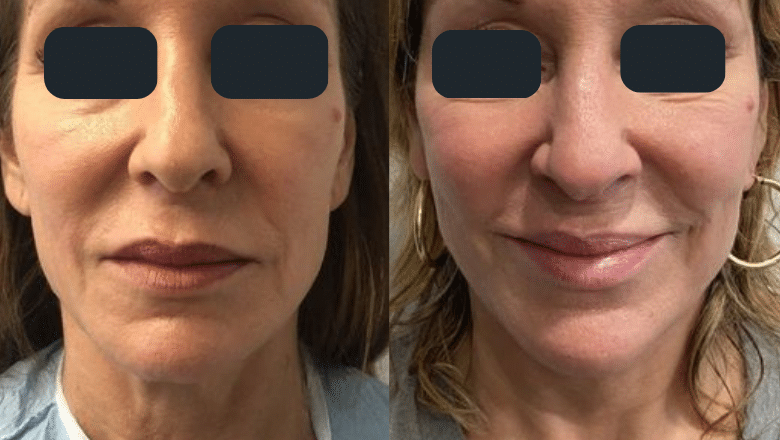
Before and after a mini facelift. Results vary between individuals.
Choosing Between a Facelift and Its Alternatives
A few practical questions help:
- Pinch test. If you can lift the skin of your jaw and neck and it stays loose rather than springing back, surgery is likely to give the better result.
- Hand test. Gently lift the skin in front of your ears with your fingertips. If that is the change you want, you are describing a lift, which needs surgery. If you mainly want smoother, brighter or fuller skin, non-surgical treatment fits.
- Time and downtime. Injectables need almost none; Morpheus8 a day or two per session; FaceTite three to five days; a mini facelift around one to two weeks before you feel comfortable being seen.
- Maintenance. Non-surgical results need topping up, from every few months for anti-wrinkle injections to yearly for skin boosters and energy treatments. A facelift result lasts years, although the face keeps ageing.
At a consultation, a surgeon examines your skin, fat and laxity and tells you honestly which group you fall into. Further consultations before any surgery are free, and we recommend a two-week cooling-off period before committing to a surgical procedure.
Frequently Asked Questions
What is a non-surgical facelift in the UK?
It is a marketing term rather than a single treatment. Clinics use it for a combination of injectables, skin boosters, lasers or radiofrequency devices that refresh the face without incisions. None of them lifts the deep tissues or removes skin as a surgical facelift does.
Can you naturally get a facelift?
No. Facial exercises, massage, rollers and creams cannot lift sagging tissue in any lasting way. Sun protection, not smoking, a stable weight and a retinoid-based skincare routine all slow skin ageing and are worth doing, but they will not reverse jowls.
What procedure makes you look 10 years younger?
There is no single answer, and anyone promising a number of years is guessing. For people with established sagging, a well-performed facelift and neck lift makes the biggest difference. For earlier changes, a combination of filler, anti-wrinkle injections and skin treatment often gives a fresher, rested look rather than a younger one.
Can old saggy skin be firmed up?
Mildly loose skin can be firmed with radiofrequency treatments such as Morpheus8 and FaceTite, which stimulate new collagen. Skin that hangs in folds cannot be tightened enough by any device and needs to be removed surgically.
What tightens face skin the most?
Among the minimally invasive options, FaceTite, which delivers radiofrequency beneath the skin, generally tightens more than treatments applied through the surface. Surgery tightens the most, as it removes skin and repositions the deeper layers.
How long do facelift alternatives last?
Anti-wrinkle injections last around three to four months, hyaluronic acid fillers roughly 9 to 18 months, and skin boosters several months after a course. Results from Morpheus8, Fotona 4D and FaceTite build over months and can last a year or more, with maintenance. The face continues to age throughout.
Are facelift alternatives safe?
In trained hands, serious complications are uncommon, but every treatment carries risk: bruising and, rarely, blocked blood vessels with fillers; burns or nerve irritation with energy devices. The NHS advice on cosmetic procedures ↗ recommends checking who will treat you and their qualifications. At Centre for Surgery, injectables are given only by surgeons.
References
- Rohrich RJ, Pessa JE. The fat compartments of the face: anatomy and clinical implications for cosmetic surgery. Plast Reconstr Surg 2007;119(7):2219-2227. doi:10.1097/01.prs.0000265403.66886.54 ↗
- Lu W, Wu P, Zhang Z, et al. Curative effects of microneedle fractional radiofrequency system on skin laxity in Asian patients: a prospective, double-blind, randomized, controlled face-split study. J Cosmet Laser Ther 2017;19(2):83-88. doi:10.1080/14764172.2016.1256485 ↗
- Keramidas E, Rodopoulou S. Radiofrequency-assisted liposuction for neck and lower face adipodermal remodeling and contouring. Plast Reconstr Surg Glob Open 2016;4(8):e850. doi:10.1097/GOX.0000000000000809 ↗
- Guo X, Yan M, Zhao M, et al. Temporary orbicular oculi palsy after radio-frequency assisted liposuction (RFAL) combined with transconjunctival lower blepharoplasty: case report and systematic review of complication. Aesthetic Plast Surg 2025;49(13):3605-3617. doi:10.1007/s00266-025-04901-0 ↗
- Gülbitti HA, Colebunders B, Pirayesh A, et al. Thread-lift sutures: still in the lift? A systematic review of the literature. Plast Reconstr Surg 2018;141(3):341e-347e. doi:10.1097/PRS.0000000000004101 ↗
- Contini M, Hollander MHJ, Vissink A, et al. A systematic review of the efficacy of microfocused ultrasound for facial skin tightening. Int J Environ Res Public Health 2023;20(2):1522. doi:10.3390/ijerph20021522 ↗
- Araco A, Araco F, Raichi M. Clinical efficacy and safety of polynucleotides highly purified technology (PN-HPT) and cross-linked hyaluronic acid for moderate to severe nasolabial folds: a prospective, randomized, exploratory study. J Cosmet Dermatol 2023;22(1):146-155. doi:10.1111/jocd.15064 ↗
Related Articles
- Thread Lift vs FaceTite vs Facelift – Which Is Best For You?
- How Long Does FaceTite Last?
- Facelift for Acne Scars
- Asymmetrical Lips — Causes, Symptoms and Treatments
- Can Botched Chin Liposuction be Corrected?
Talk to a Surgeon About Facelift Alternatives
If you are weighing up a facelift against non-surgical treatment, you can book a consultation at our Baker Street clinic by calling 020 7993 4849 or using the form below. You will see a surgeon, who will tell you honestly whether an injectable, an energy-based treatment or surgery suits your face.







