


In this guide14 sections
- Key Points
- Can You Have a Facelift If You Have Had Fillers?
- How Do Fillers Affect Facelift Planning?
- When Should Fillers Be Dissolved Before a Facelift?
- When Don’t Fillers Need to Be Dissolved Before Surgery?
- How Long Does Filler Last, and Can It Still Be There After Years?
- How Is Filler Dissolved With Hyaluronidase?
- How Long After Dissolving Fillers Can You Have a Facelift?
- Will I Look Older After Filler Is Dissolved?
- Fillers vs Facelift: Which Problems Does Each One Treat?
- Can You Have Fillers After a Facelift?
- Frequently Asked Questions
- Planning a Facelift After Fillers in London
- References
Key Points
- Do fillers need to be dissolved before a facelift? Not always. It depends on the type of filler, where it sits, how long ago it was placed and whether it distorts the tissue the surgeon needs to assess.
- You can usually still have a facelift if you have had fillers. In a 2025 chart review of 212 deep plane facelift patients, complications were not significantly more common in those with prior injectables (16% versus 8%)[1].
- Only hyaluronic acid (HA) filler can be dissolved with the enzyme hyaluronidase. Other fillers need different management.
- HA filler can outlast its expected lifespan. Case reports describe filler still present on imaging or at surgery years after injection, which is why a full filler history matters[6][7].
- Timing is a clinical decision. There is no fixed interval between dissolving filler and surgery that applies to everyone.
- After a facelift, many patients need less filler, and any top-up is usually left until the surgical result has settled.
A facelift corrects the structural changes of facial ageing, such as loose skin, jowls and deeper folds, which fillers cannot lift. Many people considering surgery have already had dermal fillers for years, so the question comes up early: do fillers need to be dissolved before a facelift?
The honest answer is that it depends. Some fillers should be dissolved first, many can simply be left, and a small number cannot be dissolved at all. This guide explains how to tell which applies to you, what the evidence says about surgery after filler, how filler dissolving works, and how fillers and a facelift fit together. If you are still deciding between the two approaches, our comparison of dermal fillers vs facelift surgery covers that choice.
Can You Have a Facelift If You Have Had Fillers?
Yes, in most cases. Having had filler does not rule out a facelift, and it is very common for facelift patients to have had injectable treatments beforehand. In the 2025 retrospective chart review of deep plane facelift patients, 57% had received injectables before surgery. Complications occurred in 16% of those with prior injectables and 8% of those without, a difference that was not statistically significant. It was a single-centre retrospective study, so it cannot prove that prior filler is risk-free[1].
A smaller 2026 pilot study of 20 facelift patients reached a similar conclusion. All had previously had anti-wrinkle injections, 90% had HA filler and 55% had a biostimulator filler, and no significant surgical complications were attributed to the earlier treatments. The authors stressed that the sample was too small to judge safety definitively[2].
The practical point is that the surgeon needs to know exactly what you have had, where and when. That information shapes the plan far more than the simple fact that you have had filler.
How Do Fillers Affect Facelift Planning?
A surgeon plans a facelift around your underlying anatomy: how much skin to remove, how to reposition the deeper supporting layer (the SMAS), and where fat has been lost or has descended. Filler placed in the cheeks, jawline, nasolabial folds or mid-face can alter how that anatomy looks and feels, so planning may be based on a shape that is partly artificial.
Three things matter most:
- Volume. Repeated rounds of cheek or jawline filler can leave more volume than is needed once the tissues are lifted, which can look heavy.
- Position. Filler can move from where it was placed, producing lumps, asymmetry or fullness in unintended areas that may become more noticeable once the skin is tightened.
- Type. HA filler can be reversed with an enzyme. Calcium hydroxylapatite, poly-L-lactic acid and permanent fillers behave differently and may persist or be difficult to remove.
The type of facelift also matters. A mid facelift works on the cheek, where cheek filler is most often found, while a lower facelift addresses the jowls and jawline. Our guide to deep plane vs SMAS facelift explains how the techniques differ in the layers they reach.
When Should Fillers Be Dissolved Before a Facelift?

Dissolving HA filler before surgery is worth considering in these situations:
- Over-correction. If repeated cheek or mid-face treatment has left more volume than the surgeon should plan around, removing the excess gives a clearer view of the support structures.
- Migrated or lumpy filler. Contour irregularities, lumps and malar swelling are recognised filler-related problems. A 2018 case series of 23 patients with periocular filler issues found that hyaluronidase dissolved the filler in one session in 15 patients and two sessions in eight, before they went on to have lower eyelid surgery[4]. The authors concluded that filler-related issues should be recognised and managed before further intervention.
- Persistent swelling around the eyes. A 2024 review describes delayed puffiness of the eyelids and cheeks weeks to years after HA injection, with hyaluronidase used for removal and surgery considered afterwards if needed[9].
- Uncertainty about what is there. If your records are incomplete and the area feels firm or irregular, dissolving a small amount can clarify what is filler and what is your own tissue.
- Personal preference. Some patients decide after years of injectables that they would rather the surgical result reflects their own structure.
The decision is made at consultation from examination, your filler history and the surgical plan, not from a rule that applies to everyone.
When Don’t Fillers Need to Be Dissolved Before Surgery?
Not every patient with previous filler needs it removed.
- Small amounts that are not distorting anything. Subtle lip enhancement or light tear trough work, for example, often does not interfere with a facelift.
- Filler that has clearly gone. If the treatment was long ago and the tissue looks and feels normal on examination, there may be nothing to dissolve.
- Filler that will not affect the operative field. The surgeon decides whether the area treated is one that surgery will reach.
In some patients, targeted filler is added after the surgical result has settled to refine small areas such as fine perioral lines. That is a separate decision, covered below.
How Long Does Filler Last, and Can It Still Be There After Years?
How long a filler lasts depends on the product, the area and the individual, so any single number is a rough guide. HA fillers are designed to break down gradually, but they do not always behave to schedule. Ultrasound is increasingly used to identify previous filler and to guide dissolving, and a 2023 review describes its role in detecting product migration and in hyaluronidase-guided removal[5].
The case literature shows why history alone can mislead:
- A 2026 case report described a woman with HA still dispersed through the fat of the chin two years after augmentation. Ultrasound had shown only a small deposit, but MRI revealed much more, and a targeted hyaluronidase injection relieved her symptoms[6].
- Another 2026 report described a 51-year-old woman with long-standing upper eyelid swelling whose tissue sample showed HA deposits, linked to temple filler injected two years earlier that she had not mentioned until after surgery[7].
These are single case reports and not a measure of how often it happens. They do show why surgeons ask detailed questions about every injectable treatment, including ones that feel long ago. If you have had many treatments, or cannot recall the product, an ultrasound can help the team decide whether anything needs dissolving.
How Is Filler Dissolved With Hyaluronidase?

Hyaluronidase is an enzyme that breaks down hyaluronic acid. Small amounts are injected into the treated areas during a short clinic appointment, and swelling or redness can follow for a day or two. UK-authored guidance on its safe use sets out the indications and the risk of allergic reaction, which is uncommon but taken seriously, particularly in people with a history of allergy to bee or wasp stings[3]. Some areas need more than one session, as the 2018 series above showed[4]. Our filler dissolving service page explains what a treatment involves.
Can non-HA fillers be dissolved?
No. Hyaluronidase only acts on hyaluronic acid. Calcium hydroxylapatite, poly-L-lactic acid and permanent fillers such as polyacrylamide hydrogel or PMMA need different management, which can range from waiting for the body to break the product down to surgical removal. A 2025 case report describes a woman whose lower eyelid swelling did not respond to repeated hyaluronidase because the cause was polyacrylamide hydrogel injected a decade earlier. Surgery was needed to remove it[8]. This is why recording the filler brand and type at every treatment is so useful.
Permanent filler is a particular challenge. In a 2026 study of 151 patients who had permanent filler removed during a deep plane facelift, followed by reconstruction with a buccal fat pad flap, 80.7% rated their outcome very good or excellent, but contour irregularities occurred in 10.6%, and results were better after primary than revision surgery[10]. That is a specialised situation and one to raise openly at consultation.
How Long After Dissolving Fillers Can You Have a Facelift?
There is no universal interval. Surgeons generally allow enough time for the swelling from dissolving to settle and for the tissues to return to their natural contour, so that the plan is based on how your face really looks rather than a temporary post-treatment state. Many clinics allow a few weeks, but the right gap depends on the amount dissolved, the area and your own healing, and it is set by the surgical team after reviewing you. If an inflammatory reaction was involved, the team may take a more cautious approach. Delayed filler reactions are uncommon but recognised, and a 2022 case series noted that they are managed case by case, with some settling on antibiotics alone without dissolving the filler[11].
Our guides to how to prepare for facelift surgery and what to expect from a facelift cover the rest of the run-up to the operation.
Will I Look Older After Filler Is Dissolved?
Some patients worry about looking older while they wait for surgery. You may look flatter or less full in the treated area for a period, which is the face as it would look without filler. For most people this is a short stage, and it is useful for planning because the surgeon can see where laxity is greatest and where volume has genuinely been lost.
If an important event falls in the gap, say so at consultation. The sequence can often be planned around it, and sometimes a smaller dissolve is enough.
Fillers vs Facelift: Which Problems Does Each One Treat?
Fillers and facelifts address different problems, and understanding the distinction helps with both decisions.
Fillers add volume. They can soften lines, restore lost volume and refine features, which makes them most useful when volume loss is the main change.
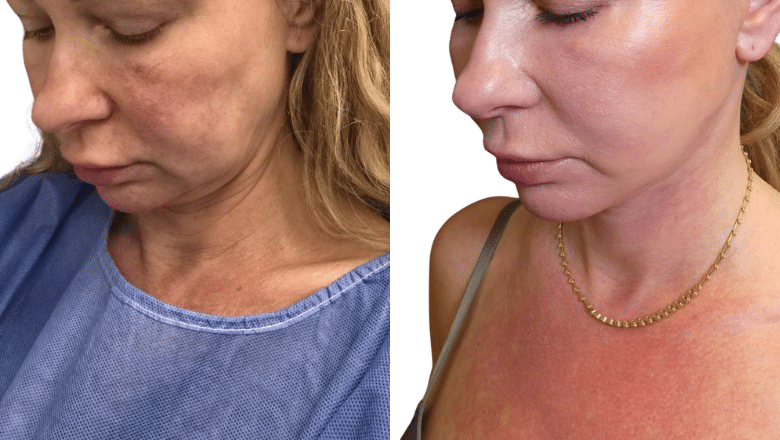
A facelift repositions and tightens the deeper supporting layer of the face and removes excess skin. It treats laxity and descent, which filler cannot correct. When filler is used to try to lift sagging tissue, the face can look heavy or overfilled rather than refreshed. A well-planned facelift can restore a sharper jawline, a smoother neck line and better mid-face support, and where the neck is the main concern, a procedure such as a trampoline neck lift may be discussed alongside it. Our page of facelift before and after photos shows the kind of change surgery produces, and our guide to facelift alternatives that don’t require surgery covers what non-surgical options can and cannot do. For a side-on view, filler placed in the chin is sometimes compared with a profiloplasty.
Can You Have Fillers After a Facelift?
Yes, and many people do. In the 2026 pilot study, all patients resumed anti-wrinkle injections after surgery and 60% had filler within the first postoperative year[2]. The usual approach is to wait until swelling has settled and the surgical result is clear, then decide whether any small areas such as the tear troughs or fine perioral lines need refining. As the facelift has addressed the underlying laxity, many patients find they need less than before, though this varies. Our guides to how to maintain your facelift results and facelift complications explain what to expect and how problems are managed, and four things worth knowing before a facelift adds a patient’s perspective.
Frequently Asked Questions
Do all fillers need to be dissolved before facelift surgery?
No. Only filler that distorts the tissue, adds excess volume or makes it hard to assess your natural anatomy is usually considered for dissolving. Small, stable amounts often do not need to be touched.
Can you get a facelift if you have had fillers?
Usually yes. A 2025 chart review found no statistically significant increase in complications among deep plane facelift patients with prior injectables. The surgeon needs a full history of what was used and where, and may suggest ultrasound or dissolving in selected cases.
How long after dissolving fillers can I have a facelift?
There is no single interval. Surgeons allow time for swelling to settle and the contour to return, which is often a few weeks, but the gap is set individually after review.
How long does filler last?
It varies with the product, the area treated and the individual. HA fillers are designed to be gradually absorbed, but case reports show some can still be detectable years later, so it is worth declaring all previous treatment.
Can non-HA fillers be dissolved?
No. Hyaluronidase only dissolves hyaluronic acid. Calcium hydroxylapatite, poly-L-lactic acid and permanent fillers need other management, which may mean waiting or, for some permanent products, surgical removal.
What happens if fillers aren’t dissolved when they should be?
The result can look less natural, with fullness, lumps or asymmetry that becomes more obvious once the skin is tightened. Raising your filler history at consultation helps avoid this.
Will dissolving fillers make me look worse before surgery?
You may look flatter or less full in the treated area for a while. This usually settles, and it helps the surgeon plan from your natural anatomy.
Can I have fillers again after my facelift?
Yes, though usually once the surgical result has settled and often in smaller amounts, as the lift treats laxity that filler was previously used to mask.
Can fillers replace a facelift?
Fillers can soften lines and restore volume, but they cannot remove excess skin or lift descended tissue. Used to treat sagging, they can look overfilled. Which approach suits you depends on whether volume loss or laxity is the main change.
Do fillers make you look older over time?
Not necessarily, but repeated or heavy filler in the lower face can make it look fuller or heavier, and migrated product can cause lumps. A review of your treatment history helps decide whether any should be reduced.
Planning a Facelift After Fillers in London
Centre for Surgery is a CQC-regulated private hospital at 95–97 Baker Street, London W1U 6RN. Facelift assessment, filler dissolving and any later injectable refinement are available in one place, so the same team can plan your whole pathway. To arrange a consultation, call 020 7993 4849 or email contact@centreforsurgery.com.
References
- Salsberg J, Motakis D. Does prior treatment with facial injectables increase the risk of rhytidectomy complications? Dermatologic Surgery 2025;52(6):568–570. doi:10.1097/DSS.0000000000004970 ↗
- Myers B, Firsowicz M, Kamrani P, Dayan S, Fabi S. Injectables and facelifts: can we coexist? A retrospective chart review assessing injectable treatments preceding and following rhytidectomy. Journal of Cosmetic Dermatology 2026;25(2):e70690. doi:10.1111/jocd.70690 ↗
- Murray G, Convery C, Walker L, Davies E. Guideline for the safe use of hyaluronidase in aesthetic medicine, including modified high-dose protocol. Journal of Clinical and Aesthetic Dermatology 2021;14(8):E69–E75. PubMed 34840662 ↗
- Zoumalan CI. Managing periocular filler-related syndrome prior to lower blepharoplasty. Aesthetic Plastic Surgery 2019;43(1):115–122. doi:10.1007/s00266-018-1250-7 ↗
- Beiu C, Popa LG, Bălăceanu-Gurău B, et al. Personalization of minimally-invasive aesthetic procedures with the use of ultrasound compared to alternative imaging modalities. Diagnostics 2023;13(23):3512. doi:10.3390/diagnostics13233512 ↗
- Mariluis CA, Lagonegro D, Cavallieri F, Barrera P. Where is the filler? Magnetic resonance imaging reveals hidden hyaluronic acid in a delayed chin complication. Plastic and Reconstructive Surgery Global Open 2026;14(1):e7412. doi:10.1097/GOX.0000000000007412 ↗
- El Feghaly C, Tawa P. Late-onset upper eyelid edema following temporal hollow correction with hyaluronic acid. Plastic and Reconstructive Surgery Global Open 2026;14(4):e7612. doi:10.1097/GOX.0000000000007612 ↗
- Zhang W, Pan Y. Iatrogenic migration from multiple filler injections for tear trough: a case report. International Journal of Surgery Case Reports 2025;136:111941. doi:10.1016/j.ijscr.2025.111941 ↗
- Eshraghi B, Babaei L, Aghajani M, Aghajani A. Late-onset periorbital edema in patients with a history of facial hyaluronic acid injection: a review on diagnosis and management. Journal of Plastic, Reconstructive & Aesthetic Surgery 2024;99:271–279. doi:10.1016/j.bjps.2024.09.061 ↗
- Ghoraba S, Ismail M. The outcome of the reconstructive procedure using buccal pad of fat flap and deep plane facelift after permanent filler removal. Aesthetic Plastic Surgery 2026;50(10):3700–3709. doi:10.1007/s00266-026-05836-w ↗
- Imen MT. Delayed infectious reactions of dermal filler injections in the face: causes and management. Journal of Stomatology, Oral and Maxillofacial Surgery 2023;124(2):101334. doi:10.1016/j.jormas.2022.11.010 ↗







