


In this guide16 sections
- Key Points
- Can You Tighten Loose Stomach Skin?
- What Causes Loose Skin on the Stomach?
- Is It Loose Skin, Fat or Muscle?
- How Severe Is Your Loose Stomach Skin?
- How to Tighten Your Stomach Skin Naturally
- Non-Surgical Stomach Skin Tightening: What Works?
- When Do You Need Surgery for Loose Stomach Skin?
- Rashes, Chafing and Hygiene: When Loose Skin Is More Than Cosmetic
- Loose Skin After GLP-1 Weight Loss: When to Treat It
- Recovery: Non-Surgical Treatment vs Tummy Tuck
- Loose Skin Around the Belly Button
- How Much Does Stomach Skin Tightening Cost?
- Frequently Asked Questions
- References
- Talk to a Surgeon About Loose Stomach Skin
Key Points
- Loose stomach skin is usually caused by pregnancy, weight loss (including weight loss on GLP-1 medicines) or ageing, which stretch the skin or reduce its collagen and elastin faster than it can recover.
- Exercise, diet and creams cannot shrink skin that has been stretched. Ab exercises strengthen the muscle underneath but, in a randomised trial, did not reduce fat over the abdomen[1].
- Non-surgical and minimally invasive stomach skin tightening (Morpheus8, BodyTite, Argo Plasma) suits mild to moderate laxity. Studies show measurable but modest tightening, roughly 8% vertical skin contraction on average after BodyTite[3].
- Skin that folds or hangs needs to be removed surgically: a mini tummy tuck below the belly button, a full or extended tummy tuck for skin above and below it, and an apronectomy for a hanging apron.
- Large folds of loose skin can cause rashes, soreness and chafing in the fold (intertrigo), and these symptoms become more common as the overhang increases[4].
- After major weight loss, wait until your weight has been stable for at least 6 months, ideally 12, before surgery. People losing weight on GLP-1 medicines often have body contouring sooner, and with less consistent timing, than people after bariatric surgery[7].
Stomach skin tightening covers everything from a course of radiofrequency treatment for slightly crepey skin to a tummy tuck for an overhang that rubs and gets sore. Which one makes sense depends on how much loose skin you have, where it sits, and whether fat or separated stomach muscles are part of the picture. This guide explains what causes loose stomach skin, how to tell how severe yours is, what you can realistically expect from non-surgical treatment, and when a tummy tuck is the only thing that will remove it.
If your loose skin started with pregnancy, our guide to loose skin after pregnancy covers the postpartum side in more detail, and our article on the mummy tummy explains the pouch that often goes with it. If you are not sure whether you are pinching skin or fat, start with loose skin vs fat.
Can You Tighten Loose Stomach Skin?
Yes, to a point. Skin that is slightly loose, crepey or wrinkled when you sit or bend forward can be firmed with energy-based treatments that heat the deeper layers of the skin, which contracts existing collagen and stimulates new collagen over the following months. That is what Morpheus8, BodyTite and Argo Plasma do.
What none of these treatments can do is make a large area of stretched skin disappear. Once skin hangs in a fold or overlaps the waistband, there is more skin than the body needs, and the only way to get rid of it is to cut it out. Most of the disappointment people have with stomach skin tightening comes from having a non-surgical treatment for skin that needed surgery, so working out which group you are in matters more than which device you choose.
What Causes Loose Skin on the Stomach?
Skin stays firm thanks to collagen, which gives it strength, and elastin, which lets it spring back. Loose skin develops when the skin is stretched further or for longer than it can recover from, or when those fibres weaken with age.
Pregnancy
During pregnancy the abdominal skin stretches a great deal over a few months. In many women it recovers well over the first year; in others, particularly after twins, a large baby, several pregnancies or pregnancies close together, some looseness remains, often with stretch marks below the belly button. Pregnancy also stretches the abdominal muscles, and a gap between them (diastasis recti) can make the stomach look looser than the skin alone would.
Weight loss, including weight loss on GLP-1 medicines
The more weight you lose and the faster you lose it, the more likely loose skin is. Skin that has been stretched for years over a larger body does not fully shrink back, and the stomach is usually the area most affected. GLP-1 medicines have made large weight loss more common, and with it the number of people asking about loose skin on the stomach; the skin behaves the same whichever way the weight was lost. Our guide to loose skin after weight loss covers the rest of the body.
Ageing and sun damage
From early adulthood the skin makes less collagen and elastin each year, and the existing fibres become weaker. On the stomach this tends to show as thin, crinkly skin around the belly button and a softer lower abdomen, even at a stable weight. Sun exposure speeds this up, and smoking makes it worse.
Genetics and skin quality
Two people with the same weight history can end up with very different skin. Thicker skin with good elasticity recovers better than thin skin, and people who developed many stretch marks tend to have skin that recovers less well.
Is It Loose Skin, Fat or Muscle?
A soft-looking stomach is often a combination of three things, and each needs a different treatment:
- Loose skin: thin, crepey skin you can lift away from the body, which may fold over when you sit. Treated by tightening or removing skin.
- Subcutaneous fat: a thicker pinch that feels soft and full. Treated by weight loss and, for stubborn areas, stomach liposuction.
- Separated or stretched muscles: a stomach that domes or bulges when you strain or sit up, even when you are slim. Only a tummy tuck with muscle repair tightens the muscle wall.
If the main problem is a roll of fat over the lower stomach, our article on how to get rid of stomach overhang is the better starting point. If the overhang is skin that hangs down like an apron, see how to get rid of apron belly.
How Severe Is Your Loose Stomach Skin?
Surgeons grade loose abdominal skin by how much of it there is, where it sits and whether it hangs. A simple way to think about it:

- Mild: crepey or wrinkled skin, mostly around and below the belly button, which flattens when you lie down and does not fold. Usually suits Morpheus8 or Argo Plasma.
- Moderate: looser skin with some fat underneath and a soft lower stomach, but no real overhang. BodyTite combined with liposuction is often the best non-surgical or minimally invasive option here.
- Moderate to severe: a fold of skin below the belly button that creases when you sit. If the skin above the belly button is reasonable, a mini tummy tuck may be enough; if not, a full tummy tuck.
- Severe: skin that hangs over the pubic area or waistband (a pannus or apron), often after major weight loss. Needs a full or extended tummy tuck, a fleur-de-lis tummy tuck or an apronectomy.
These grades are a guide, not a diagnosis. Skin quality, scars, fat and the muscle wall all affect the final recommendation, which is why a face-to-face examination matters.
How to Tighten Your Stomach Skin Naturally
The honest answer is that natural methods can improve how loose skin looks, but they cannot remove it. They are still worth doing, and they make any later treatment work better.
- Exercise. Core and strength training builds the muscle under the skin and improves posture, so the stomach looks firmer. It does not shrink skin, and it does not burn fat from the stomach specifically: in a 2011 randomised trial in the Journal of Strength and Conditioning Research ↗[1], six weeks of daily abdominal exercises improved muscular endurance but did not reduce abdominal fat.
- Lose weight slowly and keep it stable. Gradual weight loss with plenty of protein helps preserve muscle, and a stable weight gives the skin the best chance to recover.
- Do not smoke and protect your skin from the sun. Both directly damage collagen.
- Give it time. After pregnancy or weight loss, skin can keep improving for up to a year. It is sensible to wait at least that long before judging what is left.
Do skin tightening creams work on the stomach?
Firming creams and oils can make skin feel smoother and look slightly better hydrated for a few hours, and retinoid creams can improve fine crepiness over months. None of them can shrink stretched skin or remove a fold. If a cream claims to tighten loose stomach skin after weight loss or pregnancy, treat that claim with caution.
Do collagen supplements or vitamins help?
A balanced diet with enough protein and vitamin C supports normal collagen production, and a deficiency will make skin quality worse. There is no good evidence that collagen supplements or any single vitamin tightens loose stomach skin in someone who is already eating well.
Non-Surgical Stomach Skin Tightening: What Works?
Energy-based treatments tighten skin by heating the deeper layers of the skin and the tissue beneath it. The heat contracts collagen straight away and triggers new collagen over three to six months. They suit mild to moderate laxity, and they work best in people at a stable weight with reasonable skin quality.
Morpheus8 for the stomach
Morpheus8 is radiofrequency microneedling: fine insulated needles enter the skin and release radiofrequency heat at a set depth, up to 7 mm with the body handpiece. It improves crepey skin, texture and stretch marks as well as mild laxity. There is no incision, a numbing cream is used, and the skin is red and slightly swollen for a few days.
The evidence on the abdomen is small but encouraging. In a 2025 clinical study in the Journal of Dermatological Treatment ↗[2], 17 women with postpartum abdominal laxity had three microneedle radiofrequency treatments eight weeks apart. Skin elasticity improved measurably, most were satisfied and there were no serious side effects, but the change in waist measurement was not significant. In practice that means firmer, smoother skin rather than a flatter stomach. Our Morpheus8 Body guide covers sessions and aftercare.
BodyTite for loose skin and fat
BodyTite is radiofrequency-assisted liposuction. A probe passed under the skin through 3–5 mm incisions heats the fat and the underside of the skin while an external electrode controls the temperature at the surface, so fat is removed and the skin is tightened in the same procedure. It is carried out under local anaesthetic with sedation or TIVA (total intravenous anaesthesia), and you wear a compression garment for about six weeks.
In a prospective study of BodyTite in Aesthetic Plastic Surgery ↗[3], women treated on the abdomen lost an average of 6.2% of their abdominal circumference and had 7.9% vertical skin contraction at 12 weeks, with the best results reaching around 16%. That is a real but limited amount of tightening: enough for moderate laxity with some fat, not enough for an overhang. Our comparison of BodyTite vs tummy tuck explains where the line usually falls.
Argo Plasma
Argo Plasma uses a fine probe passed under the skin through small incisions to deliver argon plasma energy, which contracts the tissue from beneath. It is usually done straight after liposuction to help the skin redrape, and it suits mild to moderate looseness. The published evidence for argon plasma is still limited, so it is best seen as an add-on that can improve skin retraction rather than a replacement for surgery. Our article on Argo Plasma vs BodyTite compares the two.

Real Centre for Surgery patient before and after Argo Plasma skin tightening of the abdomen. Individual results vary.
What about laser, HIFU and other treatments?
Surface lasers and external radiofrequency machines can improve skin texture, but their tightening effect on stomach skin is mild. We do not offer HIFU. For more on how the different devices compare, see our guide to radiofrequency skin tightening.
How long do non-surgical results take and last?
Some tightening is visible within weeks, but most of the improvement builds over three to six months as new collagen forms, and Morpheus8 usually needs a course of sessions. Results are long-lasting, but the skin continues to age, and further pregnancy or weight change will affect it.
When Do You Need Surgery for Loose Stomach Skin?
If loose skin folds, hangs or creases when you stand, surgery is the only way to remove it. The type of tummy tuck depends on how much skin there is and where.
Mini tummy tuck
A mini tummy tuck removes a smaller amount of loose skin below the belly button through a shorter low scar, without moving the belly button. It suits people whose loose skin is limited to the lower stomach and whose skin above the belly button is good. Our article on mini vs full tummy tuck explains the difference in detail.
Full tummy tuck
A full tummy tuck (abdominoplasty) removes loose skin and fat from below the belly button, redrapes the skin above it, repositions the belly button and, where needed, repairs separated stomach muscles. It leaves a low scar from hip to hip that sits within most underwear. This is the right operation for most people with moderate to severe loose skin after pregnancy or weight loss.
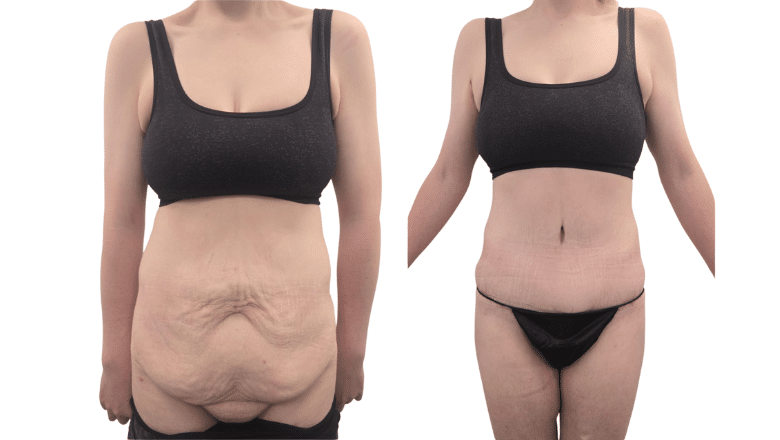
Real Centre for Surgery patient before and after a full tummy tuck for severe loose stomach skin. Individual results vary.

Real Centre for Surgery patient before and after tummy tuck surgery combined with liposuction. Individual results vary.
Extended and fleur-de-lis tummy tuck
When loose skin wraps round onto the flanks, an extended tummy tuck lengthens the scar towards the back to remove it. When there is also a lot of loose skin from side to side, usually after major weight loss, a fleur-de-lis tummy tuck adds a vertical scar up the middle to tighten the waist as well.
Apronectomy (panniculectomy)
An apronectomy removes a hanging apron of skin and fat from the lower stomach. It does not usually include muscle repair or belly button repositioning, and it is mainly done for the problems a heavy overhang causes. Our article on abdominoplasty vs apronectomy explains how they differ.
Rashes, Chafing and Hygiene: When Loose Skin Is More Than Cosmetic
Loose stomach skin is normal after pregnancy or weight loss, and many people live with it comfortably. For others it causes physical problems. In a 2021 prospective study of 147 patients in Surgery for Obesity and Related Diseases ↗[4], most people had at least 3 cm of abdominal overhang after bariatric surgery, reported more symptoms from excess skin than before their weight loss, and the number with discomfort rose as the overhang increased.
The commonest problem is intertrigo: inflammation in the skin fold caused by skin rubbing on skin, heat and trapped moisture. It can become infected with yeast or bacteria, producing a red, sore, sometimes smelly rash under the overhang[5]. Other complaints include chafing during exercise, difficulty keeping the fold clean and dry, clothes that do not fit, and the overhang getting in the way of exercise. Keeping the fold dry, wearing breathable cotton and treating infections promptly helps; removing the fold stops the problem at source. Our guide to skin irritation after weight loss has more practical advice.
Surgery can also help with function. In a 2025 prospective study in Aesthetic Surgery Journal ↗[6], women who had a tummy tuck with repair of separated muscles reported less back pain and fewer urinary symptoms at 12 months. At Centre for Surgery, tummy tucks and apronectomies are private, elective procedures. NHS funding for skin removal is limited, and private insurers rarely cover it, so check with your insurer before assuming any cover; our article on skin removal surgery on the NHS explains the criteria.
Loose Skin After GLP-1 Weight Loss: When to Treat It
If you are still losing weight, wait. Skin that is treated before your weight settles will loosen again as you lose more, and regaining weight stretches it too. We recommend a stable weight for at least 6 months, ideally 12, before body contouring surgery after major weight loss.
A 2026 propensity-matched study in Aesthetic Plastic Surgery ↗[7] compared body contouring after weight loss on GLP-1 medicines with body contouring after bariatric surgery. People on GLP-1 medicines more often had surgery within the first year of treatment and their timing varied much more, while infection, wound breakdown and blood clot rates were similar between the groups. The authors called for clearer guidance on timing. Weight often returns if GLP-1 medicines are stopped, so plan surgery around a weight you can maintain, not your lowest weight, and tell your surgeon about any weight-loss medicine you take, as some are paused around anaesthesia.
Recovery: Non-Surgical Treatment vs Tummy Tuck
- Morpheus8: redness and swelling for a few days; most people return to normal activities the next day. Results build over three to six months.
- BodyTite or Argo Plasma with liposuction: bruising and swelling for one to two weeks, a compression garment for about six weeks, and most desk-based people back at work within a week. Skin continues to tighten for up to six months or longer.
- Tummy tuck: performed under TIVA, with walking slightly bent for the first week or so, around two weeks off desk-based work, no heavy lifting or strenuous exercise for about six weeks, and the scar fading over 12 to 18 months. A responsible adult must stay with you for 24 hours after TIVA or sedation. Our tummy tuck recovery guide goes through it week by week, and tummy tuck scars explains how the scar changes.
For any surgery, stop smoking 4 weeks before and 4 weeks after, and stop aspirin 2 weeks before. Follow-up appointments are included, and after surgery you have your surgeon’s direct number for the first 24 hours, then the clinic line from 9am to 6pm, Monday to Saturday (NHS 111 or 999 out of hours).
Loose Skin Around the Belly Button
Loose, wrinkled skin around the belly button, or a belly button that has stretched or turned outwards after pregnancy, can sometimes be corrected on its own with umbilicoplasty (belly button surgery). It reshapes the belly button but does not treat loose skin across the rest of the stomach.

Real Centre for Surgery patient before and after umbilicoplasty. Individual results vary.
How Much Does Stomach Skin Tightening Cost?
The cost depends on the treatment and the size of the area. For current prices, see our tummy tuck cost guide, BodyTite cost, Argo Plasma cost and our skin aesthetics price list for Morpheus8. Finance is available, subject to status.
Frequently Asked Questions
How can I tighten my stomach skin naturally?
Build the muscle underneath with core and strength training, keep your weight stable, eat enough protein, avoid smoking and protect your skin from the sun. These steps improve how the stomach looks and help skin recover after pregnancy or weight loss, but they cannot shrink skin that has been significantly stretched.
Is there a skin tightener that actually works?
Yes, within limits. Radiofrequency treatments such as Morpheus8 and BodyTite produce measurable tightening in studies, and Argo Plasma can help the skin retract after liposuction. They work for mild to moderate laxity. No device or cream can remove a fold or overhang of skin; that needs surgery.
How long does skin tightening take to work?
You may see some change within a few weeks, but most of the improvement appears over three to six months as new collagen forms. Morpheus8 usually needs more than one session, so the full result of a course can take six months or more to show.
Will losing a lot of weight leave loose skin on my stomach?
Often, yes, particularly after losing several stone, losing it quickly, or carrying the weight for many years. Age, genetics, skin thickness and stretch marks all play a part. Losing weight gradually, staying active and not smoking give your skin the best chance, but some loose skin is common and normal after major weight loss.
Can fasting help tighten loose skin?
There is no reliable evidence that fasting tightens skin. Any effect on loose skin comes from the weight you lose, not from fasting itself, and rapid weight loss can make loose skin more noticeable.
Does loose stomach skin go away after pregnancy?
It often improves for up to a year after birth, sometimes longer. What remains after that is unlikely to change much on its own. Many women wait until they have finished having children before considering a tummy tuck, as a further pregnancy will stretch the skin and muscles again.
What is the best non-surgical skin tightening for the stomach?
It depends on what you are treating. Morpheus8 suits crepey skin and stretch marks with mild laxity; BodyTite suits moderate laxity with some fat; Argo Plasma is usually used alongside liposuction. A consultation is the best way to find out whether you are a candidate or whether surgery would serve you better.
References
- Vispute SS, Smith JD, LeCheminant JD, Hurley KS. The effect of abdominal exercise on abdominal fat. J Strength Cond Res. 2011;25(9):2559-2564. doi:10.1519/JSC.0b013e3181fb4a46 ↗
- Bai Y, Zhang Y, Bai Y, et al. An open single-arm clinical study of microneedle radiofrequency technology for addressing abdominal skin laxity in postpartum women. J Dermatolog Treat. 2025;36(1):2581744. doi:10.1080/09546634.2025.2581744 ↗
- Hurwitz D, Smith D. Treatment of overweight patients by radiofrequency-assisted liposuction (RFAL) for aesthetic reshaping and skin tightening. Aesthetic Plast Surg. 2012;36(1):62-71. doi:10.1007/s00266-011-9783-z ↗
- Elander A, Biörserud C, Fagevik Olsén M. Excess skin after weight loss following bariatric surgery: focus on the abdomen. Surg Obes Relat Dis. 2021;17(5):986-993. doi:10.1016/j.soard.2021.01.005 ↗
- Janniger CK, Schwartz RA, Szepietowski JC, Reich A. Intertrigo and common secondary skin infections. Am Fam Physician. 2005;72(5):833-838. PMID:16156342 ↗
- Marangi GF, Gratteri M, Romano FD, et al. Perception of changes in functional symptoms and psychological aspects related to rectus muscle diastasis in women who have undergone reparative abdominoplasty. Aesthet Surg J. 2025;45(8):814-820. doi:10.1093/asj/sjaf057 ↗
- Smith JE, Garbaccio NC, Mehdizadeh M, et al. Outcomes of body contouring surgery after bariatric surgery vs. GLP-1 receptor agonist-induced weight loss: a propensity score matched analysis. Aesthetic Plast Surg. 2026;50(11):4142-4150. doi:10.1007/s00266-026-05861-9 ↗
Talk to a Surgeon About Loose Stomach Skin
If you would like to know whether skin tightening or a tummy tuck suits you, you can book a consultation at our Baker Street clinic by calling 020 7993 4849 or using the form below. You will see the surgeon who would carry out your treatment, and further consultations before surgery are free.







