


In this guide16 sections
- Key Points
- What Is the Most Effective Type of Liposuction?
- What Are the Different Types of Liposuction?
- Is Power-Assisted Liposuction (PAL) Better Than Traditional Liposuction?
- Is VASER Liposuction More Effective Than Standard Liposuction?
- Can PAL and VASER Liposuction Be Combined?
- Is Laser Liposuction More Effective? Why We Do Not Offer It
- What Is the Safest Type of Liposuction?
- Which Type of Liposuction Is Best for Each Area?
- What If You Have Loose Skin? Liposuction, BodyTite or a Tummy Tuck
- Liposuction Before and After Photos
- How Long Is Liposuction Recovery?
- What Happens at a Liposuction Consultation in London?
- Frequently Asked Questions
- Liposuction in London
- References
Key Points
- What is the most effective type of liposuction? No single machine wins. Reviews of the published evidence find that suction-assisted, power-assisted, ultrasound and other techniques achieve broadly comparable fat reduction, so the surgeon’s skill and matching the technique to your fat matter most[1].
- The techniques we use: power-assisted liposuction (PAL) with fat equalisation as our standard, VASER ultrasound for dense, fibrous fat, and the two combined where your anatomy calls for it.
- The safest type of liposuction is the one that adds no heat to the skin, removes a sensible volume of fat, follows strict screening and clot-prevention routines and is carried out by a GMC-registered surgeon in a regulated hospital.
- Laser liposuction is not offered here. Heat from a laser fibre carries a recorded risk of burns, seromas and scars, and there is no substantial evidence that it beats conventional liposuction[6].
- Loose skin changes the answer. Liposuction removes fat, not skin, so loose skin may call for skin tightening or a tummy tuck instead of, or as well as, lipo.
- Suitability and costs are confirmed at consultation with the surgeon who will operate on you.
If you are searching for the most effective type of liposuction, the honest answer is that it depends on what is being removed and where. This guide compares the main types of liposuction, explains which ones carry the lowest risk, and shows how a surgeon decides between them. It is also the place to start if you have been asking whether there is a safest lipo.
At Centre for Surgery our surgeons use power-assisted liposuction, VASER liposuction or a combination of both, depending on the area. If you want a head-to-head comparison of those two, our guide to VASER vs liposuction goes into the detail, and the main liposuction page explains the operation from start to finish.
What Is the Most Effective Type of Liposuction?
The most effective type of liposuction is the technique that suits your type of fat, your skin quality and the areas being treated, performed by an experienced surgeon. There is no machine that is better for everyone. A 2026 systematic review of 13 clinical studies in Frontiers in Surgery compared suction-assisted, power-assisted, ultrasound, laser, water and radiofrequency liposuction ↗ and found that all of them achieved comparable fat reduction and contour improvement. Differences were modest: power-assisted liposuction tended to be more efficient for the surgeon, and laser and radiofrequency methods gave a small, short-term tightening effect. Patient satisfaction was consistently at or above 80% whichever technique was used[1].
The review authors also stressed that the evidence is thin. Most of the studies were case series rather than head-to-head trials, so claims that one brand of lipo is far ahead of the rest should be treated with caution. What makes a result effective in practice is a smooth, even contour, the right amount of fat removed and a patient who stays at a stable weight afterwards. Our guide to the features of a good liposuction result sets out what to look for.
What Are the Different Types of Liposuction?
Liposuction, also called liposculpture or lipoplasty, removes fat through small incisions using a thin tube called a cannula connected to suction. The main variations differ in how the fat is loosened before it is removed:
- Suction-assisted liposuction (traditional lipo): the surgeon moves the cannula by hand, with tumescent fluid injected first. It is the baseline against which newer methods are compared.
- Power-assisted liposuction (PAL): the cannula vibrates rapidly, so less force is needed to move it through the fat.
- Ultrasound-assisted liposuction (VASER): ultrasound energy emulsifies fat before it is suctioned out.
- Laser-assisted liposuction: a laser fibre heats and liquefies fat under the skin.
- Radiofrequency-assisted liposuction (for example BodyTite): radiofrequency energy heats fat and the underside of the skin to encourage tightening.
- Water-assisted liposuction: a jet of fluid loosens the fat as it is removed.
Which types of liposuction does Centre for Surgery offer?
We offer power-assisted liposuction with fat equalisation, VASER liposuction, the combination of the two for HD lipo, and BodyTite radiofrequency-assisted liposuction where skin tightening is part of the plan. All of our liposuction begins with tumescent preparation, an injection of saline, local anaesthetic and adrenaline that firms the tissue and reduces bleeding. We do not offer laser-assisted or water-assisted liposuction. For a broader overview of every method, see our guide to what the different types of liposuction are.
Is Power-Assisted Liposuction (PAL) Better Than Traditional Liposuction?
For most patients, power-assisted liposuction is a refinement rather than a revolution. The vibrating cannula glides through fat with less physical effort from the surgeon, which helps with fibrous areas such as the back and flanks. In a small pilot study of 15 women, power-assisted liposuction removed about 17% more fat per minute from the same areas than manual suction[3]. Faster, gentler removal should not be mistaken for a bigger or better result, though: how smooth the contour looks depends mainly on how evenly the surgeon works.
PAL is also now the mainstream choice among plastic surgeons. In 16 years of American Board of Plastic Surgery practice data, the share of liposuction cases using power assistance rose from 24% to 40%, while ultrasound-assisted use fell from 5% to 2%[2]. PAL generates no heat, so there is no thermal injury to the skin from the technique itself, and the fat it removes stays intact, which means it can be used for fat transfer when that is part of your plan.
Our version adds two steps to standard PAL: separation, aspiration and fat equalisation, which redistributes residual fat to smooth the treated surface and reduce the risk of ridges and dimples. You can read the full explanation on our liposuction page.
Is VASER Liposuction More Effective Than Standard Liposuction?
VASER is more effective in specific situations, not across the board. Its ultrasound energy emulsifies fat while leaving surrounding connective tissue, nerves and blood vessels largely intact, which is why it is favoured for dense, fibrous fat such as the male chest, upper back and flanks, and for fine sculpting where muscle definition is the aim. It also gives a modest degree of skin tightening, although not enough to replace surgery when the skin is loose.
The evidence is encouraging but not conclusive. A 2022 retrospective series of 261 patients ↗ treated with third-generation ultrasound-assisted liposuction over 15 years in Aesthetic Plastic Surgery reported an overall complication rate of 4.6%, mostly contour irregularity (1.9%), seroma and cellulitis, with 86% of patients saying they would recommend it. It was a single-surgeon chart review rather than a controlled comparison, so it shows that the technique can be used safely rather than proving it is better[4].
Our separate guide asks whether ultrasonic liposuction is better than regular liposuction in more depth. In short, VASER earns its place where the tissue is tough or the aim is definition, and it adds little in soft, easily removed fat.
Can PAL and VASER Liposuction Be Combined?
Yes, and for denser areas this combination is often the most effective option we use. VASER first loosens and emulsifies fibrous fat, PAL then removes it smoothly, and the fat equalisation step refines the final contour. The two are partners rather than rivals: VASER is the energy source, while PAL with fat equalisation is the surgical process around it.
This is how many surgeons work in practice. In a 2026 double-blind randomised trial of arm liposculpture ↗ in Plastic and Reconstructive Surgery, 52 women had VASER emulsification followed by either power-assisted or conventional suction. The trial found no significant difference in the quality of the fat collected between the two suction methods, and 96% of the women said they would recommend the procedure[5]. The message for patients is reassuring: the combination works well, and the exact suction device matters less than how carefully it is used.

Is Laser Liposuction More Effective? Why We Do Not Offer It
Laser liposuction, sold under names such as SmartLipo, uses a laser fibre to heat fat before removal. It is often marketed as a gentler, skin-tightening alternative, but the evidence does not support that. A 2026 review of 88 studies of laser and other technology-assisted liposuction ↗ in Aesthetic Plastic Surgery found skin burns, seromas, haematomas, infections and scars to be the commonest complications, and concluded that there is no substantial evidence that these technologies are superior to traditional liposuction, nor clear proof of a skin-tightening benefit from laser fibres[6]. The authors noted that some of the scars they treated will persist for life.
For that reason our surgeons use PAL and VASER, which remove fat without heating the skin, and reserve temperature-monitored radiofrequency for patients who need tightening. Our guide to laser lipo explains the difference between salon laser pads and surgical laser liposuction, and our article on non-surgical liposuction looks at what fat freezing and similar treatments can and cannot do.
What Is the Safest Type of Liposuction?
The safest type of liposuction is not defined by a brand name. It comes from the combination of a technique that does not heat the skin, sensible limits on how much fat is removed, careful patient selection and a well-run operating environment. Of the techniques above, PAL and VASER performed with tumescent preparation have the longest records of use and do not rely on heat to loosen fat.
How safe is liposuction overall?
When done properly, liposuction has a good safety record. The 2026 systematic review found low rates of overall complications, seroma and infection, with serious complications reported in fewer than 1 in 1,000 cases[1]. In a 2021 series of 9,002 consecutive patients treated under tumescent local anaesthesia ↗, published in Dermatologic Surgery, there were no deaths and no damage to nerves, blood vessels, muscles or organs, and 19 patients needed closer follow-up for mainly minor problems such as seroma or haematoma[7]. The authors attributed this to experienced surgeons following strict guidelines of care.
Liposuction is still surgery, and the real risks are worth knowing. Our guides to liposuction side effects, liposuction scars and botched liposuction cover them in full.
What actually makes liposuction safer?
The factors that matter most are:
- Volume of fat removed. Large-volume liposuction raises the risk. At Centre for Surgery we typically remove 1 to 4 litres and do not perform large-volume liposuction; see how much fat can be removed.
- Combining procedures. The more operations done at once, the higher the risk. Clot-related complications are a particular concern: in a 2025 analysis of more than 3.3 million surgeries in accredited US facilities, liposuction was the procedure most often linked to deep vein thrombosis or pulmonary embolism among plastic surgery patients, and the peaks in these events coincided with gaps in clot-prevention measures[8].
- Screening and preparation. A thorough medical assessment, a stable weight and being a non-smoker or stopping beforehand all lower risk. Our guide on whether you are suitable for liposuction explains who is a good candidate.
- Anaesthesia and monitoring. Liposuction at our hospital is a day case, usually under TIVA (total intravenous anaesthesia), with local anaesthetic and sedation for small single areas.
- The surgeon and the facility. Every operation is carried out by a GMC-registered surgeon at our CQC-regulated Baker Street hospital. Our advice on how to choose a liposuction surgeon lists the questions worth asking anywhere.
For independent patient information, the NHS liposuction guide ↗ and the British Association of Aesthetic Plastic Surgeons liposuction page ↗ are both worth reading.
Which Type of Liposuction Is Best for Each Area?
The right technique varies by body area, because fat is not the same everywhere. As a general guide:
- Tummy and waist: soft fat in the abdomen responds well to PAL, and the whole midsection can be treated together with 360 liposuction. See also stomach liposuction.
- Back, flanks and love handles: these areas are often fibrous, so VASER followed by PAL is commonly chosen.
- Male chest and torso: dense tissue makes VASER particularly useful, as described on our male liposuction page.
- Thighs, hips and arms: either technique can be used, with the choice depending on how fibrous the fat feels and how thin the skin is.
- Muscle definition: abdominal etching and high-definition liposuction rely on VASER and PAL together.
- Chin and neck: small, precise areas, usually under local anaesthetic with sedation; see chin and neck liposuction.
Our guide to the common liposuction areas shows which parts of the body can be treated. If the fat is painful, symmetrical and in the legs or arms, it may be lipoedema, which follows a different treatment pathway to cosmetic liposuction.

What If You Have Loose Skin? Liposuction, BodyTite or a Tummy Tuck
The most effective type of liposuction cannot tighten skin that has lost its elasticity. Liposuction works well in people close to a stable weight who have reasonably firm skin. Where skin is mildly loose, BodyTite or Argo Plasma skin tightening can be added to lipo to encourage the skin to contract. Our comparison of BodyTite vs liposuction explains when each is the better fit.
When skin hangs in a fold, or the abdominal muscles have separated after pregnancy, fat removal alone can leave the area looking looser than before. In that situation a tummy tuck may be the more effective choice, sometimes combined with liposuction of the flanks. Our guides to liposuction vs tummy tuck and alternatives to liposuction help you weigh the options, and our body contouring page shows the wider range of procedures.
Liposuction Before and After Photos
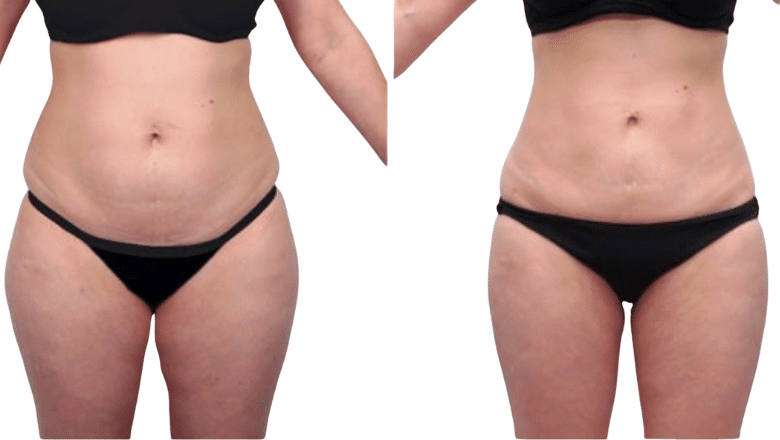
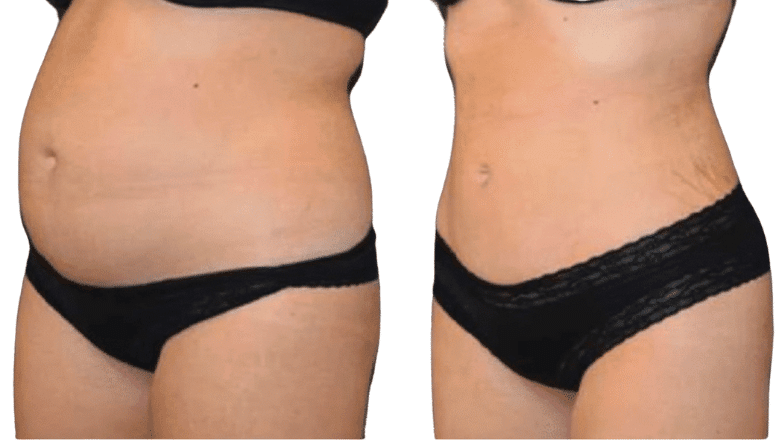
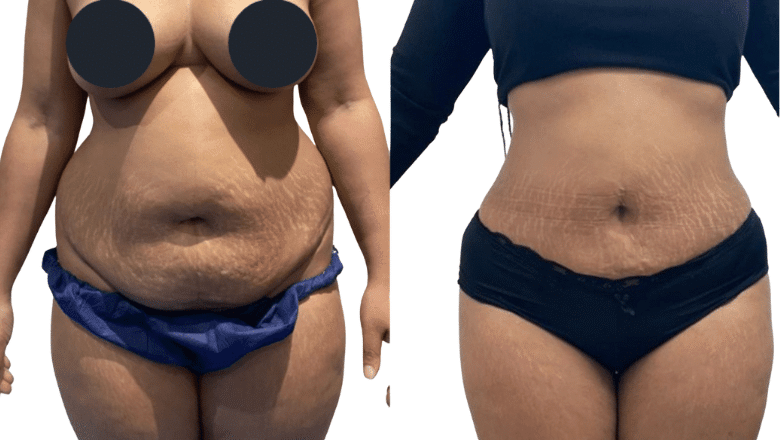
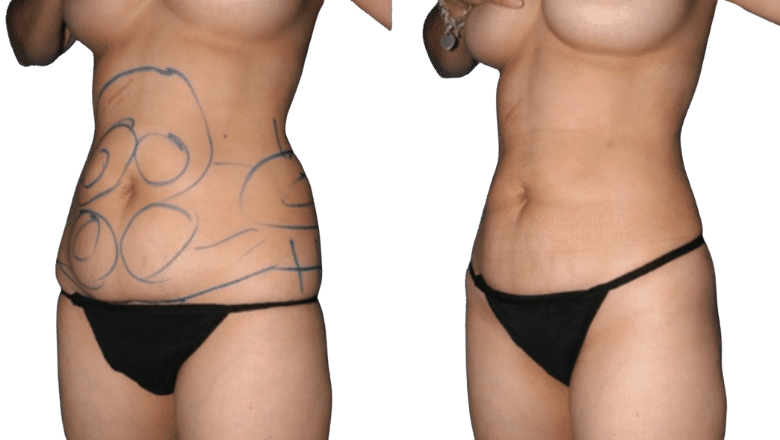
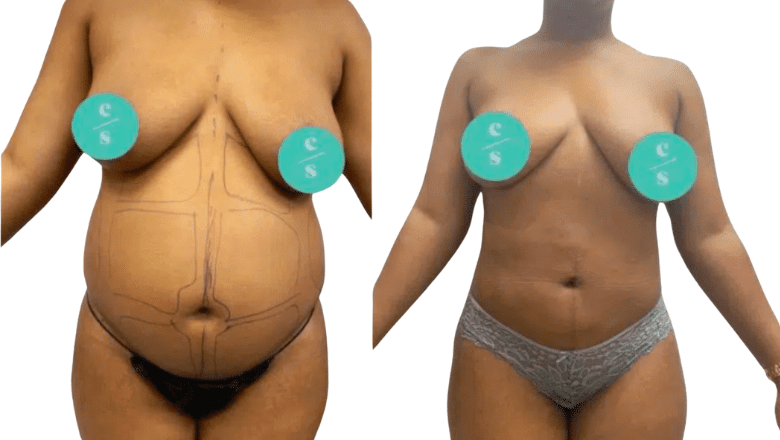
These photographs are from patients who gave written consent for their use. Results vary from person to person, and the technique used was chosen for each patient’s anatomy. A wider selection is shown in our liposuction before and after photos gallery.
How Long Is Liposuction Recovery?
Recovery is broadly similar whichever technique is used, because it depends more on the areas and volume treated than on the device. Typical timings at Centre for Surgery are:
- Back to desk work: 2 to 5 days, or 1 to 2 weeks for physically demanding jobs.
- Compression garment: worn continuously for 6 weeks, removed only briefly for showering.
- Exercise: walking from day 1, light activity from 2 weeks and full exercise from 6 weeks.
- Swelling: bruising and swelling settle over 2 to 3 weeks, with deeper swelling lasting 3 to 6 months.
- Final result: usually visible at 3 to 6 months.
These are typical timeframes, and your surgeon will advise you based on your own healing. Our liposuction recovery guide covers the stages in detail, and does liposuction hurt answers the question most people ask first.
What Happens at a Liposuction Consultation in London?
Your consultation is with the surgeon who will operate on you. They examine the areas you want treated, assess how firm and elastic your skin is, check your medical history and weight stability, and explain which technique, or combination, suits you and why. A cooling-off period of two weeks from consent is recommended, so there is time to think before you commit.
The cost of your surgery depends on the number of areas and the technique, and is confirmed in writing after your consultation; our liposuction cost guide explains what affects it, and finance options are available subject to status. If you are travelling to London, our team can advise on virtual consultations and same-day surgery. Results last as long as your weight stays stable, as our guide on whether liposuction is permanent explains.
Frequently Asked Questions
What is the safest type of liposuction?
No single brand of liposuction is safest. The lowest-risk approach combines a technique that does not heat the skin, such as power-assisted or VASER liposuction with tumescent preparation, with careful patient selection, modest fat volumes, clot-prevention measures and an experienced, GMC-registered surgeon in a regulated hospital.
Which liposuction technique gives the best results?
Results depend more on the surgeon than the machine. Studies find similar fat reduction across techniques, so the aim is to match the method to your fat: PAL for softer fat, VASER followed by PAL for dense or fibrous areas, and the pair together for definition work.
What happens 10 years after liposuction?
Fat cells removed by liposuction do not grow back, so the contour you achieve can last for many years if your weight stays stable. The remaining fat cells can still enlarge with weight gain, and ageing affects skin elasticity regardless. Gaining weight later may change where fat is stored.
How many liposuction treatments are needed?
Most people need a single operation, planned to treat all the areas you want at one sitting, within safe limits. A minor touch-up is sometimes discussed once swelling has fully settled, usually after three to six months, but it is not routine.
Is it possible to get liposuction without general anaesthesia?
Yes, for small areas. Chin, neck or a single small area can often be treated under local anaesthetic with sedation. Larger or combined areas are usually done under TIVA, which is given entirely through a drip. Our guide on liposuction under local anaesthetic explains how the choice is made.
What are the downsides of getting liposuction?
Expect bruising, swelling, temporary numbness and six weeks in a compression garment. Less commonly there can be contour irregularities, seroma, infection or visible scars, and in rare cases clots. Liposuction is not a weight-loss treatment, and it cannot tighten loose skin. Our liposuction myths article covers common misunderstandings.
Which is safer, lipo or a tummy tuck?
Liposuction is a smaller operation with smaller incisions, so it generally carries fewer wound-related risks than a tummy tuck. Both are major elective surgery with risks, including clots. The right choice depends on whether the problem is fat, loose skin or separated muscles rather than on which sounds safer.
Which is more painful, lipo 360 or a tummy tuck?
Most people find a tummy tuck more uncomfortable, because the muscles are tightened and the abdomen feels tight for longer. Lipo 360 usually feels like deep bruising and aching, managed with regular pain relief. Individual experience varies, and your surgeon will explain what to expect for your plan.
Liposuction in London
If you are weighing up the most effective type of liposuction, a consultation with one of our plastic surgeons will establish which technique, or combination, is right for your body and your goals. Find out more about liposuction at Centre for Surgery.
Phone: 020 7993 4849 | Address: 95–97 Baker Street, Marylebone, London W1U 6RN
Contact us to schedule a consultation
References
- Yang C. Safety and clinical outcomes of contemporary liposuction techniques: evidence from a systematic review. Frontiers in Surgery 2026;13:1892614. doi:10.3389/fsurg.2026.1892614 ↗
- Stein MJ, Sasson DC, Harrast J, Alderman A, Matarasso A, Gosain AK. A 16-year review of clinical practice patterns in liposuction based on continuous certification by the American Board of Plastic Surgery. Plastic and Reconstructive Surgery 2023;152(3):523–531. doi:10.1097/PRS.0000000000010254 ↗
- Scuderi N, Tenna S, Spalvieri C, De Gado F. Power-assisted lipoplasty versus traditional suction-assisted lipoplasty: comparative evaluation and analysis of output. Aesthetic Plastic Surgery 2005;29(1):49–52. doi:10.1007/s00266-004-0003-y ↗
- Tran BNN, Didzbalis CJ, Chen T, Shulzhenko NO, Asaadi M. Safety and efficacy of third-generation ultrasound-assisted liposuction: a series of 261 cases. Aesthetic Plastic Surgery 2022;46(5):2310–2318. doi:10.1007/s00266-022-02992-7 ↗
- Cala Uribe LC, Perez Pachon ME, Zannin Ferrero A. Cold versus warm tumescent solution in arm liposculpture: a double-blind randomized clinical study. Plastic and Reconstructive Surgery 2026;158(3S):30S–37S. doi:10.1097/PRS.0000000000012595 ↗
- Ribas DBR, Kroumpouzos G, Costa ALM, de Oliveira NR, de Souza Brandão MPA, Nunes MH, et al. Uncovering the complications of liposuction-assisted technologies and the need for caution: a literature overview. Aesthetic Plastic Surgery 2026;50(7):2608–2625. doi:10.1007/s00266-025-05562-9 ↗
- Boeni R, Waechter-Gniadek PV. Safety of tumescent liposuction under local anesthesia in 9,002 consecutive patients. Dermatologic Surgery 2021;47(5):e184–e187. doi:10.1097/DSS.0000000000002987 ↗
- Foppiani JA, Hernandez Alvarez A, Escobar-Domingo MJ, Thomas C, Lee D, Taritsa IC, et al. Assessment of mortality rates associated with perioperative deep vein thrombosis screening and prophylaxis in cosmetic outpatient procedures: an updated national evaluation using QUAD A patient safety data. Aesthetic Surgery Journal Open Forum 2025;7:ojaf105. doi:10.1093/asjof/ojaf105 ↗







