


In this guide23 sections
- Key Points
- What Areas of the Body Can Be Treated With Liposuction?
- Which Areas Are Best for Liposuction?
- Stomach Liposuction: Can You Lipo Your Belly?
- Love Handles and Waist Liposuction
- Back Fat and Bra Roll Liposuction
- Thigh Liposuction: Inner Thigh and Outer Thigh Fat
- Hip Liposuction and Hip Dips
- Knee, Calf and Ankle Liposuction
- Arm Liposuction for Bingo Wings
- Chin and Neck Liposuction
- Male Chest Liposuction and Gynaecomastia
- Can You Have Liposuction on the Buttocks, Face or Mons Pubis?
- How Many Areas Can You Have Liposuction On at Once?
- What Areas Can’t Liposuction Treat?
- Does Fat Come Back in Treated Areas?
- Which Liposuction Technique Is Used for Each Area?
- How Long Is Recovery After Liposuction on Different Areas?
- How Safe Is Liposuction?
- What Happens at a Liposuction Consultation?
- Frequently Asked Questions
- Liposuction Areas in London
- References
Key Points
- What are the common areas of liposuction? The stomach, flanks (love handles), back, hips, inner and outer thighs, knees, upper arms, chin and neck, and in men the chest. Any area with soft, pinchable fat that a surgeon can reach safely can be treated.
- Liposuction removes fat under the skin only. It cannot reach visceral fat around the organs, and it does not tighten loose skin, remove cellulite or treat lipoedema in the way a specialist plan does.
- Areas are counted by anatomical zone. The upper and lower abdomen are two areas, while both flanks together count as one.
- Up to five litres of fat can be removed in one session, usually as a day case under TIVA. A small single area such as the chin can be done under local anaesthetic with sedation.
- Fat removed from an area does not regrow there, but a randomised trial found that body fat can return elsewhere if lifestyle stays the same[3].
- Loose skin changes the answer. Mild to moderate looseness may suit liposuction with BodyTite, and significant looseness usually needs a tummy tuck, arm lift or thigh lift.
The areas of liposuction patients ask about most are the stomach, waist, thighs and arms, and the honest answer to “where can lipo be done?” is wider than many people expect. Our liposuction service treats fat in most areas of the body where diet and exercise have stopped making a difference, and each area behaves a little differently when it comes to technique, recovery and the result you can realistically expect.
This guide walks through every common area in turn, from tummy lipo to chin and neck liposuction, then covers how many areas you can have treated at once, what lipo cannot do and what recovery looks like. If you are still deciding which zones are worth treating first, our companion guide to the best areas for liposuction looks at the choice from that angle, and our liposuction page explains the operation itself.
What Areas of the Body Can Be Treated With Liposuction?
Liposuction, also called lipo or liposculpture, removes localised pockets of fat through 3 to 5 mm incisions using a thin cannula and gentle suction. It is body contouring rather than weight loss, aimed at the fat that stays put however well you eat and train. In practice the usual liposuction body areas fall into groups:
- Torso: upper abdomen, lower abdomen, flanks, waist, upper back, lower back and the bra-roll area.
- Hips and legs: hips, outer thighs (saddlebags), inner thighs, front and back of the thigh, knees, calves and ankles.
- Arms and chest: upper arms, the armpit area and, in men, the chest.
- Face and neck: under the chin and the neck, and in selected cases the jowls.
The common thread is subcutaneous fat, the layer you can pinch between finger and thumb. If an area is mostly firm skin, muscle or deeper abdominal fat, liposuction has little to offer there. Our guide to visceral vs subcutaneous fat shows how to tell which you have.
Which Areas Are Best for Liposuction?
Some areas respond more predictably than others. The areas that tend to give the smoothest, most lasting results share four features: a defined pocket of fat, skin that is firm enough to settle back, a stable weight for at least three months and a safe route for the cannula. A weight close to a healthy level matters too, and a BMI above 30 may mean liposuction is not suitable until weight comes down. You also need to be 18 or over and willing to stop smoking for four weeks before and after surgery.
On that basis the stomach, flanks, thighs, knees and chin are the areas most patients and surgeons find straightforward, while ankles, calves and areas with thin or very loose skin need more careful assessment. Suitability is always decided at a face-to-face consultation, and our guide to whether you are suitable for liposuction sets out the checklist in full.
Stomach Liposuction: Can You Lipo Your Belly?
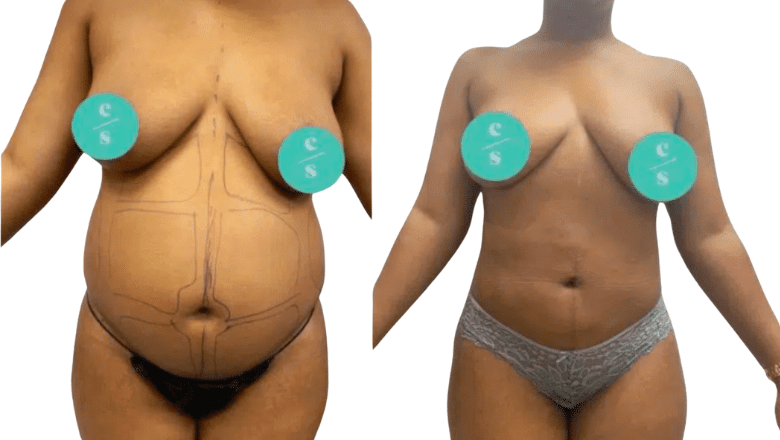
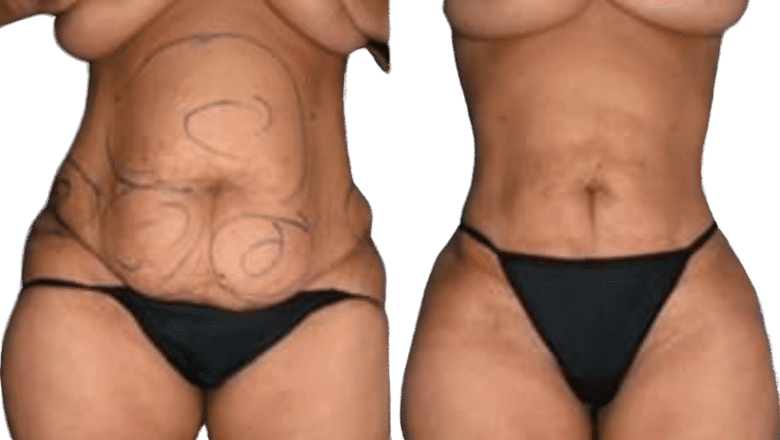
Yes. Stomach liposuction is one of the most requested areas for men and women alike. Fat tends to collect on the abdomen as metabolism slows with age, and the pinchable layer in front of the muscle wall responds well to lipo. Tummy lipo usually takes one to two hours, the upper and lower abdomen are often treated in the same session, and the 3 to 5 mm incisions are placed in the navel, natural folds or near existing scars with no drains needed.
The result depends on what is causing the bulge. A soft, pinchable belly with firm skin suits liposuction alone. After pregnancy or major weight loss, loose skin and separated muscles are often the real cause, and a tummy tuck will do more than fat removal can. Our comparison of liposuction vs tummy tuck explains how to choose.
Love Handles and Waist Liposuction
Love handles, also called flanks or muffin top, are the rolls of fat above the hips at the sides of the waist. Fat here is often stubborn even in people who are otherwise slim, which makes the flanks one of the most rewarding areas of lipo. Treating them alongside the abdomen and lower back as one circumferential zone is called 360 liposuction, and it is what creates a visible inward curve at the waist rather than a flat front with a fuller back.
Our detailed guide to love handles liposuction covers the causes and the techniques. Where the flank skin is loose as well as full, BodyTite vs liposuction is worth reading first, because radiofrequency tightening can be combined with fat removal.
Back Fat and Bra Roll Liposuction
The back is divided into the upper back and bra-roll area, the mid-back and the lower back. Bra-line rolls and the fat above the buttocks are common reasons to ask about back liposuction, and the back is usually treated together with the flanks because the two blend into one contour. The back skin is thicker and the fat more fibrous than on the abdomen, so the surgeon may use ultrasound energy to loosen it before removal, which is where VASER liposuction earns its place.
Thigh Liposuction: Inner Thigh and Outer Thigh Fat
The thighs are treated in several zones: the outer thigh (saddlebags), the inner thigh, the front and the back of the thigh. Inner thigh liposuction can also relieve chafing where the thighs rub together when walking. The skin on the inner thigh is thin and prone to laxity, so assessment is careful, and when loose skin is the main problem a thigh lift is the better operation. Our guide to thigh liposuction goes into each zone, and treating the whole thigh circumference together is part of a 360 approach.

Hip Liposuction and Hip Dips
Fat on the outer hip widens the silhouette and pushes the hips out beyond the waist. Hip liposuction reduces that fat and is often combined with the flanks and outer thighs. A hip dip, the inward curve below the hip bone, is a different problem: it comes from bone shape and fat distribution rather than too much fat, so liposuction alone does not fill it, and fat transfer is sometimes used instead.
Knee, Calf and Ankle Liposuction
Knee fat is a small, well-defined pocket on the inner side of the knee that suits lipo well, and the result is usually easy to see because so little else changes in the area. Our guide to knee liposuction covers it in detail. Calf and ankle liposuction is more demanding. The tissue there contains lymphatic channels and swells readily, results are more modest and the swelling can last longer, so the surgeon needs to be confident the cause is fat rather than fluid. Persistent heavy, painful, symmetrical legs may point to lipoedema instead.
Lipoedema is a long-term condition of painful, symmetrical fat build-up in the legs and sometimes the arms. In a 2024 retrospective study in JPRAS Open of 47 patients, tumescent liposuction for lower limb lipoedema ↗ improved quality-of-life scores at an average of 12 months, though the author noted that longer follow-up and controlled studies are needed[6]. Our lipoedema treatment page explains how that pathway differs from cosmetic lipo.
Arm Liposuction for Bingo Wings
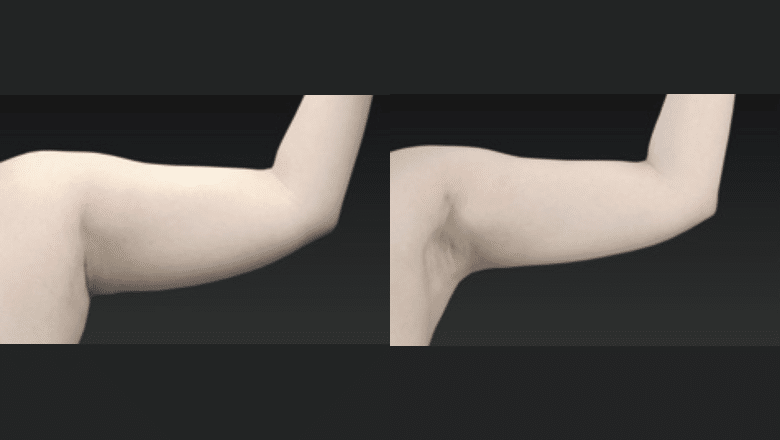
Fat on the back of the upper arm, often called bingo wings or bat wings, responds well to lipo when the skin is firm. Incisions are tiny and sited discreetly, including in the armpit for sculpting work. Arms are visible all year, so patients are often pleased by how quickly clothing fits differently once swelling settles. If the upper arm hangs as a fold of skin rather than a pad of fat, liposuction will not fix it, and an arm lift is the operation to compare. Our guide to arm liposuction helps you decide.
Chin and Neck Liposuction
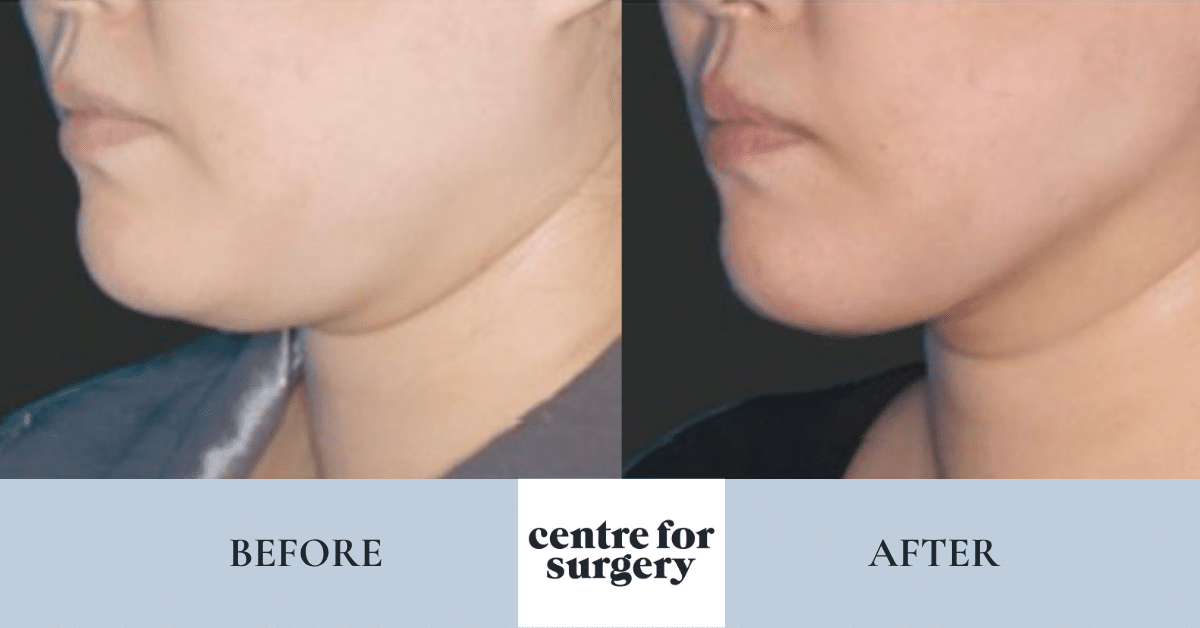
Under-chin fat blurs the jawline and can persist at a healthy weight. Chin and neck liposuction takes around an hour as a standalone procedure, usually under local anaesthetic with sedation, through incisions of 3 to 5 mm under the chin and sometimes behind each earlobe. Suture removal is at day 5 to 7 and most people take 7 to 10 days off work. It works best with good skin elasticity; if the neck is lax, a neck lift may be needed.
Male Chest Liposuction and Gynaecomastia
Men often ask about liposuction for the chest. If the fullness is fat alone, known as pseudogynaecomastia, lipo can flatten it. If a firm disc of gland sits under the nipple, liposuction is usually combined with gland excision. A 2017 analysis of the US NSQIP database published in Aesthetic Plastic Surgery found that gynaecomastia surgery in 1,583 adults ↗ carried a 30-day surgical complication rate of 1.9%[5]. Our gynaecomastia surgery page explains which approach suits which chest, and HD lipo is used when the aim is muscle definition across the chest, abdomen and arms.
Can You Have Liposuction on the Buttocks, Face or Mons Pubis?
The buttocks are rarely suctioned to make them smaller. Fat is more often taken from the surrounding areas and, in a Brazilian butt lift, transferred into the buttocks. The exception is the banana roll, the crescent of fat just under the buttock crease, which can be treated while the crease itself is preserved.
On the face, lipo is limited to the chin, neck and sometimes the jowls, and the cheeks are usually handled by buccal fat removal instead. The mons pubis, the fatty pad above the pubic bone, can also be reduced.

How Many Areas Can You Have Liposuction On at Once?
There is no fixed number of areas, because safety is governed by how much fat is removed and how long the operation takes. At Centre for Surgery up to five litres can be removed in one session, typically one to four litres, and we do not perform large-volume liposuction above that. Staying within that limit is also why a patient with a great deal of fat to lose is usually advised to lose weight first.
Areas are counted by anatomical zone for planning. The upper abdomen and lower abdomen are two areas, while both flanks together are one, so treating the whole abdomen and both flanks counts as three. Your final plan is confirmed in writing after a face-to-face consultation, and finance is available subject to status.
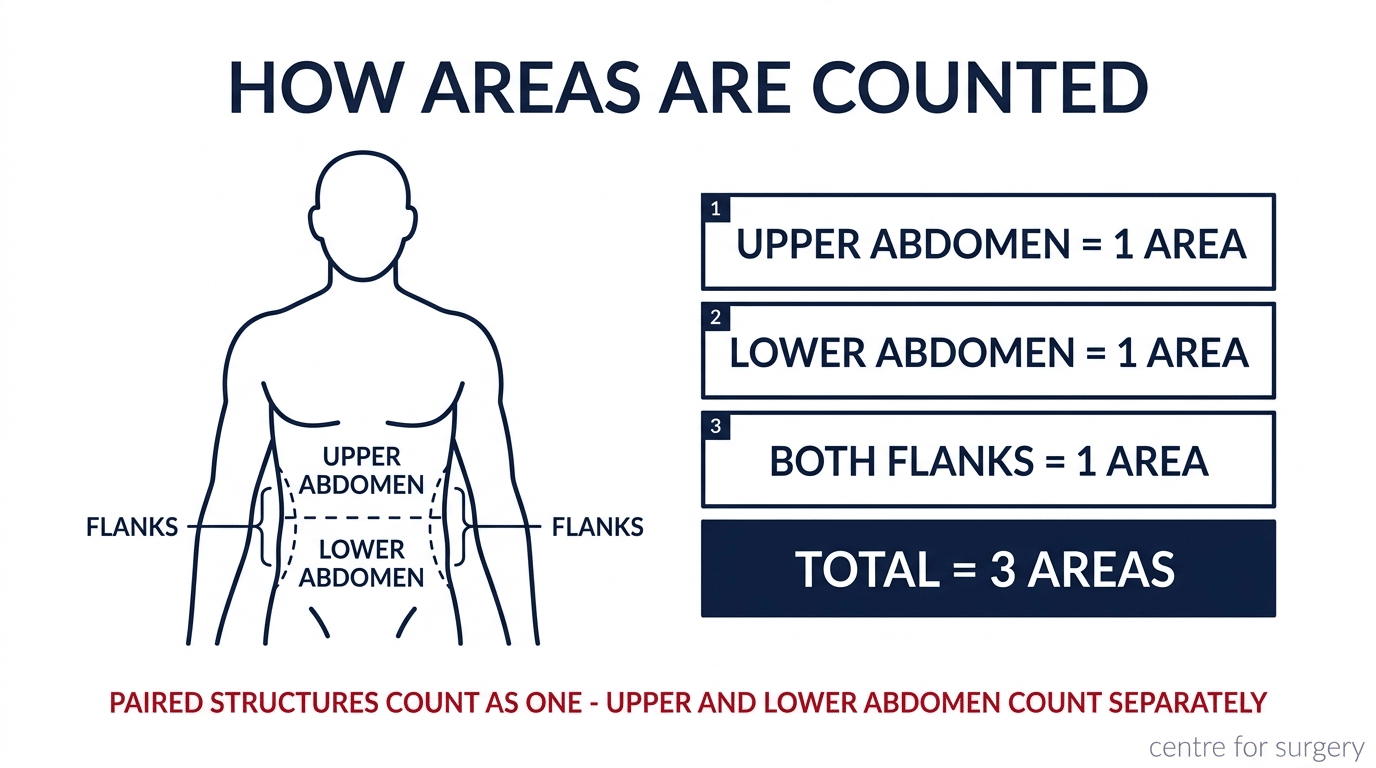
Combining several areas with other operations raises the risk. In a prospective cohort of 31,010 liposuction procedures, a 2017 study in Aesthetic Surgery Journal ↗ found that liposuction performed alone carried a major complication rate of 0.7%, while combined procedures were an independent predictor of major complications (relative risk 4.81)[1]. A 2025 retrospective study of 670 patients in Aesthetic Plastic Surgery likewise reported higher complication rates when abdominoplasty was paired with liposuction[4]. Your surgeon will talk through what is sensible to combine in one sitting.
What Areas Can’t Liposuction Treat?
Knowing the limits is as useful as knowing the areas. Liposuction will not help with:
- Visceral fat. The deeper fat around the organs causes a firm, protruding belly in some slim people and cannot be suctioned.
- Loose or crepey skin. Lipo removes volume but does not tighten skin.
- Cellulite and stretch marks. Dimpling can occasionally look more noticeable.
- Weight loss. It is not a weight-loss treatment.
A 2004 randomised study in the New England Journal of Medicine found that large-volume abdominal liposuction in 15 obese women ↗ did not improve insulin sensitivity or other heart disease risk factors, concluding that removing fat mass alone does not deliver the metabolic benefits of weight loss[2]. Liposuction is for shape, not health.
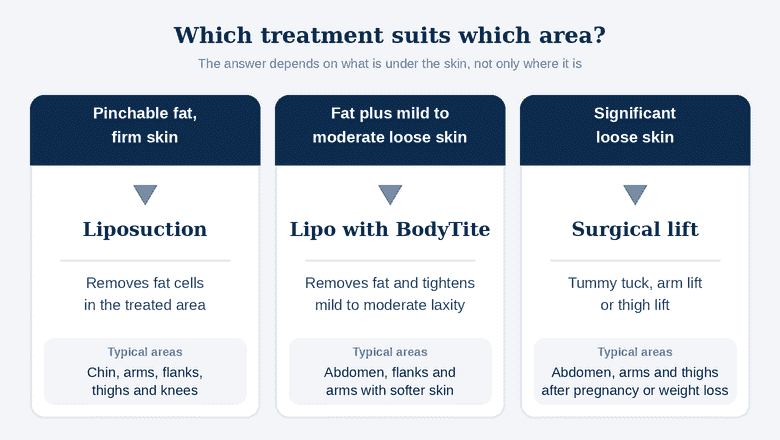
Where fat comes with mild to moderate looseness, BodyTite can tighten the skin as the fat is removed, and where skin hangs in folds a lift such as a lower body lift or a mummy makeover after pregnancy may suit better.
Does Fat Come Back in Treated Areas?
The fat cells removed from a treated area do not grow back, which is why results are described as permanent in that area. What matters is what the rest of your body does afterwards. In a randomised trial of 32 non-obese women, small-volume suction lipectomy compared with no surgery ↗ reduced body fat at six weeks, but by one year total body fat had been restored and had redistributed: the thigh region stayed reduced while fat reaccumulated in the abdominal region[3]. The participants made no lifestyle changes, so the lesson is practical rather than alarming: a stable weight keeps the result. Our guide to whether fat can come back after liposuction goes further.
Which Liposuction Technique Is Used for Each Area?
Two techniques are used at Centre for Surgery, and your surgeon may combine them in one operation. Power-assisted liposuction (PAL) loosens fat with a vibrating cannula and suits most areas, finishing with fat equalisation to smooth the remaining layer. VASER uses ultrasound energy to loosen dense or fibrous fat, which helps on the back, flanks and chest and where fine sculpting is the goal. HD lipo builds on both to define the muscles of the abdomen, chest and arms, and 360 lipo is simply a combination of areas treated as one zone. We do not offer laser lipo.
How Long Is Recovery After Liposuction on Different Areas?
Most liposuction is a day case under TIVA, with local anaesthetic and sedation used for small single areas. The pattern is similar whichever area is treated:
- First days: soreness, tightness and bruising, with reddish tumescent fluid leaking from the incisions for 24 to 48 hours. Most people return to desk work after two to five days, or one to two weeks for physical jobs.
- Weeks 1 to 4: walking from day one, light activity from about week two, no strenuous exercise or heavy lifting until week four. Driving is usually possible after 7 to 10 days.
- Week 6: the compression garment, worn continuously for six weeks, comes off, full exercise resumes and your surgeon reviews you.
- Three to six months: swelling settles fully and the final contour shows.
Larger or multiple areas such as the abdomen and flanks swell more than a single small area. Our guide to liposuction recovery and aftercare covers each stage.
How Safe Is Liposuction?
Liposuction performed alone is considered a safe procedure with a low risk of major complications when carried out by a trained surgeon in a regulated hospital, and the 0.7% major complication rate quoted above reflects liposuction alone[1]. No operation is risk-free. Contour irregularity is the commonest aesthetic problem, and seroma, haematoma, infection, numbness, asymmetry and, rarely, blood clots can occur, with revision occasionally needed. Our guide to the risks of liposuction separates expected effects from complications.
What Happens at a Liposuction Consultation?
At Centre for Surgery your consultation is face to face with the GMC-registered surgeon who will operate. They assess each area, pinch-test the fat, judge skin quality, discuss your goals and tell you honestly which areas are worth treating and which are better left or handled another way. A written plan follows, and a cooling-off period applies before you commit. The surgeon who assesses you is the surgeon who performs your surgery, at our CQC-regulated hospital on Baker Street, and you have your surgeon’s direct number for the first 24 hours afterwards.
Frequently Asked Questions
What are the 12 areas of liposuction?
Clinics group them differently, but a common list of twelve is: chin and neck, upper arms, chest, upper abdomen, lower abdomen, flanks, upper back and bra roll, lower back, hips, outer thighs, inner thighs and knees. Calves, ankles and the banana roll area are treated less often.
What is the most common area for liposuction?
The abdomen is the most commonly treated area in both men and women, usually together with the flanks. The thighs, arms and chin follow.
Where do they cut for liposuction?
Through 3 to 5 mm incisions placed in natural skin folds, the navel or near existing scars, using as few as needed. They are closed with dissolvable stitches and typically fade to near-invisible marks over up to 12 months.
How many areas can you liposuction at once?
There is no fixed number. The limit is how much fat can be removed safely, which is up to five litres at Centre for Surgery, and how long the operation takes. Upper and lower abdomen count as two areas and both flanks as one.
What happens 10 years after liposuction?
The fat cells removed do not grow back, so treated areas stay slimmer than before if your weight is stable. Ageing, pregnancy and weight gain still change your shape, and fat can enlarge in untreated areas.
What do I wish I knew before liposuction?
That it removes only the fat you can pinch, does not tighten loose skin, and takes three to six months to show its final result. You will also look swollen, sometimes bigger, for several weeks first.
What are the different types of liposuction?
At Centre for Surgery the techniques are power-assisted liposuction and VASER ultrasound-assisted liposuction, often used together, with HD lipo and 360 lipo as ways of applying them. We do not offer laser lipo.
Can you have liposuction on any part of the body?
Not every part. It suits areas with soft subcutaneous fat that can be reached safely, so the stomach, thighs and arms are routine, while the face, calves and ankles are limited and visceral fat cannot be treated at all.
Liposuction Areas in London
If you would like to know which areas of liposuction suit your body, a consultation will establish where your fat sits, how firm your skin is and what result is realistic.
Phone: 020 7993 4849 | Address: 95–97 Baker Street, Marylebone, London W1U 6RN
Contact us to schedule a consultation
References
- Kaoutzanis C, Gupta V, Winocour J, Layliev J, Ramirez R, Grotting JC, et al. Cosmetic liposuction: preoperative risk factors, major complication rates, and safety of combined procedures. Aesthetic Surgery Journal 2017;37(6):680–694. doi:10.1093/asj/sjw243 ↗
- Klein S, Fontana L, Young VL, Coggan AR, Kilo C, Patterson BW, et al. Absence of an effect of liposuction on insulin action and risk factors for coronary heart disease. New England Journal of Medicine 2004;350(25):2549–2557. doi:10.1056/NEJMoa033179 ↗
- Hernandez TL, Kittelson JM, Law CK, Ketch LL, Stob NR, Lindstrom RC, et al. Fat redistribution following suction lipectomy: defense of body fat and patterns of restoration. Obesity 2011;19(7):1388–1395. doi:10.1038/oby.2011.64 ↗
- Neel OF, Al-Khafaji MQM, Alrashoud NM, Alnujaim N, Al-Terkawi RA, Mortada H. Safety and outcomes of combined aesthetic surgical procedures: a retrospective study of risk factors, complication rates, and outcomes. Aesthetic Plastic Surgery 2025;50(3):1190–1198. doi:10.1007/s00266-025-05348-z ↗
- Zavlin D, Jubbal KT, Friedman JD, Echo A. Complications and outcomes after gynecomastia surgery: analysis of 204 pediatric and 1583 adult cases from a national multi-center database. Aesthetic Plastic Surgery 2017;41(4):761–767. doi:10.1007/s00266-017-0833-z ↗
- Malcolm L. A retrospective comparative study of patient-reported outcome measures, pre-treatment and twelve months post-treatment using tumescent liposuction for the management of lower limb lipoedema. JPRAS Open 2024;41:285–294. doi:10.1016/j.jpra.2024.05.007 ↗







