


In this guide15 sections
- Key Points
- Nose Shapes Chart: The Common Types of Noses
- Nose Shape Names: What Each Type of Nose Looks Like
- What Nose Shape Do I Have? How to Identify Yours
- What Determines Nose Shape?
- Nose Types in Men and Women
- Nose Shape and Ethnicity: What the Evidence Shows
- Is There a Most Attractive Nose Shape?
- Does Your Nose Change Shape With Age?
- How Can You Change Your Nose Shape?
- How Much Does It Cost to Change Your Nose Shape?
- Frequently Asked Questions
- Rhinoplasty Consultation at Centre for Surgery
- References
- Related Reading
Key Points
- Nose shape names are descriptions, not diagnoses. Straight, Roman, hooked, snub, button, upturned and the other common types of noses are everyday labels. Surgeons measure the bridge, the tip and the width instead.
- Three checks tell you which nose type you have. Whether your bridge is straight, convex or concave in profile, where your tip points, and how wide the base is compared with the gap between your eyes.
- Nose shape is largely inherited. A large twin study found that genes explain most of the variation in nose width, height and prominence, and specific genes have been linked to the width of the bridge and nostrils.
- No nose shape is better than another. Classical “ideal” proportions fit only a minority of real faces, and in one survey the nose angle people preferred for a man varied with who was asked.
- Noses change with age. Most nasal growth is complete by the mid to late teens, but the nose continues to get larger into old age.
- Filler can add but not reduce. Non-surgical rhinoplasty can smooth a bump temporarily; only surgery can make a nose smaller, and both carry risks.
Nose shapes are usually described with everyday names: Roman, Greek, snub, button, hooked, celestial or retroussé. These are the names people use when they look up types of noses, and almost none of them are clinical terms.
Those labels are useful shorthand but not a diagnosis. A surgeon assessing a nose does not record “hawk nose”; they record the profile of the nose bridge, how far the tip projects, which way it points and how wide the base is, because those are the things that can be measured and, if you want, changed.
This guide covers both. It sets out a nose shapes chart and what each name describes, how to work out which type of nose you have from three simple checks, what determines nose shape, how noses differ between men and women and change with age, and what rhinoplasty and non-surgical rhinoplasty can realistically do. It also answers a question many people ask alongside it: whether nose shape indicates ethnicity.
Where your concern is breathing rather than appearance, nasal valve collapse, a deviated septum and enlarged turbinates are the relevant pages.
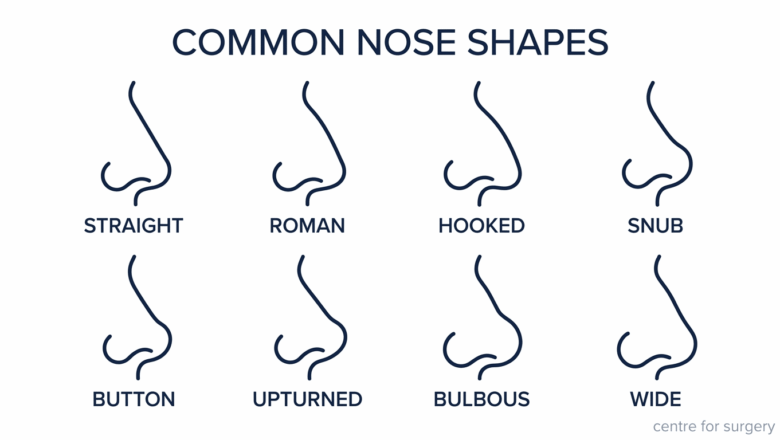
Nose Shapes Chart: The Common Types of Noses
The chart below summarises the nose shape names in common use. A nose can combine features of more than one type, so treat it as a guide to the vocabulary rather than a set of boxes.
| Nose type | Also called | Key features |
|---|---|---|
| Straight | Greek nose | Straight bridge with no hump, defined tip |
| Roman | Convex nose, aquiline (mild) | Bridge curves outward; tip stays roughly level |
| Hooked | Hawk nose, aquiline | Marked outward curve; tip turns downward |
| Snub | Short nose | Short, with a rounded tip sitting slightly higher than the bridge |
| Button | Small round nose | Small, with a narrow bridge and a soft, rounded tip |
| Upturned | Celestial, retroussé, ski slope | Tip rotated upward so more nostril shows in profile; may have a slight dip in the bridge |
| Pointed | Pointy nose | Narrow, projecting tip that comes to a point |
| Bulbous | Round-tipped nose | Wide, rounded, less defined tip |
| Wide | Broad nose | Broad bridge, wide nostrils, or both |
| Flat | Low-bridged nose | Low bridge, so the nose sits closer to the face in profile |
| Fleshy | Thick-skinned nose | Larger overall, with thick skin and a soft tip |
| Crooked | Deviated nose | Bridge or tip sits off-centre |
| Saddle | Saddle nose deformity | Collapsed, scooped bridge after loss of support |
Nose Shape Names: What Each Type of Nose Looks Like
Straight nose (Greek nose)
A straight bridge with no hump and a defined tip, often called the Greek nose after classical sculpture. Nothing about it is medically superior; it is one normal variant among many.
Roman nose (aquiline nose)
A convex bridge with a gentle slope towards a tip that stays roughly level. It is a strong, defined profile and a normal variant. “Aquiline” is used for both Roman and hooked profiles, usually where the tip is beginning to turn down. Our guide to the Roman nose compares Roman, Greek and aquiline profiles in more detail.
Hooked nose (hawk nose)
A more marked version of the same, with a pronounced outward curve and a tip that turns downward. Hook nose and hawk nose describe the same profile; see our guide to the hooked nose. Where someone wants it changed, surgery involves reducing the dorsal hump and, where needed, supporting the tip. Removing the hump alone can leave the middle of the nose narrowed or pinched inward over time.
Snub nose
Short, with a rounded tip sitting slightly higher than the bridge. See our detailed guide to the snub nose shape.
Button nose
Small and round, with a narrow bridge and a soft, less defined tip. The button nose shape overlaps with the snub nose but emphasises smallness and roundness rather than shortness and rotation. See button nose.
Upturned nose (celestial nose)
Defined by tip rotation rather than length: the tip is raised so more of the nostril shows in profile. It is also called a celestial or retroussé nose, and is often described with a slight dip in the middle of the bridge. See upturned nose rhinoplasty.
Pointed nose
A narrow, well-projected tip that comes to a point. It reflects narrow, strongly defined tip cartilages showing through the skin.
Bulbous nose
A rounded, wide, less defined tip, caused by broad or convex lower lateral cartilages, sometimes combined with thicker skin. See bulbous nose tips.
Worth distinguishing from rhinophyma, a thickening of the skin of the nose linked with rosacea. Rhinophyma is a skin condition, not a cartilage one, so rhinoplasty is not the treatment: the excess tissue is removed surgically or with a laser.
Wide nose
A broad bridge, wide nostrils, or both. Bridge width and nostril width are separate problems with separate solutions: narrowing the bony bridge requires osteotomies (controlled cuts in the nasal bones), while narrowing the nostril base is alar base reduction. See how to make a wide nose smaller and flared nostrils.
Flat nose (low nose bridge)
A low bridge, so the nose sits closer to the face in profile. It is a normal variant. Where someone wants more height, the bridge can be built up with filler or, during rhinoplasty, with a cartilage graft. See nose bridge shapes.
Fleshy nose
Larger overall, with thicker skin and a soft, less defined tip. Thick skin is the defining feature, and it limits how much definition surgery can produce. See rhinoplasty with thick skin.
Crooked nose
Deviating to one side, after an injury or present from birth. When the septum is bent as well as the external framework, correction is septorhinoplasty rather than rhinoplasty alone. See broken nose surgery.
Saddle nose
A collapsed bridge producing a scooped profile, caused by loss of septal support after injury, previous surgery, recreational drug use (particularly cocaine) or some inflammatory diseases. It is a deformity rather than a normal variant, and rebuilding it usually needs structural grafts. See saddle nose deformity.
What Nose Shape Do I Have? How to Identify Yours

Rather than matching yourself to a photograph or a nose shapes chart, answer three questions.
1. Is your nose straight, convex or concave in profile?
Look at your profile in a mirror or a side-on photograph. Imagine a straight line from the root of your nose, between the eyes, to the tip.
- Bridge sits on the line: a straight nose.
- Bridge rises above it: a convex nose, giving a Roman, aquiline or hooked profile depending on how pronounced the curve is and where the tip points. A bump on the bridge is called a dorsal hump.
- Bridge dips below it: a concave or scooped nose, sometimes called a ski slope or celestial profile. Where the bridge has collapsed, it is a saddle nose.
2. Where does the tip point?
Look at the angle between your upper lip and the base of your nose, called the nasolabial angle. There is no single normal value, and the “ideal” figures quoted for it are preferences rather than norms: in a survey of 98 members of the public, the angles rated most attractive were about 101 to 109 degrees for a woman’s nose and about 91 to 103 degrees for a man’s[1]. Those figures show what one group of people preferred, not what is normal or better, so treat them only as a rough reference point:
- Clearly more open than that: an upturned or rotated tip, showing more nostril in profile.
- Within it: a neutral tip.
- Clearly more closed than that: a dropped or drooping tip, which can be more noticeable when smiling.
3. How wide is the base?
Front-on, compare the width across the base of your nostrils with the distance between the inner corners of your eyes. Classical proportions say the two should be equal, but real faces vary: in a 1985 study of 153 young white adults in North America, the two matched in only 40%[2]. A base clearly wider than the gap between your eyes is described as a wide nose or alar flare.
Those three answers (bridge, tip and width) describe your nose more usefully than any label, and they are what a surgeon would assess.
What Determines Nose Shape?

The nose divides into three parts, and knowing which is which explains most of what follows.
- The upper third is bone: the paired nasal bones. This sets the height and width of the bridge between the eyes.
- The middle third is formed by the upper lateral cartilages, which make the sides of the bridge. Hump height is largely determined here and where they meet the nasal bones.
- The lower third is the paired lower lateral cartilages, which form the tip. Their size, strength and orientation determine whether a tip is defined or rounded, projected or flat, rotated up or dropped.
- The septum runs down the centre of the nose, supporting all three parts. It is the reason a deviated septum can make the whole nose look crooked.
Skin thickness sits over all of it and matters a great deal. Thin skin shows the underlying structure clearly, so small changes are visible. Thick skin conceals it, which is why the same operation can produce a subtler result in one person than in another.
Is nose shape genetic?
Largely, yes. In a 2016 UK study of 1,380 female twins, genetic factors explained more than 70% of the variation in nose width, prominence and height[3]. A genome-wide study of about 6,000 Latin Americans linked specific genetic regions to the breadth of the nose bridge, the breadth of the nostril wings and the angle of the columella (the strip of tissue between the nostrils), with the strongest signals in or near the genes RUNX2, GLI3, PAX1 and DCHS2[4]. Injury, ageing and surgery then modify the shape you inherit.
Nose Types in Men and Women
Men and women have the same range of nose types, but there are measurable average differences. In a three-dimensional measurement study of 859 healthy people aged 4 to 73, men on average had larger noses than women, with greater volume, surface area and linear dimensions and a higher width-to-height ratio, but there were no sex differences in the nasal angles measured[5]. On average, then, the difference is mainly one of size, although men’s noses were also wider relative to their height. Skin differs too: in a small ultrasound study of 43 people attending a rhinoplasty clinic in Saudi Arabia, the skin over the tip and just above it was thicker in men than in women[6].
Preferences also differ. In the survey of 98 members of the public mentioned above, the nasolabial angle rated most attractive averaged about 105 degrees for a woman’s nose and about 97 degrees for a man’s[1]. Male rhinoplasty is generally planned with less tip rotation than female rhinoplasty; see differences between female and male rhinoplasty.
Nose Shape and Ethnicity: What the Evidence Shows
This question comes up often, and much of what is written about it is either evasive or wrong.
What is true: average nose shape differs between populations, and the differences can be measured. A 2017 study in PLoS Genetics found that the width of the nostrils and of the nasal base differ between populations more than would be expected from chance (genetic drift) alone, and that nostril width was correlated with local temperature and absolute humidity[7]. One job of the nose is to warm and moisten air before it reaches the lungs, which is why climate is thought to have played a part. The authors cautioned that climate is a simplified explanation of a complex evolutionary history that may also involve other forces, such as sexual selection[7].
What is false: that you can tell someone’s ethnicity from their nose. Noses vary widely within every population and the ranges overlap, so shapes given national or ethnic labels (“Roman”, “Irish”, “Egyptian”) are found in people of many backgrounds. In the nineteenth and early twentieth centuries, nasal measurements such as the nasal index were used to sort people into racial categories, an approach that has long been discredited.
What this means in practice: there is no correct nose, and no nose shape needs correcting because of where it came from. Ethnic rhinoplasty is not about making a nose look as if it belongs to a different ethnic group; it means refining proportion while keeping the character of the nose and the identity it belongs to.
We also do not use terms like “Nubian nose” here. They come from racial anthropometry rather than anatomy, and describing a nose by its own bridge, tip and width is more accurate and applies to individuals rather than groups.
Is There a Most Attractive Nose Shape?
No single nose shape is the most attractive, and the evidence points that way in two respects.
First, the classical “ideal” proportions do not describe most real faces. In the 1985 study of 153 young adults, the rule that nose width equals the distance between the eyes held in only 40% of people, and the authors concluded that the neoclassical canons “do not represent the average facial proportions”[2].
Second, preferences can depend on who is asked. In the survey of 98 members of the public, the raters’ age, sex, ethnicity and education all affected which nasolabial angle they preferred for a man’s nose, although not for a woman’s[1].
A nose is also seen against the rest of the face: the same nose can look different depending on chin projection, lip position and facial width. Our guide to what the published nose measurements do and do not mean covers the angles in more detail. Fashions change as well, so planning surgery around a current trend risks a result that dates.
The most useful question at consultation is not “what is the most attractive nose shape” but “what specifically about my nose do I notice, and would changing it make my face look more like itself or less?”
Does Your Nose Change Shape With Age?
Yes, in several ways, most of them slow.
- Growth: the nose keeps developing through the teenage years. A systematic review of growth studies in white adolescents estimated that 98% of girls have finished nasal growth by about 16 and 98% of boys by about 17[8], which is why surgery is not usually offered before then. See minimum age for rhinoplasty.
- Ageing: in the three-dimensional study of 859 people aged 4 to 73, nasal volume, surface area and linear measurements increased from childhood into old age, while the nasal tip angle decreased with age[5]. Cartilage support weakens and the tip gradually descends, so a hump can look more prominent as the tip drops. See does your nose keep growing?
- Injury: even a minor fracture can shift the nasal bones or septum, sometimes noticed only years later.
- Weight change: makes little difference. The nose carries little fat, and in the ultrasound study above, body mass index was not linked to nasal skin thickness[6].
- Pregnancy: can cause nasal congestion and mild swelling, which settle after the birth.
Can you change nose shape naturally?
No. Nose exercises, taping, massage, clips and shaping devices do not change bone or cartilage, and there is no good evidence that they work. Some can bruise or irritate the skin. Makeup contouring can change how a nose looks in photographs and in person while it is worn.
Does septoplasty change nose shape?
It is not intended to. Septoplasty straightens the septum internally to improve breathing and does not set out to alter the external appearance. Occasionally a small change is noticeable: where a badly deviated septum was pulling the external framework off-centre, straightening it can slightly alter the profile. Where the outside also needs correcting, the procedure is septoplasty combined with rhinoplasty, planned deliberately rather than as a side effect.
How Can You Change Your Nose Shape?
Non-surgical rhinoplasty (nose filler)
Dermal filler can camouflage a small dorsal hump by adding height above and below it, straighten a profile visually and add a little tip projection. In a review of 5,000 non-surgical rhinoplasty treatments by a single clinician, a dorsal hump was the most common reason for treatment (44%); swelling and redness that settled on their own affected about half of patients, and there were two infections and three cases of localised skin necrosis (tissue damage)[9].
Its limitation is absolute: filler adds volume and cannot remove it. It cannot make a nose smaller, narrower or shorter, and the effect is temporary. Filler in the nose also carries a rare but serious risk of blocking a blood vessel: a 2019 review of published cases of sight loss after filler injection identified 48 new cases between 2015 and 2018, and the nose was the most frequently involved area (56%)[10]. Treatment should only be given by a trained, medically qualified injector with hyaluronidase to hand. See non-surgical rhinoplasty and the one stitch nose lift.
Rhinoplasty
Surgery can reduce or build up the bridge, refine or rotate the tip, narrow the bony vault, reduce nostril width and straighten a deviated nose, individually or together.
Techniques have developed to keep more of the nose’s own structure. Preservation rhinoplasty lowers a hump while keeping the natural line of the bridge, and ultrasonic rhinoplasty uses an ultrasonic instrument to reshape bone. The evidence comparing approaches is still developing: a 2025 meta-analysis of six studies (753 patients) found higher cosmetic satisfaction after dorsal preservation than after conventional hump reduction for the first six months, but similar results after that and a similar improvement in breathing[11].
The approach is either open or closed. A splint is usually worn for around a week and bruising fades over the following couple of weeks, but swelling takes many months to settle fully, and longer in thick skin. See rhinoplasty recovery.
What are the risks of rhinoplasty?
Like any operation, rhinoplasty carries risks, including bleeding, infection, prolonged swelling, difficulty breathing through the nose, asymmetry and a result you are not happy with. Some people need a second operation. In a 2016 US study of 175,842 people who had septorhinoplasty, 3.3% had revision surgery during at least three years of follow-up; the rate was higher when the operation had been for cosmetic reasons (7.9%) and in younger patients[12]. See rhinoplasty risks.
How Much Does It Cost to Change Your Nose Shape?
Rhinoplasty cost depends on complexity, whether functional work is included, whether grafts are needed and the anaesthetic required. Your exact cost is confirmed in writing after an in-person consultation, and our rhinoplasty cost guide explains what affects the price. Finance is available through Chrysalis Finance, subject to status; see our finance options.
Purely cosmetic rhinoplasty is not available on the NHS. Functional surgery for documented breathing difficulty may be, subject to local criteria.
Which nose procedure is right for you?
Four short questions about what bothers you and how you breathe. You will get a suggested procedure, what recovery actually involves, and where surgery may not be the answer.
Frequently Asked Questions
What are the different types of nose shapes?
Commonly named types of noses include straight (Greek), Roman, hooked (hawk), snub, button, upturned (celestial), pointed, bulbous, wide, flat, fleshy, crooked and saddle. These are descriptive labels rather than clinical categories. Surgeons assess the bridge profile, tip projection, tip rotation and width instead.
How many nose shapes are there?
There is no official number. Different guides list different numbers of nose shape names because the categories overlap, and one nose can fit more than one. This guide describes 13 of the names in common use.
What nose shape do I have?
Three checks answer it. In profile, see whether your bridge sits on, above or below a straight line from the root of the nose to the tip. Then look at the angle between your upper lip and the base of your nose, and compare the width of your nostril base with the distance between the inner corners of your eyes.
What is the most common nose shape?
There is no reliable answer. Measurement studies record angles and widths on continuous scales rather than sorting people into named types, so any figure quoted for the “most common” nose shape should be treated with caution.
What is the rarest nose shape?
For the same reason, there is no reliable data on which named shape is rarest, and claims online that one type is the rarest are not based on population measurement. A saddle nose is a deformity caused by loss of support rather than a natural nose type.
What is a convex nose?
A convex nose has a bridge that curves outward in profile, rising above a straight line from the root of the nose to the tip. A mild curve with a level tip is called a Roman nose; a more marked curve with a tip that turns down is described as hooked or aquiline. The curve is caused by a dorsal hump of bone and cartilage.
What is a concave nose?
A concave nose has a bridge that dips below a straight line from the root of the nose to the tip, giving a scooped or “ski slope” profile, sometimes with an upturned tip. A mild concavity is a normal variant. A marked dip caused by collapse of the bridge is a saddle nose.
What is a celestial nose?
A celestial nose is another name for an upturned nose. The tip is rotated upward so more of the nostril shows in profile, and the bridge may have a slight dip. It is also called a retroussé nose.
What is the difference between a hawk nose and a Roman nose?
Both have a convex bridge. In a Roman nose the curve is gentle and the tip stays roughly level; in a hawk (hooked) nose the curve is more pronounced and the tip turns downward. “Aquiline” is used for both, usually where the tip is beginning to turn down.
What is the most attractive nose shape?
There is no evidence for a single ideal. In one study the classical facial proportions fitted only a minority of normal faces[2], and in one survey the nose angle people rated most attractive for a man varied with who was asked[1]. A nose that suits one face can look wrong on another.
Can I change my nose shape without surgery?
Dermal filler can add height and smooth a profile temporarily but cannot reduce anything, and it carries a rare risk of blocking a blood vessel[10]. Nose exercises, taping and shaping devices do not change bone or cartilage, and there is no good evidence that they work. Makeup contouring changes how a nose looks while it is worn.
Does a broken nose change your nose shape?
It can, even when the injury seemed minor. The nasal bones or septum may shift and heal in a new position, and the change is sometimes noticed only months or years later. See broken nose.
What nose shape suits a man?
There is no single answer. On average men’s noses are larger than women’s, while the nasal angles measured in one large study were similar in both sexes[5]. Male rhinoplasty is generally planned with a straighter bridge and less tip rotation than female rhinoplasty. See male rhinoplasty.
Will my baby’s nose shape change?
Yes, considerably. A baby’s nose is small with a low bridge, and it changes a great deal through childhood. Nasal growth continues into the mid to late teens[8].
Can rhinoplasty give me a specific nose from a photograph?
Not exactly, and any surgeon promising it is overselling. Your result is limited by your own bone, cartilage and skin thickness. Photographs are useful for communicating direction and unhelpful as targets.
Rhinoplasty Consultation at Centre for Surgery
Consultation starts with what you notice about your own nose rather than which label fits it. Assessment covers the bridge, tip, width and skin thickness together with the rest of the face, since proportion is what determines whether a result looks right.
Where breathing is also a concern, our ENT surgeon and rhinologist examines the nasal airway at the same time, so that any cosmetic change is planned without compromising function.
We will tell you plainly where the realistic limit sits for your anatomy, and if what you are describing sits within normal variation and is unlikely to be worth operating on, we will say so.
All surgery is performed by GMC-registered surgeons at our own private hospital at 95–97 Baker Street, Marylebone. We are regulated by the Care Quality Commission and rated Good overall. We recommend a two-week cooling-off period before any surgery is booked.
Patient reviews
You can read our reviews in full on Google Reviews, or on our own patient reviews page. We are rated 4.6 on Google.
Book a consultation
Phone: 020 7993 4849
Email: contact@centreforsurgery.com
Address: 95–97 Baker Street, Marylebone, London W1U 6RN
Contact us to schedule your consultation
Your initial in-person consultation is £100, redeemable against the cost of surgery if you proceed.
References
- Sinno HH, Markarian MK, Ibrahim AMS, et al. The ideal nasolabial angle in rhinoplasty: a preference analysis of the general population. Plastic and Reconstructive Surgery 2014;134(2):201–210. doi:10.1097/PRS.0000000000000385
- Farkas LG, Hreczko TA, Kolar JC, et al. Vertical and horizontal proportions of the face in young adult North American Caucasians: revision of neoclassical canons. Plastic and Reconstructive Surgery 1985;75(3):328–338. doi:10.1097/00006534-198503000-00005
- Djordjevic J, Zhurov AI, Richmond S, et al. Genetic and environmental contributions to facial morphological variation: a 3D population-based twin study. PLoS One 2016;11(9):e0162250. doi:10.1371/journal.pone.0162250
- Adhikari K, Fuentes-Guajardo M, Quinto-Sánchez M, et al. A genome-wide association scan implicates DCHS2, RUNX2, GLI3, PAX1 and EDAR in human facial variation. Nature Communications 2016;7:11616. doi:10.1038/ncomms11616
- Sforza C, Grandi G, De Menezes M, et al. Age- and sex-related changes in the normal human external nose. Forensic Science International 2010;204(1–3):205.e1–205.e9. doi:10.1016/j.forsciint.2010.07.027
- Assiri H, Abdelkader W, Alfallaj R, et al. The association between nasal skin thickness and body mass index in preoperative rhinoplasty patients: a prospective study. Ear, Nose & Throat Journal 2023;105(3):175–180. doi:10.1177/01455613231162506
- Zaidi AA, Mattern BC, Claes P, et al. Investigating the case of human nose shape and climate adaptation. PLoS Genetics 2017;13(3):e1006616. doi:10.1371/journal.pgen.1006616
- van der Heijden P, Korsten-Meijer AG, van der Laan BF, et al. Nasal growth and maturation age in adolescents: a systematic review. Archives of Otolaryngology–Head & Neck Surgery 2008;134(12):1288–1293. doi:10.1001/archoto.2008.501
- Harb A, Brewster CT. The nonsurgical rhinoplasty: a retrospective review of 5000 treatments. Plastic and Reconstructive Surgery 2020;145(3):661–667. doi:10.1097/PRS.0000000000006554
- Beleznay K, Carruthers JDA, Humphrey S, et al. Update on avoiding and treating blindness from fillers: a recent review of the world literature. Aesthetic Surgery Journal 2019;39(6):662–674. doi:10.1093/asj/sjz053
- Kim DH, Jang DW, Hwang SH. Comparison of patient-reported outcomes between dorsal preservation and conventional dorsal hump reduction rhinoplasty: a systematic review and meta-analysis. Aesthetic Plastic Surgery 2025;49(17):4846–4856. doi:10.1007/s00266-025-04828-6
- Spataro E, Piccirillo JF, Kallogjeri D, et al. Revision rates and risk factors of 175 842 patients undergoing septorhinoplasty. JAMA Facial Plastic Surgery 2016;18(3):212–219. doi:10.1001/jamafacial.2015.2194

Related Reading
- Saddle nose deformity: early signs, causes and reconstruction
- Rhinoplasty (nose job)
- Snub nose shape
- Upturned nose rhinoplasty
- Aquiline and hooked nose surgery
- Dorsal hump removal
- Bulbous nose tips
- How to make a wide nose smaller
- Flared nostrils
- Ethnic rhinoplasty
- Male rhinoplasty
- Nasal valve collapse


