


In this guide9 sections
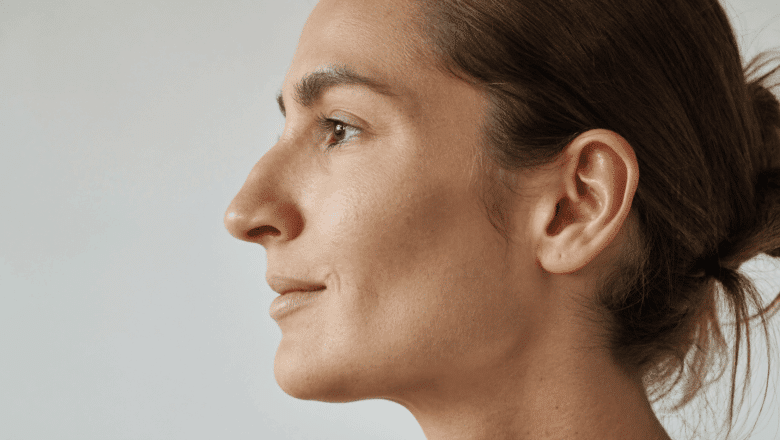
A snub nose is short, with a rounded tip that sits slightly higher than the bridge. It is one of the most common nose shapes, it is entirely normal, and for a great many people it is the feature they like most about their face.
It is worth saying that plainly at the start, because pages like this one tend to imply that every nose shape with a name is a problem waiting to be solved. A snub nose is not a deformity, it causes no functional difficulty, and choosing to leave it alone is a perfectly reasonable decision.
Some people would still prefer a longer profile or a less rotated tip, and that is equally reasonable. This guide explains what actually defines a snub nose, how it differs from a button nose and an upturned nose — which are related but not the same — and what can and cannot be changed, whether by dermal filler or rhinoplasty.
What Is a Snub Nose?

Three things combine to produce the snub appearance:
- Short nasal length — the distance from the root of the nose, between the eyes, down to the tip is shorter than average.
- Modest tip projection — the tip does not extend far forward from the face, so the nose sits close to the profile.
- A slightly increased nasolabial angle — the angle between the upper lip and the base of the nose. Typical ranges are around 90 to 95 degrees in men and 95 to 110 degrees in women. In a snub nose it sits toward or a little beyond the upper end, which rotates the tip upward.
The tip is also usually rounded rather than defined, because the lower lateral cartilages are softer or set slightly further apart. That roundness is what most people are describing when they call a nose “snub” rather than simply “small”.
What does snub nose mean?
In everyday English, “snub” describes something short and blunt — the word predates its use for noses. A snub nose therefore means a short nose with a blunt, rounded, slightly upturned tip.
Two notes on usage. The term is descriptive rather than clinical — surgeons talk about nasal length, tip projection and rotation rather than “snub”. And it also refers to a type of short-barrelled revolver, which is why searching the phrase returns a great deal about firearms.
Snub, Button or Upturned: What’s the Difference?

These three terms are used interchangeably in everyday speech and describe different things.
Snub nose — short overall, rounded tip, mild upward rotation. The defining feature is shortness combined with bluntness.
Button nose — small and round, with a soft tip and a narrow bridge. The defining feature is smallness and roundness rather than rotation. A button nose may or may not be upturned; a snub nose usually is, slightly.
Upturned nose — defined by rotation alone. The tip is raised so that more of the nostril is visible in profile. An upturned nose can be long or short; a snub nose is short by definition.
In practice many noses sit across two categories, which is why the labels blur. What matters clinically is not which word applies but which measurement you would want changed — length, projection or rotation.
What Causes a Snub Nose?
- Genetics — overwhelmingly the main factor. Nasal length, tip cartilage shape and nasolabial angle are inherited.
- Ethnic variation — shorter noses with lower tip projection are more common in some populations, and this is normal anatomical variation. Ethnic rhinoplasty addresses proportion while preserving the character of the nose rather than imposing a single template.
- Childhood facial development — the nose grows until the late teens, so a nose that looked snub at twelve may not by twenty.
- Previous rhinoplasty — over-rotating the tip or removing too much dorsal height can create a snub or over-shortened appearance that was not there before. This is one of the commoner reasons for revision rhinoplasty, and it is considerably harder to correct than the original problem.
- Trauma in childhood — injury to the growth centres of the nose can restrict subsequent development, producing a shorter nose in adulthood.
Is a snub nose attractive?
This has no medical answer, and anyone claiming otherwise is selling something.
What can be said is that short, slightly upturned noses have been consistently well regarded across cultures and periods, and that facial attractiveness research finds no single ideal nasal profile. What reads as harmonious depends on the rest of the face — chin projection, lip position, forehead shape — far more than on the nose in isolation.
The only question that matters is whether it bothers you. If it does not, there is nothing here to fix.
Can a Snub Nose Be Changed?

Non-surgical rhinoplasty
Dermal filler placed along the bridge adds height, which makes the nose read as longer and straighter in profile and reduces the apparent upward tilt of the tip. A small amount at the base of the tip can add a little projection.
It is a 15-minute treatment with no downtime, and it lasts around 12 to 18 months. Its limits are worth understanding: filler can only add volume, never remove or reposition it. A short nose can be made to look straighter, but it cannot be made shorter or genuinely longer, and a rotated tip cannot be rotated down.
Filler in the nose also carries a small but real risk of vascular occlusion, which is why it should only be performed by an experienced injector with hyaluronidase available. More on non-surgical rhinoplasty.
Rhinoplasty
Surgical lengthening of a short nose is one of the more technically demanding rhinoplasty procedures, because it involves building structure rather than reducing it.
Cartilage grafts — typically septal extension grafts — are used to lengthen the septum and push the tip forward and down, increasing projection and reducing rotation. Where septal cartilage is insufficient, particularly after previous surgery, ear or rib cartilage is used.
The skin is the limiting factor. Skin can be redraped over a lengthened framework only so far, and thick skin resists showing the underlying definition. This is why the achievable change is often smaller than people expect, and why an honest surgeon will tell you the realistic limit before you book rather than afterwards.
Both open and closed approaches are used, though lengthening usually requires open access for accurate graft placement. More on open versus closed rhinoplasty.
What about exercises, taping or tools?
None of them work. The shape of the nose is determined by cartilage and bone, neither of which responds to massage, exercise or clip-on devices. Nose-shaping tools sold online produce no lasting change and can bruise or damage the skin.
Makeup contouring genuinely works visually and is free of risk.
Recovery and Realistic Expectations
Rhinoplasty to lengthen a short nose is a day-case procedure under TIVA. A splint is worn for a week. Bruising and swelling settle over two to three weeks, and most people return to work within two weeks and to full exercise at four to six.
The result takes time. Around 80 per cent of swelling resolves by three months, but the tip continues to refine for 12 to 18 months, and longer in thicker skin. Judging the outcome at six weeks is judging swelling, not surgery.
Cost
Cost depends on whether the change is achieved with filler or surgery, on the complexity of the surgical plan, and on whether cartilage needs to be taken from the ear or rib. Your exact cost is confirmed in writing after in-person consultation. Finance is available through Chrysalis Finance, subject to status — see our finance options.
Rhinoplasty performed for appearance alone is not available on the NHS.
Snub Nose FAQs
What is a snub nose?
A short nose with a rounded, blunt tip that sits slightly higher than the bridge. It is defined by shorter nasal length, modest tip projection and a slightly increased nasolabial angle. It is a common, normal nose shape.
What does snub nose mean?
“Snub” means short and blunt. Applied to a nose it describes a short nose with a rounded, slightly upturned tip. It is a descriptive term rather than a clinical one — surgeons refer to nasal length, projection and rotation instead.
What is the difference between a snub nose and a button nose?
A snub nose is defined by being short with a blunt, slightly raised tip. A button nose is defined by being small and round with a narrow bridge. They overlap, but snub emphasises shortness and rotation while button emphasises smallness and roundness.
Is a snub nose the same as an upturned nose?
No. An upturned nose is defined purely by tip rotation and can be any length. A snub nose is short by definition and usually only mildly rotated. Many noses are both.
What causes a snub nose?
Genetics, principally — nasal length and tip cartilage shape are inherited, with normal variation between populations. Less commonly it follows childhood nasal injury affecting growth, or previous rhinoplasty in which the tip was over-rotated or the bridge over-reduced.
Can you fix a snub nose without surgery?
Dermal filler can add height to the bridge, which makes the nose read as longer and straighter and reduces the apparent tilt of the tip. It lasts 12 to 18 months. It cannot shorten, lengthen or de-rotate the nose — filler only adds volume.
Do nose exercises or nose-shaping tools work?
No. Nasal shape is set by cartilage and bone, which do not respond to exercise, massage or external devices. Contouring with makeup works visually and carries no risk.
Can rhinoplasty make a short nose longer?
Yes, within limits. Cartilage grafts lengthen the septum and reposition the tip downward and forward. The skin envelope limits how much lengthening is achievable, particularly where skin is thick, so the realistic change is often smaller than expected.
Is a snub nose attractive?
There is no medical answer to this. Short, slightly upturned noses are widely regarded as attractive across cultures, and facial harmony depends far more on the relationship between features than on any single nasal shape. The only question worth answering is whether it bothers you.
Do men and women need different treatment for a snub nose?
The anatomy is the same but the aesthetic targets differ. A male nose is generally planned toward a straighter dorsum and a nasolabial angle around 90 to 95 degrees, whereas 95 to 110 degrees is typical in women. Over-rotating a male nose is a common cause of an unnatural result. More on male rhinoplasty.
Will my nose change shape as I get older?
Yes, gradually. Cartilage weakens with age and the tip tends to drop, so a snub nose often becomes less rotated over decades. This is one reason to be cautious about over-rotating a tip surgically in a younger patient.
Can a snub nose cause breathing problems?
Not in itself. Difficulty breathing through the nose is caused by nasal valve collapse, a deviated septum or enlarged turbinates — internal structures unrelated to external shape.
Why does my nose look snub after rhinoplasty?
Usually swelling. The tip appears more rotated in the first months and settles as swelling resolves over 12 to 18 months. Persistent over-rotation beyond that may reflect over-resection of the septum or excessive tip rotation, and is assessable at review.
Rhinoplasty Consultation at Centre for Surgery
Consultation begins with what you actually want changed, which is often more specific than “my nose is snub” — more commonly it is the profile view, or how the tip looks in photographs.
Assessment covers nasal length, tip projection, rotation and skin thickness, alongside the rest of the face, because chin projection and lip position influence how a nose reads as much as the nose does. Where breathing is also a concern, the nasal airway is examined at the same time.
We will tell you plainly where the realistic limit sits, and if what you are describing is within normal variation and unlikely to be worth operating on, we will say so.
All surgery is performed by GMC-registered surgeons at our own day-surgery facility at 95–97 Baker Street, Marylebone. We are regulated by the Care Quality Commission and rated Good overall. We recommend a two-week cooling-off period before any surgery is booked.
Patient reviews
You can read our reviews in full on Google Reviews, or on our own patient reviews page. We are rated 4.6 on Google.
Book a consultation
Phone: 020 7993 4849
Email: contact@centreforsurgery.com
Address: 95–97 Baker Street, Marylebone, London W1U 6RN
Contact us to schedule your consultation
Your initial in-person consultation is £100, redeemable against the cost of surgery if you proceed.
Related Reading
- Nose shapes: the common types and how to identify yours
- Upturned nose rhinoplasty
- What causes a droopy nose?
- Rhinoplasty (nose job)
- Tip rhinoplasty
- Non-surgical rhinoplasty
- Open vs closed rhinoplasty
- Revision rhinoplasty
- Ethnic rhinoplasty
- Nasal valve collapse



