


In this guide10 sections
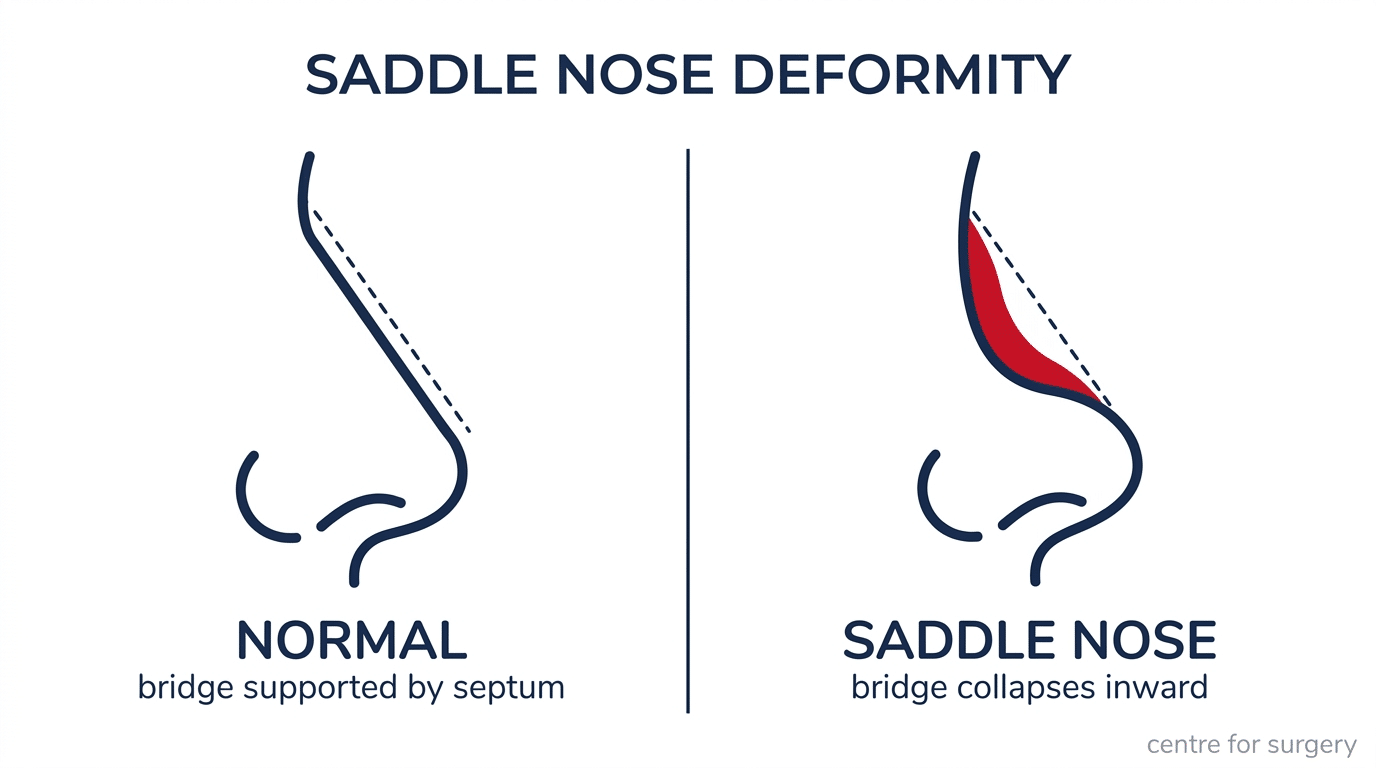
A saddle nose deformity is a collapse of the nasal bridge, producing a scooped, dipped profile that resembles a saddle. It is the one nose shape on our nose shapes guide that is genuinely a deformity rather than a variant, because something has been lost: the septal support that holds the bridge up from inside.
That distinction matters more than the cosmetic appearance, and it is the reason this page opens with a warning rather than a treatment list.
A saddle nose that develops without an obvious injury is a medical finding before it is a cosmetic one. Several of its causes are systemic diseases where the nose is simply the first visible sign, and two of them can cause irreversible organ damage if missed. If your nose has changed shape and you cannot account for why, the correct first step is your GP, not a surgeon.
This guide covers what a saddle nose is, the early signs, every significant cause, when to seek medical assessment urgently, and how the nose is reconstructed once any underlying condition is controlled.
What a Saddle Nose Looks Like
The saddle shaped nose has a recognisable combination of features, and they appear together because they share one cause.
- A dipped or scooped bridge — the middle third of the nose sinks below the line from root to tip. This is the defining feature.
- An upturned, over-rotated tip — as the bridge loses height, the tip rotates upward, showing more nostril in profile.
- A shortened nose — the whole nose appears shorter from root to tip.
- A widened, flattened appearance from the front, sometimes with a broadened tip.
- Loss of tip support — the tip feels soft and moves easily when pressed.
Severity ranges considerably. A mild saddle nose may show only a slight dip in profile that most people would not notice, while a severe one produces marked collapse with the tip almost sitting against the face.
Saddle nose images and photographs vary so widely in severity that comparing yourself to one you have found online is unreliable. The diagram above shows the pattern; the degree is what varies.
Early Signs of Saddle Nose
The collapse is usually gradual, and the earliest signs are not always visual.
- A whistling sound when breathing — often the very first sign, caused by a septal perforation before any external change appears
- Persistent crusting inside the nose, sometimes with recurrent bleeding
- A blocked nose that will not settle, particularly with a foul-smelling discharge
- A subtle change in profile noticed in photographs before it is noticed in the mirror
- Glasses sitting differently on the bridge of the nose
- A softening of the tip — loss of the firm resistance the nose normally has
If you have septal perforation symptoms — whistling, crusting, bleeding — without a clear cause such as recent surgery, that is worth investigating promptly. Perforation frequently precedes collapse, and treating the cause at that stage can prevent the deformity entirely.
When a Saddle Nose Needs Urgent Medical Assessment

See a doctor promptly if your nose is collapsing and you have not injured it, particularly alongside any of the following:
- Blood in the urine, or frothy urine — suggesting kidney involvement
- A persistent cough, coughing blood, or breathlessness
- Red, painful, swollen ears that spare the earlobes
- Joint pain, unexplained fever, night sweats or weight loss
- Recurrent sinus infections that do not respond to antibiotics
- Numb or reddened eyes, or blurred vision
That combination points toward granulomatosis with polyangiitis or relapsing polychondritis, both of which are treatable and both of which cause permanent damage if left. Diagnosis usually begins with a simple blood test — ANCA antibodies, inflammatory markers, kidney function — and your GP can arrange it.
Cosmetic surgery on a nose being actively destroyed by untreated inflammatory disease will fail. Sequence matters.
Saddle Nose Causes

Whatever the cause of saddle nose, the mechanism is identical — loss of septal cartilage or the bone behind it, so the bridge has nothing to rest on.
Trauma
A fractured nose with an untreated septal haematoma is the classic cause. Blood collects between the septal cartilage and its covering, cutting off the cartilage’s blood supply; without drainage within a few days the cartilage dies, and collapse follows weeks or months later. This is why a nasal injury with complete blockage on one side should be assessed within 24 to 48 hours rather than left. See broken nose surgery.
Previous nasal surgery
Over-resection during septoplasty or rhinoplasty is one of the commonest causes seen today. Removing too much septal cartilage, or failing to preserve an adequate L-shaped strut of cartilage along the bridge and at the base, leaves the nose without a support beam. Collapse can appear years later as remaining cartilage weakens.
Aggressive dorsal hump reduction without reconstructing the middle vault produces a related problem, sometimes called an inverted-V deformity, which can progress toward a saddle appearance. It is a frequent reason for revision rhinoplasty.
Granulomatosis with polyangiitis
Formerly Wegener’s granulomatosis. An autoimmune vasculitis that inflames small blood vessels, frequently affecting the nose, sinuses, lungs and kidneys. Saddle nose is a recognised feature, and nasal symptoms are often the first presentation — months before anything else. Treatment is immunosuppression, and outcomes are good when caught early and poor when not.
Relapsing polychondritis
A rarer autoimmune condition attacking cartilage throughout the body. The characteristic sign is inflamed, painful ears that spare the earlobes, because earlobes contain no cartilage. Nasal cartilage is affected in a majority of cases, producing progressive saddling.
Recreational drug use
Intranasal stimulant use causes intense vasoconstriction, and repeated use starves the septal cartilage of blood supply. The result is septal perforation and, in advanced cases, drug-induced midline destructive lesion — destruction extending beyond the septum to the palate and sinuses.
This is a genuine and increasingly common cause. It is worth being straightforward about it for one practical reason: reconstruction has a substantially higher failure rate if use continues, and surgeons will generally require a documented period of abstinence before operating. That is not a moral position, it is a structural one — grafted cartilage placed into a nose still being subjected to vasoconstriction does not survive.
Congenital syphilis
Historically the best-known cause, and the reason saddle nose appears in older medical texts alongside other stigmata of congenital infection. Untreated congenital syphilis damages the developing nasal bones and cartilage, producing collapse in later childhood. It is now rare in the UK owing to antenatal screening, though syphilis rates have risen in recent years and it remains part of the differential.
Other causes
Leprosy remains a significant cause worldwide though it is very rare in the UK. Nasal lymphoma, sarcoidosis, tuberculosis and prolonged intranasal steroid or decongestant misuse are all documented, less common causes.
How Saddle Nose Is Diagnosed
Assessment covers three questions: how much support has been lost, what caused it, and whether the cause is still active.
Examination includes nasal endoscopy to see the septum directly and identify any perforation, along with palpation to assess remaining support. Imaging, usually CT, shows the extent of bone and cartilage loss and how much septal cartilage remains available for grafting.
Blood tests are performed wherever the cause is not obviously traumatic or surgical — ANCA antibodies, inflammatory markers, kidney function, and syphilis serology. Biopsy of the nasal lining may be needed where vasculitis or malignancy is suspected.
Where an inflammatory cause is found, management passes to rheumatology first. Reconstruction follows once disease is quiescent, typically after a sustained period of remission.
Saddle Nose Reconstruction
This is structural surgery rather than cosmetic refinement. The aim is to rebuild the support that has been lost, restore the profile, and reopen the airway — usually all three at once, since a collapsed bridge nearly always obstructs breathing.
Grafting material
- Costal (rib) cartilage — the standard for moderate to severe cases. It provides enough material to carve an L-shaped strut that supports both the bridge and the tip. Taken through a small incision under the breast crease or along the rib margin.
- Ear (conchal) cartilage — suitable for milder saddling where less volume is needed. It is naturally curved, so it is used for contour rather than structural support.
- Septal cartilage — ideal when available, but usually is not, because its loss is what caused the problem.
- Diced cartilage in fascia — cartilage diced finely and wrapped in temporalis fascia, used to build smooth dorsal height. Excellent for contour, but it does not provide structural support and is used alongside a strut rather than instead of one.
- Irradiated donor rib — avoids a donor site, though with a higher long-term resorption rate than the patient’s own cartilage.
Synthetic implants such as silicone are generally avoided in saddle nose reconstruction. Rates of extrusion and infection are meaningfully higher in a nose with compromised lining, which is precisely the situation here.
What the surgery involves
An open approach is nearly always used, since accurate graft placement and fixation cannot be done blind. Where the nasal lining is deficient — common after perforation or inflammatory disease — the lining must be repaired or reconstructed first, sometimes as a separate earlier stage.
Surgery typically takes two to four hours. Where rib is harvested there is chest discomfort for one to two weeks, and this is often the more uncomfortable part of recovery.
Recovery
A splint is worn for a week to ten days. Bruising and swelling settle over two to three weeks. Most people return to desk work at two weeks and to full activity at six, with heavy lifting restricted for longer where rib has been taken.
The final result takes 12 to 18 months, and revision rates are higher than for standard rhinoplasty — this is complex reconstructive surgery, and a degree of graft resorption over time is normal and sometimes requires adjustment.
Are non-surgical options possible?
Dermal filler can camouflage very mild saddling by adding height to the bridge, and it can be a reasonable option where the deformity is slight, the cause is resolved, and someone does not want surgery. It lasts 12 to 18 months.
It has clear limits. Filler adds volume but provides no structural support, so it will not lift a collapsed bridge or improve breathing, and it is unsuitable for moderate or severe deformity. It should not be used at all where the underlying cause is still active. See non-surgical rhinoplasty.
Cost
Saddle nose reconstruction is complex surgery and cost reflects that — it depends on the grafting required, whether rib harvest is needed, whether lining reconstruction is necessary, and whether the procedure is staged. Your exact cost is confirmed in writing after in-person consultation and imaging. Finance is available through Chrysalis Finance, subject to status — see our finance options.
Where saddle nose causes functional nasal obstruction or follows disease or trauma, NHS treatment may be available. Your GP is the route to referral, and this is more likely to be funded than purely cosmetic nasal surgery.
Saddle Nose Deformity FAQs
What is a saddle nose deformity?
A collapse of the nasal bridge producing a scooped, dipped profile, caused by loss of the septal cartilage or bone that supports it. It is usually accompanied by an upturned tip, a shortened nose and difficulty breathing.
What causes saddle nose?
Loss of septal support. The commonest causes are untreated septal haematoma after nasal injury, over-resection during previous septoplasty or rhinoplasty, granulomatosis with polyangiitis, relapsing polychondritis, intranasal recreational drug use and, historically, congenital syphilis.
What are the early signs of saddle nose?
A whistling sound when breathing, persistent crusting or bleeding inside the nose, a nose that will not unblock, glasses sitting differently, a softening of the tip, and a subtle profile change first noticed in photographs. Whistling often indicates septal perforation before any external change appears.
Is saddle nose serious?
The deformity itself is not dangerous, but several of its causes are. A saddle nose developing without injury needs medical assessment, because conditions such as granulomatosis with polyangiitis can also affect the kidneys and lungs and cause permanent damage if untreated.
Can saddle nose be a sign of something serious?
Yes. It is a recognised feature of systemic vasculitis and of relapsing polychondritis. Where it appears alongside blood in the urine, cough or breathlessness, red painful ears, joint pain or unexplained fever, it needs prompt investigation with blood tests.
Can recreational drug use cause saddle nose?
Yes. Intranasal stimulant use constricts the blood vessels supplying the septum, and repeated use causes the cartilage to die, producing perforation and eventually collapse. Reconstruction is possible but has a substantially higher failure rate if use continues, so surgeons generally require documented abstinence beforehand.
Can septoplasty cause saddle nose?
It can, though it is uncommon with modern technique. Removing too much cartilage, or failing to leave an adequate L-shaped strut along the bridge and base, deprives the nose of support. Collapse may appear years after the original operation.
Why does syphilis cause saddle nose?
Untreated congenital syphilis damages the developing nasal bones and cartilage, causing collapse in later childhood. It is now rare in the UK because of antenatal screening, but remains part of the diagnostic picture.
Can a saddle nose be fixed?
Yes. Reconstruction using cartilage grafts, usually from the rib, rebuilds the bridge and restores both appearance and breathing. Results are generally good, though it is complex surgery with a higher revision rate than standard rhinoplasty.
Can filler fix a saddle nose?
Only very mild cases, and only cosmetically. Filler adds height to camouflage a slight dip but provides no structural support and does not improve breathing. It is unsuitable for moderate or severe deformity, and inappropriate where the underlying cause is still active.
What is a mild saddle nose?
A slight dip in the bridge with support largely preserved and little or no functional problem. It may need nothing at all, or can be improved with a small cartilage graft or with filler.
Does saddle nose affect breathing?
Usually yes. The same loss of structure that collapses the bridge narrows the internal airway, and the middle of the nose frequently collapses inward on inspiration — the same mechanism as nasal valve collapse.
Is saddle nose reconstruction available on the NHS?
It may be, where there is functional obstruction or the deformity follows disease or trauma. Access varies by area and your GP can advise on local criteria. Purely cosmetic nasal surgery is not funded.
How long does recovery take?
A splint for a week to ten days, swelling settling over two to three weeks, desk work at two weeks and full activity at six. Where rib cartilage is harvested, chest discomfort lasts one to two weeks. The final result takes 12 to 18 months.
Nasal Reconstruction at Centre for Surgery
Saddle nose is assessed by our ENT surgeon and rhinologist, because the first question is not what the nose looks like but why it collapsed.
Assessment covers endoscopy, imaging where indicated, and blood tests where the cause is not clearly traumatic or surgical. Where an inflammatory or systemic cause is identified we will refer you for medical management first — operating on an actively inflamed nose produces a poor result and delays the diagnosis that matters more.
Where reconstruction is appropriate, we will be explicit about what is achievable, what grafting is required, and the likelihood of needing revision.
All surgery is performed by GMC-registered surgeons at our own day-surgery facility at 95–97 Baker Street, Marylebone. We are regulated by the Care Quality Commission and rated Good overall. We recommend a two-week cooling-off period before any surgery is booked.
Patient reviews
You can read our reviews in full on Google Reviews, or on our own patient reviews page. We are rated 4.6 on Google.
Book a consultation
Phone: 020 7993 4849
Email: contact@centreforsurgery.com
Address: 95–97 Baker Street, Marylebone, London W1U 6RN
Contact us to schedule your consultation
Your initial in-person consultation is £100, redeemable against the cost of surgery if you proceed.
Related Reading
- Nose shapes: the common types
- Revision rhinoplasty
- Septoplasty (deviated septum surgery)
- Septorhinoplasty
- Nasal valve collapse
- Broken nose surgery
- What is a deviated septum?
- Nasal turbinates
- Rhinoplasty (nose job)



