


In this guide12 sections
- Key Points
- Can You Repair and Re-pierce an Earlobe at the Same Time?
- Why Most Surgeons Wait Before Re-piercing
- How Long After Earlobe Repair Can I Re-pierce?
- Can Ears Be Re-pierced in the Same Spot?
- What Does Earlobe Repair Involve?
- Earlobe Repair Before and After
- How to Re-pierce Safely After Earlobe Repair
- What Are the Risks of Earlobe Repair?
- Frequently Asked Questions
- References
- Talk to a Surgeon About Earlobe Repair
Key Points
- Some surgeons re-pierce the earlobe during the repair itself, but many prefer to close the lobe completely and re-pierce later, once the scar is strong.
- At Centre for Surgery, earlobe repair and re-piercing are not done in the same procedure. The lobe is repaired first, and re-piercing waits at least six months.
- The new hole is placed 2–3 mm from the scar, not through it, because scar tissue is weaker than normal skin and a piercing through it is more likely to stretch or split again.
- Earlobe repair takes 20–45 minutes per lobe under local anaesthetic, the stitches come out at day 5 to 7, and most people return to work the same day or the next.
- You can usually re-pierce close to where your earrings sat before, so earrings line up as they did, but not in the exact same spot as the old split.
A split, torn or stretched earlobe is easy to repair, and most people want to wear earrings again afterwards. The obvious question is whether the hole can be put back at the same time, so you leave with a repaired lobe and a new piercing in one visit. This guide explains what earlobe repair involves, whether you can re-pierce in the same procedure, why most surgeons, including ours, wait, and how to re-pierce safely when the time comes. For the procedure itself, see our earlobe repair page.
Can You Repair and Re-pierce an Earlobe at the Same Time?
It is possible, and some surgeons do it. The published techniques fall into two groups. Some leave a small opening, or create a new one, during the repair, so a piercing is ready straight away. A 2002 paper in Dermatologic Surgery[4] describes immediate re-piercing at the time of repair, and a 2012 technique report[5] preserves part of the original hole with a permanent buried stitch to reinforce it. Others close the lobe completely and re-pierce later. A 2004 review of earlobe repair techniques in Facial Plastic Surgery ↗[1] notes that many authors advocate complete closure of the torn lobe and re-piercing at a later time.
At Centre for Surgery, we repair the lobe first and re-pierce later. Earlobe repair is also not offered as a same-day see-and-treat procedure on the day of your consultation: the repair is booked as a separate appointment once your surgeon has assessed the lobe.
Why Most Surgeons Wait Before Re-piercing
A repaired earlobe heals with a scar along the old split. Scar tissue is never as strong as normal skin, and it takes months to mature. Putting a new hole in or right next to it while it is still healing has three risks:
- The repair can reopen, particularly if the earring is heavy or is caught early on.
- The new hole can stretch along the scar, so the lobe splits again over time. A 2005 report in Dermatologic Surgery ↗[3] explains that piercing within a scarred area increases the risk of the tract elongating again, because the scar has less tensile strength.
- Infection in a fresh piercing can spread into a wound that has not yet sealed.
Waiting avoids all three. It also lets your surgeon see where the scar has settled and choose the best spot for the new piercing.
How Long After Earlobe Repair Can I Re-pierce?
At Centre for Surgery, wait at least six months after earlobe repair before re-piercing, so the scar has fully matured and strengthened. This matches the published experience: in a 2010 series of 30 split earlobe repairs in Aesthetic Plastic Surgery[2], re-piercing was allowed after six months. Re-piercing too early is one of the main reasons a repaired earlobe splits again.

Can Ears Be Re-pierced in the Same Spot?
Not exactly. After a repair, the old hole and split have become a line of scar. The new piercing should sit 2–3 mm from that scar, not through it. In practice this is close enough that your earrings still sit where they used to, and most people cannot tell the difference. Your surgeon will plan where the scar will lie at the time of repair, so there is healthy tissue left for the new hole.
If your earring hole has simply stretched, rather than split, the same rule applies: the stretched hole is closed and the new piercing goes into normal tissue beside the scar.
What Does Earlobe Repair Involve?
Earlobe repair is a short procedure under local anaesthetic:
- Anaesthetic: a small injection of local anaesthetic, which stings for 5 to 10 seconds and then numbs the lobe for about 2 to 3 hours.
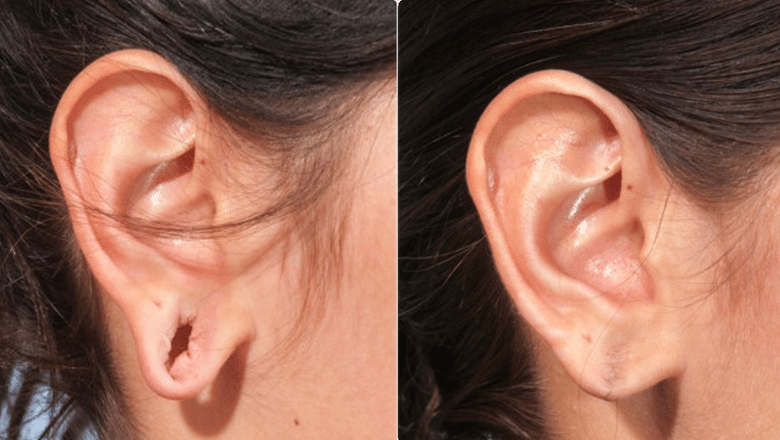
- The repair: the edges of the split are freshened, or the stretched tissue removed, and the lobe is closed in layers with fine stitches. A zigzag closure (Z-plasty) at the bottom edge helps prevent a notch.
- Time: 20 to 45 minutes per earlobe; both ears can be done in one session.
- Afterwards: you can drive home if only local anaesthetic was used, and most people return to work the same day or the next.
- Stitches: removed at the clinic at day 5 to 7.
Large holes from gauges need a different approach; our guide to repairing stretched earlobes from gauges explains the options. If your earlobes are simply large or long, earlobe reduction can be done at the same time, and earlobe repair can also be combined with otoplasty (ear pinning) for one recovery.
Earlobe Repair Before and After

How to Re-pierce Safely After Earlobe Repair
When the six months are up:
- Check with your surgeon first, so they can confirm the scar has matured and mark the best position, 2–3 mm from the scar.
- Use a clean, sterile technique with a reputable piercer, or ask at your follow-up appointment.
- Start with lightweight, hypoallergenic studs for the first few months.
- Avoid heavy or dangling earrings long term, and use spreader-type earring backs that share the weight.
- Take earrings out for sport, sleeping and when handling young children, who often pull on them.
What Are the Risks of Earlobe Repair?
Earlobe repair is a low-risk procedure, but it is still surgery:
- Notching: a small V-shaped step at the bottom of the lobe, which the Z-plasty helps prevent and which can be revised under local anaesthetic.
- Infection: uncommon.
- Raised or keloid scarring: more likely if you have had keloids before. Tell your surgeon at consultation so a scar management plan can be arranged; our guide to keloids on the ear explains the risk.
- The wound reopening if you re-pierce too early or wear heavy earrings too soon.
- The damage recurring over the years if heavy earrings are worn again.
If a lump has appeared in your earlobe rather than a split, see our guide to an earlobe cyst.
Frequently Asked Questions
Can you pierce your ears in the same spot twice?
If a piercing has simply closed up and the lobe is intact, a piercer can often re-pierce close to the old spot. After an earlobe repair, the old hole has become a scar, so the new piercing should go 2–3 mm away from it rather than through it.
Is earlobe repair painful?
Only the local anaesthetic injection is felt, as a sting for 5 to 10 seconds. After that the lobe is completely numb for the procedure. Afterwards there may be mild soreness for a day or two, usually managed with simple painkillers.
How do you repair an ear hole?
A stretched or split ear hole is repaired by removing the thin, stretched lining of the hole or freshening the edges of the split, then closing the lobe in layers with fine stitches. It takes 20 to 45 minutes under local anaesthetic, and the stitches come out at day 5 to 7.
Can I re-pierce my ears with scar tissue?
It is better not to pierce directly through scar tissue, because it is weaker than normal skin and more likely to stretch or split again. After a repair, wait six months and place the new hole 2–3 mm from the scar.
Can I wear earrings after earlobe repair?
Yes, once you have re-pierced at six months. Start with light studs, and avoid heavy or dangling earrings, which are the most common cause of the lobe splitting again.
References
- Watson D. Repair of the torn earlobe. Facial Plast Surg. 2004;20(1):39-45. doi:10.1055/s-2004-822957 ↗
- Chiummariello S, Iera M, Arleo S, Alfano C. L-specular plasty versus double-round plasty: two new techniques for earlobe split repair. Aesthetic Plast Surg. 2011;35(3):398-401. doi:10.1007/s00266-010-9596-5 ↗
- Greco JF, Stanko CS, Greenbaum SS. Use of a deep polypropylene suture during earlobe repair: a method to provide permanent reinforcement in the prevention of recurrent earlobe tract elongation. Dermatol Surg. 2005;31(11 Pt 1):1442-1443. doi:10.2310/6350.2005.31212 ↗
- Niamtu J. Eleven pearls for cosmetic earlobe repair. Dermatol Surg. 2002;28(2):180-185. doi:10.1046/j.1524-4725.2002.01052.x ↗
- Yadav S, Sarangal R, Dogra S. One-step technique for esthetic earlobe repair. J Cosmet Dermatol. 2012;11(4):307-309. doi:10.1111/jocd.12005 ↗
Talk to a Surgeon About Earlobe Repair
If you have a split, torn or stretched earlobe and want to wear earrings again, you can book a consultation at our Baker Street clinic by calling 020 7993 4849 or using the form below. Your surgeon will plan the repair and where you can re-pierce. If your earlobes have changed with age, our guide to why earlobes get bigger with age may also help.





