


In this guide14 sections
- Key Points
- Do Ears Keep Growing? The Short Answer
- Do Your Ears and Nose Keep Growing? What the Measurements Show
- Why Do Ears Get Bigger With Age?
- Do Earlobes Keep Growing? Big Earlobes and Long Earlobes Explained
- Why Earlobes Sag: The Causes of Enlarged, Long or Droopy Earlobes
- Does Ear Size Mean Anything?
- Do Ears Keep Growing After You Die?
- Do Women’s Ears Keep Growing?
- Do Your Ears and Nose Keep Growing?
- How to Fix Big or Sagging Earlobes
- Frequently Asked Questions
- Earlobe Assessment at Centre for Surgery
- References
Do ears keep growing? It is one of those questions that everyone has heard an answer to — usually “yes, ears and noses never stop growing” from one relative and “no, that’s a myth” from another. The measurements settle it, and the honest answer is that both relatives are partly right. Ears do measure longer in every older age group, by roughly a centimetre between the age of 20 and 70. But the cartilage that gives the ear its shape stops growing when the rest of the skeleton does, which is also why an ear that was a different shape at birth, such as a Stahl’s ear, keeps that shape for life. What changes afterwards is almost entirely the earlobe, which lengthens slowly for the rest of your life, and the tissue around the cartilage, which softens and gives under gravity. Whether you call that growth or stretch is a matter of definition; the tape measure does not care.
This guide sets out what the studies actually found, why ears get bigger with age, which part of the ear is responsible, and what that means if you have big earlobes, long earlobes or earlobes that have started to sag. It is written from a clinic that performs earlobe reduction and otoplasty, so the treatment section is short and specific — most people reading this need nothing done at all. If your question is about the nose rather than the ears, our companion guide on whether your nose keeps growing covers that in the same detail.
Key Points
- Ears measure longer in older people. In the largest study, 1,448 ears from newborns to a 92-year-old, average ear length was 65 mm in men and 61 mm in women at 20, and 78 mm and 72 mm respectively after 70.
- The rate is small — about 0.22 mm a year in length and about 0.5 mm a year in circumference — but it adds up to around a centimetre over fifty years.
- The cartilage is not growing. The ear’s framework is essentially complete by the end of the teens. What changes afterwards is the earlobe, which is the only part of the ear shown to lengthen significantly with age, plus softening of the cartilage and skin.
- Do your ears and nose keep growing? Both get longer and look bigger with age for the same reasons — tissue stretch and loss of elasticity rather than new growth. The nose is covered in our separate guide.
- Men’s ears grow more than women’s, and the difference widens with age. Women’s earlobes change comparatively little after 40.
- Big or sagging earlobes are usually ageing, genetics or earrings, and occasionally a keloid, cyst or the “pixie ear” that follows a facelift. Only the last three are medical problems.
- Nothing has to be done. Where the length bothers you, earlobe reduction is a 20 to 40 minute procedure under local anaesthetic; stretched or split lobes are treated with earlobe repair.
Do Ears Keep Growing? The Short Answer
Yes, in the sense that matters to most people typing “do your ears keep growing” into a search box: if you measure ears across the population, they are longer in each successive decade of life, and the difference between a 20-year-old and a 75-year-old is around 10 to 13 mm — visible, not subtle. No, in the strict biological sense: the elastic cartilage that gives the ear its folds and shape does not keep producing new tissue after skeletal maturity. Ears get longer because the soft tissue lengthens and the whole structure yields to gravity over decades, not because they are still growing in the way a child’s ears grow.
That distinction is not pedantry. It tells you which part of the ear will change, how fast, and what — if anything — can be done about it.
Do Your Ears and Nose Keep Growing? What the Measurements Show

Do ears grow with age, and if so by how much? The question was first put to a test in 1995, in the Christmas issue of the British Medical Journal, by a group of general practitioners in Kent who measured the ears of 206 patients aged 30 to 93. Ear length rose steadily with age, at an average of 0.22 mm a year — about 11 mm across fifty years — and the paper’s title, “Why do old men have big ears?”, has been quoted ever since (Heathcote 1995).
A geriatrics team in Texas then compared ear and nose measurements in younger and older adults and found that ear circumference increased by about 0.51 mm a year and correlated with age more closely than any nose measurement did — closely enough that they published an equation for estimating someone’s age from the circumference of their ear (Tan et al 1997).
The most complete data set is German. Anthropologists in Berlin measured 1,448 ears from newborn babies to volunteers in their nineties. Average ear length was about 52 mm at birth in both sexes, 61 mm in women and 65 mm in men at around 20, and 72 mm in women and 78 mm in men over 70. Growth was fastest in early childhood, slowed markedly from the age of 8 to 10, and then continued at a low, roughly linear rate for the rest of life — with men gaining more than women in every measurement that changed after adulthood (Niemitz et al 2007). An Italian study of 843 people aged 4 to 73, measured in three dimensions, found the same pattern and added a detail: the ratio of ear width to ear length falls with age, so older ears are not just bigger but relatively longer and narrower (Sforza et al 2009).
One caveat applies to all of these. They are cross-sectional — each compares different people of different ages at one moment, rather than following the same people for decades — so some of the difference between a 20-year-old and a 70-year-old born fifty years earlier could reflect changes in nutrition and body size between generations. The Berlin group corrected for this as far as the data allowed, and the age trend survived. Nobody has yet measured the same ears for fifty years.
Why Do Ears Get Bigger With Age?

Why do ears keep growing in later life when nothing else does? Strictly, they don’t. The outer ear is a sheet of elastic cartilage covered by thin skin, with a soft, cartilage-free earlobe hanging from the bottom. Cartilage grows through childhood and adolescence and then stops; it does not contain the growth plates that lengthen bones, and it has no mechanism for adding new tissue in a 60-year-old. The Berlin study found that several parts of the ear — the width of the concha (the bowl around the ear canal), the notch above the earlobe and the thickness of the helix rim — did not grow at all after birth. So if the ear as a whole measures longer, the change has to be coming from somewhere else. Four things are happening.
The earlobe lengthens. A study of 123 volunteers at Brown University measured every part of the ear and found that total ear height rose significantly with age, but once the height of the lobe was subtracted, the difference disappeared. The lobule was the only part of the ear that changed with age (Brucker et al 2003). The earlobe is skin and fat with no cartilage to hold its shape, and it hangs from the ear by a narrow attachment, so decades of gravity and the loss of collagen and elastin in the skin gradually pull it longer and thinner.
The cartilage softens and yields. Elastic cartilage loses elastin and gains stiffer, cross-linked collagen with age; the ear becomes less springy and more prone to holding whatever position gravity gives it. This is why older ears often look slightly longer and flatter even above the lobe, and why the width-to-length ratio falls.
The skin loses elasticity. The same collagen and elastin breakdown that produces jowls loosens the skin over the ear, so the whole structure drapes a little lower. Sun exposure accelerates this, and the ears — which few people ever put sunscreen on — receive a great deal of it.
The face around the ears shrinks. Fat pads in the cheek and temple lose volume, the jawline softens and the hairline recedes. Ears that have gained a few millimetres are then seen against a face that has lost some, and the effect is out of proportion to the actual change. This is a large part of why ears seem to grow more than they measurably do.
At what age are ears fully grown?
Ears grow from birth at their fastest rate, and most of the ear’s growth is done early. The ear is already large relative to the head at birth and reaches roughly nine-tenths of its adult size by the age of 8 to 10, after which yearly increases fall sharply. The cartilage framework is effectively complete by the end of the teens, which is why surgeons are comfortable correcting prominent ears in children from around the age of five. What continues after that is the slow adult drift described above, most of it in the lobe.
Do Earlobes Keep Growing? Big Earlobes and Long Earlobes Explained
It is often written — including by clinics — that earlobes do not grow in adulthood and only appear larger. The measurements say otherwise. Whether the mechanism is called growth or stretch, the earlobe measures longer in every decade, and it is the one part of the ear where the change is large enough to notice.
The reference study measured 547 adults aged 20 to 80. Average earlobe length was about 2 cm — 1.97 cm on the left and 2.01 cm on the right, a small but consistent asymmetry — and it differed significantly between the 20 to 40, 40 to 60 and over-60 age groups in both sexes. Free-hanging, pendulous lobes were longer and less symmetrical than lobes attached along their front edge. Sex and age were the only factors that independently predicted lobe length; body weight mattered only in women; and, surprisingly, pierced lobes were not longer than unpierced ones — in men, unpierced left lobes were actually longer. The authors also noted that women’s earlobes change comparatively little after 40 (Azaria et al 2003).
A series of studies from Southern Illinois then defined what an earlobe of “ideal” proportion looks like, by asking people to rank profiles with different lobe lengths, and split the lobe into two parts: the attached segment along the cheek, and the free segment that hangs below it. Preferred free-lobe lengths were 5 mm, then 10 mm; anything over 15 mm was consistently disliked (Mowlavi et al 2003). When the same group measured patients seeking facial surgery, the free segment increased decade by decade with age while the attached segment did not; only 22% of earlobes had a free segment in the preferred 1 to 5 mm range, and most people’s two ears differed from each other (Mowlavi et al 2004). That is the earlobe version of the whole-ear story: the part that hangs free is the part that lengthens.
So big earlobes in later life are, for most people, simply the normal outcome of an unsupported piece of soft tissue hanging from the face for sixty years. Large earlobes from childhood are a different matter and are usually inherited. Both are variants of normal anatomy rather than conditions.
Why Earlobes Sag: The Causes of Enlarged, Long or Droopy Earlobes
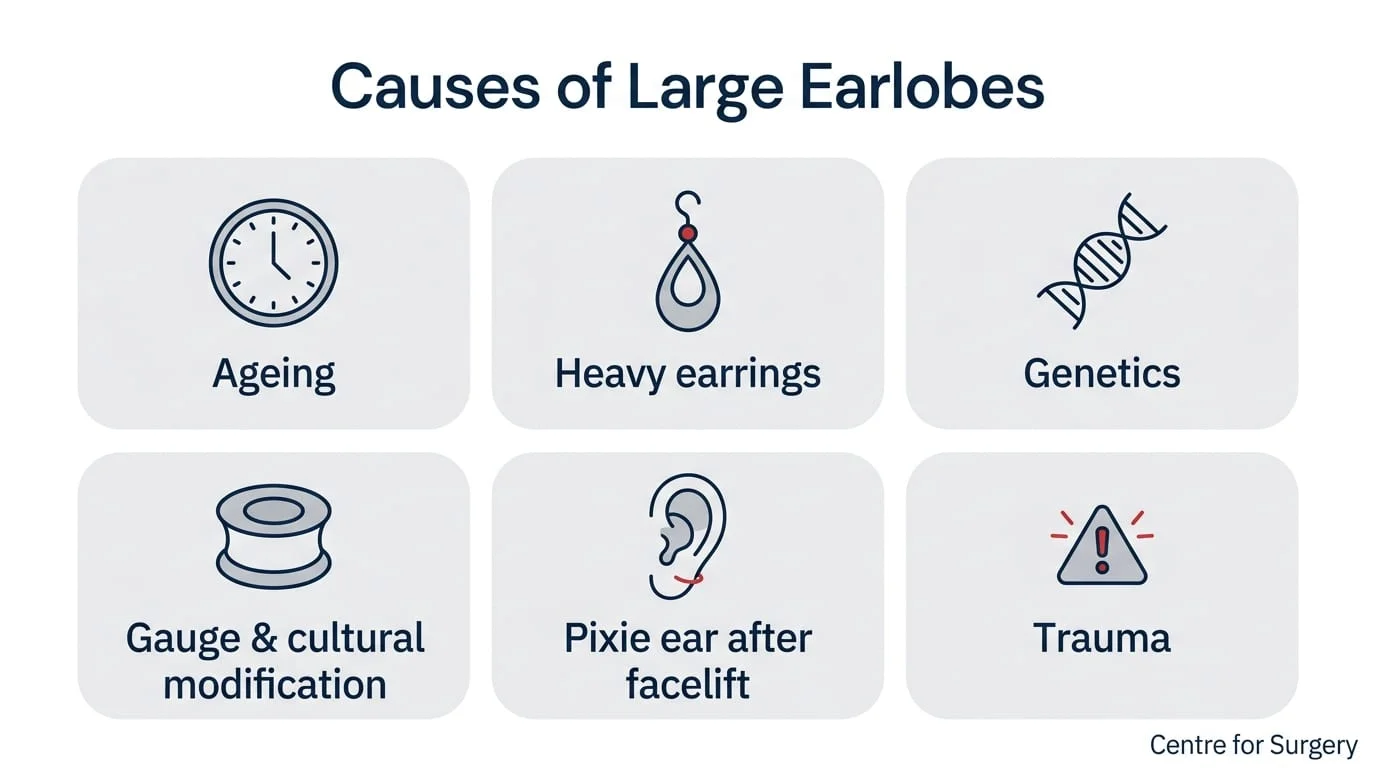
Enlarged earlobes almost always have one of the seven causes below, and the first three account for nearly all of them.
Ageing. The dominant cause, as the studies above show. Collagen and elastin decline, the skin thins, the fat in the lobe reduces, and gravity does the rest — which is why saggy earlobes are so common after sixty. Rapid weight loss can add to this by deflating the lobe faster than the skin can retract, leaving it looking wrinkled or empty.
Genetics. Earlobe length, whether the lobe is attached or free-hanging, and skin thickness are all partly inherited. If your parents have long earlobes, you are more likely to develop them, and the change can begin earlier.
Earrings. Heavy or dangling earrings worn daily for years pull the piercing hole downward until it becomes a slot, and a very elongated hole can eventually tear through the lower edge of the lobe. Note the distinction the evidence draws: earrings elongate the piercing and can distort the lobe around it, but the 547-subject study found that pierced lobes were not longer overall than unpierced ones. Earrings cause a specific, local problem, treated by earlobe repair; they are not the main reason the whole lobe gets longer with age.
Stretching and gauges. Deliberate stretching with plugs or tunnels enlarges the piercing rather than the lobe, but beyond roughly 8 to 10 mm the hole will not close on its own once the jewellery is removed, and the lobe is left as a thin loop of skin. Our guide to whether stretched earlobes from gauges can be repaired covers what is involved.
Facelift surgery. The “pixie ear” — a lobe pulled downward and tethered to the cheek so it looks stuck on — is a recognised complication of facelift. The Southern Illinois group measured 44 facelift patients and found the attached segment of the lobe lengthened after surgery, with the proportion of lobes classed as pseudoptosis rising from 12% to 17% (Mowlavi et al 2004). It is correctable, and our earlobe reduction page covers pixie ear correction specifically.
Keloids and cysts. A lobe that has become thicker or lumpier rather than longer is a different problem. Ear keloids after piercing and earlobe cysts both enlarge the lobe, and both have their own treatment pathways — steroid injection and excision for keloids, removal for a cyst that is growing or repeatedly infected.
Injury. A torn lobe, a healed split or old scar tissue can leave a lobe that is misshapen or bulkier on one side.
Thick earlobes and fat earlobes
Some people are concerned about thickness rather than length — earlobes that feel fleshy, thick or fat compared with the rest of the ear. This is almost always inherited anatomy rather than anything acquired, and it does not change much with age; if anything, lobes lose volume as they lengthen, which is why an older lobe looks thin and pendulous rather than fat. A lobe that has recently become thicker on one side is more likely to be a keloid, a cyst or the result of an injury, and is worth having looked at.
Does Ear Size Mean Anything?
Not in the way folklore suggests. There is no evidence linking ear size to intelligence, longevity or character, and big ears in an older person are the ordinary consequence of the changes described above. Ear size is a reasonable predictor of age — the Texas group’s equation works within a decade or two — and that is about the limit of what it tells you.
One feature of the earlobe does carry medical meaning, and it is worth knowing about. A diagonal crease running across the lobe from the ear canal towards the lower edge — known as Frank’s sign — has been associated with coronary artery disease for fifty years. A 2025 systematic review and meta-analysis of 12 studies, covering 2,415 patients and 2,545 controls, found that people with the crease were about four times as likely to have coronary artery disease, and that in every study that examined it the association held independently of age and other cardiovascular risk factors (Curtis & Walford 2025). A crease is an association, not a diagnosis, and many people with one have healthy hearts. But if you notice a new diagonal crease and have other risk factors, it is a reasonable thing to mention to your GP.
Do Ears Keep Growing After You Die?
No. This belongs with the related myth that hair and nails keep growing after death. Growth needs living cells and a blood supply; neither continues. What happens is that the skin dehydrates and retracts, so nails, hair and features can look more prominent. Ears, which are mostly cartilage and skin, do not grow, lengthen or change size after death.
Do Women’s Ears Keep Growing?
Yes, but less than men’s. Every study that separated the sexes found women’s ears smaller at every age and gaining less over adulthood: in the Berlin data, women’s ears lengthened from 61 mm at 20 to 72 mm after 70, against 65 mm to 78 mm in men, and the sex difference widened with age. At the earlobe specifically, the 547-subject study found women’s lobes change little after 40, whereas men’s continue to lengthen. Why the sexes differ is not fully explained; larger head and body size accounts for some of it, and there may be differences in skin thickness and how the lobe is loaded.
Do Your Ears and Nose Keep Growing?
The two are usually mentioned together — whether the question is put as “do your ears and nose keep growing” or “do noses and ears keep growing” — and the biology is the same. Both are made of cartilage and skin, both stop growing in the strict sense once the skeleton matures, and both measure longer in older people because the soft tissues stretch and sag as they lose elasticity. The Texas study measured both and found the ear correlated with age more strongly than the nose, but the nose changes too: the tip drops, the bridge appears more prominent, and the whole nose looks longer. That has its own consequences and its own treatment, which our guide to whether your nose keeps growing covers in full.
How to Fix Big or Sagging Earlobes
For most people the right answer is to do nothing. Longer earlobes at 60 are as normal as grey hair, and no clinic should be treating a measurement. Treatment is worth considering only where the length, the shape or a specific problem with the lobe genuinely bothers you — most often because earrings no longer sit properly, because a facelift has left a pixie ear, or because a piercing has stretched or torn.
Change the load. If earrings are lengthening the piercing, lighter studs, giving the ear days off, and stopping altogether if the hole is already a slot will slow the process. It will not reverse it.
Earlobe reduction. If you are searching for how to make earlobes smaller, the only reliable answer is surgical. Where the lobe itself is too long or too large, earlobe reduction removes a measured wedge or crescent of tissue and closes the lobe in a smaller, better-proportioned shape. It is performed under local anaesthetic, takes 20 to 40 minutes per side, and has no medical downtime; sutures come out at five to seven days and the scar sits in the natural lobe margin. Pixie ear after a facelift is corrected with a variant of the same procedure. The tissue removed does not return, so the result is permanent, though the slow ageing drift described above continues in the tissue that remains.
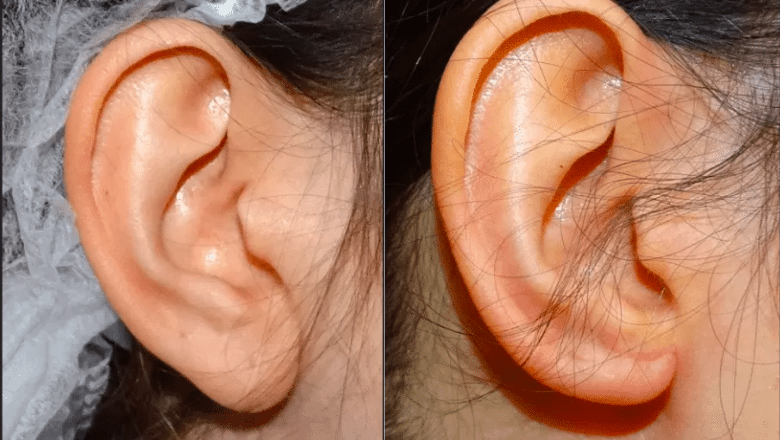
Earlobe reduction before and after — female patient. Individual results vary.
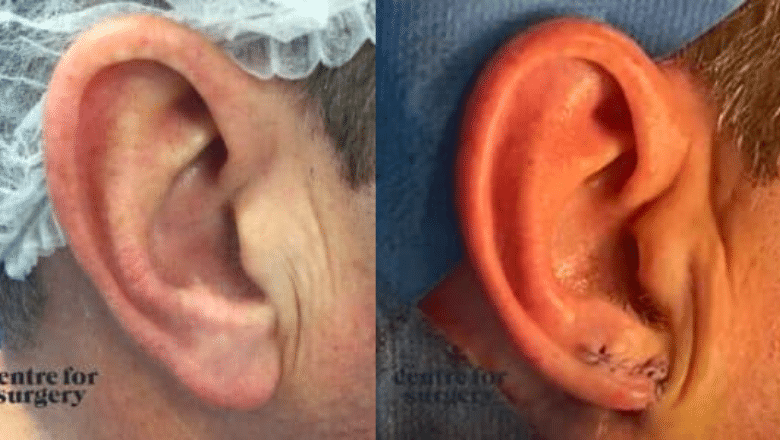
Earlobe reduction before and after — male patient. Individual results vary.
Earlobe repair. A stretched, split or torn piercing is a different operation: earlobe repair excises the lining of the elongated hole and rebuilds the lobe edge, again under local anaesthetic. The ear can usually be re-pierced once healed — our guide to repairing and re-piercing earlobes explains the timing.
Filler for a deflated lobe. Where the concern is a lobe that has lost volume and looks thin or wrinkled rather than long, a small amount of hyaluronic acid filler can restore fullness for six to twelve months. It does not shorten a long lobe and it does not fix a stretched piercing.
Keloids and cysts are treated on their own terms, as above, and a keloid history matters before any lobe surgery because it changes how the scar is managed.
Suitability for any of these is decided at an in-person consultation, where the surgeon measures both lobes — they are rarely the same — and establishes which of the causes above is actually responsible. Costs for earlobe surgery are set out on the otoplasty and earlobe surgery cost guide.
Frequently Asked Questions
Do ears keep growing?
They measure longer with age — about 0.22 mm a year in length and 0.5 mm in circumference — but the cartilage is not growing. The change comes from the earlobe lengthening and the tissue softening and sagging under gravity.
Do your ears grow as you get older?
Yes, in the sense that ears grow as you get older when measured across the population. Average ear length is around 61 to 65 mm at 20 and 72 to 78 mm after 70, with men at the upper end of both ranges. The visible change is concentrated in the earlobe.
Do ears get bigger with age?
They measure bigger — longer, and relatively narrower — in every older age group. Do ears grow with age in the biological sense? No: the cartilage stops growing by the end of the teens, and the increase comes from the lobe lengthening and the tissue sagging.
At what age are ears fully grown?
The ear reaches most of its adult size by 8 to 10 and its cartilage framework is complete by the end of the teens. The slow lengthening of the lobe continues throughout adult life.
Do earlobes keep growing?
Do earlobes grow with age? They are the only part of the ear shown to lengthen significantly with age. Average adult lobe length is about 2 cm, and it increases across each decade — more in men, and comparatively little in women after 40.
Why do old people have big ears?
The lobe has lengthened over decades, the cartilage and skin have softened and dropped, and the face around the ears has lost fat and volume, so the ears look bigger relative to it. The cartilage itself has not grown.
Why do earlobes get bigger with age?
The earlobe has no cartilage to support it. As collagen and elastin in the skin decline, the lobe stretches under its own weight; heavy earrings elongate the piercing on top of that.
Do women’s ears keep growing?
Yes, but less than men’s — women gain around 11 mm in ear length across adulthood against about 13 mm in men, and women’s earlobes change little after 40.
Do ears keep growing after you die?
No. Growth stops at death. The appearance of growth in nails, hair or features is caused by skin drying and retracting.
Does ear size mean anything?
Ear size predicts age reasonably well and nothing else of note. A diagonal crease across the earlobe is associated with coronary artery disease in a 2025 meta-analysis and is worth mentioning to your GP if it is new; ear size itself is not.
Can big earlobes be made smaller?
Yes. Big ear lobes, whether inherited or age-related, are reduced by earlobe reduction, which removes a wedge or crescent of tissue under local anaesthetic in 20 to 40 minutes per side, with permanent results. It is a cosmetic choice; nothing about a long lobe needs treating.
Why are my earlobes so big?
If they have always been large, it is almost certainly inherited. If they have lengthened over the years, it is the normal ageing of the lobe, possibly hastened by heavy earrings. If one has recently become bigger or thicker than the other, think keloid, cyst or an old injury, and have it examined.
Do heavy earrings make earlobes longer?
They elongate the piercing hole and can distort the lower part of the lobe, but the measurement studies found pierced lobes were not longer overall than unpierced ones. Earrings cause a local problem, fixed by earlobe repair, rather than general lengthening.
Is it normal for one earlobe to be bigger than the other?
Yes. The average right lobe is about 0.4 mm longer than the left, and in the facelift-patient study most people’s two lobes differed from each other. Surgery measures each side independently for this reason.
Does losing weight make earlobes look bigger?
It can make them look thinner and more wrinkled, because the lobe loses fat faster than the skin retracts. Weight had a measurable effect on lobe length only in women.
Earlobe Assessment at Centre for Surgery
If the length or shape of your earlobes bothers you, an in-person consultation with a plastic surgeon establishes what is causing it — ageing, a stretched piercing, a tethered lobe after facelift, a keloid or a cyst — and whether any treatment would be worthwhile. Frequently the honest answer is that it would not, and we would rather say so.
Consultations are with GMC-registered plastic surgeons at our CQC-regulated private hospital at 95–97 Baker Street, Marylebone, rated Good overall. The £100 consultation fee is redeemable against treatment, we treat adults aged 18 and over, and we recommend a two-week cooling-off period after any consent. Finance is available through our partner Chrysalis Finance — see our finance options for the current terms.
Phone: 020 7993 4849 | Email: contact@centreforsurgery.com | Address: 95–97 Baker Street, Marylebone, London W1U 6RN
Contact us to schedule a consultation

References
- Heathcote JA. Why do old men have big ears? BMJ 1995;311(7021):1668. doi:10.1136/bmj.311.7021.1668
- Tan R, Osman V, Tan G. Ear size as a predictor of chronological age. Archives of Gerontology and Geriatrics 1997;25(2):187–191. doi:10.1016/s0167-4943(97)00010-1
- Niemitz C, Nibbrig M, Zacher V. Human ears grow throughout the entire lifetime according to complicated and sexually dimorphic patterns — conclusions from a cross-sectional analysis. Anthropologischer Anzeiger 2007;65(4):391–413. PMID 18196763
- Sforza C, Grandi G, Binelli M, Tommasi DG, Rosati R, Ferrario VF. Age- and sex-related changes in the normal human ear. Forensic Science International 2009;187(1–3):110.e1–7. doi:10.1016/j.forsciint.2009.02.019
- Brucker MJ, Patel J, Sullivan PK. A morphometric study of the external ear: age- and sex-related differences. Plastic and Reconstructive Surgery 2003;112(2):647–652. doi:10.1097/01.PRS.0000070979.20679.1F
- Azaria R, Adler N, Silfen R, Regev D, Hauben DJ. Morphometry of the adult human earlobe: a study of 547 subjects and clinical application. Plastic and Reconstructive Surgery 2003;111(7):2398–2402. doi:10.1097/01.PRS.0000060995.99380.DE
- Mowlavi A, Meldrum DG, Wilhelmi BJ, Ghavami A, Zook EG. The aesthetic earlobe: classification of lobule ptosis on the basis of a survey of North American Caucasians. Plastic and Reconstructive Surgery 2003;112(1):266–272. doi:10.1097/01.PRS.0000066368.07829.9B
- Mowlavi A, Meldrum DG, Wilhelmi BJ, Zook EG. Incidence of earlobe ptosis and pseudoptosis in patients seeking facial rejuvenation surgery and effects of aging. Plastic and Reconstructive Surgery 2004;113(2):712–717. doi:10.1097/01.PRS.0000101505.66716.DF
- Mowlavi A, Meldrum DG, Wilhelmi BJ, Zook EG. Effect of face lift on earlobe ptosis and pseudoptosis. Plastic and Reconstructive Surgery 2004;114(4):988–991. doi:10.1097/01.prs.0000133172.28160.6f
- Curtis J, Walford S. Why we should be looking for earlobe creases in ENT. A systematic review and meta-analysis of diagonal earlobe crease and coronary artery disease. Journal of Laryngology and Otology 2025;139(3):160–167. doi:10.1017/S0022215121004138
Related Articles
- Does Your Nose Keep Growing as You Age?
- Earlobe Reduction London
- Earlobe Repair London
- Can Stretched Earlobes From Gauges Be Repaired With Surgery?
- Earlobe Cyst: Causes, Symptoms and Removal
- Ear Keloids: Causes, Treatment and Removal
- Otoplasty Ear Reshaping London


