


Real calf augmentation results from patients treated at our Baker Street day surgery facility. Jump to Bilateral Calf Implants or Calf Augmentation for Asymmetry.
Results vary from patient to patient. All photos are published with written patient consent and are examples of outcomes achieved at Centre for Surgery, not guaranteed results. After photos were taken at least six months after surgery unless the caption says otherwise. No photograph has been retouched or filtered; some are cropped or masked only to protect patient privacy. Full disclaimer below, and how to read these photos — including why a contracted calf and a relaxed calf are not the same calf.
Bilateral Calf Implants — Before & After
14 photographs
Calf augmentation adds volume to the lower leg using a soft solid silicone implant, placed through a short incision behind the knee into a pocket beneath the fascia overlying the calf muscle. It adds a fixed volume in a fixed position. It does not build muscle, and it cannot make a calf larger than the space available will accept.


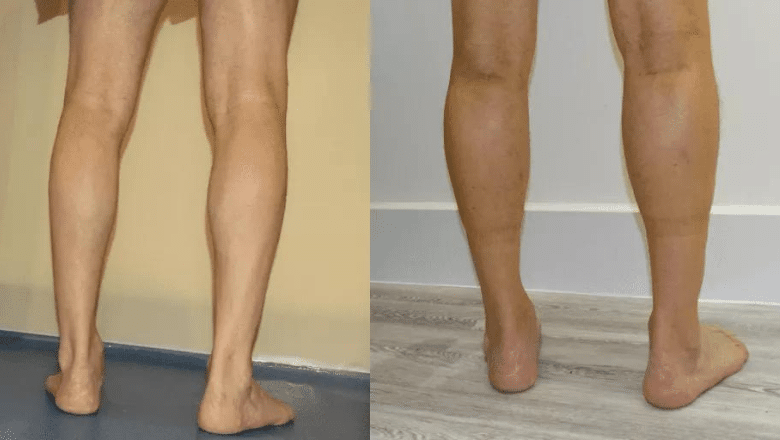


Calf Augmentation for Asymmetry — Before & After
6 photographs
Not every calf augmentation is cosmetic in the ordinary sense. Where one calf is markedly smaller than the other — through congenital underdevelopment, childhood illness such as polio, injury, or nerve damage — an implant can be placed on one side alone to reduce the difference. The implant is selected to match the larger leg. It reduces the asymmetry; it does not abolish it, because two legs are never identical and a fixed implant cannot reproduce the contour of a working muscle. See also whether calf implants help with skinny legs or muscle imbalance.


About These Calf Augmentation Photos
The calf augmentation photos above are presented for educational purposes only and should be interpreted subjectively. They do not represent the opinion or view of any patient regarding their result, and they are not intended to suggest the result that any other patient may achieve. No two patients are alike, and no two results are necessarily alike. Only a personal consultation with your surgeon can provide you with a reasonable expectation of the results you may achieve from any specific procedure. We only publish photographs of patients who have given full written consent for their images to be used.
How to Read Calf Implant Before and After Photos
Calf photographs are unusually easy to mislead with, because a calf changes shape depending on what the leg is doing at the moment the shutter opens.
A contracted calf is not the same calf
Rise onto the toes, or shift your weight onto one leg, and the gastrocnemius contracts and bunches. The calf becomes visibly larger and more defined, with no implant involved at all. This is the most powerful and least detectable distortion in any calf gallery. In a trustworthy pair, both feet are flat, the weight is even, and the muscle is relaxed in both frames. If the after photograph shows a leg bearing weight and the before does not, some of the difference is not the implant.
The compartment decides the size, not you
The implant sits in a pocket beneath a sheet of fascia that has very little give. That fascia is what holds the result in place, and it is also what limits it. An implant larger than the compartment comfortably accepts produces tightness, a longer and more painful recovery, and an edge that can be seen or felt. Patients often arrive with a photograph of a calf they want. What is achievable is decided by measuring your leg, not by the photograph.
Asymmetry is reduced, not abolished
Where one calf is smaller, an implant narrows the gap. It does not make the legs identical, because a solid implant does not behave like a muscle: it does not change shape when you walk, and it does not contract. Judged fairly, a good asymmetry result looks like two legs that no longer draw the eye — not two legs that match.
Where the volume is placed matters more than how much
The calf has an inner and an outer head, and most people who want fuller calves want the inner one. An implant placed to fill the inner head reads as muscle. Volume placed where muscle does not naturally sit reads as an implant, however moderate the size.
What a photograph will not settle
The old version of this page told you to judge a surgeon’s skill from before and after images, and to treat consistent results across patients as proof of reliability. We have removed that, because it is not true. A gallery contains the cases a clinic chose to publish. It is evidence of what is possible, not evidence of what is typical, and no photograph substitutes for asking a surgeon how many of these operations they perform, what their complication rate is, and what they do when it goes wrong.
What Stage of Healing You’re Looking At
Calf implant surgery is a day case, but the recovery is more demanding than its scale suggests, for a simple reason: you cannot rest a calf. Every step uses it.
For the first days the legs are elevated and walking is deliberately restricted. Most patients walk short distances slowly within the first week, with a period of significant tightness and stiffness in the calf as the fascia accommodates the implant. Driving, standing for long periods and any impact exercise are deferred for weeks, and running and calf-loading exercise for considerably longer, on your surgeon’s advice.
Swelling in the lower leg and ankle is common and takes months to settle fully — gravity is not on the calf’s side. The implant sits high and tight at first and settles into its final position over roughly three to six months. The scar behind the knee is short and sits in a natural crease, where it usually fades well.
A calf photographed at six weeks is a swollen, tight calf. A calf photographed at six months is the result.
The after photographs in this gallery were taken at least six months after surgery, unless the caption says otherwise. For what to expect at each stage before then, see our calf implant recovery guide.
What These Photographs Cannot Show You
There is a limit to what any gallery can tell you, and a clinic that pretends otherwise is selling rather than informing.
- What the calf feels like. An implant beneath the fascia can be firm to the touch and its edge can sometimes be felt, particularly in a thin leg. No photograph conveys this.
- Tightness on walking in the early months, and how long it lasted.
- The implant shifting or rotating out of position, which can require a further operation to correct.
- Capsular contracture — the scar capsule around any implant tightening — which can change the shape and firmness of the calf over time.
- Infection. An infected implant usually has to be removed and replaced at a later date.
- Numbness around the incision or along the outer calf, which is common early and occasionally persists.
- Whether the implant will be replaced. Implants are not always permanent. Read whether calf implants need to be replaced.
- How the leg looks contracted, from behind, and in motion — the three circumstances in which other people actually see it.
None of this is a reason to distrust before and after photographs. It is a reason to treat them as the beginning of a conversation with a surgeon rather than the end of one.
Calf Implant Results: Common Questions
Are calf implants a real option?
Yes. Calf implants are solid silicone implants placed beneath the tough layer covering the calf muscle, through a small incision in the crease behind the knee. They add size and shape to naturally slim calves, or correct asymmetry between the legs. Fat transfer is an alternative for smaller changes.
How long do calf implants last?
Calf implants are solid silicone, so they cannot rupture or leak like breast implants, and most patients keep them long term without routine replacement. They may need removal or repositioning if a problem such as displacement, capsular contracture or infection develops.
Calf Implants at Centre for Surgery
Centre for Surgery is a private hospital for plastic and cosmetic surgery on Baker Street in Marylebone, London, registered with and independently inspected by the Care Quality Commission. Our plastic surgeons perform calf augmentation with implants at our Baker Street day surgery facility, both as a bilateral cosmetic procedure and as a unilateral correction of asymmetry.
Bilateral Augmentation and Asymmetry Correction
Bilateral calf implants add volume to both lower legs for patients whose calves remain slim regardless of training. Unilateral augmentation is used where one calf is smaller than the other following congenital underdevelopment, illness, injury or nerve damage, and the implant is chosen to approach the size of the opposite leg. In both cases the implant is sized to the compartment available in your leg, which your surgeon will measure at consultation.
Implant Selection
Implants are soft solid silicone, supplied in a range of sizes and profiles, and are placed through a short incision within the crease behind the knee. Your surgeon will discuss which size the anatomy of your leg will accept, and will tell you when the size you have in mind is more than your leg will comfortably take. Every plastic surgeon on our team is GMC-registered and independently verifiable on the General Medical Council register.
Aftercare and Follow-Up
Calf augmentation is performed as a day case. Walking is restricted in the early days and your surgeon will set out when you can return to work, to driving and to exercise. You have your surgeon’s direct number for the first 24 hours after surgery, and follow-up appointments are included throughout your recovery. Read more about recovery after calf implant surgery.
Verified Patient Reviews
We invite you to read what our calf augmentation patients say on independent, verified review platforms. Every review is publicly verifiable, dated, and linked to a real named patient.
- Google Reviews: Read our Google reviews — rated 4.6 stars based on hundreds of verified patient reviews.
- Patient reviews page: Read patient reviews by procedure — Google and Trustpilot reviews brought together on our own site.
As a CQC-regulated provider, every surgeon on our team is GMC-registered and independently verifiable. View our CQC rating.
Related Reading
- Can Calf Implants Help With Skinny Legs or Muscle Imbalance?
- Do Calf Implants Need To Be Replaced?
- What Is Recovery Like After Calf Implant Surgery?
- How Much Do Calf Implants Cost?
Explore More Before and After Galleries
View our full collection of plastic surgery before and after photos, or browse related male surgery galleries: Gynecomastia Before and After Photos | Pectoral Implants Before and After Photos | Liposuction Before and After Photos
Subject to status, we offer finance options with Chrysalis Finance. For a full price breakdown, see our calf augmentation cost guide. Browse our Plastic Surgery Blog or find answers in our Clinic FAQs.
To book a consultation, call us on 020 7993 4849, email contact@centreforsurgery.com, or visit us at 95–97 Baker Street, London W1U 6RN. Visit our About Us page to learn more.



