


In this guide13 sections
- Key Points
- What Is Pillow Face?
- What Does Pillow Face Look Like?
- What Causes Pillow Face?
- Swelling After Filler or Too Much Filler in Your Face?
- Cheek Filler Gone Wrong, Jawline Filler Gone Wrong and Other Areas
- How Do You Fix Pillow Face?
- How to Avoid Pillow Face
- Is Pillow Face Dangerous? The Long-Term Effects of Fillers
- Filler Dissolving in London
- Frequently Asked Questions
- References
- Talk to a Surgeon About Filler Dissolving
Key Points
- Pillow face is the puffy, overfilled look that builds up when too much dermal filler is placed in the face, usually over several top-ups. Doctors also call it facial overfilled syndrome.
- Typical signs are wide, high cheeks that sit like cushions, a face that looks rounder and flatter at the same time, puffiness under the eyes, a heavy or square lower face and lips that look swollen or project too far.
- It usually happens gradually: filler is topped up before the last treatment has gone, filler can last years longer than expected, and hyaluronic acid filler draws in water, so volume quietly adds up.
- Pillow face from hyaluronic acid filler can usually be corrected by dissolving the filler with an enzyme called hyaluronidase, often over one or more sessions, followed by a pause before any new treatment.
- Prevention is about restraint: treating the cause rather than chasing every line, leaving time between treatments and choosing an injector who will say no.
Pillow face is the look people mean when they say someone has had “too much filler”. The cheeks look inflated, the face looks wide and doughy, and expressions seem slightly off, as if the features are sitting on cushions. It rarely happens after one treatment. More often it creeps in over years of dermal filler top-ups, until a face that started out looking fresh looks swollen and unfamiliar.
The good news is that pillow face from hyaluronic acid filler can usually be reversed. This guide explains what pillow face is, what causes it, how to tell it apart from normal swelling, and how filler dissolving and a more measured plan can restore a natural-looking face. At Centre for Surgery, all injectable treatments, including filler dissolving, are given by our surgeons.
What Is Pillow Face?
What is pillow face? It is an overfilled face: too much filler in the face, or filler in the wrong places, so that the face looks puffy, broad and unnatural rather than refreshed. A 2023 review in Dermatologic Clinics ↗ describes it as facial overfilled syndrome, a distortion of the face caused by repeated or poorly placed filler that is often exaggerated when the person smiles or talks[1]. You may also see it called filler face.
Pillow face filler problems almost always involve hyaluronic acid (HA) filler, the type used in most clinics for cheeks, lips, under the eyes and the jawline. These pillow face fillers are not faulty products; the problem is how much is used, where it goes and how often it is topped up. HA is a sugar-based gel that the body slowly breaks down. That matters for two reasons: it explains why pillow face develops, and it is also why the problem can usually be fixed, as HA filler can be dissolved.
What Does Pillow Face Look Like?
Pillow face from filler tends to share a recognisable pattern. A face that is starting to look overfilled may show:
- Cheeks that sit too high or too wide, like cushions on the cheekbones, so the face looks rounder from the front and the natural shadow under the cheekbone disappears.
- A flat, featureless midface when seen from the side, as the normal curves between the cheek, under-eye area and mouth are filled in.
- Puffiness under the eyes or a soft ridge along the lower eyelid, which can look like eye bags and is often worse in the morning.
- A heavy, square or wide lower face from too much jawline or chin filler.
- Overfilled lips that project forward, lose their natural border or roll outwards.
- Expressions that look odd: the cheeks bunch up too much when smiling, or the face looks stiff and mask-like.
Some people describe this as an uncanny valley face: nothing is obviously wrong in a photograph, but in person the face looks not quite natural. Friends and family often notice before the person does.

Overfilled lips: trout pout and duck lips
Overfilled lips are one of the most familiar versions of filler gone wrong. A “trout pout” or “duck lips” look happens when too much filler is placed, or filler spreads above the lip border into the skin of the upper lip, creating a shelf or “filler moustache”. Over time, repeated lip filler can also stretch the lips, as our article on whether lip filler stretches your lips explains. A review of reported lip filler complications found that swelling, lumps and filler spreading beyond the lips were among the problems seen after hyaluronic acid filler[2].
What Causes Pillow Face?
Pillow face is rarely the result of a single bad treatment. It usually builds up from several of these causes together[1] [3]:
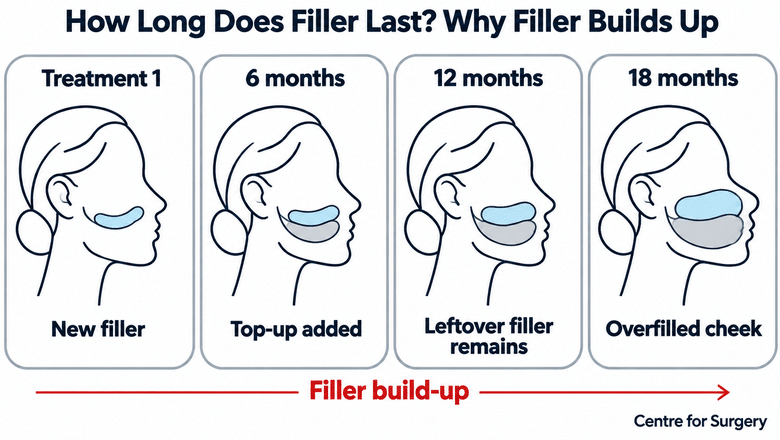
- Too much filler over time. Top-ups are booked before the previous filler has broken down, so each treatment adds to what is already there.
- Chasing lines. Filling every crease, such as the folds from the nose to the mouth, rather than treating the reason the crease has formed. The nasolabial folds are a good example: filling them heavily adds weight to the lower face without lifting it.
- Filler in the wrong place. Volume placed too high, too wide or too superficially distorts the shape of the face, even in small amounts.
- Filler that spreads. Filler can move away from where it was placed over months or years. Our guide to lip filler migration explains why.
- Using filler to treat sagging. As the face ages, the skin and deeper tissues loosen and descend. Adding more and more volume to make up for this can make the face look heavier rather than lifted.
- Getting used to the result. People adjust to their new face quickly, so each top-up can feel like a small change while the total effect becomes large.
How long does filler last?
Often longer than you think. Hyaluronic acid filler is usually described as lasting several months to a year or two, but it can stay in the tissues much longer, particularly in areas with little movement such as under the eyes. A 2017 case series in Ophthalmic Plastic and Reconstructive Surgery ↗ found hyaluronic acid filler still present on scans up to nine years after it was injected around the eyes[4], and another report confirmed residual filler on MRI two and a half years after treatment[5]. Periocular specialists have noted that filler in this area can migrate and outlast its expected lifespan[6]. If you have top-ups every six to twelve months, the earlier filler may not have gone by the time the next is added. Our guide to how long tear trough fillers last looks at the under-eye area in more detail.
Why does filler make the face look puffy?
Hyaluronic acid naturally holds water. Once injected, filler draws in fluid from the surrounding tissue, so a modest volume of gel can look larger than expected, and puffiness can come and go with salt, alcohol, sleep and hormones. Under the thin skin of the lower eyelid this can show as persistent swelling, which is one of the delayed problems described after tear trough filler[7].
Swelling After Filler or Too Much Filler in Your Face?
Not every fuller face after filler is pillow face. It is normal to look swollen for a few days after any filler treatment, and lips in particular can look much bigger at first. As a guide:
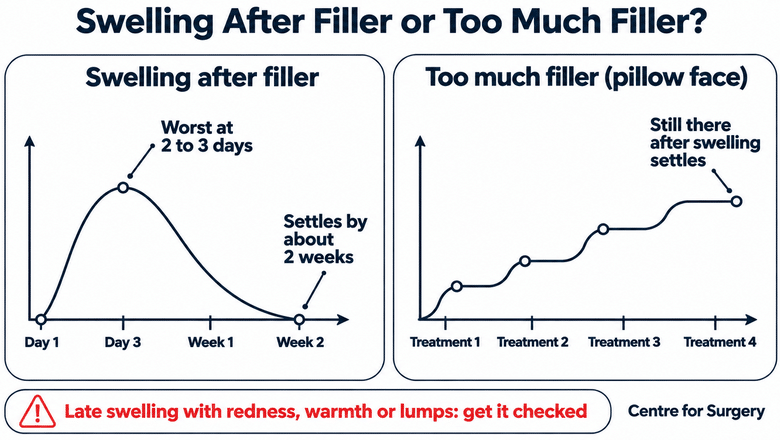
- Swelling after treatment is usually at its worst in the first two to three days and settles within about two weeks. Our guide to lip filler swelling explains the usual timeline.
- Pillow face is still there once the swelling has gone, tends to build over several treatments, and does not improve with time in the way swelling does.
- Swelling that appears months or years later, especially with redness, warmth, tenderness or lumps, needs a prompt review, as it can be a delayed reaction or infection rather than simple overfilling[5] [7].
If you are unsure, it helps to compare recent photographs with ones taken before you started filler. That comparison often makes the change clear. If you also bruised, our guide to lip filler bruising explains how long it usually lasts.
Cheek Filler Gone Wrong, Jawline Filler Gone Wrong and Other Areas
Filler gone wrong looks different depending on where it was placed:
- Cheeks. Cheek filler placed too high or too far forward is the most common cause of the classic pillow face, giving wide, puffy cheeks that bunch up when you smile.
- Under the eyes. Tear trough filler that is too much, too superficial or has spread can cause puffiness, a bluish tinge or a sausage-like ridge. Our article on whether tear trough filler is worth it explains who suits it.
- Jawline and chin. Jawline filler gone wrong usually means a wide, square or heavy lower face. Jawline filler and chin filler need careful planning so they define rather than enlarge the face.
- Lips. Too much lip filler causes overfilled lips, migration above the lip border and loss of natural shape. Our article on why less is more with lip filler explains the approach we prefer.
- Temples and forehead. Overfilling these areas can make the upper face look bulky or swollen.
How Do You Fix Pillow Face?
Pillow face from hyaluronic acid filler can usually be corrected. The first step is an in-person assessment, so your surgeon can see and feel where the filler sits, how much is left and whether the problem is too much filler, filler in the wrong place, or underlying changes that filler was being used to hide.
How does hyaluronidase dissolve filler?
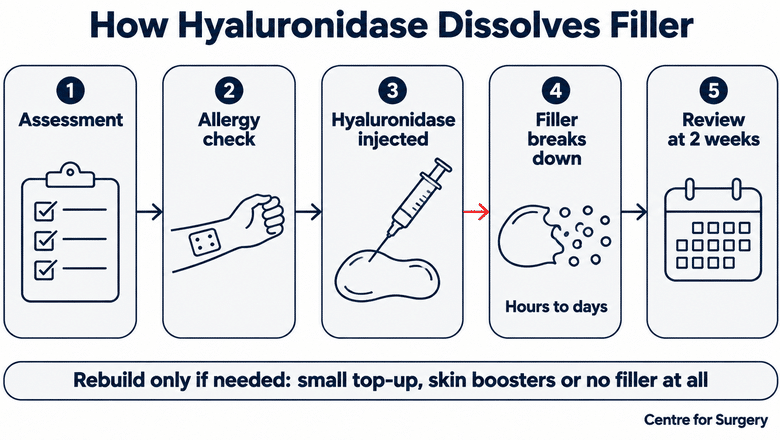
The main treatment is dissolving the filler with hyaluronidase, an enzyme that breaks down hyaluronic acid. It is injected directly into the filler and starts working within hours, with most of the filler breaking down over the following days. UK guidance on its use in aesthetic practice sets out allergy checks, dosing and how to manage complications[8], and reviews of periocular filler complications describe hyaluronidase as generally effective for overcorrection and filler that has spread[9].
A few practical points about how to dissolve fillers safely:
- It only works on hyaluronic acid filler. Permanent or semi-permanent fillers cannot be dissolved, which is one reason we advise against them, as our article on permanent lip fillers explains.
- An allergy check comes first for planned treatment, usually with a small skin test, particularly if you have reacted to bee or wasp stings.
- More than one session is common where there is a lot of filler, several areas are involved or the filler is a firmer product. A further session is usually at least two weeks later.
- Swelling can hide the change at first, so the final result is judged at about two weeks.
Our full guide to dissolving filler in the face and lips covers the process step by step, and our hyaluronidase treatment page explains how appointments work.
How long after dissolving filler can I get more?
Many people find that once the excess filler has gone, they need much less than they thought, or none at all. If some support is still needed, a small, carefully placed amount of filler can be added once the tissues have settled, usually after at least two weeks and often longer. Others prefer to stay filler-free, or to use treatments that improve skin quality without adding volume, such as skin boosters.
When is a facelift better than more filler?
If filler was being used to hide sagging, adding more will not solve it. A facelift or neck lift repositions loose tissue rather than inflating it, and facial fat transfer uses your own fat to restore volume where it has genuinely been lost. If you are planning surgery, our article on whether fillers need to be dissolved before a facelift explains how the two fit together.
Will my face go back to normal?
In most cases the face looks much as it did before the filler once the swelling from dissolving has settled. After years of heavy filler, though, the skin and tissues may have stretched and can take weeks to months to tighten again, and some changes are due to ageing rather than filler. Your surgeon will tell you honestly what dissolving can and cannot change before you start.
How to Avoid Pillow Face
Most pillow face is preventable. The habits that help most are:
- Treat the cause, not the line. A crease is often a sign of lost support or sagging elsewhere. Filling every line is the quickest route to an overfilled face.
- Leave time between treatments. Wait until filler has settled, and be wary of routine top-ups that are not based on a fresh assessment.
- Keep a record. Note the product, amount, area and date of each treatment, and keep photographs from before you started.
- Choose an injector who will say no. A good injector will tell you when more filler will not help. At Centre for Surgery, injectable treatments are carried out by surgeons who also perform facial surgery, so they can advise on every option.
- Be honest about why you want more. If you find yourself repeatedly unhappy with your face despite treatment, it is worth talking about. Our article on body dysmorphia and cosmetic treatment explains why.
Rapid weight loss can also change how filler looks, as the face loses its own fat while the filler stays put. Our article on facial changes after weight-loss injections explains how weight loss changes the face.
Is Pillow Face Dangerous? The Long-Term Effects of Fillers
Pillow face itself is mainly a cosmetic problem rather than a dangerous one. The long-term effects of fillers can include more than an overfilled look, though: filler that has spread, lumps, delayed swelling and, occasionally, late inflammation or infection around old filler[2] [7]. A large amount of old filler can also make future treatment or surgery harder to plan.
Pillow face is quite different from a filler emergency. If, during or soon after filler, the skin turns pale, dusky or mottled, becomes very painful, or you notice any change in your vision, filler may have blocked a blood vessel. That needs urgent treatment: contact the clinic that treated you straight away, and call 999 for any change in vision.
Filler Dissolving in London
At our Baker Street hospital, filler dissolving is carried out only by our surgeons. Your surgeon examines you in person, checks your allergy history, explains what dissolving can and cannot change, and talks you through the alternatives, including waiting for the filler to break down on its own. Many of the people we see had their filler elsewhere, so bring any details you have about the product, the area and the date, and photographs from before your first treatment if you can.
You will get honest advice and no pressure. If dissolving is not the right answer for you, we will say so, and whether you stay filler-free afterwards or plan something new is entirely your choice. Find out more about filler dissolving in London at Centre for Surgery.
Frequently Asked Questions
What does a pillow face mean?
A pillow face means a face that looks puffy, wide and overfilled after too much dermal filler, as if the cheeks and features are sitting on cushions. It usually builds up over several treatments rather than one, and doctors call it facial overfilled syndrome.
What causes a pillow face?
It is usually caused by too much filler over time: top-ups before earlier filler has gone, filling lines rather than treating their cause, filler placed in the wrong areas or spreading, and using volume to hide sagging. Hyaluronic acid filler also holds water, which adds to the puffy look.
Will a pillow face go away?
It may soften slowly as filler breaks down, but filler can last much longer than expected, sometimes years. Waiting is an option, but pillow face from hyaluronic acid filler can usually be corrected far sooner by dissolving the filler with hyaluronidase.
How do I get rid of my pillow face?
Book an assessment with an experienced practitioner, ideally a surgeon. If the filler is hyaluronic acid, it can usually be dissolved with hyaluronidase over one or more sessions. Once things have settled, you can decide whether you need a small amount of carefully placed filler, a different treatment or nothing at all.
How to correct a pillow face without making it worse?
Dissolve first, then reassess. Adding filler to “balance” an overfilled face usually makes it worse. Dissolving gradually, in measured amounts, protects your natural tissue, and any new filler should only be considered after at least two weeks.
Is pillow face permanent?
Not usually. Pillow face from hyaluronic acid filler can be reversed by dissolving the filler. Permanent or semi-permanent fillers cannot be dissolved, so correcting those is more difficult and may need surgery.
Can pillow face happen after one treatment?
It can if a large amount of filler is placed in one session or placed in the wrong areas, but most pillow face builds up gradually over several treatments, often without the person noticing.
Which celebrities have a pillow face?
We do not comment on individuals, but the term became widely used to describe public figures whose faces looked increasingly puffy after repeated filler. The pattern is the same as in anyone else: volume added over years, often to replace lift that filler cannot provide.
How long does filler stay in your face?
Hyaluronic acid filler is usually expected to last from several months to around two years, depending on the product and area. Scans have shown it can remain much longer, up to nine years in one report around the eyes, which is why top-ups can quietly add up.
Can you dissolve filler from another clinic?
Yes, if it is hyaluronic acid filler. Bring any details you have about the product, area and date. If the product is unknown, your surgeon may suggest dissolving a small test area first.
References
- Lim T. Facial overfilled syndrome. Dermatol Clin. 2024;42(1):121-128. doi:10.1016/j.det.2023.06.007 ↗
- Diwan Z, Trikha S, Etemad-Shahidi S, et al. Evaluation of current literature on complications secondary to lip augmentation following dermal filler injection. J Clin Aesthet Dermatol. 2023;16(7):26-33. PMC10409513 ↗
- Fakih N, Bertossi D, Vent J. The overfilled face. Facial Plast Surg. 2022;38(2):173-176. doi:10.1055/s-0042-1744180 ↗
- Chang JR, Baharestani S, Salek SS, et al. Delayed superficial migration of retained hyaluronic acid years following periocular injection. Ophthalmic Plast Reconstr Surg. 2017;33(3S Suppl 1):S116-S118. doi:10.1097/IOP.0000000000000434 ↗
- Kalmanson OA, Misch ES, Terella A. Hyaluronic acid fillers may be longer-lasting than previously described: a case report of delayed filler-associated facial cellulitis. JPRAS Open. 2022;33:37-41. doi:10.1016/j.jpra.2022.05.011 ↗
- Murthy R, Roos JCP, Goldberg RA. Periocular hyaluronic acid fillers: applications, implications, complications. Curr Opin Ophthalmol. 2019;30(5):395-400. doi:10.1097/ICU.0000000000000595 ↗
- Trinh LN, McGuigan KC, Gupta A. Delayed complications following dermal filler for tear trough augmentation: a systematic review. Facial Plast Surg. 2022;38(3):250-259. doi:10.1055/s-0041-1736390 ↗
- King M, Convery C, Davies E. This month’s guideline: the use of hyaluronidase in aesthetic practice (v2.4). J Clin Aesthet Dermatol. 2018;11(6):E61-E68. PMC6011868 ↗
- Wang Y, Massry G, Holds JB. Complications of periocular dermal fillers. Facial Plast Surg Clin North Am. 2021;29(2):349-357. doi:10.1016/j.fsc.2021.02.001 ↗
Talk to a Surgeon About Filler Dissolving
If you are worried that you have too much filler, or you would like a second opinion about filler placed elsewhere, you can book a consultation at our Baker Street clinic by calling 020 7993 4849 or using the form below. A patient coordinator will be your point of contact throughout.







