


In this guide12 sections
- What Is a No-Drain Tummy Tuck?
- Why Are Drains Used After a Tummy Tuck in the First Place?
- How the No-Drain Technique Works
- Is a No-Drain Tummy Tuck Right for Everyone?
- Mini Tummy Tuck: A Different Reason to Be Drain-Free
- Benefits of Avoiding a Drain
- What If I Do Need a Drain?
- Recovery: No-Drain vs Standard Technique
- How Much Does a No-Drain Tummy Tuck Cost?
- Why Choose Centre for Surgery?
- Frequently Asked Questions
- Learn More
A no-drain tummy tuck uses a specialised suturing technique — progressive tension abdominoplasty with barbed sutures — to close the internal space where fluid would otherwise collect, removing the need for a postoperative drain in suitable patients. At Centre for Surgery, our plastic surgeons assess every patient individually at consultation to determine whether the no-drain technique is appropriate for their anatomy. This guide explains exactly how it works, why drains are traditionally used at all, who is and isn’t a good candidate, and what to realistically expect from recovery either way.
What Is a No-Drain Tummy Tuck?
During a standard tummy tuck (abdominoplasty), the surgeon lifts the abdominal skin away from the underlying muscle layer to remove excess skin and repair separated muscles. This dissection creates a potential space between the skin and muscle — and that space can fill with fluid after surgery, a complication called a seroma. The traditional solution is a surgical drain: a thin tube placed under the skin during the procedure that channels fluid out of the body as it accumulates, usually removed a few days after surgery once output has settled.
A no-drain tummy tuck avoids this by closing the potential space itself, rather than managing the fluid that would otherwise collect in it. Instead of leaving the dissected space open and relying on a drain to manage the runoff, the surgeon uses rows of specialised barbed sutures — known as quilting or progressive tension sutures — to stitch the skin flap directly down to the muscle layer at multiple points across the abdomen as the incision is closed. This eliminates the dead space where fluid would pool in the first place, which is why the technique can remove the need for a drain rather than simply making one more comfortable.
Why Are Drains Used After a Tummy Tuck in the First Place?

Surgical drains exist to manage a genuinely common and well-understood complication, not because surgeons default to them without reason. When the abdominal skin flap is lifted during a full abdominoplasty, blood vessels and lymphatic channels in that plane are disrupted, and fluid seeps into the space left behind as the body’s normal healing response. Left unmanaged, that fluid can accumulate into a seroma — a collection large enough to cause swelling, discomfort, delayed wound healing, and in some cases infection risk if it isn’t drained.
A drain is simply a thin, soft tube that channels this fluid out of the body into a small collection bulb, allowing your surgical team to monitor exactly how much fluid is accumulating and remove the tube once output has reduced to a safe level — typically a few days after surgery. Drains are a well-established, safe part of abdominoplasty and remain the right choice for many patients, particularly where a large amount of tissue is being repositioned. Needing a drain is not a mark of a worse result or a lesser technique; it’s the appropriate management for a specific anatomical situation.
How the No-Drain Technique Works

Progressive tension abdominoplasty was developed specifically to close the dead space that causes seromas, rather than manage the fluid after the fact. As the abdominal skin flap is repositioned during closure, the surgeon places multiple rows of barbed sutures running from the muscle layer up to the underside of the skin, working progressively down the abdomen. Each suture has tiny barbs along its length that grip the tissue and lock in place without needing to be tied off individually, allowing the surgeon to distribute tension evenly across the entire closure rather than concentrating it at the incision line alone.
The practical effect is that the skin is drawn down and adhered to the muscle at multiple points across the whole treated area, not just stitched together at the edges. With no significant gap left between the layers, there’s nowhere for fluid to accumulate in the first place — which is the mechanism that can remove the need for a drain, rather than the sutures simply being a cosmetic alternative to one.
Is a No-Drain Tummy Tuck Right for Everyone?
Not every patient is suitable for the no-drain technique, and it’s worth being direct about that rather than overselling it. Whether it’s appropriate depends on how much tissue needs to be repositioned, the amount of dead space likely to form once the skin flap is lifted, and your individual anatomy — all of which your surgeon assesses at consultation, not before. Patients having a more extensive procedure, or with a larger amount of tissue to reposition, may still be better served by a standard drain, and that’s a legitimate, safe recommendation rather than a fallback.
Where the no-drain technique isn’t the right fit for you, a standard drain remains a well-established, safe option used successfully in the vast majority of tummy tucks performed worldwide — it is not something to be concerned about, and it doesn’t mean a worse outcome. Your surgeon will discuss which approach suits your specific procedure honestly at consultation, rather than defaulting to whichever sounds more appealing to describe.
Mini Tummy Tuck: A Different Reason to Be Drain-Free
It’s worth separating two distinct reasons a tummy tuck might not need a drain, because they’re often conflated. A mini tummy tuck — which addresses only the lower abdomen below the umbilicus — is naturally drain-free for most patients simply because it involves far less tissue undermining than a full abdominoplasty. There’s less dead space created in the first place, so a drain typically isn’t needed regardless of suturing technique. This is a structural consequence of the smaller procedure, not a special technique being applied.
A full tummy tuck, by contrast, involves lifting the abdominal skin flap up to the lower sternum — a much larger dissection where a drain is more commonly needed unless the progressive tension technique specifically closes that dead space. So while both a mini tummy tuck and a successful no-drain full tummy tuck can leave you without a drain, they get there for different reasons — one because there’s less space to manage, the other because that space has been actively closed during surgery.
Benefits of Avoiding a Drain
For patients who are suitable candidates, avoiding a drain offers genuine practical advantages during recovery:
- No tube management at home: standard drains typically stay in for three to five days, during which you or a carer need to empty and measure the collection bulb, and take care not to dislodge the tube — a particular concern if you have young children or pets at home.
- No separate drain-removal appointment: without a drain, there’s one less clinical visit required in the days immediately after surgery.
- Reduced risk of drain-site irritation: the small incision where a drain exits the skin can occasionally become irritated or, rarely, infected; removing the drain from the equation removes this specific risk.
- Often a more comfortable early recovery: many patients find the physical sensation of a drain — and the need to move carefully around it — adds to early discomfort, independent of the surgery itself.
These are genuine, meaningful benefits for suitable patients — but they’re incremental comfort improvements to an already safe, well-managed recovery process, not a difference in surgical safety or long-term result.
What If I Do Need a Drain?
If your surgeon recommends a standard drain for your procedure, this reflects your specific anatomy and the extent of your surgery — not a lesser outcome. Drains are removed at the clinic, typically two to three days after your procedure, once output has reduced to a safe threshold; you’re never asked to remove one yourself. The vast majority of tummy tucks performed in the UK and internationally are still carried out safely and successfully with drains, and the evidence for one approach being categorically superior to the other for every patient simply doesn’t exist — it’s a case-by-case decision.
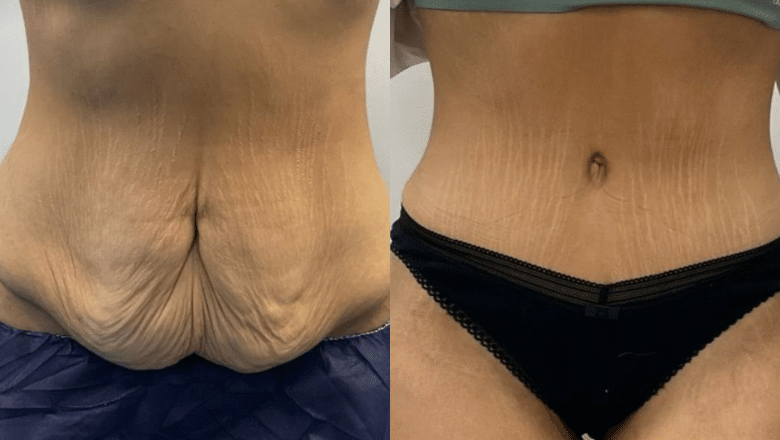
Recovery: No-Drain vs Standard Technique
| Aspect | No-Drain (Progressive Tension) | Standard (With Drain) |
|---|---|---|
| Drain management | None required | Tube and collection bulb for 2–5 days |
| Drain removal visit | Not needed | Clinic appointment at 2–3 days |
| Suitability | Assessed individually — not appropriate for all patients | Suitable for the vast majority of patients |
| Seroma risk | Reduced, due to closed dead space | Managed via active drainage |
| Overall recovery timeline | Similar to standard technique | Similar to no-drain technique |
| Cost | No separate charge — included in your quoted price | Included in your quoted price |
How Much Does a No-Drain Tummy Tuck Cost?
The no-drain technique isn’t priced as a separate add-on — it’s a technique choice your surgeon makes based on your anatomy, within your standard tummy tuck price. Tummy tuck pricing at Centre for Surgery depends on the type of procedure and whether it’s combined with anything else:
- Mini, full and extended tummy tuck: current starting prices are in our tummy tuck cost guide
All prices include your surgeon’s fee, TIVA anaesthesia, theatre and facility costs at our CQC-regulated Baker Street clinic, compression garment, and follow-up appointments including your six-week surgeon review. Finance is available through Chrysalis Finance, subject to status. Your initial consultation is £100, redeemable against the cost of your procedure if you proceed. Tummy tuck surgery is a cosmetic procedure and isn’t covered by private medical insurance.
Why Choose Centre for Surgery?
Whichever technique is right for your anatomy, your tummy tuck is performed by a GMC-registered plastic surgeon at our purpose-built, CQC-regulated private hospital on Baker Street, which holds a CQC “Good” rating. TIVA (Total Intravenous Anaesthesia) is used as standard for all tummy tuck procedures, giving a smoother, safer anaesthetic experience with faster recovery than traditional gas-based general anaesthesia.
Our surgeons are experienced in both progressive tension abdominoplasty and standard drain technique, so you get an honest recommendation based on what your specific procedure needs — not a default to whichever is easier to market. If the no-drain technique isn’t right for your anatomy, we’ll tell you that directly at consultation and explain exactly why a standard drain is the safer, more appropriate choice for your case.
Every tummy tuck package includes unlimited pre-operative consultations, a recommended two-week cooling-off period, full pre-operative medical assessment, a dedicated patient coordinator throughout, and full aftercare through your follow-up reviews.
Book Your Consultation
Phone: 020 7993 4849
95–97 Baker Street, Marylebone, London W1U 6RN
Contact us to schedule your consultation
Your initial in-person consultation is £100, redeemable against the cost of surgery if you proceed.
Frequently Asked Questions
What is a no-drain tummy tuck?
A no-drain tummy tuck (progressive tension abdominoplasty) uses rows of barbed sutures to close the internal space between the skin and muscle layer during surgery, removing the need for a postoperative drain in suitable patients. It’s a suturing technique choice, not a different type of tummy tuck.
Is a drain-free tummy tuck safe?
Yes — progressive tension abdominoplasty is a well-established technique used by experienced surgeons. It’s assessed as appropriate on a patient-by-patient basis; where it isn’t suitable, a standard drain remains an equally safe, well-established alternative.
Will I definitely avoid a drain if I ask for the no-drain technique?
Not necessarily. Suitability depends on your specific anatomy and the extent of your surgery, assessed by your surgeon at consultation. Some patients who would prefer to avoid a drain are still better served by one, based on how much tissue needs repositioning.
Why do some tummy tucks need drains and others don’t?
It depends on the amount of dead space created during surgery and how that space is managed. A mini tummy tuck often doesn’t need a drain simply because less tissue is undermined. A full tummy tuck using the progressive tension technique can avoid a drain by closing that space with barbed sutures during closure; a full tummy tuck using standard technique manages the same space with a drain instead.
How long do tummy tuck drains stay in?
Typically three to five days, though this varies by patient. Drains are removed at the clinic once fluid output has reduced to a safe level — you’re never asked to remove one yourself.
Does the no-drain technique cost more?
No. It’s a technique choice made by your surgeon based on your anatomy, included within your standard tummy tuck price rather than charged separately.
Learn More
- Tummy tuck (abdominoplasty)
- Mini tummy tuck
- Tummy tuck cost
- Tummy tuck seroma — causes, symptoms and treatment
- How to get the best tummy tuck — nine top tips
- Can I combine liposuction with a tummy tuck?







