


In this guide13 sections
- What Causes Large Breasts?
- Gigantomastia, Macromastia, and Breast Hypertrophy — What Do They Mean?
- Common Myths About Large Breasts
- Symptoms Associated With Large Breasts
- Can Losing Weight Reduce the Size of Large Breasts?
- Is It Possible to Reduce Large Breasts Without Surgery?
- Am I a Good Candidate for Breast Reduction?
- What Does Breast Reduction Surgery Involve?
- How Long Is Breast Reduction Recovery?
- How Much Does Breast Reduction Cost?
- Choosing a Surgeon for Breast Reduction
- Frequently Asked Questions
- Breast Reduction at Centre for Surgery
Large breasts are extremely common, and for most women, they’re simply a normal variation in body shape rather than a medical concern. But “why are my breasts so big?” is one of the most frequently asked questions we hear at consultation — and the honest answer is that breast size is influenced by a complex mix of genetics, hormones, body composition, and life events like pregnancy and breastfeeding. Some women embrace their larger chest entirely; others find it comes with real physical discomfort or self-consciousness. Both responses are completely valid. This guide covers everything from the everyday causes of larger breasts to the rare medical condition gigantomastia, what actually works (and doesn’t) for reducing breast size, and when breast reduction surgery might be the right option for you.
What Causes Large Breasts?
Breast size is most commonly influenced by a combination of genetic and environmental factors — much like height or shoe size, it runs in families and varies enormously from person to person. There’s no single “normal” breast size, and a broad range of shapes and sizes are entirely healthy.
Hormonal changes play a significant role too. During puberty, rising oestrogen levels drive breast tissue development, and the amount of tissue laid down at this stage varies widely between individuals. Later in life, pregnancy brings substantial hormonal shifts that prepare the breasts for milk production, and breastfeeding itself causes further temporary enlargement as the glandular tissue expands to accommodate milk supply. For many women, breasts don’t fully return to their pre-pregnancy size afterwards, which is one of the most common reasons women seek breast reduction later in life.
Weight gain also plays a part, since breast tissue contains a significant proportion of fat — as overall body fat increases, breast size often increases proportionally, though this varies from person to person based on where the body tends to store fat.
Breast size and breast heaviness are closely linked, and our guide to the causes of heavy breasts looks at how the two overlap.
Gigantomastia, Macromastia, and Breast Hypertrophy — What Do They Mean?
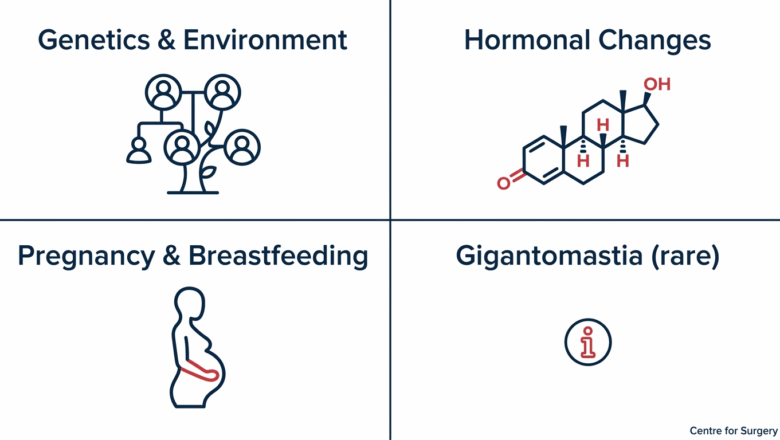
For a small number of women, very large breast size is caused by a genuine medical condition called gigantomastia — sometimes also referred to as macromastia, breast hypertrophy, or hypermastia, all of which describe the same underlying condition using different medical terminology. Gigantomastia involves significant, disproportionate overgrowth of breast tissue, well beyond what’s needed for normal breast development or function.
It’s a very rare condition — only a small number of cases have ever been formally reported in medical literature — and its exact cause isn’t well understood. It appears to occur sporadically in most cases, though there’s some association with puberty, pregnancy (sometimes called gestational gigantomastia), and certain hormonal medications. Men aren’t affected by gigantomastia, since it specifically involves the hormonally-responsive glandular tissue unique to female breast development.
Gigantomastia is considered a benign condition — it carries no cancerous potential — but it can be physically and psychologically disabling if left untreated, causing severe back and shoulder pain, skin breakdown beneath the breast fold, and significant difficulty with everyday activities and clothing. The only effective treatment for gigantomastia is breast reduction surgery, and in the most severe or recurrent cases, a mastectomy with subsequent breast reconstruction may be considered.
It’s worth stressing that for the vast majority of women with large breasts, gigantomastia isn’t the cause — most large breasts are simply a normal variation shaped by genetics and hormones. But if your breast size has grown rapidly, disproportionately, or in a way that feels medically unusual, it’s worth discussing with your GP or a specialist breast surgeon to rule out gigantomastia or other underlying causes.
Common Myths About Large Breasts
There’s a lot of misinformation circulating about large breasts. A few of the most persistent myths, and the facts:
“Large breasts mean you’re overweight.” Myth. Breast size and body weight aren’t the same thing — women of every body size and shape can have large breasts, and breast size is driven more by genetics and glandular tissue volume than overall body fat alone.
“You can shrink your breasts with the right exercises.” Myth. Chest exercises strengthen the underlying pectoral muscle, which can subtly change the chest’s appearance, but breast tissue itself doesn’t respond to targeted exercise — you can’t “spot reduce” breast size through exercise alone.
“Large breasts are always hereditary.” Partly true, partly myth. Genetics are the single biggest factor, but hormonal changes, pregnancy, breastfeeding, and weight fluctuation all independently affect breast size too — genetics alone don’t tell the whole story.
“Bras can permanently reduce breast size.” Myth. A well-fitted, supportive bra can improve comfort and reduce strain considerably, but it doesn’t change the underlying volume or weight of breast tissue.
Symptoms Associated With Large Breasts
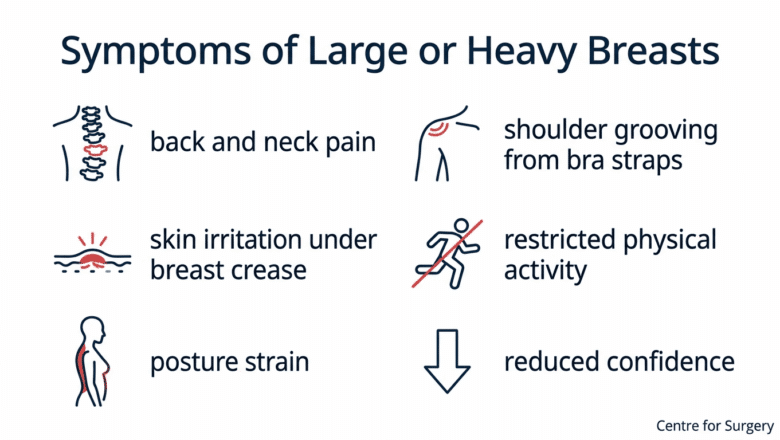
Breast reduction is one of the most commonly performed procedures at our Baker Street clinic, largely because of how substantial the symptom relief can be for women living with disproportionately large breasts. Common symptoms include:
- Back, neck, and shoulder pain — the weight of large breasts places significant, continuous strain on the upper spine and supporting muscles.
- Shoulder grooving — deep, sometimes permanent indentations from bra straps digging into the shoulders under the weight of the breasts.
- Numbness or tingling in the arms and hands — from nerve compression related to poor posture and strap pressure.
- Breathlessness during physical activity, related to the additional weight on the chest wall.
- Skin irritation, rashes, and fungal infections in the breast crease, where skin-on-skin contact and moisture accumulate.
- Sleep disturbance — finding a comfortable sleeping position becomes difficult with significant breast weight.
- Postural changes — many women unconsciously develop a stooped or hunched posture over time to compensate for the weight.
- Restricted physical activity — difficulty participating in sports or exercise comfortably, sometimes leading many women to avoid activity altogether.
- Reduced self-confidence — social embarrassment and unwanted attention are common, and many women report avoiding certain clothing, social situations, or activities as a result.
Many women live with these symptoms for years — often feeling reluctant to raise the issue with their GP, or unsure whether their symptoms are “bad enough” to warrant treatment — before eventually seeking help.
Can Losing Weight Reduce the Size of Large Breasts?
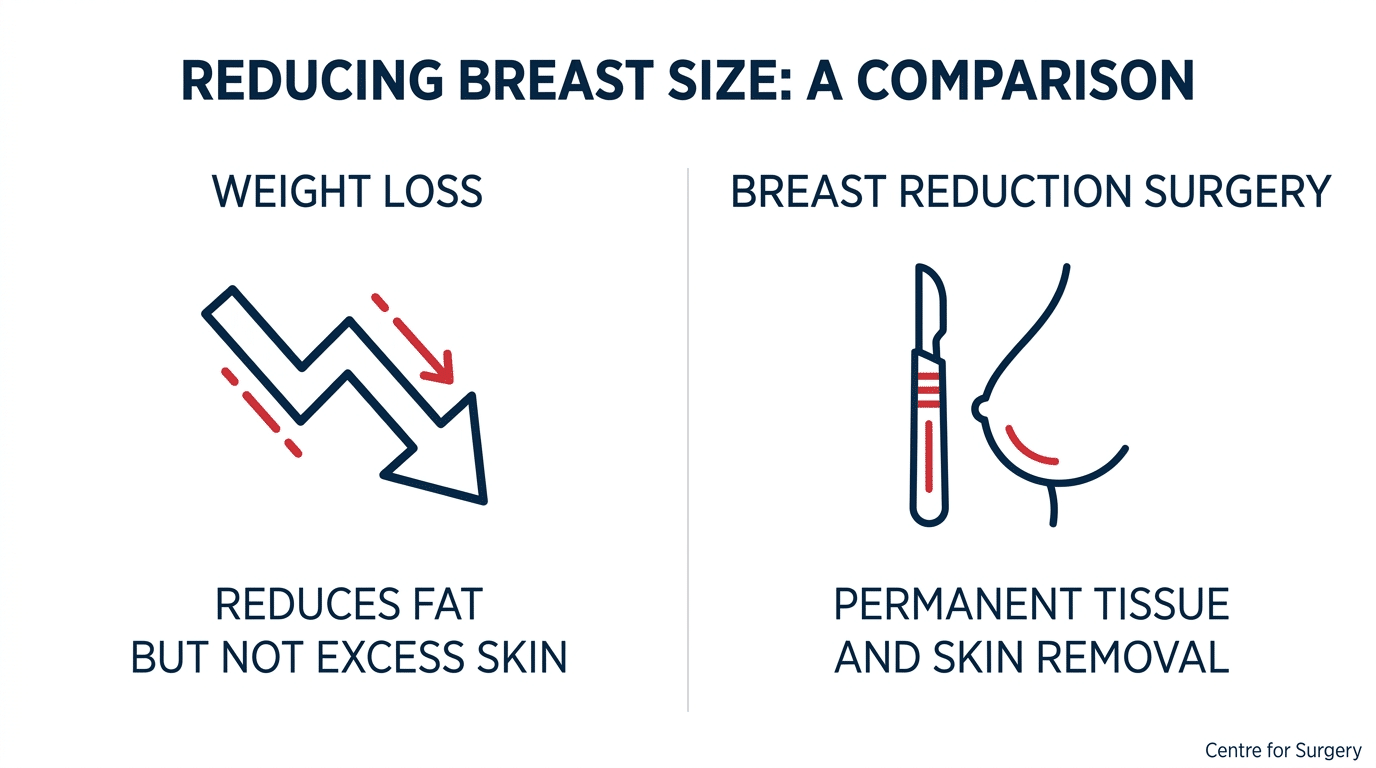
Weight loss through a healthy diet and regular exercise can genuinely help reduce breast size to some degree, since breast tissue contains a meaningful proportion of fat. Cardiovascular exercise — running, cycling, swimming — is generally the most effective way to reduce overall body fat, including the fat component of breast tissue, and toning the underlying chest wall muscles can also improve the appearance of the chest area.
However, weight loss alone isn’t the most effective or reliable way to treat the symptoms of large breasts, for one key reason: the overlying skin of the breast doesn’t shrink proportionally with fat loss. Skin that has been stretched over time — by breast size, pregnancy, or weight fluctuation — retains a degree of laxity even once the underlying volume reduces. In practice, this means weight loss on its own most commonly results in breasts that appear saggier or more deflated, rather than genuinely smaller and better supported. The skin component simply cannot be “exercised away” — it needs to be surgically removed for a permanent, well-supported reduction in breast size and shape.
For women whose symptoms are primarily driven by the weight and bulk of glandular tissue, rather than skin laxity, breast reduction surgery remains the only reliably effective, long-term solution.
Is It Possible to Reduce Large Breasts Without Surgery?
For women with milder symptoms, some relief may come from non-surgical approaches — a well-fitted, supportive bra from a specialist bra fitter, physiotherapy to strengthen supporting back and shoulder muscles, or anti-inflammatory medication for flare-ups of pain. These measures can genuinely help manage day-to-day discomfort.
However, for the majority of women with more significant, persistent symptoms, non-surgical approaches don’t provide lasting relief, because they don’t address the underlying cause — the volume and weight of the breast tissue itself. Breast reduction surgery remains the only treatment that permanently addresses both the physical symptoms and the proportions of the breast.
Am I a Good Candidate for Breast Reduction?
Good candidates for breast reduction are typically women who are in good general physical and mental health, at or near a stable weight, and experiencing genuine physical symptoms — back, neck, or shoulder pain, skin irritation, or restricted activity — related to their breast size. Non-smokers, or those willing to stop several weeks before and after surgery, tend to heal more predictably, since smoking measurably impairs wound healing and increases complication risk.
It’s also worth being at a stable weight before proceeding, since significant weight fluctuation after surgery can affect your results. If you’re planning further pregnancies, it’s worth discussing this at consultation too, since pregnancy and breastfeeding after a reduction can affect the longevity of your results, though it won’t prevent you from having children afterwards. Your surgeon will assess your specific anatomy, symptoms, and goals in detail at a face-to-face consultation before recommending the most appropriate approach.
What Does Breast Reduction Surgery Involve?
Breast reduction, also known as reduction mammoplasty, is a surgical procedure that removes excess breast tissue, fat, and overlying loose skin to reduce both the size and weight of the breast. As part of the procedure, the nipple and areola are typically repositioned to a higher, more central location on the reshaped breast mound, creating a more youthful, proportionate, and often perkier appearance. The procedure is frequently combined with a breast uplift (mastopexy) to further improve shape and position at the same time.
If sagging bothers you more than size, compare breast reduction vs breast lift to see which suits you.
Step 1 — Assessment and marking. Before surgery, your surgeon marks the planned incision pattern and new nipple position while you’re standing, taking into account your existing anatomy and desired outcome.
Step 2 — Incisions and tissue removal. Under TIVA anaesthesia, your surgeon makes the planned incisions and removes the excess breast tissue, fat, and skin needed to achieve the agreed reduction in size.
Step 3 — Reshaping and nipple repositioning. The remaining breast tissue is reshaped, and the nipple-areola complex is repositioned to a higher, more central position appropriate to the new breast size and shape.
Step 4 — Closure. Incisions are closed in layers with dissolvable sutures, and a supportive surgical bra is fitted before you leave theatre.
Centre for Surgery specialises in breast reduction for women with breasts that are disproportionately large for their body frame, causing meaningful physical discomfort — most commonly arising from genetics, pregnancy, and childbirth, though hormonal factors and weight changes play a role too.
Liposuction breast reduction is a less invasive alternative appropriate for some patients, using fat removal alone rather than tissue and skin excision — your surgeon can advise whether this technique suits your specific anatomy and goals at consultation.
Men can be affected by a related but medically distinct condition called gynaecomastia — enlarged male breast tissue, usually caused by a hormonal imbalance rather than the mechanisms behind gigantomastia. This is treated with a specially modified reduction technique typically combining liposuction and glandular tissue removal to contour a flatter, more masculine chest.
Will Breast Reduction Affect My Ability to Breastfeed?
This is one of the most common questions we’re asked at consultation. Meticulous surgical technique is used to preserve the milk ducts and nerve supply around the nipple as much as possible, which helps minimise the risk of difficulty breastfeeding after surgery. That said, no surgeon can guarantee breastfeeding will be entirely unaffected — if this is important to you, raise it directly at consultation so your surgeon can factor it into your surgical plan and technique selection.
How Long Is Breast Reduction Recovery?
Most patients return to their normal daily activities within four to six weeks, with recovery generally considered complete by around six weeks. The final breast shape and appearance takes a little longer to fully settle, typically becoming apparent at three to six months, as swelling resolves completely and the tissue softens into its lasting position.
Breast reduction surgery is highly effective at relieving the physical symptoms associated with large breasts — particularly back, neck, and shoulder pain — and patient satisfaction rates for this procedure are consistently among the highest of any cosmetic surgery we perform, reflecting how substantial the day-to-day improvement in comfort and quality of life tends to be.
How Much Does Breast Reduction Cost?
The cost of breast reduction depends on factors including the surgical technique required, the amount of tissue to be removed, and whether the procedure is combined with a breast lift. Cost shouldn’t be the deciding factor in your decision — choosing a properly qualified, experienced plastic surgeon matters far more than price alone. For a full, personalised breakdown, book a consultation for an itemised quote, or see our breast reduction service page for further detail. Finance is available through Chrysalis Finance, subject to status; see our finance options page.
Choosing a Surgeon for Breast Reduction
Given how much this procedure can improve day-to-day comfort and quality of life, choosing the right surgeon matters. Look for a plastic surgeon on the GMC Specialist Register with genuine, specific experience in breast reduction — not just breast surgery in general. Ask to see relevant before-and-after photographs at consultation, and read independent patient reviews for a sense of real-world outcomes. A properly regulated, CQC-inspected facility also matters just as much as the surgeon’s individual skill.
Frequently Asked Questions
What do large breasts indicate?
In the vast majority of cases, large breasts don’t indicate any underlying medical concern — they’re simply a normal variation in body shape, shaped by genetics, hormones, and life events like pregnancy. Rarely, a rapid or disproportionate change in breast size can be a sign of an underlying medical condition, so any sudden or unusual change is worth mentioning to your GP.
What causes extremely large breasts?
Extremely large breasts most often result from a combination of genetics, hormonal factors, pregnancy, and weight gain. In rare cases, significant disproportionate breast size is caused by gigantomastia (also called macromastia, breast hypertrophy, or hypermastia) — a very uncommon condition with no single defined cause, though it’s sometimes associated with puberty, pregnancy, or certain hormonal medications.
Can breast size change suddenly?
Yes — hormonal fluctuations from puberty, the menstrual cycle, pregnancy, breastfeeding, or certain medications can all cause breast size to change, sometimes fairly quickly. A sudden, unexplained, or one-sided change in breast size is always worth having checked by your GP.
Is it normal to have one breast larger than the other?
Yes, a degree of natural asymmetry between the breasts is extremely common and normal. If the difference is significant or has changed recently, it’s worth discussing with your surgeon or GP — options like breast asymmetry correction exist if it bothers you.
Does having large breasts increase breast cancer risk?
Breast size itself isn’t a recognised risk factor for breast cancer — risk is influenced by factors like age, family history, and genetics rather than breast volume. That said, all women, regardless of breast size, should follow the NHS breast screening guidance appropriate for their age and continue regular self-checks.
Should I have a breast reduction or a breast lift?
This depends on what’s actually bothering you. If your main concern is the size and weight of your breasts, a reduction addresses that directly by removing tissue. If your breasts have lost firmness and position — commonly after pregnancy or weight loss — without excess volume, a lift alone may be more appropriate. Many women benefit from a combination of both, addressing size and position in a single procedure. Your surgeon can advise which applies to you at consultation.
Breast Reduction at Centre for Surgery
At Centre for Surgery, breast reduction is performed by GMC-registered plastic surgeons, at our CQC-regulated Baker Street facility, under TIVA (Total Intravenous Anaesthesia) as a day case. Our team understands that living with large breasts affects far more than appearance — it can shape your comfort, your activity levels, and your day-to-day confidence. For further information, or to book a face-to-face consultation with a specialist breast surgeon in London, get in touch with one of our patient coordinators.
Book Your Consultation
Phone: 020 7993 4849
95–97 Baker Street, Marylebone, London W1U 6RN
Contact us to schedule your consultation