


In this guide14 sections
- Key Points
- What Is a Cartilage Graft Nose Job?
- When Is a Cartilage Graft Needed in Rhinoplasty?
- Septal, Ear or Rib Cartilage: Which Is Best for Rhinoplasty?
- What Is Diced Cartilage Rhinoplasty?
- Cartilage Grafts vs Silicone Implants
- What Happens During a Cartilage Graft Nose Job?
- Cartilage Graft Rhinoplasty Recovery
- What Are the Risks of Cartilage Grafts in Rhinoplasty?
- Does Nose Cartilage Grow Back?
- Rhinoplasty Before and After
- Frequently Asked Questions
- References
- Talk to a Surgeon About a Cartilage Graft Nose Job
Key Points
- A cartilage graft nose job is a rhinoplasty that uses your own cartilage to add support, height or shape where the nose lacks it.
- There are three donor sites: the septum inside the nose, the bowl of the ear, and the rib. Surgeons use septum first, then ear, and rib only when neither is enough.
- Ear cartilage is soft and curved, suiting the tip and nostril rims. Rib cartilage gives the most volume and strength for rebuilding the bridge or a collapsed nose, but needs a small chest incision.
- Diced cartilage, finely chopped and sometimes wrapped in fascia, is used to build up or smooth the bridge.
- In a 2026 review of 4,482 patients, rib cartilage grafts had low pooled rates of warping (2.9%), resorption (1.6%) and infection (1.9%).[1]
- Nose cartilage that is removed does not grow back, so grafts are how missing support is replaced.
Many rhinoplasties only reduce or reshape the nose. A cartilage graft nose job is different: it adds tissue. Surgeons graft cartilage when the nose needs more support, more height or a better-defined tip, or when an earlier operation removed too much. This guide explains where the cartilage comes from, how septal, ear and rib cartilage compare, what diced cartilage is, and what recovery from each donor site involves.
If you want the full list of graft types by job, such as spreader grafts, columellar struts and alar rim grafts, see our guide to rhinoplasty grafts. For the operation itself, see our rhinoplasty page.
What Is a Cartilage Graft Nose Job?
A cartilage graft nose job, also called cartilage rhinoplasty or structural rhinoplasty, is nose surgery in which the surgeon takes a piece of your own cartilage from one place and carves it to support, lengthen or build up part of the nose. The graft might sit along the bridge, between the tip cartilages, along the nostril rim or beside the septum.
Cartilage is firm but flexible tissue. It has no blood supply of its own and lives on nutrients from the surrounding tissue, which is why a graft can survive once it is placed in a well-made pocket. Using your own tissue (an autologous graft) avoids the rejection and higher infection risk of synthetic implants. A 2026 review of more than 7,000 patients found autologous grafts carried a significantly lower infection risk than synthetic implants such as silicone.[2]
When Is a Cartilage Graft Needed in Rhinoplasty?
Your surgeon will usually suggest a graft in one of these situations:
- A low or flat bridge that you would like built up, common in ethnic rhinoplasty and augmentation rhinoplasty.
- A weak or drooping tip that needs support to hold its projection and rotation.
- A collapsed or scooped bridge, such as a saddle nose deformity after injury or earlier surgery.
- Breathing problems from a narrow or collapsing valve area. Our guide to nasal valve collapse explains the symptoms.
- Revision surgery, where an earlier operation removed or weakened support. Most revision rhinoplasty cases need grafts.
- A crooked nose, where grafts help straighten and brace the midline.
Septal, Ear or Rib Cartilage: Which Is Best for Rhinoplasty?
There is no single best donor site. The choice depends on how much cartilage is needed, how strong it has to be, and how much septum you still have. Surgeons follow a simple order: septum first, ear second, rib only when neither is enough.

| Donor site | What it is like | Used for | Where the incision is |
|---|---|---|---|
| Septum | Flat, straight and firm | Tip support, spreader grafts, small bridge grafts | Inside the nose, no extra scar |
| Ear (concha) | Soft, curved and springy | Tip shape, nostril rims, softening small irregularities | Behind the ear, hidden in the crease |
| Rib (costal) | Thick, strong and plentiful | Rebuilding the bridge, major revision, saddle nose | A short incision under the breast or chest |
Septal cartilage graft
The septum is the wall dividing the two sides of the nose. Its cartilage is straight and strong, and it can be taken through the same incisions used for the rest of the operation, so there is no second scar. Surgeons always leave an L-shaped strip of septum in place to keep the nose supported. The limit is quantity: there may be too little left after a previous septoplasty, an injury or an earlier rhinoplasty.
Ear cartilage rhinoplasty
Ear cartilage comes from the concha, the bowl next to the ear canal. It is taken through a small incision hidden behind the ear, and the outer ear keeps its shape because the rim and folds are left alone. Its natural curve suits the tip and nostril rims, though it is less suited to long, straight grafts along the bridge.
In a 2024 study of 60 patients, ear shape after conchal harvest scored close to “no deformity” on average. Minor problems at the ear, including a blood collection, slow wound healing or a pale scar, affected 9.4% of ears.[3]
Rib cartilage rhinoplasty
Rib cartilage gives the most material and the most strength. It is used when the bridge needs rebuilding, for a saddle nose, or in revision cases where little septum remains. It is taken through a short incision on the chest; in women it is often placed in or near the fold under the breast. In one series of 83 patients the chest incision averaged 2.4 cm, there were no cases of air leak around the lung (pneumothorax) and two patients developed a raised chest scar.[4] Pneumothorax is uncommon, but it is a recognised risk of rib harvest, reported in 2.9% of patients in another comparison.[5]
Rib cartilage can bend over time, known as warping. Surgeons reduce this by carving from the centre of the rib, layering thin slices, or dicing the cartilage. In the 2026 review, layered rib grafts on the bridge had lower warping rates than single solid blocks (0.0% vs 5.4%).[1]
Donor rib cartilage
Some surgeons use rib cartilage from a tissue bank instead of your own rib, which avoids a chest incision. A 2026 meta-analysis of 2,322 patients found infection (1–2%) and warping (1–3%) rates were similar for your own rib and donor rib cartilage.[6] Your surgeon will explain which they recommend for your nose.
What Is Diced Cartilage Rhinoplasty?
Diced cartilage rhinoplasty uses cartilage chopped into pieces of about half a millimetre to a millimetre. The pieces can be packed straight into a small area, or wrapped in a thin sleeve of fascia (a sheet of connective tissue, often from the temple) and laid along the bridge. This is called a diced cartilage fascia, or DCF, graft.
Diced cartilage can be moulded by hand on the table and under the skin, which makes it useful for building a smooth bridge without the risk of a solid graft bending. In a series of 546 rhinoplasties, 79 patients had diced cartilage grafts; the most common problems were over-correction, visibility of the graft and small steps at the edges, and these were usually simple to correct.[7] Septal, ear or rib cartilage can all be diced.
Cartilage Grafts vs Silicone Implants
Silicone implants are pre-formed and quicker to place, but they are a foreign material. They carry a higher long-term risk of infection, shifting and extrusion (the implant working its way through the skin), particularly in the thin skin over the bridge.[2] Cartilage grafts take longer to carve and need a donor site, but they become part of the nose. We do not offer silicone nasal implants at Centre for Surgery.
What Happens During a Cartilage Graft Nose Job?
- Consultation: your surgeon examines the inside and outside of the nose, checks how much septum is available and discusses where any extra cartilage would come from. If you have had nose surgery before, bring your operation notes if you can.
- Anaesthesia: rhinoplasty at our Baker Street clinic is usually a day case under total intravenous anaesthesia (TIVA).
- Harvest: the cartilage is taken first, or alongside the nasal work, then carved, layered or diced to shape.
- Placement: grafts are stitched into position, most often through an open approach with a small incision across the columella.
- Length: revision cases usually take 3–4 hours, and 5–6 hours where rib cartilage is harvested.
- Afterwards: you spend around 3–4 hours in the recovery unit before going home with a splint on the nose and a responsible adult to collect you.
Cartilage Graft Rhinoplasty Recovery
Recovery from the nose is much the same as any rhinoplasty. The difference is the donor site.
- Septal cartilage: no second wound. The nose feels blocked for the first week or so.
- Ear cartilage: the ear is sore and may have a small dressing for a few days. Avoid sleeping on that side until it has settled.
- Rib cartilage: the chest is usually the most uncomfortable part of recovery for one to two weeks. Deep breaths, coughing and lifting feel sore at first.
For the nose itself:
- The splint usually comes off at about one week.
- No nose-blowing for 10 days.
- Keep glasses off the bridge for six weeks.
- No contact sport for three months.
- Sleep on your back with your head raised for at least the first one to two weeks. Our guide to sleeping after rhinoplasty has practical tips.
Grafted noses tend to stay swollen for longer, especially after revision or rib grafts, and the final shape can take a year or more to show. Our rhinoplasty recovery guide covers the week-by-week picture and our rhinoplasty swelling guide explains how the shape settles.
What Are the Risks of Cartilage Grafts in Rhinoplasty?
Alongside the general risks of rhinoplasty, such as bleeding, infection and a result you are unhappy with, grafts carry some risks of their own:
- Warping: a graft bending after surgery, mostly with solid rib grafts.
- Resorption: the body absorbing part of the graft, so it shrinks.
- Visibility: edges showing through thin skin, more likely on the bridge.
- Movement: a graft shifting from where it was placed.
- Donor-site problems: a blood collection or scar at the ear, or chest pain, a scar or, rarely, pneumothorax after rib harvest.
Across 50 studies of rib cartilage grafts, pooled rates were 2.9% for warping, 1.6% for resorption, 1.9% for infection and 5.0% for revision surgery.[1] Most of these studies looked back at past cases, so the figures are a guide rather than a guarantee.
Does Nose Cartilage Grow Back?
No. Cartilage removed from the nose during rhinoplasty or septoplasty does not grow back. Cartilage has no blood supply of its own and very little ability to repair itself, so the space is filled by scar tissue rather than new cartilage. This is why noses that have had too much cartilage removed can collapse or pinch over the years, and why revision surgery usually involves adding cartilage back with grafts.
A nose can still look different years after surgery: swelling settles, scar tissue contracts and the skin and tip change with age. If your nose has collapsed or pinched after an earlier operation, our guides to polly beak deformity and alar rim retraction explain some of the common patterns.
Rhinoplasty Before and After
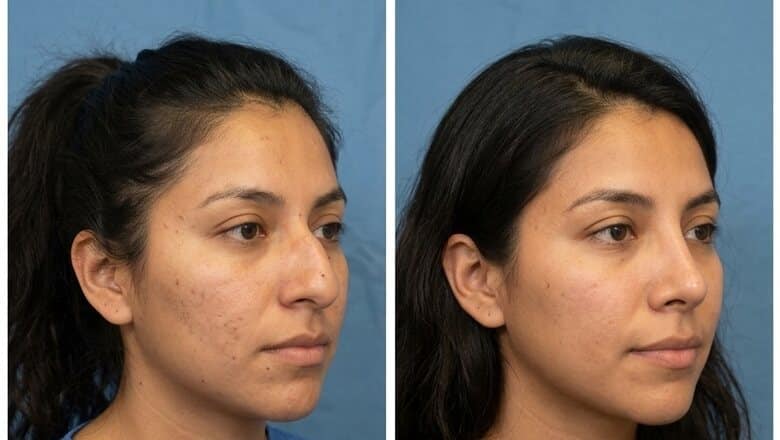
Real Centre for Surgery patient, rhinoplasty, three-quarter view. Individual results vary. See more results in our rhinoplasty before and after photos.
Frequently Asked Questions
Can you get nose cartilage removed?
Yes. Rhinoplasty often trims or reshapes cartilage, for example to reduce a hump or refine a bulbous tip. Surgeons now try to remove less and reshape more, as removed cartilage does not grow back and over-resection can weaken the nose. Where support has been lost, cartilage grafts are added back.
What are the side effects of ear cartilage rhinoplasty?
The ear is sore for a few days and may be bruised. Less common problems include a blood collection under the skin, slow healing of the incision and a pale or visible scar behind the ear, which affected 9.4% of ears in one study.[3] The outer shape of the ear is usually unchanged.
Is ear or rib cartilage better for rhinoplasty?
It depends on the job. Ear cartilage is soft and curved, so it suits small to moderate tip and nostril work. Rib cartilage is thicker and stronger, so it suits rebuilding the bridge or a collapsed nose, but it needs a chest incision and adds to recovery. Your surgeon will choose based on how much support your nose needs and how much septum you have.
Does rib cartilage rhinoplasty leave a scar?
Yes, a short scar on the chest. In one series the incision averaged 2.4 cm.[4] In women it is often placed in or near the fold under the breast, where it can be hidden by a bra or bikini. Most scars fade well, though some people form a raised scar.
Do cartilage grafts last?
Grafts made from your own cartilage are designed to be permanent. A small proportion are partly absorbed or bend over time, and the rest of the nose keeps ageing as it would anyway. Grafts placed to support the tip and nostril rims help the nose hold its shape over the long term.
Will people notice I had a cartilage graft nose job?
The graft itself sits under the skin and should not be visible once swelling has settled. Septal grafts leave no outside scar, ear grafts leave a scar hidden behind the ear, and rib grafts leave a short scar on the chest. With an open approach there is also a small scar across the columella that usually fades to a fine line.
References
- Jullamusi T, Kowitwibool S, Mungmee P, et al. Adverse outcomes and complications of autologous versus homologous costal cartilage grafts in septorhinoplasty: a systematic review and meta-analysis. Aesthet Surg J 2026. doi:10.1093/asj/sjag131 ↗
- Khatlah A, AlKaabba F, Almari M, et al. Outcomes and complications of autologous versus alloplastic grafts in augmentation rhinoplasty: a systematic review of studies from 2000 to 2024. JPRAS Open 2026;51:330–344. doi:10.1016/j.jpra.2026.01.031 ↗
- Li Q, Chen Z, Jiang Z, et al. A novel conchal cartilage harvesting technique. Aesthetic Plast Surg 2024;48(15):2941–2950. doi:10.1007/s00266-024-03958-7 ↗
- Park JH, Jin HR. Use of autologous costal cartilage in Asian rhinoplasty. Plast Reconstr Surg 2012;130(6):1338–1348. doi:10.1097/PRS.0b013e31826d9f03 ↗
- Zhao R, Pan B, Lin H, et al. Application of trans-areola approach for costal cartilage harvest in Asian rhinoplasty and comparison with traditional approach on donor-site morbidity. Aesthet Surg J 2020;40(8):829–835. doi:10.1093/asj/sjaa012 ↗
- Datta S, Ramly EP, Tucci A, et al. Rib grafts in rhinoplasty: a systematic review and meta-analysis of autologous, fresh-frozen, and irradiated cartilage. Plast Reconstr Surg Glob Open 2026;14(6):e7875. doi:10.1097/GOX.0000000000007875 ↗
- Daniel RK. Diced cartilage grafts in rhinoplasty surgery: current techniques and applications. Plast Reconstr Surg 2008;122(6):1883–1891. doi:10.1097/PRS.0b013e31818d2104 ↗
Talk to a Surgeon About a Cartilage Graft Nose Job
If you are considering rhinoplasty and think you may need cartilage grafts, you can book a consultation at our Baker Street clinic by calling 020 7993 4849 or using the form below. You can also read our rhinoplasty cost guide and finance options.







