



In this guide12 sections
- Key Points
- What Is the Inframammary Fold?
- What Holds the Inframammary Fold in Place?
- Why Does the Inframammary Fold Matter in Breast Surgery?
- What Is a High, Low or Tight Inframammary Fold?
- Inframammary Fold Problems After Breast Surgery
- Is It Normal Settling or a Fold Problem?
- How Is the Inframammary Fold Corrected?
- Breast Augmentation Before and After
- Frequently Asked Questions
- References
- Talk to a Surgeon About Your Breast Crease
Key Points
- The inframammary fold (IMF), also called the inframammary crease or breast crease, is the natural fold where the lower edge of the breast meets the chest wall.
- It is held in place by a band of connective tissue that anchors the skin to the chest wall, and it usually sits around the level of the fifth and sixth ribs.
- The fold sets the bottom of the breast. Surgeons measure the distance from the nipple to the fold before breast augmentation, a breast lift or a breast reduction, and often hide the scar in it.
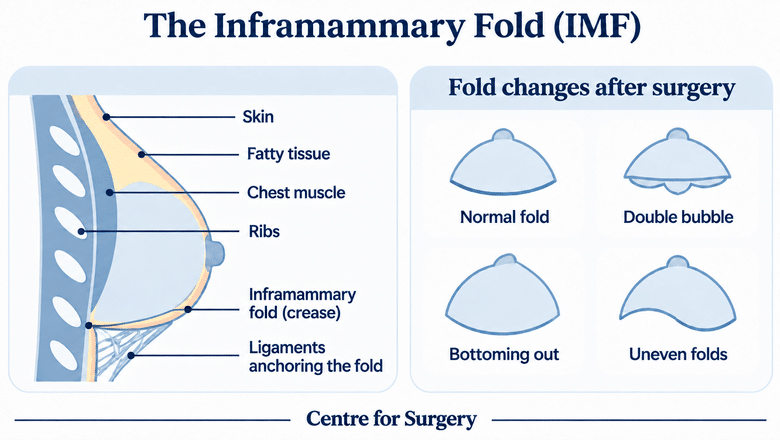
- Problems with the fold after surgery include a double bubble, where the implant sits below the old crease, bottoming out, where the implant drops too low, and folds that sit at different heights.
- Most fold problems can be corrected with revision surgery that rebuilds or repositions the crease, usually under TIVA as a day case at our Baker Street clinic.
The inframammary fold is the crease under your breast. It looks like a small detail, but it is one of the main landmarks your surgeon uses when planning breast augmentation, a breast lift or a breast reduction. This guide explains where the fold is, what holds it in place, why it matters in breast surgery and what can go wrong with it afterwards. If you already have implants and are worried about how they sit, our guide to breast implant problems covers the wider picture, and our breast anatomy basics guide explains the rest of the breast.
What Is the Inframammary Fold?
The inframammary fold is the line where the underside of the breast joins the chest wall. “Infra” means below and “mammary” means breast, so the name simply describes a fold below the breast. You will also hear it called the inframammary crease, the inframammary line, the breast crease or the IMF.
The fold forms the lower border of the breast. It marks where the breast footprint ends at the bottom, in the same way that the edge of the breastbone marks the inner border and the side of the chest marks the outer border.
Where is the inframammary fold?
In most women the fold sits over the fifth or sixth rib, roughly in line with the bottom of a bra underwire. It runs in a gentle curve from near the breastbone towards the side of the chest. Its exact height varies from person to person and is often slightly different on each side, which is one reason why few women have perfectly matching breasts.
What is the inframammary crease?
The inframammary crease is another name for the inframammary fold. Some surgeons use “crease” for the visible line on the skin and “fold” for the deeper structure that creates it, but in everyday use the two terms mean the same thing.
What Holds the Inframammary Fold in Place?
The fold is not just a skin crease. It is a strong, organised band of connective tissue that ties the skin to the chest wall.
A cadaver study by Boutros and colleagues in Plastic and Reconstructive Surgery ↗ found that the fold is a structure within the skin itself, made of regular rows of collagen running along the crease, held in place by a zone where the superficial fascia sticks firmly to the tissue over the chest muscle.[1] The authors concluded that this structure should be preserved in breast surgery where possible to keep a natural result.
Later work has added detail. In a dissection study of ten breasts, Takaya and colleagues ↗ found layers of fascia running from the skin near the fold to the covering of the pectoralis major muscle, anchored mainly at the level of the fourth rib and partly at the fifth.[2] In other words, the skin of the fold “hangs” from attachments slightly higher up, rather than being stuck down directly beneath it. A systematic review of breast fascia in Plastic and Reconstructive Surgery describes the fold as the structure that supports and defines the lower half of the breast, working alongside the Cooper’s ligaments and the fascia that wraps the breast.[3]
Why Does the Inframammary Fold Matter in Breast Surgery?
The fold is the fixed point at the bottom of the breast. Nearly every breast operation is measured from it, built around it or hidden in it.
Planning the shape of the breast
Before surgery your surgeon measures the distance from the nipple to the fold, along with your breast width and skin stretch. These measurements guide implant size and whether the fold needs to stay where it is or be lowered. Where the nipple is close to the fold, a larger implant needs more room in the lower half of the breast, so the fold may be moved down to make space and keep the nipple central on the new breast mound.
Hiding the scar
The fold is the most common place for a breast implant incision. At Centre for Surgery the incision for breast augmentation is usually 3.5 to 5 cm long and sits in the crease, where it is hidden by the natural shadow of the breast and by most bras and bikinis. Our guide to breast augmentation incisions compares this with the other options. The horizontal scar of an anchor breast lift or reduction also lies in or close to the fold.
Holding the implant in place
The fold acts as a floor for a breast implant. If it is kept intact, or rebuilt securely when it is lowered, the implant stays where it was placed. If it is released too much or weakens over time, the implant can slip below it.
What Is a High, Low or Tight Inframammary Fold?
Surgeons often describe the fold by its position and how firm it feels.
- High fold: the crease sits higher on the chest than usual, so the lower half of the breast looks short. A high fold is one of the features of tuberous breasts, together with a narrow base and a puffy areola.
- Tight or strong fold: the crease stays deep and well defined even when you lift your arms. This is common in women with small breasts and a short distance from the nipple to the fold.
- Low or loose fold: the crease has dropped, often with stretched skin after pregnancy, weight change or ageing. This usually goes with sagging and may point towards a lift rather than implants alone.
- Uneven folds: one crease sits higher than the other. This is a common cause of one breast looking bigger or lower than the other.
A tight fold needs particular care when it is lowered. In a technique paper in Plastic and Reconstructive Surgery, Hoffman and Tavakoli ↗ explain that a strong fold which does not soften when the arms are raised must be fully released when the fold is moved down; if it is not, mild bottoming out or a double bubble can follow.[4]
Inframammary Fold Problems After Breast Surgery
Most women never notice their fold after breast surgery. When something does go wrong, the problem usually shows in the lower half of the breast.
Double bubble
A double bubble is when a visible line or step runs across the lower breast. It happens when the implant sits below the original fold, and the old crease still pulls in across the front of the implant, so you see two curves: the breast above and the implant bulging below. It is more likely when a tight fold is lowered without fully releasing it, when the implant sits under the muscle and the muscle pulls up on the breast tissue, or when the implant moves down after surgery. A double bubble can be more obvious when you lift your arms or tense your chest muscles. It is different from a waterfall deformity, where the breast tissue slides down off the front of an implant that stays high.
Bottoming out
Bottoming out is when the implant drops below the planned fold, so too much of the breast sits below the nipple and the nipple appears to point upwards. It usually develops months or years after surgery as the lower fold stretches. Our separate guide to bottoming out of breast implants covers the causes, how it differs from normal settling, and how it is repaired.
Folds at different heights
If one fold is lowered more than the other, or one side stretches more over time, the creases end up at different heights and the breasts look uneven from the front. Small differences are normal and often present before surgery. A larger difference can be corrected by raising or lowering one fold, sometimes with a change of implant on one side through breast asymmetry correction.
Implants that sit too high
The fold can also hold the implant too high. This is more common with implants under the muscle or with capsular contracture, where scar tissue tightens around the implant and lifts it. Some high riding is normal in the first weeks, while the implant settles.
Is It Normal Settling or a Fold Problem?
Implants take time to settle into the lower pole of the breast. In a 3D scanning study of women after dual-plane breast augmentation, Ji and colleagues ↗ found that the distance from the nipple to the fold kept changing in the early months but did not change significantly after 6 months, and most changes in breast shape were complete by then.[5] This is why surgeons usually wait around 6 months before judging the final position of the fold.
Signs worth raising with your surgeon include:
- a line or groove across the lower breast that does not fade as swelling settles
- nipples that point upwards, or a breast that looks heavy below the nipple
- a scar that has moved up onto the front of the breast instead of sitting in the crease
- one fold that is clearly lower or higher than the other after 3 to 6 months
- new pain, hardness or a change in shape on one side, which may point to capsular contracture or another implant problem
How Is the Inframammary Fold Corrected?
Fold correction is a form of breast revision. The approach depends on whether the fold needs to come up, go down or be redefined.
- Raising the fold: for bottoming out or a fold that sits too low, the surgeon closes the lower part of the implant pocket with internal stitches to create a new, higher floor. The scar from the original incision is usually reused.
- Softening a double bubble: the old crease is released from the inside, and the implant pocket or plane may be adjusted. Some surgeons add a small fat graft under the skin of the old crease to smooth the step.
- Matching the folds: one fold is raised or lowered so both sides match, sometimes with a different implant size on one side.
- Changing or removing the implant: a lighter or smaller implant puts less strain on a repaired fold. This is done through breast implant replacement, or breast implant removal if you would prefer not to have implants.
At Centre for Surgery, breast implant revision is carried out by GMC-registered plastic surgeons at our CQC-regulated Baker Street hospital, usually as a day case under TIVA (total intravenous anaesthesia).
Breast Augmentation Before and After
These photos show a breast augmentation with implants 6 weeks after surgery. The incision sits in the inframammary fold, and the lower half of the breast has a smooth curve down to the crease. The final shape continues to settle over the following months.

Breast augmentation with implants, front view, 6 weeks after surgery.

Side profile, 6 weeks after surgery. The fold defines the lower curve of the breast.
Frequently Asked Questions
What is the medical term for under the breast?
The medical term for the area under the breast is the inframammary region, and the crease itself is the inframammary fold or inframammary crease. Doctors also use “inframammary” for things in that area, such as an inframammary incision for breast implants or inframammary intertrigo, a rash in the skin fold.
What does a high inframammary fold mean?
A high inframammary fold means the crease sits higher on the chest than usual, so the lower half of the breast looks short or tight. It can be a natural variation or part of tuberous breasts. In breast augmentation a high fold is often lowered to give the implant room and keep the nipple central, with care taken to fully release the old crease.
What is the inframammary ridge?
The inframammary ridge is a firm, curved band of tissue that you can feel along the inframammary fold, especially in larger breasts. It is a normal part of breast anatomy, made of the dense connective tissue of the fold. A ridge that feels the same on both sides is usual. A new lump, a change on one side, or skin dimpling should be checked by your GP.
Why does my inframammary fold hurt?
Pain along the fold has many possible causes. Common ones include a sore, red rash in the skin crease, an underwire bra rubbing, strain of the chest wall muscles, or inflammation where the ribs join the breastbone. After breast surgery, the incision in the fold can feel tender or tight for several weeks. See your GP or surgeon if the pain is new and persists, if there is a lump, or if you have redness, heat or a fever after surgery.
Will an inframammary incision scar show?
An inframammary incision is placed in the fold so the scar is hidden by the natural shadow of the breast when you stand. It is usually 3.5 to 5 cm long and fades gradually over the first year. It can be visible when you lie on your back or lift your arms, and it can move up onto the breast if the fold is not set in the right place or if the implant later drops.
References
- Boutros S, Kattash M, Wienfeld A, Yuksel E, Baer S, Shenaq S. The intradermal anatomy of the inframammary fold. Plast Reconstr Surg. 1998;102(4):1030-1033. doi:10.1097/00006534-199809020-00017 ↗
- Takaya K, Sakamoto Y, Imanishi N, Kishi K. The fascial structure of the breast: new findings on the anatomy of the inframammary fold. J Plast Reconstr Aesthet Surg. 2022;75(5):1632-1638. doi:10.1016/j.bjps.2021.11.109 ↗
- Duncan AM, Al Youha S, Joukhadar N, Konder R, Stecco C, Wheelock ME. Anatomy of the breast fascial system: a systematic review of the literature. Plast Reconstr Surg. 2022;149(1):28-40. doi:10.1097/PRS.0000000000008671 ↗
- Hoffman SW, Tavakoli K. The inframammary fold effacement flap for strong fold breast augmentation patients. Plast Reconstr Surg. 2026;157(6):989-992. doi:10.1097/PRS.0000000000012358 ↗
- Ji K, Luan J, Liu C, et al. A prospective study of breast dynamic morphological changes after dual-plane augmentation mammaplasty with 3D scanning technique. PLoS One. 2014;9(3):e93010. doi:10.1371/journal.pone.0093010 ↗
Talk to a Surgeon About Your Breast Crease
If you are planning breast surgery, or you are unhappy with how your fold or implants sit after a previous operation, you can book a consultation at our Baker Street clinic by calling 020 7993 4849 or using the form below. Your surgeon will examine your folds, take measurements and explain your options.







