



In this guide12 sections
- Key Points
- What Is a Crescent Breast Lift?
- Who Is a Good Candidate for a Crescent Lift?
- Pros and Cons of a Crescent Lift
- Is a Crescent Breast Lift Worth It?
- The Crescent Lift Procedure
- Crescent Breast Lift With or Without Implants
- Recovery Timeline After a Crescent Lift
- Crescent Breast Lift Scar
- Crescent Breast Lift Before and After
- Frequently Asked Questions
- Crescent Breast Lift at Centre for Surgery
Key Points
- A crescent lift removes a half-moon of skin above the areola. The single scar sits along the top edge of the areola, and the nipple is raised by around 1 to 2cm.
- It suits very mild sagging only. It works best when the nipple sits no more than about 1.5 to 2cm below the breast crease, for small differences in nipple height between the breasts, or alongside breast implants.
- It leaves the smallest scar, but not no scar. In the study that first described it, the scar widened in almost half of patients, and the areola can be pulled into a slightly oval shape.
- More sagging needs a different lift. A donut lift gives more correction for mild sagging; vertical (lollipop) and anchor lifts are for moderate or severe sagging.
- Recovery is quick. Most people return to desk work within about 10 days and to full exercise at 6 weeks.
The crescent breast lift is the least invasive of the four recognised breast lift techniques, using a single small incision to achieve a subtle correction for minor sagging. It’s a genuinely modest procedure — not a solution for established ptosis — and understanding that limitation up front is the key to a satisfying result. For the full comparison against the other three techniques, see our guide: Types of Breast Lift.
A crescent lift is also called a crescent mastopexy. At Centre for Surgery it is one of two minimal-scar options, alongside the mini breast lift (doughnut mastopexy), and our breast lift page covers every technique we offer.
What Is a Crescent Breast Lift?
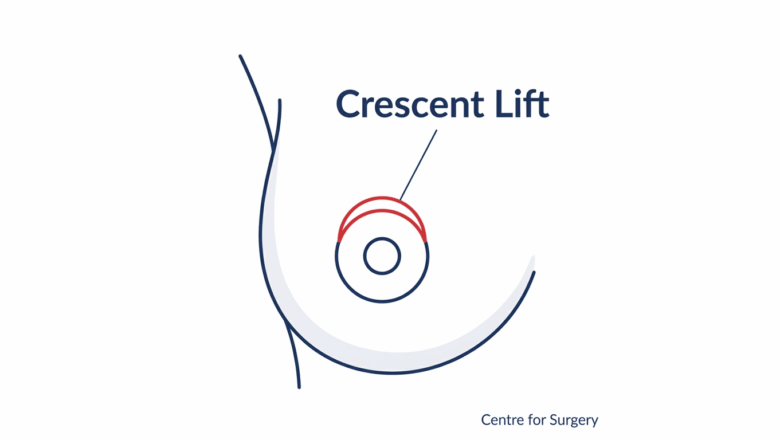
The crescent lift uses a single, half-moon-shaped incision positioned along the upper edge of the areola. Using the natural border of the areola as a guide, a small crescent-shaped segment of skin above it is removed, and the remaining skin is sutured back together — pulling the areola and breast into a marginally higher position. The typical lift achieved is around 2cm, which places a clear ceiling on what this technique can correct.
Who Is a Good Candidate for a Crescent Lift?
The crescent lift suits women with:
- Minor sagging only — this is not a technique for established or moderate ptosis
- Smaller breasts, which generally require less lifting and reshaping to begin with
- A specific desire for a subtle, minimally invasive adjustment — often used primarily to reposition the areola rather than correct significant droop
- Small differences in nipple height between the two breasts
- Breast implants with a nipple that sits slightly low — the crescent lift raises the nipple a little while the implant adds volume
The study that first defined the technique found it worked when the nipple had dropped no more than about 1.5 to 2cm below the breast crease (Puckett 1985). Beyond that, a crescent lift cannot raise the nipple far enough, and a donut lift or a vertical lift will give a better result. Our guide to breast ptosis grades explains how sagging is measured.
Pros and Cons of a Crescent Lift
Advantages
- Minimal scarring — a single small incision that typically blends well with the areola’s natural border
- The least invasive breast lift option, with correspondingly less tissue trauma and a more comfortable early recovery
- Quick to perform, given the limited scope of the incision
Disadvantages
- Limited correction — around 2cm of lift, which will not address genuine sagging
- Not combinable with significant reshaping goals — if you want a dramatic transformation, this is not the right technique regardless of preference
Is a Crescent Breast Lift Worth It?
A crescent lift is worth it for a narrow group of women: those whose nipples sit only slightly low, who want the smallest possible scar, and who understand the lift will be subtle. For anyone with more sagging than that, it is usually not worth it. The correction is too small, and a donut or vertical lift gives a better, longer-lasting result for a modest increase in scarring.
The research explains why surgeons use it sparingly. Removing skin only from above the areola puts all the tension of the lift on one curved closure. In the study that first described crescent mastopexy with implants, the scar widened in 46% of patients, although most were not troubled by it (Puckett 1985). Later work on lifts around the areola lists areola spreading, thickened scars and a return of sagging as the main problems, all caused by tension on the closure (Gruber 2006). Pulling the areola upward from one side can also change its shape, making it slightly oval.
That is why a good surgeon will tell you honestly if a crescent lift is too small for what you need. Many women who ask about a crescent lift are better served by a mini breast lift, by implants without a lift, or by a full lift.
The Crescent Lift Procedure
All breast lift surgery at Centre for Surgery is performed under TIVA (Total Intravenous Anaesthesia) as a day case at our CQC-regulated Baker Street facility. Guided by the natural shape of the areola, a crescent-shaped incision is made along its top half, a small segment of skin removed, and the remaining skin sutured — lifting the nipple and areola into a slightly higher position.
Crescent Breast Lift With or Without Implants
A crescent lift is most often done at the same time as breast augmentation. An implant adds volume and some upper-breast fullness but cannot raise the nipple. A crescent lift adds the small amount of nipple lift that an implant alone would leave behind. When the two are done in one operation, recovery follows the implant timeline.
A crescent breast lift without implants is also possible, for women who are happy with their breast size but want the nipple to sit slightly higher, or who want to correct a small difference in nipple height. It will not add fullness to the upper breast. If you would like more volume without implants, fat transfer or a breast lift with auto-augmentation may suit you better. Our guide to breast lift vs breast augmentation explains how surgeons decide between a lift, implants or both.
Recovery Timeline After a Crescent Lift
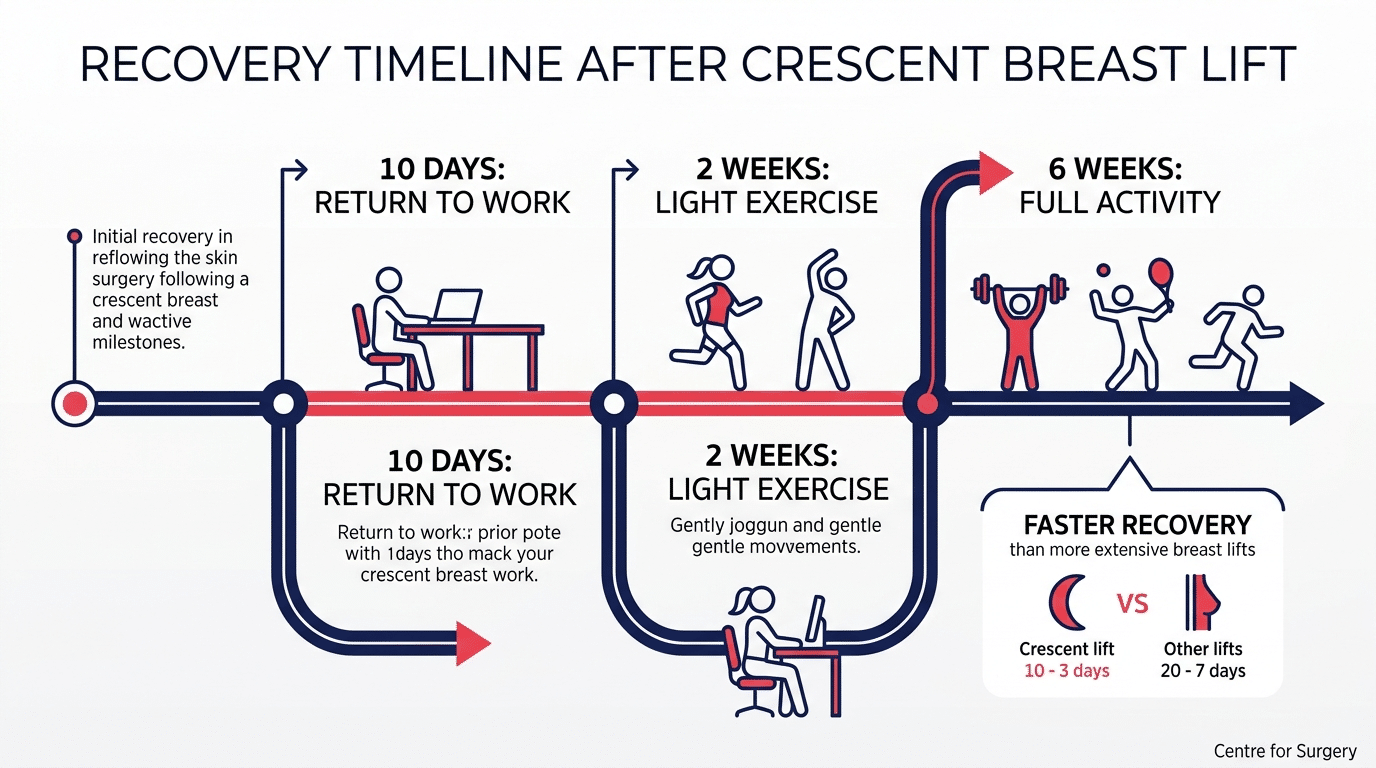
- Ten days: most patients return to work, provided the role isn’t physically demanding
- Two weeks: light, lower-body-focused exercise can typically resume
- Six weeks: most patients are cleared for their full regular exercise routine, subject to surgeon approval
This is the least extensive of the four techniques, so the shape typically settles faster than with a vertical or anchor lift — though final results are still best judged at the six-month to one-year mark.
Crescent Breast Lift Scar
Yes, there is a scar after a crescent lift. It runs along the top half of the areola, where the darker areola skin meets the lighter breast skin, so the change in colour helps to hide it. For the first few months it is pink and may be slightly raised, then it fades and flattens over around 12 months. Using silicone gel or tape on the scar from about 4 weeks after surgery helps it heal well.
The scar can widen because it carries the tension of the lift, and the areola can be pulled into a slightly oval shape. Both are more likely when too much skin is removed, which is why the technique is kept for very small lifts. If you tend to form thick or raised scars, discuss this with your surgeon at your consultation.
Crescent Breast Lift Before and After
These are Centre for Surgery breast uplift patients who have consented to their photographs being used. The technique used for each patient depended on how much sagging she had. Individual results vary.
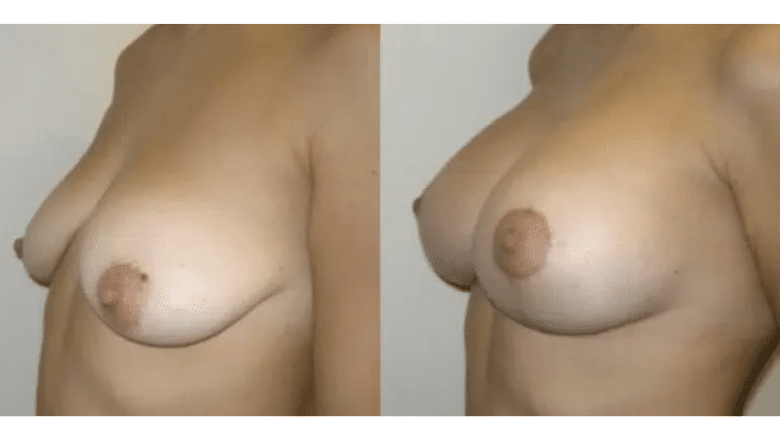

You can see more results in our breast lift before and after gallery.
Frequently Asked Questions
Is a crescent lift the same as a donut lift?
No. A crescent lift uses a half-moon incision along the top half of the areola only. A donut (periareolar) lift uses a full circular incision around the entire areola, giving somewhat more correction.
Will a crescent lift fix significant sagging?
No. It’s designed for minor adjustments — around 2cm of lift — and isn’t suitable for moderate or significant ptosis. If your sagging is more established, a vertical or anchor lift will be needed instead; see our full comparison: Types of Breast Lift.
How visible is a crescent lift scar?
Once healed, it is one of the least noticeable breast lift scars, because it follows the natural border of the areola. It is not invisible: the scar can widen, and the areola can become slightly oval, as explained in the scar section above.
How much does a crescent lift cost?
Crescent lift prices are quoted at your consultation, because the cost depends on whether the lift is done on its own or with implants. Our breast lift cost guide explains what affects the price.
Crescent Breast Lift at Centre for Surgery
At Centre for Surgery, breast lift surgery — including the crescent technique — is performed by GMC-registered plastic surgeons, at our CQC-regulated Baker Street facility, rated Good overall, under TIVA anaesthesia as a day case. Our medical content is reviewed by Specialist Plastic Surgeon Dr Spyridon Vlachos (GMC 7522950).
See real results in our breast lift before and after photo gallery, or read verified patient reviews on Google, or on our own patient reviews page, which brings together verified reviews from Google and Trustpilot.
We offer flexible finance options and a recommended two-week cooling-off period as standard.
To book a consultation, call 020 7993 4849 or complete the contact form below.
References
- Puckett CL, Meyer VH, Reinisch JF. Crescent mastopexy and augmentation. Plastic and Reconstructive Surgery. 1985;75(4):533–43. doi:10.1097/00006534-198504000-00015
- Gruber R, Denkler K, Hvistendahl Y. Extended crescent mastopexy with augmentation. Aesthetic Plastic Surgery. 2006;30(3):269–74. doi:10.1007/s00266-005-0138-5



