

In this guide19 sections
- Key Points
- What Is a Collapsed Nostril?
- What Does a Collapsed Nostril Look Like?
- What Causes a Collapsed Nostril?
- Collapsed Nostril After Rhinoplasty
- What Are the Symptoms of a Collapsed Inner Nostril?
- How Do You Know If Your Nasal Valve Has Collapsed?
- What Can Be Mistaken for Nasal Valve Collapse?
- Will a Collapsed Nostril Heal on Its Own?
- How to Fix a Collapsed Nostril Without Surgery
- Can a Collapsed Nostril Be Fixed?
- Does Surgery for a Collapsed Nostril Work?
- Will Nose Surgery for a Collapsed Nostril Change How My Nose Looks?
- What Is a Collapsed Nose Bridge, and Is It the Same Thing?
- Recovery After Surgery for a Collapsed Nostril
- Can I Get Surgery for a Collapsed Nostril on the NHS?
- Frequently Asked Questions
- Collapsed Nostril Assessment in London
- References
Key Points
- What is a collapsed nostril? A nostril, or the sidewall of the nose just above it, that narrows or pulls inward when you breathe in because the cartilage holding it open is weak, thin or damaged. Doctors usually call it nasal valve collapse.
- What causes it? The commonest acquired cause is an earlier nose operation that removed or weakened supporting cartilage. Injury, a deviated septum, naturally thin cartilage and ageing also play a part, and often more than one is involved.
- Will it heal on its own? No. Cartilage that is weak or displaced does not rebuild itself, although symptoms vary from day to day with the nasal cycle and with allergy.
- Can you fix it without surgery? You can manage it. Nasal strips and internal dilators hold the sidewall open, and a steroid spray helps if swelling is adding to the blockage. None of these changes the anatomy.
- Can a collapsed nostril be fixed permanently? Cartilage grafts such as alar batten grafts and spreader grafts are the standard surgical repair. A 2026 systematic review found that surgical and minimally invasive treatments reduced NOSE scores by 40 to 55 points on average, although most of the evidence is observational.
- A collapsed nose bridge is different. A sunken bridge (saddle nose) is a problem with the bone and cartilage of the bridge, not the nostril, and is covered in a separate guide.
A nostril that sucks in when you breathe is easy to dismiss until it starts to interfere with exercise, sleep or an ordinary day. People who search for a collapsed nostril, nostril collapse or a collapsed nose usually want four things answered: what is happening, why, whether it will get better by itself and whether anything can be done.
This guide answers those questions in plain language. The technical side, including the full anatomy of the two nasal valves and a step-by-step guide to the Cottle test, is in our companion article on nasal valve collapse. If your concern is nostrils that are simply small or slim, start with narrow nostril surgery for breathing difficulties. Where surgery is the answer, repair is usually carried out as part of septorhinoplasty or functional rhinoplasty.
What Is a Collapsed Nostril?
A collapsed nostril is a nostril, or the soft side of the nose just above it, that caves inward as you breathe in. Air moving quickly through a narrow space lowers the pressure inside the nose, and if the cartilage supporting the sidewall is too thin or too weak to resist, the wall is drawn in and the airway narrows just when you need it open. When the breath ends, the nostril springs back.
The medical term is nasal valve collapse, or lateral wall insufficiency. The nasal valve is the narrowest part of the nasal airway, and nasal valve dysfunction is described in a 2026 systematic review as a common yet under-recognised cause of nasal obstruction[1]. Two areas are involved:
- The external nasal valve is the nostril opening itself. Collapse here is the one you can sometimes see in a mirror, because the nostril rim draws inward on a deep breath.
- The internal nasal valve sits higher up, where the side cartilage meets the septum. Collapse here is usually invisible from the outside.
Many people have a mixture of the two. Our guide to nasal valve collapse explains how each valve is built and why they need different repairs.
What Does a Collapsed Nostril Look Like?
At rest, often nothing. A collapsed nostril usually looks normal until you breathe in firmly, and then the nostril rim or the soft area beside it moves inward and the opening narrows. Some people notice it in a mirror, or in photographs taken mid-breath, and others only feel it as a nose that will not stay open.
A few features suggest a structural cause rather than a cold or allergy:
- One or both nostrils visibly narrow when you sniff or breathe in hard.
- The tip of the nose looks pinched, or the side of the nose looks flat or slightly hollow.
- The nose looks perfectly normal, yet breathing through it is hard.
A collapsed nostril should not be confused with a collapsed nose bridge. If you can see a dip or dent along the bridge itself, the cause is different and is covered later in this guide.
What Causes a Collapsed Nostril?
The cartilage framework that holds the nostril open can be weakened in several ways. Most collapsed nostrils have one main cause with one or two contributors, and finding all of them is what makes treatment work.
Previous nose surgery
Removing or over-narrowing cartilage during an earlier operation is a recognised cause of a collapsing nostril. The lower and upper side cartilages give the sidewall its stiffness, and when too much is trimmed, or the support at the roof of the nose is not rebuilt after a hump is reduced, the sidewall can drift inward. The problem sometimes shows years after an operation that seemed to go well. In a 2026 systematic review comparing two ways of reshaping the bridge, nasal valve collapse accounted for 11 of 128 late complications reported across the studies[7].
A broken nose or other injury
A blow to the nose can fracture or displace the cartilage and bone that support the valve. If the sidewall heals pulled inward, or with scar tissue holding it in position, the airway stays narrower than it was. Our guide to a broken nose explains how these injuries are assessed.
A deviated septum
The septum is the wall between the two nostrils. A bend near the front of the nose narrows the valve angle directly, and the wider side often takes more airflow and pressure, which can leave the sidewall more prone to buckling. A deviated septum and valve weakness are often found together, and in a 2019 survey of Canadian ENT surgeons nasal valve collapse was the second most common reason given for a septoplasty failing to relieve breathing[3].
Naturally thin or weak cartilage
Some people are born with narrow valve angles, thin side cartilage or a nostril rim that lacks support. They may have noticed since their teens that the nose clogs during sport or on a deep breath, and assumed it was normal.
Ageing
Cartilage loses stiffness over time and the tip of the nose can drop. A review of rhinoplasty in older adults listed internal and external valve collapse among the features of the ageing nose[6]. The change is gradual and often unrelated to any injury.
Swelling, scarring and other conditions
Scar bands inside the nose (nasal synechiae), enlarged turbinates and chronic inflammation do not collapse the nostril themselves, but they narrow the airway behind it and make a weak valve feel much worse. Facial nerve weakness can also reduce the muscle tone that stabilises the sidewall, and nasal obstruction from valve collapse is also recognised after cleft lip repair.
Collapsed Nostril After Rhinoplasty
It is a worry that people raise often, so it deserves a direct answer. A nostril or sidewall can collapse after rhinoplasty if the operation weakens the structures that hold the airway open and they are not rebuilt. It does not happen to most people, but it is one of the recognised late problems of nose surgery, and it can appear weeks, months or years afterwards[7].
Why it happens depends on what was done. Hump reduction can narrow the angle between the septum and the side cartilage unless the roof is supported again. Heavy trimming of the lower side cartilage can leave the nostril rim without enough stiffness. Techniques that keep spreader grafts or sutures in place are used to reduce the risk. In a trial of 210 patients with a small nasal hump, both spreader grafts and mattress sutures gave better valve patency than no support at all[8].
If breathing was fine before surgery and is worse afterwards, tell your surgeon. A swollen nose in the first weeks always feels blocked, so the picture is judged once healing has settled. Persistent blockage that is clearly worse on breathing in is a reason to be examined, and where a structural cause is found, revision rhinoplasty is the usual route. Our article on rhinoplasty risks sets out what is expected, uncommon and rare.
What Are the Symptoms of a Collapsed Inner Nostril?
The pattern is more telling than any single symptom:
- A blocked nose that does not respond to steroid sprays or antihistamines after several weeks of correct use.
- Breathing that is worse when you breathe in deeply, exercise or lie down.
- Obstruction that feels worse on one side, or that swaps sides during the day.
- Clear relief when you wear a nasal strip or gently draw the cheek outward.
- Mouth breathing, a dry mouth on waking and unrefreshing sleep.
- Snoring, or difficulty tolerating a CPAP mask if you have sleep apnoea.
The key feature is that the harder you try to breathe in, the worse the blockage gets. Swelling behaves the other way: it blocks the nose at rest.
See your GP if nasal obstruction has lasted more than a few weeks. Seek advice sooner if it affects one side only and is getting worse, you have nosebleeds or blood-stained discharge, or the nose has changed shape without an injury.
How Do You Know If Your Nasal Valve Has Collapsed?
You can get a clue at home, but diagnosis needs an examination. The usual home check is the Cottle manoeuvre: breathe in, draw the cheek gently outward, and breathe in again. If the second breath is clearly easier, valve collapse is likely. The full method is set out in our guide to the Cottle test and nasal valve collapse.
The test has limits. In a 2025 cross-sectional study of 106 volunteers, the 2025 validation study in the Journal of Craniofacial Surgery ↗ found that the modified Cottle manoeuvre produced a positive result even in people with no objective lateral wall insufficiency, whereas a gentler lateral support manoeuvre improved breathing only in those with true collapse[4]. A positive Cottle test is therefore a reason to be assessed, not a diagnosis.
At consultation, your surgeon will ask about previous surgery and injuries, watch the nose as you breathe in and out, and look inside with a small camera (nasal endoscopy). Supporting different parts of the sidewall while you breathe, and asking you to score the difference, helps to show which area is failing, and has been used to plan surgery in patients with obstruction[10]. The 2026 systematic review of 72 studies in Diagnostics ↗ concluded that diagnosis needs a multimodal approach combining clinical assessment, validated symptom scores and selective objective tests, because no single bedside manoeuvre is reliable alone[1]. The Nasal Obstruction Symptom Evaluation (NOSE) scale, a short questionnaire, is the usual way of scoring symptoms before and after treatment[5].
What Can Be Mistaken for Nasal Valve Collapse?
Several common conditions block the nose and can look similar, and they often coexist with a weak valve:
- Enlarged turbinates. The shelf-like structures inside the nose swell with allergy or irritation. This blockage varies with season and exposure. See why the nasal turbinates swell.
- A deviated septum. Fixed, one-sided blockage that does not worsen on breathing in. Our guide to rhinoplasty or septoplasty explains how the two are told apart.
- Allergic or chronic rhinitis. Congestion with sneezing, itching or a runny nose that usually improves with treatment.
- Nasal polyps or scarring. Rarer causes, picked up on endoscopy.
- Naturally small nostrils. Slim openings that may not be a problem at all.
This is why a quick look is not enough. Correct one cause and leave another, and the nose can stay blocked.
Will a Collapsed Nostril Heal on Its Own?
No. A collapsed nostril is a structural problem with cartilage that is weak, thin or displaced, and none of these changes by itself. There is no swelling to settle or infection to clear.
What does change is how much it bothers you. The nose goes through a natural nasal cycle in which the two sides take turns being more open, allergy flares come and go, and breathing is harder in exercise than at rest. On a good day it can feel as though the problem has gone, when the anatomy is unchanged. A helpful rule: obstruction that eases with a decongestant is mainly swelling, whereas obstruction that persists but improves when you hold the sidewall outward is mainly structural.
In a few people a mild collapse does not progress and is easy to live with. Others notice it gradually worsening as cartilage softens with age. Either way, it is worth knowing which type you have.
How to Fix a Collapsed Nostril Without Surgery
There is no medicine that strengthens cartilage, but several options reduce the symptoms:
- External nasal strips. Adhesive strips across the bridge pull the sidewall outward. They are practical for sleep and exercise, and the fact that they help is a useful clue to the diagnosis.
- Internal nasal dilators. Small supports worn just inside the nostrils. Some people tolerate them well overnight.
- Treating swelling. A daily steroid spray used for six to eight weeks and saline rinses can improve the airway if allergy or swollen turbinates are adding to the problem. They will not strengthen the valve.
- Office-based devices. Radiofrequency treatment and absorbable implants have been studied for lateral wall weakness. A 2023 meta-analysis of four studies (218 patients) reported lower NOSE scores three months after radiofrequency treatment of the nasal valve[12], and a meta-analysis of five studies (396 patients) found improved quality of life 12 months after a bioabsorbable implant, with adverse effects in about 5%[13]. Both reviews called for larger randomised trials, and availability in the UK varies, so ask what is suitable for you.
Breathing exercises, steam and clips sold online may feel helpful for a few minutes, but none of them stiffens a weak nostril. Fillers do not either, and filler placed in the wrong part of the nose can narrow it further.
Can a Collapsed Nostril Be Fixed?
Yes, in most cases the problem can be treated, and surgery is the usual way to correct it permanently. The aim is to rebuild the support that has been lost, which means placing cartilage where the nose needs it.

Alar batten grafts for a collapsing nostril rim
An alar batten graft is a small, curved piece of cartilage placed along the sidewall, like a splint, to stiffen it against the pull of inspiration. It is used for external valve collapse and lateral wall weakness.
Spreader grafts for a narrow internal valve
Spreader grafts are thin strips of cartilage placed between the septum and the side cartilage on each side. They open the valve angle and are also placed during rhinoplasty to prevent collapse after a hump is removed.
Other techniques
A lateral crural strut graft supports a weak lower side cartilage, and sutures can widen or lift the sidewall. A bony technique that enlarges the opening of the nose (pyriform aperture) has also been described for selected patients. Surgeons often combine techniques, and valve repair is rarely a stand-alone operation. It is commonly done with septoplasty and turbinate reduction, so that the whole airway is treated at one sitting.
Where does the cartilage come from?
Grafts are normally taken from your own body, which avoids rejection. Septal cartilage is used first because it is close to the surgical site and, in a 2022 systematic review of autologous cartilage grafts in nasal tip surgery, showed a low rate of resorption, extrusion and warping. The same review reported that ear (conchal) cartilage has been used to correct both internal and external valve collapse, and that rib cartilage is used when septal cartilage is not available[9]. Our guides to cartilage graft nose surgery and rhinoplasty grafts explain how the donor site is chosen.
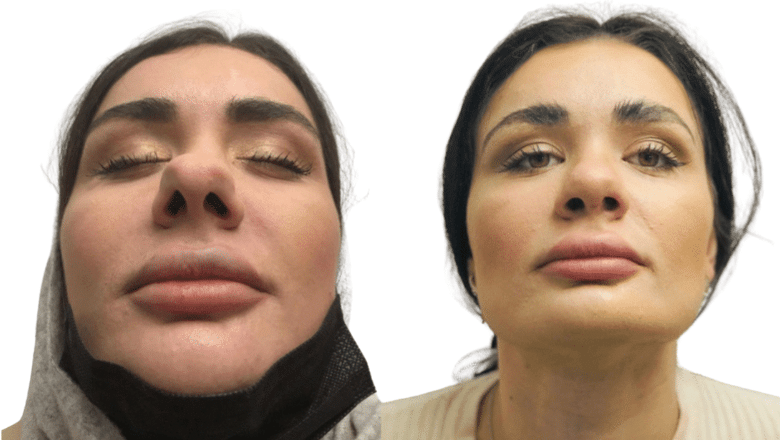
Functional surgery aims to improve breathing first, so the visible change is often modest. More nose surgery before and after photos are in our gallery.
Does Surgery for a Collapsed Nostril Work?
The evidence is encouraging, with an honest caveat about its quality. A 2008 systematic review in Otolaryngology and Head and Neck Surgery ↗ assessed 44 studies of functional rhinoplasty for nasal valve problems. Nearly all supported its effectiveness, but most were low-level evidence and only two were of higher quality[2]. The 2026 Diagnostics review pooled 12 studies (1,210 patients) and found that both traditional surgical and minimally invasive treatments improved breathing, with mean NOSE score reductions of 40 to 55 points, though the studies differed too much to say which approach is better[1].
In a smaller retrospective study of 31 septorhinoplasty patients, subjective breathing scores improved by 38% overall at six to nine months, and people with severe obstruction before surgery improved the most[11]. That is encouraging, but it is a single-centre study and results in your own nose depend on the cause, the technique and healing.
Surgery is not guaranteed to cure every case. The commonest reason for disappointment is a second contributor, such as a deviated septum or swollen turbinates, that was not treated.
Will Nose Surgery for a Collapsed Nostril Change How My Nose Looks?
Possibly, slightly. Spreader grafts can subtly widen the middle of the nose, and batten grafts can add a little fullness at the sidewall, so a very narrow nose may look marginally broader. Septoplasty and turbinate reduction work inside the nose and do not alter its outside shape. If you would also like the appearance refined, that is discussed and agreed at consultation, and the plan covers the bridge and tip as well as the airway. Where one nostril looks bigger than the other, our article on why one nostril is bigger than the other explains the common reasons.
What Is a Collapsed Nose Bridge, and Is It the Same Thing?
No. People searching for a collapsed nose bridge or a caved-in nose usually describe a visible dip along the bridge, a nose that has dropped or flattened, or a bridge that has lost height after an injury or operation. That is a saddle nose deformity. It involves the support of the bridge, not the nostril, although the two can occur together and both can affect breathing. Our guide to saddle nose deformity covers its early signs, causes and reconstruction.
If the nostril rim is the problem, see the grafts above. If the bridge itself has lost support, the repair is a larger reconstruction that usually involves rebuilding the bridge with cartilage, and it needs its own assessment.
Recovery After Surgery for a Collapsed Nostril
Recovery depends on which operations are combined, but the pattern is similar:
- Day of surgery: usually a day case at our Baker Street hospital, with a responsible adult to take you home and stay with you for 24 hours.
- First one to two weeks: the nose feels more blocked than before, because the lining is swollen. Any internal splints come out after about a week. Do not blow your nose for two weeks, and sleep propped up.
- Back at desk work: usually within 7 to 10 days; light exercise from about two weeks and full exercise from around four weeks, if your surgeon agrees.
- Breathing: improves gradually over two to three months as the swelling inside the nose settles.
Our guides to rhinoplasty recovery and aftercare and how painful rhinoplasty is describe the first weeks in more detail. Smokers have a higher risk of problems with healing, so stopping well before and after surgery is advised.
Can I Get Surgery for a Collapsed Nostril on the NHS?
Sometimes. NHS guidance on nose reshaping ↗ says it may be offered where it is needed to help you breathe, subject to local criteria and a GP referral. Cosmetic changes are not funded, waiting times vary by area, and funding may be harder to obtain where the collapse followed an earlier cosmetic operation. Centre for Surgery is a private hospital, so treatment here is self-funded, although some private insurers contribute where there is a documented functional problem. Check your policy first. Our guides to getting a nose job on the NHS and functional rhinoplasty explain the pathway.
Frequently Asked Questions
Is a collapsed nostril fixable?
Usually, yes. Strips and dilators hold the nostril open temporarily, and cartilage grafts such as alar batten grafts and spreader grafts rebuild the support more permanently. The right repair depends on which part of the nose is failing, so an examination comes first. Results are good in many studies but not guaranteed.
What causes a collapsed nostril?
Weak or damaged cartilage. The commonest acquired cause is earlier nose surgery that removed or weakened support. Others are a broken nose, a deviated septum, naturally thin cartilage and ageing. Several often combine, which is why the whole nose is assessed.
How do you know if your nasal valve has collapsed?
The nose usually feels blocked when you breathe in, especially during exercise, and a nasal strip or gently drawing the cheek outward helps. A surgeon confirms it by watching your nose as you breathe and by looking inside with a small camera. A home Cottle test can suggest it but is not conclusive.
How to fix a collapsed nostril without surgery?
Nasal strips, internal dilators and treating coexisting swelling with a steroid spray can relieve symptoms. They do not change the cartilage, so the problem returns when you stop. Fillers, exercises and clips sold online do not rebuild a weak nostril.
What are the symptoms of a collapsed inner nostril?
A blocked nose that does not respond to sprays, breathing that is worse on a deep breath or during exercise, relief from a nasal strip, mouth breathing, a dry mouth on waking, and snoring. Inner collapse often shows nothing in the mirror.
How common is a collapsed nostril?
Exact figures are hard to give. Nasal valve dysfunction is described as a common but under-recognised cause of nasal obstruction[1], and it is frequently found alongside a deviated septum or after rhinoplasty.
Can a collapsed nostril happen after a nose job?
Yes, though it affects a minority. It can follow an operation that removes or weakens supporting cartilage without rebuilding it, and may appear years later. Revision surgery with grafts is the usual treatment.
Can a collapsed nostril cause snoring?
It can contribute. A narrowed nasal airway raises resistance, which pushes you to breathe through your mouth at night and can make snoring and sleep apnoea worse. Opening the nasal airway may make a CPAP mask easier to tolerate, but nasal surgery is rarely a complete answer to sleep apnoea.
Is surgery for a collapsed nostril painful?
Most people describe pressure and congestion rather than sharp pain, worst in the first few days. Simple painkillers are usually enough, and a stronger one can be prescribed if needed.
Collapsed Nostril Assessment in London
If your nose feels blocked when you breathe in, a consultation will establish whether the cause is your nostril rim, valve, septum or turbinates, and what would help. We will tell you plainly if a strip, a spray or your GP is the right first step. Find out more about rhinoplasty at Centre for Surgery.
Phone: 020 7993 4849 | Address: 95–97 Baker Street, Marylebone, London W1U 6RN
Contact us to arrange a consultation
References
- Daoud M, Gherasie LM, Fufezan ML, et al. Diagnostic approaches and surgical outcomes in nasal valve dysfunction: a systematic review. Diagnostics (Basel) 2026;16(9). doi:10.3390/diagnostics16091324 ↗
- Rhee JS, Arganbright JM, McMullin BT, Hannley M. Evidence supporting functional rhinoplasty or nasal valve repair: a 25-year systematic review. Otolaryngology–Head and Neck Surgery 2008;139(1):10–20. doi:10.1016/j.otohns.2008.02.007 ↗
- Wang Y, Bonaparte JP. Diagnosis and management of septal deviation and nasal valve collapse: a survey of Canadian otolaryngologists. Journal of Otolaryngology – Head and Neck Surgery 2019;48(1):71. doi:10.1186/s40463-019-0394-z ↗
- Pak KY, Nunez A, Lee MK. Lateral support maneuver: validation of a diagnostic tool specific to dynamic nasal valve collapse. Journal of Craniofacial Surgery 2025;36(8):e1420–e1422. doi:10.1097/SCS.0000000000011960 ↗
- Stewart MG, Witsell DL, Smith TL, Weaver EM, Yueh B, Hannley MT. Development and validation of the Nasal Obstruction Symptom Evaluation (NOSE) scale. Otolaryngology–Head and Neck Surgery 2004;130(2):157–163. doi:10.1016/j.otohns.2003.09.016 ↗
- Khetpal S, Gowda AU, Parsaei Y, et al. Rhinoplasty in the older adult. Aesthetic Surgery Journal 2021;41(11):1231–1241. doi:10.1093/asj/sjab140 ↗
- Khatib M, Skorochod R, Wolf Y. Comparison of dorsal preservation rhinoplasty and dorsal hump reduction rhinoplasty: a systematic review and meta-analysis of postoperative outcomes. Aesthetic Plastic Surgery 2026;50(17):6994–7006. doi:10.1007/s00266-026-06105-6 ↗
- Atighechi S, Sarafraz Z, Baradaranfar M, et al. The effect of spreader graft and mattress suture technique on rhinoplasty in patients with nasal hump smaller than 3 mm. Journal of Craniofacial Surgery 2018;29(8):2110–2113. doi:10.1097/SCS.0000000000005078 ↗
- Gentile P, Cervelli V. Nasal tip remodeling using autologous cartilage grafts: systematic review. Journal of Craniofacial Surgery 2022;33(7):2035–2040. doi:10.1097/SCS.0000000000008494 ↗
- Constantinides M, Galli SKD, Miller PJ. A simple and reliable method of patient evaluation in the surgical treatment of nasal obstruction. Ear, Nose & Throat Journal 2002;81(10):734–737. PubMed 12405095 ↗
- Zoumalan RA, Constantinides M. Subjective and objective improvement in breathing after rhinoplasty. Archives of Facial Plastic Surgery 2012;14(6):423–428. doi:10.1001/archfacial.2012.665 ↗
- Casale M, Moffa A, Giorgi L, et al. Could the use of a new novel bipolar radiofrequency device (Aerin) improve nasal valve collapse? A systematic review and meta-analysis. Journal of Otolaryngology – Head and Neck Surgery 2023;52(1):42. doi:10.1186/s40463-023-00644-7 ↗
- Kim DH, Lee HH, Kim SH, Hwang SH. Effectiveness of using a bioabsorbable implant (Latera) to treat nasal valve collapse in patients with nasal obstruction: systemic review and meta-analysis. International Forum of Allergy & Rhinology 2020;10(6):719–725. doi:10.1002/alr.22543 ↗