


In this guide10 sections
Frown lines are the vertical creases that form between the eyebrows. Most people call them the elevens, because that is usually what they look like — two parallel vertical lines sitting just above the bridge of the nose. Clinically they are known as glabellar lines, after the glabella, the flat area of bone between the brows.
They are among the earliest lines to become permanent, and they carry more social weight than most wrinkles because of where they sit. Lines that deepen when you concentrate can make a relaxed face read as angry, worried or disapproving to other people, which is why patients often describe the problem as looking cross rather than looking old.
This guide covers what causes frown lines, why they set faster than lines elsewhere, and the full ladder of treatment from skincare through anti-wrinkle injections to surgery — including what each option genuinely achieves at each stage.
What are frown lines?
Frown lines are vertical wrinkles between the eyebrows produced by repeated contraction of the muscles that pull the brows together and down. You make them every time you concentrate, squint at a screen, read something confusing, or feel irritated.
You will see them called several things, all describing the same lines: the elevens, 11 lines, glabellar lines, frown lines between eyebrows, or simply the frown complex. Some people have a single central line rather than two, and some have three — the pattern depends on individual muscle anatomy rather than on anything you are doing differently.
They are distinct from the two other upper-face line groups, and the distinction matters because the treatment differs. Horizontal lines running across the forehead come from the frontalis muscle raising the brows, and are covered in our guide to deep forehead wrinkles. Lines radiating from the outer eye come from the orbicularis oculi, and are covered in our guide to crow’s feet. Three different muscles, three different patterns, and a treatment plan that works on one will not address the others.

The anatomy behind the elevens
Three muscles produce the glabellar frown, and they work as a group.
The corrugator supercilii is the principal one. It runs from the bone at the inner end of the brow outward and upward into the skin of the mid-brow. When it contracts it drags the inner eyebrow inward and downward, bunching the skin between the brows into vertical folds. This is the muscle producing the elevens.
The procerus is a small vertical strip running from the bridge of the nose up into the skin between the brows. It pulls the inner brow straight down and creates the horizontal crease that many people have across the top of the nose. Some patients’ main complaint is this horizontal line rather than the vertical ones.
The depressor supercilii sits alongside, pulling the inner brow further down and contributing to the overall scowl.
The clinical point is that these three act together, so treating one in isolation gives an incomplete result. The wider point is that the glabellar group pulls the brow down, while the frontalis across the forehead pulls it up. They are antagonists. Reduce the frontalis without addressing the depressors and the brow drops; reduce the depressors alone and the brow tends to lift slightly. This interaction is the reason the upper face is usually assessed and treated as one unit rather than area by area.
What causes frown lines
Muscle activity is the mechanism. Several factors govern how quickly repeated movement turns into a permanent line.
Habitual expression. People who frown a great deal — through concentration, poor lighting, chronic pain, or simply temperament — develop deeper glabellar lines earlier. This is one of the few line patterns where behaviour genuinely dominates the timeline.
Uncorrected vision and screen work. Squinting recruits the corrugator alongside the eye muscles. A great many patients presenting with early elevens turn out to need reading glasses or a change of monitor position, and the lines are the visible product of eight hours a day of low-grade squinting.
Ultraviolet exposure. UV degrades dermal collagen and elastin, so the skin recovers less well from each fold. Daily broad-spectrum sunscreen is the highest-value preventive habit available and costs almost nothing.
Smoking. Reduces dermal blood supply and degrades collagen directly, on top of the squinting that smoke irritation provokes.
Genetics. Baseline skin thickness, collagen density and the bulk of the corrugator muscle itself are inherited. Some people have a substantially stronger corrugator than average and will develop the elevens in their late twenties regardless of behaviour.
Sleep position. Sleeping face-down or consistently on one side compresses the glabella for hours a night and contributes to asymmetry.

Dynamic versus static frown lines
This distinction determines what will work for you, and it takes ten seconds to establish.
Look in a mirror in good light with your face completely relaxed. If the lines disappear entirely, they are dynamic — present only during muscle contraction, with undamaged skin underneath. Reducing muscle activity resolves them almost completely.
If lines remain visible with your face at rest, they are static. Years of folding have disrupted the collagen along the crease and the skin now holds the line independently of the muscle. Reducing muscle movement stops the line deepening further and softens it, but cannot erase it, because the problem is no longer purely muscular.
The glabella converts from dynamic to static faster than most areas, because the corrugator is powerful, the folds it creates are deep, and the skin is being compressed rather than merely stretched. That is why treating frown lines earlier gives better long-term results than waiting until they bother you — and why patients who start treatment in their thirties tend to need less intervention at fifty.
How to get rid of frown lines
Skincare, and what it can realistically do
Daily broad-spectrum sunscreen is the foundation, applied every morning regardless of season. Retinol at cosmetic strength has genuine evidence for stimulating collagen turnover over months of consistent use, and vitamin C serum supports collagen synthesis while providing antioxidant protection.
None of this removes an established eleven. Topicals work on skin quality, not on muscle activity, and the glabellar line is fundamentally a mechanical problem. Skincare is worth doing for prevention and for overall skin condition, and it will disappoint anyone using it to treat lines that are already set.
Where it does earn its place is in the twenties and early thirties, before static lines have formed. At that stage skincare plus sun protection is genuinely the right answer and nothing more invasive is warranted.
Anti-wrinkle injections for frown lines
Relaxing the glabellar muscle group is the most direct and most effective treatment for the elevens, and it is the single most commonly requested injectable treatment in the upper face.
How it works. Small quantities of a muscle-relaxing product are placed into the corrugator and procerus at specific points, reducing their ability to contract. The skin between the brows then stops being folded, and the dynamic component of the lines resolves.
Technique matters more here than anywhere else in the face. The glabella sits directly above the eyebrow and upper eyelid, and product diffusing into the wrong plane can cause temporary brow drop or eyelid ptosis. A study of 105 patients using a refined three-point technique — targeting the muscular origin of the procerus and corrugator specifically rather than the conventional five- or seven-point pattern — reported no cases of eyebrow ptosis, upper eyelid ptosis or medial brow drop, with effect maintained across the four-month study period and onset averaging three and a half days (DOI). The relevant point for patients is that adverse effects in this area are largely a function of injection technique and anatomical knowledge, not of bad luck.
What to expect. The appointment takes ten to fifteen minutes. A fine needle is used and no numbing cream is required. Small raised bumps settle within about fifteen minutes and occasional light bruising resolves over a few days.
Timing. Softening begins at three to five days, with the complete result at two weeks. Effect typically lasts three to four months, and often slightly longer for patients treated consistently over several years as the muscle bulk reduces.
The honest limit. On dynamic elevens the result is close to complete. On established static lines you should expect meaningful softening rather than removal — the muscle stops deepening the crease, but the crease itself remains until the skin is treated separately.
On brow position. The glabellar group pulls the brow down, so relaxing it produces a small lift of one to two millimetres at the inner brow. This is usually welcome. It also means treating the forehead at the same time requires balance, since relaxing the frontalis without the depressors lets the brow settle heavier than the patient wants.
Frown lines filler for deep static creases
Where a line remains visibly etched after muscle relaxation has taken full effect, a small quantity of dermal filler placed within the crease itself can lift the depression from underneath.
This needs a clear safety caveat. The glabella is the highest-risk site on the face for filler complications, because the supratrochlear and supraorbital vessels run through it and connect to the retinal circulation. Inadvertent intravascular injection here can cause skin necrosis or, rarely, visual loss. It is not a treatment to have from an inexperienced injector, and it should never be a first-line approach — the correct sequence is to relax the muscle first, wait to see what the line looks like at two weeks, and only then consider whether filler is warranted for what remains.
For many patients, what remains after muscle relaxation is minor enough that filler is unnecessary.
Energy-based treatment for skin quality
Where static lines are accompanied by general skin texture change — sun damage, crepiness, loss of firmness across the whole upper face — treating the skin directly complements the muscle work.
Morpheus8 combines microneedling with radiofrequency energy to remodel collagen at depth, with four to seven days of pinkness afterwards. Fotona 4D works across the full face in four sequential modes with no downtime and suits patients whose concerns extend beyond the glabella. Neither replaces muscle relaxation for the elevens; both improve the skin that the muscle has been folding.
The published literature also describes selective radiofrequency ablation of the nerve supply to the corrugator and procerus as a longer-lasting alternative, with a series of 27 patients showing significant improvement on a wrinkle assessment scale sustained over a mean 18-month follow-up (DOI). It is worth knowing this exists, but it is not routine practice in UK aesthetic clinics and we do not offer it — the trade-off between permanence and loss of natural expression is one most patients decline once it is explained.

When surgery is appropriate — and what it does not fix
A brow lift is sometimes presented as a treatment for frown lines. It is worth being precise about what it does.
A brow lift repositions a descended brow and smooths the forehead. Some surgical approaches, including the endoscopic brow lift, also allow the surgeon to weaken or partially divide the corrugator muscles directly during the procedure, which does reduce glabellar lines and lasts far longer than injections. But the operation is indicated by brow position and forehead laxity, not by the elevens alone. Nobody should be having surgery purely to treat lines between the brows when injections address them well.
The realistic position is this. If your brow has descended, your upper lids feel heavy, and you also have deep glabellar lines, a brow lift addresses all three at once and is worth discussing. If your only concern is the elevens and your brow sits where it always has, injections are the proportionate treatment and surgery is not.
All surgical procedures at Centre for Surgery are carried out by GMC-registered plastic surgeons at our Baker Street day-surgery facility, which is regulated by the Care Quality Commission and rated Good overall. Upper-face procedures are performed under local anaesthetic or TIVA rather than general anaesthesia.

Which treatment fits your stage
Twenties to early thirties, no lines at rest. Sunscreen, retinol, and an eye test if you work at a screen. Preventive injections are a reasonable option for patients with a visibly strong corrugator and early dynamic lines, and starting before lines set genuinely reduces what you will need later.
Mid-thirties to forties, dynamic lines with faint static ones. Anti-wrinkle injections every three to four months, treating the glabellar group as a unit. This is the mainstay and the stage at which results are most satisfying.
Forties to fifties, established static lines. Injections plus skin treatment, with a small amount of filler considered for any residual crease after the muscle result has settled. Expect improvement rather than erasure.
Fifties onward with brow descent or upper lid hooding. Surgical assessment, since the structural problem has outgrown what injectables address. Injections often continue afterwards as maintenance.
A consultation with our specialist team, including Dr Spyridon Vlachos, establishes which stage applies and what the lightest effective option is.
Cost
Treating the upper face as a unit — frown lines together with forehead and crow’s feet — is better value than booking areas separately and produces a more balanced result, for the antagonist reasons described above.
Prices for these treatments are on our Skin & Aesthetics price list.
Filler and energy-based treatments are priced per session and quoted at consultation, as are surgical procedures.
Finance is available through Chrysalis Finance. Finance is available through Chrysalis Finance, subject to status.
Frequently asked questions
What are the 11 lines between the eyebrows?
They are the two vertical creases produced by the corrugator supercilii pulling the inner brows together. The name comes from their resemblance to the number eleven. Clinically they are called glabellar lines. Some people develop one central line or three rather than two, which reflects individual muscle anatomy rather than anything having gone wrong.
How do you get rid of frown lines without injections?
Honestly, only partially. Sunscreen, retinol and reducing habitual squinting slow their formation and improve the skin around them. Energy-based treatment softens the etched component of a static line. But the underlying cause is muscle contraction, and nothing topical stops a muscle contracting — so complete resolution of dynamic elevens without injections is not realistic.
Do frown lines go away on their own?
Dynamic lines are absent at rest by definition, so they appear to come and go. Static lines do not resolve without treatment, and generally deepen over time as the folding continues.
Will treating my frown lines make me look expressionless?
Not with conservative dosing. The aim is to reduce the depth of the frown while keeping the brow mobile. Over-treatment across the whole upper face is what produces the frozen look people fear, which is why a modest first dose with a two-week review is a better approach than treating heavily at the first appointment.
Can frown lines filler be dangerous?
The glabella carries genuine vascular risk because of vessels connecting to the retinal circulation, and complications, while rare, are serious. This is an area where the practitioner’s anatomical knowledge matters far more than the product used. It should not be a first-line treatment and should not be performed by anyone without specific experience in the region.
How long do frown line treatments last?
Muscle-relaxing injections last three to four months, often marginally longer with consistent repeat treatment. Filler placed in a static crease lasts longer but is a secondary measure. Surgical corrugator modification during a brow lift is effectively permanent, though it is indicated by brow position rather than by lines alone.
Do men need different treatment for frown lines?
Usually higher doses, because the corrugator is typically bulkier. The aesthetic target also differs — a male brow should stay relatively flat rather than arched, so the injection pattern is adjusted to avoid producing a peaked brow.
Can I treat frown lines and forehead lines at the same time?
Yes, and it is usually preferable, because the muscles are antagonists and treating one alone can unbalance brow position. Our guides to forehead wrinkles and crow’s feet cover the other two upper-face areas.
References
- Cotofana S, Pedraza AP, Kaufman J, et al. Respecting upper facial anatomy for treating the glabella with neuromodulators to avoid medial brow ptosis — a refined 3-point injection technique. Journal of Cosmetic Dermatology, 2021;20(6):1625–1633. https://doi.org/10.1111/jocd.14133
- Kim JH, Jeong JW, Son D, et al. Percutaneous selective radiofrequency nerve ablation for glabellar frown lines. Aesthetic Surgery Journal, 2011;31(7):747–755. https://doi.org/10.1177/1090820X11416807
- Kołodziejczak A, Rotsztejn H. Efficacy of fractional laser, radiofrequency and IPL rejuvenation of periorbital region. Lasers in Medical Science, 2021;37(2):895–903. https://doi.org/10.1007/s10103-021-03329-7
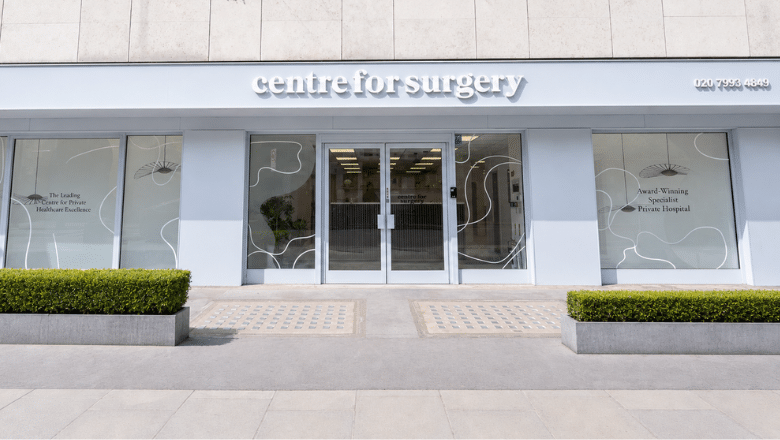
Centre for Surgery · CQC-regulated · GMC-registered surgeons · 95–97 Baker Street, Marylebone, London W1U 6RN · 020 7993 4849 · Book a consultation