


In this guide14 sections
- Key Points
- What Is Profileplasty?
- Does a Weak Chin Make Your Nose Look Bigger?
- Which Procedures Can Be Part of a Profileplasty?
- Rhinoplasty and Chin Surgery Together: What Does the Evidence Show?
- Chin Implant vs Genioplasty: Which Is Used in Profileplasty?
- Surgical vs Non-Surgical Profileplasty
- Who Is a Good Candidate for Profileplasty?
- What Does Profileplasty Surgery Involve?
- Profileplasty Before and After: What Can Change?
- What Are the Risks of Profileplasty?
- Profileplasty in London at Centre for Surgery
- Frequently Asked Questions: Profileplasty
- References
Key Points
- What is profileplasty? Profileplasty (also spelled profiloplasty) is not one operation. It is a plan that balances the side view of the face by treating the nose, chin and sometimes the lips, jawline or neck together.
- The nose and chin do most of the work. A small or receding chin can make a nose look larger, so the right plan is sometimes a chin procedure, sometimes a rhinoplasty and often both.
- The evidence is encouraging but limited. Studies of combined rhinoplasty and chin surgery report good profile outcomes and stable results, but most are small, retrospective or based on simulated images.
- Surgical and non-surgical routes differ. Fillers are adjustable and temporary, while rhinoplasty, chin implants and genioplasty are permanent and carry surgical risks, including infection and numbness around the chin.
- Not everyone needs everything. A good assessment can conclude that one feature, or no surgery at all, is the right answer.
- Planning starts with a consultation, where your profile is assessed as a whole, usually with imaging to preview the options.
Profileplasty (also spelled profiloplasty) is the name given to a group of surgical and non-surgical treatments that improve the profile, or side view, of the face. It is an angle you rarely see of yourself but other people see constantly, and in photographs and video calls more people are now noticing it. This guide explains what profileplasty is, which treatments it can combine, what the research says about doing a nose job and chin surgery together, who is a good candidate, and what to realistically expect.
Can a profileplasty improve your side view? That is its whole purpose. Rather than treating one feature in isolation, a profileplasty balances the forehead, nose, lips, chin and jawline so that they complement one another. Every face is different, so the plan is tailored to your own features and goals. If you are still working out what a balanced profile looks like, our guide to the perfect side profile explains the landmarks surgeons use.
What Is Profileplasty?
Profileplasty (or profiloplasty) is not a single operation. It is a concept that groups together the procedures that can change how the face looks from the side. The two most common are rhinoplasty (nose reshaping) and genioplasty (chin surgery), but lip, neck and jawline treatments can be part of the plan too. The aim is not only to change individual features but to make sure they sit well together, since the balance between features is what makes a profile look harmonious.
The nose and chin play the biggest roles, so bringing those two into better proportion is often the heart of a profileplasty. For anyone self-conscious about a prominent nose, a weak or receding chin or a lack of jawline definition, profileplasty offers one joined-up plan rather than a series of separate fixes. The term itself is old: it appears in the medical literature as far back as the 1960s, when it described chin implants, and today surgeons use it for the whole-profile approach.
Does a Weak Chin Make Your Nose Look Bigger?
Often, yes. Many people assume that improving the profile means changing the nose, but sometimes the nose is perfectly proportionate and it is the relationships between features that are out of balance. The angles and distances matter as much as any single feature: the angle between the forehead and nose, the relationship between the nose and upper lip, how far the chin projects compared with the nose, and the angle between the chin and neck.
A classic example is a nose that looks prominent because the chin sits too far back. Strengthening the chin can bring the whole profile into balance and make the nose look smaller without touching it. The reverse is also true: a person with a small chin who has a rhinoplasty alone may still feel that something is off. In a 2018 simulation study in the Journal of Contemporary Dental Practice ↗, orthodontists and lay people rated computer-modified silhouettes of 30 people with a convex profile and a nasal hump. Scores were highest when the hump reduction and chin advancement were combined, higher than for either change alone[1]. It was a simulation using outlines rather than real surgical results, but it illustrates why a profileplasty assessment looks at the whole face. Our guides to solutions for a receding chin and the perfect nose look at each half of that relationship in more detail.
Which Procedures Can Be Part of a Profileplasty?
Rhinoplasty (Nose Reshaping)
A nose job is the most common profileplasty procedure. The nose sits at the centre of the face, so even a subtle change in size or shape alters the profile, whether that is reducing a bump on the bridge, refining a droopy or bulbous tip or improving overall proportion. For smaller, non-permanent changes, non-surgical (liquid) rhinoplasty can smooth minor irregularities or lift the tip, although only surgical rhinoplasty permanently changes the structure of the nose. The NHS guidance on nose reshaping ↗ gives a useful overview of what the operation involves.
Chin Surgery and Chin Augmentation
The chin is the second key profile feature. Genioplasty reshapes the chin bone itself, while a chin implant or fat transfer adds projection. Hyaluronic acid chin fillers can add contour temporarily, and where the chin is over-projected, a reduction can bring it back into balance. Our comparison of chin implants vs chin fillers explains how the options differ.
Lips
The lips form part of the profile as well. A lip lift shortens the distance between the base of the nose and the upper lip, and lip fillers add volume. The upper lip sits directly beneath the nose, so lip changes can alter how the nose is read; our article on whether a lip lift changes your nose explains the link.
Cheeks, Jawline and Neck
Cheek volume and jawline definition complete the picture. Fillers, fat transfer or implants restore volume to the mid-face, while chin and neck liposuction sharpens the jawline and neck contour. Where there is more laxity, a neck lift or facelift may be considered.
Rhinoplasty and Chin Surgery Together: What Does the Evidence Show?
Combining a nose job with chin surgery is the classic profileplasty, and it has been studied for decades. A 2013 retrospective study in JAMA Facial Plastic Surgery ↗ followed 90 people who had open rhinoplasty and genioplasty in the same operation. At three years the chin bone had moved back by no more than 1 mm in the patients measured, and the authors concluded that the combined approach produced a more harmonious and consistent outcome[2]. It was a single-centre retrospective study, so it shows stability rather than proving that combining is better than staging the operations.
A more extensive version appears in a 2023 case series in Facial Plastic Surgery ↗, which described 113 patients treated between 2010 and 2019 with a combination of up to five procedures in one operation: forehead fat grafting, rhinoplasty, lip fat grafting, genioplasty and submental liposuction. Measurements taken against a standard soft-tissue analysis moved into the normal ranges, and patient satisfaction was assessed at three and twelve months[3]. The authors suggested that one combined operation also avoids repeated anaesthetics. As with most surgical series, there was no comparison group, so results from a specialist team cannot be assumed for every surgeon or every face.
The honest summary is that the research supports combined nose and chin surgery as a safe-looking, stable approach for suitable people, but much of it is retrospective and comes from a small number of centres. Whether you need both procedures, one of them, or a staged plan is a decision for your consultation rather than a rule. If a nose job is part of your plan, our rhinoplasty recovery guide explains the timeline that applies to the nose side of a combined operation.
Chin Implant vs Genioplasty: Which Is Used in Profileplasty?
When the chin needs more projection, there are two main surgical routes. A chin implant is placed over the chin bone through a small incision, usually inside the mouth or under the chin. A sliding genioplasty cuts and repositions the chin bone itself, which can move the chin forwards, shorten it, lengthen it or correct asymmetry. A 2022 systematic review in Plastic and Reconstructive Surgery ↗ of 54 studies and 4,897 patients found consistently satisfactory cosmetic outcomes across techniques. Overall complication rates were 15.7% for implants and 19.7% for osteotomy (bone cutting), with transient injury to the nerve supplying the chin and lower lip in 2.4% and 16.4% respectively[4]. The studies were of mixed quality, and complications were reported inconsistently.
A 2025 systematic review of seven studies and 1,126 patients ↗ comparing the two found high satisfaction with both[5]. Implants had higher reported infection rates (up to 23.8% in one included study) and wound separation, while genioplasty was associated with temporary numbness that persisted in roughly 7% to 12.5% of patients in some series. Soft-tissue change followed the bone more predictably after genioplasty than with an implant. Differences between studies were large, so these figures show the pattern of risk rather than a number to expect for yourself.
Implant material and technique matter too. A 2023 systematic review in Annals of Plastic Surgery ↗ of 39 articles found low overall complication rates for the commonly used implants, with silicone having the lowest rate of altered sensation (0.4%, against 20.1% for high-density porous polyethylene), and the placement plane and incision route influencing outcomes[6]. Your surgeon will recommend a route based on your bone, bite and how much change is needed. Our article on how long chin augmentation lasts covers durability.
Surgical vs Non-Surgical Profileplasty
A profileplasty can be surgical, non-surgical or a combination. The non-surgical route uses dermal fillers in the nose, chin, cheeks and jawline for subtle enhancement, with little downtime and results you can see straight away. Fillers are adjustable and temporary, typically lasting months to a year or more depending on the product and area, and they cannot achieve the degree of change that surgery can. Reviews of chin augmentation describe rapid contour improvement and mostly mild, short-lived side effects such as swelling and bruising with fillers, but with rare serious vascular complications, while surgical options give more durable projection with their own risks[7].
The surgical route (rhinoplasty, genioplasty, chin implants) offers permanent, larger change but involves recovery time and surgical risk. The right choice depends on how much change you want, whether you want it permanent, and your tolerance for downtime. Many people start with non-surgical rhinoplasty or chin filler to preview a change before committing to surgery, and it is reasonable to ask for that.
Who Is a Good Candidate for Profileplasty?
Good candidates are people bothered by the balance of their side profile, often a nose-and-chin disproportion or a profile that looks flat or unbalanced, who are in good general health, have finished facial development and have realistic expectations. The key word is realistic. A profileplasty aims to bring your features into better harmony while still looking like you, not to create a different face. Our guide to facial proportions and the golden ratio explains why measurements are a guide, not a target.
Research on patient-reported outcomes is reassuring about nose surgery in general. A 2020 systematic review of 29 articles on rhinoplasty satisfaction found that most reported improved satisfaction after surgery[8], and a 2026 systematic review of 28 studies using patient-reported measures found consistent improvements in appearance, function and wellbeing[9]. Both reviews mix different techniques and populations, and neither is specific to combined profile surgery. A thorough consultation, often with imaging to preview potential changes, is the essential first step.
What Does Profileplasty Surgery Involve?
As profileplasty is a tailored combination of procedures, the exact surgery depends on what is included: the techniques used, the type of anaesthetic and whether an overnight stay is needed. A combined rhinoplasty and chin procedure is more involved than a single filler appointment. Our guide to anaesthesia for cosmetic surgery explains the options, and the surgeon will agree the plan with you at consultation.
Recovery follows the slowest element. Swelling from a rhinoplasty takes months to settle fully, while chin surgery brings its own swelling and, after genioplasty, a period of numbness around the chin and lower lip. Both are covered in our rhinoplasty recovery guide and the chin surgery page. If you have had a nose job elsewhere and are not happy with the balance, revision rhinoplasty can be assessed alongside the chin.
Profileplasty Before and After: What Can Change?
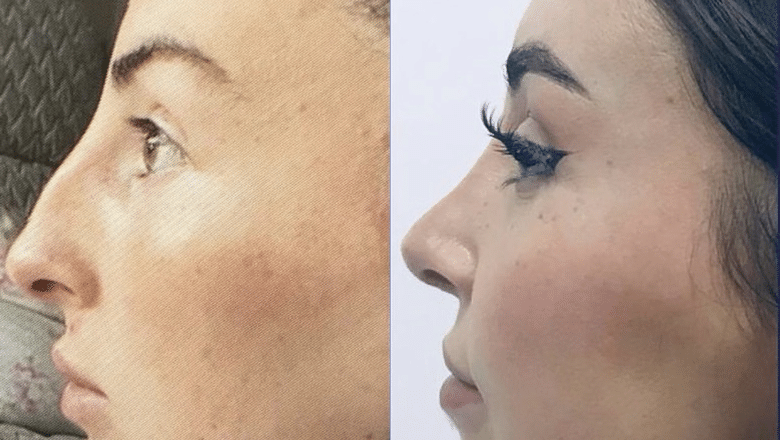
The photograph above shows the nose half of a profile change: a bump on the bridge reduced to a straighter line. In a full profileplasty the same view is assessed for the chin, lips and neck as well. You can see more results in our rhinoplasty before and after gallery. Photographs show what was possible for one person, not what will happen for you, and healing continues for many months.
What Are the Risks of Profileplasty?
Every operation carries risks, and combining procedures adds the risks of each. For a nose and chin plan these include bleeding, infection, swelling that takes months to settle, asymmetry, a result you are not happy with, the need for revision, and anaesthetic risks. Chin surgery adds the risk of numbness or altered sensation around the lip and chin, and with an implant, shifting or the need for removal. The studies above show how widely reported rates vary, which is why a surgeon should talk you through the risks that apply to your own plan, and why choosing a GMC-registered surgeon matters. A two-week cooling-off period between consultation and surgery is recommended.
Profileplasty in London at Centre for Surgery
At Centre for Surgery in London, profileplasty is carried out by GMC-registered plastic surgeons at our CQC-regulated Baker Street hospital, rated Good overall by the Care Quality Commission (CQC). Each plan is tailored to your individual features and goals, assessing the face as a whole rather than one feature in isolation. Finance options are available, and your coordinator can explain them at consultation.
Phone: 020 7993 4849 | Email: contact@centreforsurgery.com | Address: 95-97 Baker Street, London W1U 6RN
Frequently Asked Questions: Profileplasty
What is profileplasty?
Profileplasty is a plan to balance the side view of the face, using surgical or non-surgical treatments for the nose, chin, lips, jawline or neck. It is not a single operation, and the combination is chosen to suit your own face.
Is profileplasty the same as profiloplasty?
Yes. Profiloplasty is an alternative spelling, used more often in Europe, and both words describe the same whole-profile approach.
Can you have rhinoplasty and a chin implant at the same time?
Yes, many people do. Doing both in one operation means one anaesthetic and one recovery, and the studies above report stable results for combined nose and chin surgery. Whether it suits you depends on your anatomy, and some surgeons prefer to stage procedures. Your surgeon will advise at consultation.
Does a small chin make your nose look bigger?
It can. When the chin sits well behind the tip of the nose, the nose looks more prominent by comparison. Adding projection to the chin can rebalance the profile, and in a simulation study the combination of nose and chin changes was rated more attractive than either alone[1].
How can I fix my side profile without surgery?
Fillers in the chin, nose or jawline can subtly rebalance a profile for a limited time, and lip or skin treatments can refine the lower face. They cannot reshape bone or produce large changes, and they need repeating. A consultation can show whether a non-surgical trial is worth doing first.
Why is my side profile so flat?
A flat-looking profile may come from a low nasal bridge, a recessed chin, limited cheek or mid-face projection, or a combination. Working out which is responsible is the first step of a profileplasty assessment.
Will people notice I have had a nose job?
Surgeons aim for a result that looks natural and in proportion with the rest of your face. How noticeable any change is depends on how much was altered, your skin and your features. Swelling and bruising are visible for a couple of weeks after surgery, and the nose keeps refining for months.
Is facial plastic surgery painful?
You are asleep or sedated during surgery. Afterwards most people describe discomfort and tightness rather than severe pain, managed with prescribed painkillers. A blocked nose is often more bothersome than pain after rhinoplasty, and the chin can feel sore and numb.
What happens 10 years after rhinoplasty?
The structural changes made to the nose are intended to be lasting, but the face carries on ageing, so skin thins and the tip can drop slightly over time. Regular weight changes and sun exposure also affect how the nose looks. Having your result reviewed years later is reasonable.
Can a chin implant be done under local anaesthetic?
Chin implants can be placed under local anaesthetic in some settings, with or without sedation. When combined with a rhinoplasty, sedation (such as TIVA) is more usual. Your surgeon and anaesthetist will recommend the safest option for the operation you are having.
References
- Sadeghian S, Shirvani A, Azamian Z. Assessment of the effect of simulated rhinoplasty and genioplasty on the facial profile attractiveness of patients with a convex face. Journal of Contemporary Dental Practice 2018;19(6):719–725. PubMed 29959302 ↗
- Bertossi D, Albanese M, Turra M, Favero V, Nocini P, Lucchese A. Combined rhinoplasty and genioplasty: long-term follow-up. JAMA Facial Plastic Surgery 2013;15(3):192–197. doi:10.1001/jamafacial.2013.759 ↗
- Bertossi D, Sacchetto L, Chirumbolo S, Panozzo G, Kapoor KM. Single-step full-face surgical treatment of the facial profile. Facial Plastic Surgery 2023;40(1):9–18. doi:10.1055/a-2015-0853 ↗
- Oranges CM, Grufman V, di Summa PG, Fritsche E, Kalbermatten DF. Chin augmentation techniques: a systematic review. Plastic and Reconstructive Surgery 2023;151(5):758e–771e. doi:10.1097/PRS.0000000000010079 ↗
- Kauke-Navarro M, Knoedler L, Allam O, et al. Implant-based chin augmentation vs osseous genioplasty: a systematic review of indications and outcomes. Aesthetic Surgery Journal Open Forum 2025;7:ojaf048. doi:10.1093/asjof/ojaf048 ↗
- Liao CD, Rodriguez E, Zhao K, Kunda N, George F. Complications following alloplastic chin augmentation: a systematic review of implant materials and surgical techniques. Annals of Plastic Surgery 2023;90(6S Suppl 5):S515–S520. doi:10.1097/SAP.0000000000003423 ↗
- Alwathnani YK, Alkhwildi LA, Almathami AA, et al. Surgical vs non-surgical chin augmentation: a systematic review of techniques, satisfaction, and complications. Aesthetic Plastic Surgery 2026;50(11):4292–4314. doi:10.1007/s00266-026-05611-x ↗
- Levin M, Ziai H, Roskies M. Patient satisfaction following structural versus preservation rhinoplasty: a systematic review. Facial Plastic Surgery 2020;36(5):670–678. doi:10.1055/s-0040-1714268 ↗
- Murtiani F, Saputra R, Febriani B, Fatimah F, Marisa A, Lestari AA. Comprehensive evaluation of quality of life in patients after rhinoplasty using patient-reported outcome measures (PROMs): a systematic review. Plastic and Aesthetic Nursing 2026;46(4):204–218. doi:10.1097/PSN.0000000000000704 ↗
Related Articles
- Rhinoplasty (Nose Reshaping)
- Chin Surgery (Genioplasty)
- Golden Ratio Face: Facial Beauty & Proportions







